About the Report
Base Year 2024Global Consumer IoT Market Overview
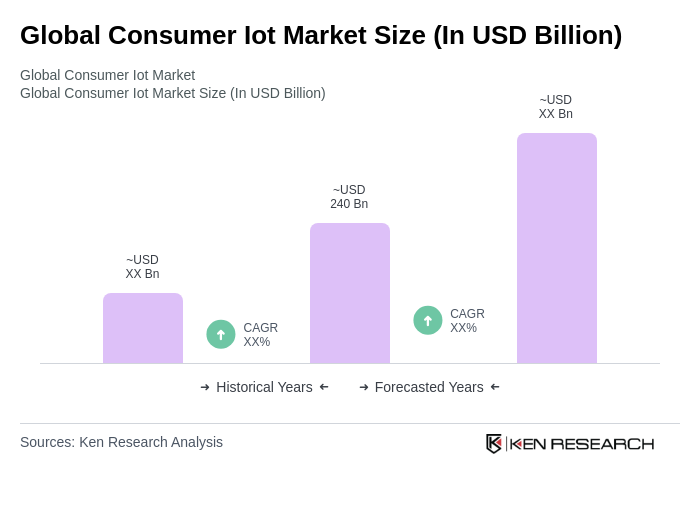
- The Global Consumer IoT Market is valued at USD 240 billion, based on a five?year historical analysis, reflecting widespread adoption of smart home devices, wearables, and connected consumer electronics as devices integrate sensors, connectivity, and voice assistants to automate daily life and improve convenience and efficiency .
- Key players in this market include the United States, China, and Germany, supported by strong technology ecosystems, manufacturing depth, and high household spending on connected devices; North America accounts for a significant global share, aided by high penetration of fitness wearables and smart home products .
- The European Union’s General Data Protection Regulation establishes strict transparency, consent, and data?minimization obligations for connected devices and services, shaping consumer IoT offerings and trust; ongoing EU initiatives such as the proposed Cyber Resilience Act and the Data Act further reinforce security and interoperability expectations for IoT products , , .
Global Consumer IoT Market Segmentation
By Type:The market is segmented into various types, including Smart Home Devices, Wearable Devices, Connected Consumer Electronics, Health & Wellness Devices, Smart Appliances, Connected Vehicles & Infotainment, and Others.Smart Home Devicesare leading due to widespread use of smart speakers, security cameras, lighting, and thermostats that integrate with voice assistants and home platforms to boost convenience and energy efficiency .Wearable Devicesare gaining strong traction for health and fitness monitoring (heart rate, sleep, activity), benefiting from sensor advances and integration with healthcare and sports use cases .

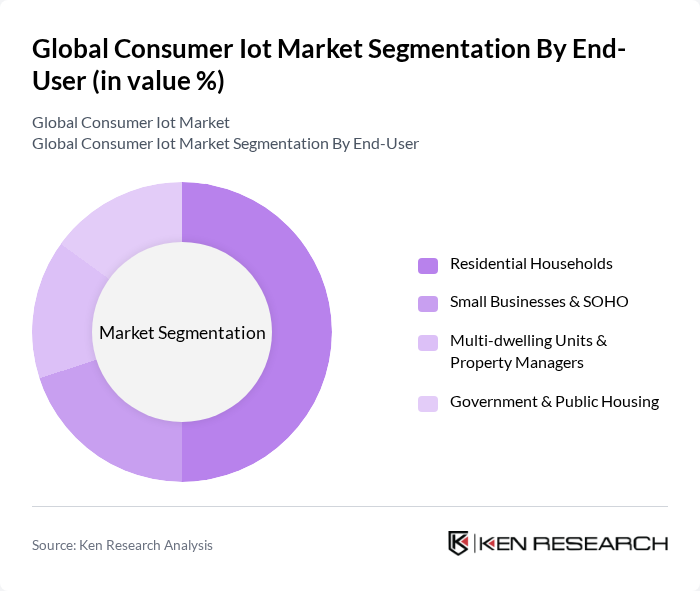
By End-User:The end-user segmentation includes Residential Households, Small Businesses & SOHO, Multi-dwelling Units & Property Managers, and Government & Public Housing.Residential Householdsdominate due to rapid uptake of smart speakers, security systems, lighting, and thermostats for convenience, energy savings, and home safety.Small Businesses & SOHOincreasingly deploy connected cameras, routers, and environmental sensors to improve efficiency, security, and customer experience .
Global Consumer IoT Market Competitive Landscape
The Global Consumer IoT Market is characterized by a dynamic mix of regional and international players. Leading participants such as Amazon.com, Inc., Google LLC (Nest), Apple Inc., Samsung Electronics Co., Ltd., Signify N.V. (Philips Hue), Xiaomi Corporation, TP-Link Technologies Co., Ltd., Huawei Technologies Co., Ltd., Bosch Smart Home GmbH, LG Electronics Inc., Sony Group Corporation, Fitbit LLC (Google), Honeywell Home (Resideo Technologies, Inc.), Cisco Systems, Inc., Arlo Technologies, Inc. contribute to innovation, geographic expansion, and service delivery in this space.
Global Consumer Iot Market Industry Analysis
Growth Drivers
- Increasing Adoption of Smart Home Devices:The smart home device market is projected to reach 1.4 billion units in the future, driven by consumer demand for convenience and energy efficiency. According to Statista, the global revenue from smart home devices is expected to exceed $100 billion in the future. This surge is supported by the growing number of households adopting smart technologies, with an estimated 30% of homes in developed regions equipped with at least one smart device, enhancing the overall IoT ecosystem.
- Rising Demand for Wearable Technology:The wearable technology market is anticipated to grow to 500 million units in the future, fueled by advancements in health monitoring and fitness tracking. According to the International Data Corporation (IDC), global spending on wearables is projected to reach $60 billion in the future. This growth is driven by increasing health consciousness among consumers, with 70% of users reporting improved health management through wearable devices, thus expanding the IoT landscape significantly.
- Enhanced Connectivity through 5G Networks:The rollout of 5G networks is expected to facilitate the connection of over 1 billion IoT devices in the future, according to the Global System for Mobile Communications Association (GSMA). This technology will enable faster data transfer rates and lower latency, enhancing user experiences across various applications. With 5G expected to cover 40% of the global population in the future, the increased connectivity will drive the adoption of IoT solutions in sectors like healthcare, automotive, and smart cities.
Market Challenges
- Data Privacy and Security Concerns:As the number of connected devices grows, so do concerns regarding data privacy and security. A report by Cybersecurity Ventures predicts that cybercrime will cost the world $10.5 trillion annually in the future. This alarming statistic highlights the urgent need for robust security measures in IoT devices, as 60% of consumers express concerns about data breaches, potentially hindering market growth and consumer trust in IoT technologies.
- High Initial Investment Costs:The initial costs associated with deploying IoT solutions can be significant, with estimates suggesting that businesses may need to invest upwards of $1 trillion in IoT infrastructure in the future. This financial barrier can deter small and medium-sized enterprises from adopting IoT technologies. Additionally, the lack of immediate ROI can further complicate investment decisions, as 45% of businesses cite cost as a primary obstacle to IoT implementation.
Global Consumer Iot Market Future Outlook
The future of the consumer IoT market appears promising, driven by technological advancements and increasing consumer engagement. As smart home devices and wearables become more integrated into daily life, the demand for seamless connectivity will rise. Furthermore, the expansion of 5G networks will enhance device interoperability, paving the way for innovative applications. Companies that prioritize security and user education will likely gain a competitive edge, fostering a more robust IoT ecosystem that addresses consumer concerns while capitalizing on emerging trends.
Market Opportunities
- Expansion of Smart Cities Initiatives:Governments worldwide are investing heavily in smart city projects, with an estimated $1.5 trillion allocated in the future. This investment will create opportunities for IoT solutions in urban planning, traffic management, and public safety, enhancing the quality of life for residents and driving demand for innovative technologies.
- Integration of AI with IoT Devices:The convergence of AI and IoT is expected to unlock new capabilities, with the AIoT market projected to reach $30 billion in the future. This integration will enable smarter decision-making and predictive analytics, enhancing operational efficiency across various sectors, including healthcare, manufacturing, and agriculture, thus creating significant growth opportunities.
Scope of the Report
| Segment | Sub-Segments |
|---|---|
| By Type | Smart Home Devices (smart speakers, lighting, thermostats, security cameras, smart TVs) Wearable Devices (smartwatches, fitness bands, hearables, AR/VR) Connected Consumer Electronics (streaming devices, gaming consoles, routers) Health & Wellness Devices (smart scales, BP/glucose monitors, sleep trackers) Smart Appliances (connected refrigerators, washers, ovens, robot vacuums) Connected Vehicles & Infotainment (in-vehicle assistants, dongles, eCall) Others (pet trackers, kids trackers, personal safety devices) |
| By End-User | Residential Households Small Businesses & SOHO Multi-dwelling Units & Property Managers Government & Public Housing |
| By Application | Home Automation & Control Health, Fitness & Personal Safety Home Security & Surveillance Energy Management & Smart Lighting Entertainment & Digital Lifestyle |
| By Distribution Channel | Online Retail & Marketplaces Offline Retail (electronics, carriers, big-box) Direct-to-Consumer & Subscription |
| By Consumer Demographics | Age Group (Gen Z, Millennials, Gen X, Boomers) Income Level (Mass, Affluent, Premium) Geographic Location (Urban, Suburban, Rural) |
| By Pricing Strategy | Premium & Ecosystem Lock-in Mid-tier Value Entry-level & Bundled |
| By Technology Integration | Connectivity (Wi?Fi, Bluetooth/BLE, Zigbee/Z?Wave/Thread, Cellular, UWB) AI & Voice Assistants (Alexa, Google Assistant, Siri) Cloud & Edge Computing Interoperability Standards (Matter, HomeKit, SmartThings) |
Key Target Audience
Investors and Venture Capitalist Firms
Government and Regulatory Bodies (e.g., Federal Communications Commission, National Institute of Standards and Technology)
Manufacturers and Producers
Distributors and Retailers
Telecommunications Companies
Smart Home Technology Developers
Consumer Electronics Brands
Insurance Companies
Players Mentioned in the Report:
Amazon.com, Inc.
Google LLC (Nest)
Apple Inc.
Samsung Electronics Co., Ltd.
Signify N.V. (Philips Hue)
Xiaomi Corporation
TP-Link Technologies Co., Ltd.
Huawei Technologies Co., Ltd.
Bosch Smart Home GmbH
LG Electronics Inc.
Sony Group Corporation
Fitbit LLC (Google)
Honeywell Home (Resideo Technologies, Inc.)
Cisco Systems, Inc.
Arlo Technologies, Inc.
Table of Contents
Market Assessment Phase
1. Executive Summary and Approach
2. Global Consumer Iot Market Overview
2.1 Key Insights and Strategic Recommendations
2.2 Global Consumer Iot Market Overview
2.3 Definition and Scope
2.4 Evolution of Market Ecosystem
2.5 Timeline of Key Regulatory Milestones
2.6 Value Chain & Stakeholder Mapping
2.7 Business Cycle Analysis
2.8 Policy & Incentive Landscape
3. Global Consumer Iot Market Analysis
3.1 Growth Drivers
3.1.1 Increasing Adoption of Smart Home Devices
3.1.2 Rising Demand for Wearable Technology
3.1.3 Enhanced Connectivity through 5G Networks
3.1.4 Growing Consumer Awareness of IoT Benefits
3.2 Market Challenges
3.2.1 Data Privacy and Security Concerns
3.2.2 High Initial Investment Costs
3.2.3 Lack of Standardization Across Devices
3.2.4 Limited Consumer Understanding of IoT Technologies
3.3 Market Opportunities
3.3.1 Expansion of Smart Cities Initiatives
3.3.2 Integration of AI with IoT Devices
3.3.3 Development of Interoperable Solutions
3.3.4 Growth in E-commerce for IoT Products
3.4 Market Trends
3.4.1 Increasing Focus on Energy Efficiency
3.4.2 Rise of Subscription-Based IoT Services
3.4.3 Proliferation of Health Monitoring Devices
3.4.4 Shift Towards Edge Computing in IoT
3.5 Government Regulation
3.5.1 Implementation of GDPR for Data Protection
3.5.2 Regulations on IoT Device Security Standards
3.5.3 Incentives for Smart Home Technology Adoption
3.5.4 Policies Supporting IoT Research and Development
4. SWOT Analysis
5. Stakeholder Analysis
6. Porter's Five Forces Analysis
7. Global Consumer Iot Market Market Size, 2019-2024
7.1 By Value
7.2 By Volume
7.3 By Average Selling Price
8. Global Consumer Iot Market Segmentation
8.1 By Type
8.1.1 Smart Home Devices (smart speakers, lighting, thermostats, security cameras, smart TVs)
8.1.2 Wearable Devices (smartwatches, fitness bands, hearables, AR/VR)
8.1.3 Connected Consumer Electronics (streaming devices, gaming consoles, routers)
8.1.4 Health & Wellness Devices (smart scales, BP/glucose monitors, sleep trackers)
8.1.5 Smart Appliances (connected refrigerators, washers, ovens, robot vacuums)
8.1.6 Connected Vehicles & Infotainment (in-vehicle assistants, dongles, eCall)
8.1.7 Others (pet trackers, kids trackers, personal safety devices)
8.2 By End-User
8.2.1 Residential Households
8.2.2 Small Businesses & SOHO
8.2.3 Multi-dwelling Units & Property Managers
8.2.4 Government & Public Housing
8.3 By Application
8.3.1 Home Automation & Control
8.3.2 Health, Fitness & Personal Safety
8.3.3 Home Security & Surveillance
8.3.4 Energy Management & Smart Lighting
8.3.5 Entertainment & Digital Lifestyle
8.4 By Distribution Channel
8.4.1 Online Retail & Marketplaces
8.4.2 Offline Retail (electronics, carriers, big-box)
8.4.3 Direct-to-Consumer & Subscription
8.5 By Consumer Demographics
8.5.1 Age Group (Gen Z, Millennials, Gen X, Boomers)
8.5.2 Income Level (Mass, Affluent, Premium)
8.5.3 Geographic Location (Urban, Suburban, Rural)
8.6 By Pricing Strategy
8.6.1 Premium & Ecosystem Lock-in
8.6.2 Mid-tier Value
8.6.3 Entry-level & Bundled
8.7 By Technology Integration
8.7.1 Connectivity (Wi?Fi, Bluetooth/BLE, Zigbee/Z?Wave/Thread, Cellular, UWB)
8.7.2 AI & Voice Assistants (Alexa, Google Assistant, Siri)
8.7.3 Cloud & Edge Computing
8.7.4 Interoperability Standards (Matter, HomeKit, SmartThings)
9. Global Consumer Iot Market Competitive Analysis
9.1 Market Share of Key Players
9.2 Cross Comparison of Key Players
9.2.1 Company Name
9.2.2 Group Size (Large, Medium, or Small as per industry convention)
9.2.3 Consumer IoT Revenue (latest fiscal, USD)
9.2.4 YoY Revenue Growth in Consumer IoT (%)
9.2.5 Installed Base/Active Devices (millions)
9.2.6 Average Revenue per User (ARPU) or per Household (USD)
9.2.7 Subscription Attach Rate (% of devices on paid plans)
9.2.8 Return/Failure Rate (% within 12 months)
9.2.9 Customer Satisfaction/NPS (score)
9.2.10 R&D Intensity (% of revenue) and Patent Filings (last 3 years)
9.2.11 Channel Mix (% Online, Offline, Direct)
9.2.12 Interoperability Coverage (Matter/Thread/Zigbee support count)
9.3 SWOT Analysis of Top Players
9.4 Pricing Analysis
9.5 Detailed Profile of Major Companies
9.5.1 Amazon.com, Inc.
9.5.2 Google LLC (Nest)
9.5.3 Apple Inc.
9.5.4 Samsung Electronics Co., Ltd.
9.5.5 Signify N.V. (Philips Hue)
9.5.6 Xiaomi Corporation
9.5.7 TP-Link Technologies Co., Ltd.
9.5.8 Huawei Technologies Co., Ltd.
9.5.9 Bosch Smart Home GmbH
9.5.10 LG Electronics Inc.
9.5.11 Sony Group Corporation
9.5.12 Fitbit LLC (Google)
9.5.13 Honeywell Home (Resideo Technologies, Inc.)
9.5.14 Cisco Systems, Inc.
9.5.15 Arlo Technologies, Inc.
10. Global Consumer Iot Market End-User Analysis
10.1 Procurement Behavior of Key Ministries
10.1.1 Government Initiatives for Smart Homes
10.1.2 Funding for IoT Research Projects
10.1.3 Partnerships with Tech Companies
10.2 Corporate Spend on Infrastructure & Energy
10.2.1 Investment in Smart Energy Solutions
10.2.2 Budget Allocation for IoT Devices
10.2.3 Expenditure on Security Systems
10.3 Pain Point Analysis by End-User Category
10.3.1 High Costs of Implementation
10.3.2 Complexity of Integration
10.3.3 Concerns Over Data Security
10.4 User Readiness for Adoption
10.4.1 Awareness of IoT Benefits
10.4.2 Technical Skills of Users
10.4.3 Availability of Support Services
10.5 Post-Deployment ROI and Use Case Expansion
10.5.1 Measurement of Cost Savings
10.5.2 User Feedback for Improvements
10.5.3 Expansion into New Use Cases
11. Global Consumer Iot Market Future Size, 2025-2030
11.1 By Value
11.2 By Volume
11.3 By Average Selling Price
Go-To-Market Strategy Phase
1. Whitespace Analysis + Business Model Canvas
1.1 Market Gaps Identification
1.2 Value Proposition Development
1.3 Revenue Streams Analysis
1.4 Key Partnerships Exploration
1.5 Customer Segmentation
1.6 Cost Structure Evaluation
1.7 Competitive Advantage Assessment
2. Marketing and Positioning Recommendations
2.1 Branding Strategies
2.2 Product USPs
2.3 Target Audience Identification
2.4 Communication Channels
2.5 Promotional Activities
2.6 Market Positioning
3. Distribution Plan
3.1 Urban Retail Strategies
3.2 Rural NGO Tie-Ups
3.3 E-commerce Platforms
3.4 Direct Sales Approaches
3.5 Distribution Partnerships
4. Channel & Pricing Gaps
4.1 Underserved Routes
4.2 Pricing Bands Analysis
4.3 Competitor Pricing Comparison
4.4 Consumer Price Sensitivity
5. Unmet Demand & Latent Needs
5.1 Category Gaps Identification
5.2 Consumer Segments Analysis
5.3 Emerging Trends Exploration
6. Customer Relationship
6.1 Loyalty Programs
6.2 After-sales Service
6.3 Customer Feedback Mechanisms
7. Value Proposition
7.1 Sustainability Initiatives
7.2 Integrated Supply Chains
7.3 Customer-Centric Innovations
8. Key Activities
8.1 Regulatory Compliance
8.2 Branding Efforts
8.3 Distribution Setup
9. Entry Strategy Evaluation
9.1 Domestic Market Entry Strategy
9.1.1 Product Mix Considerations
9.1.2 Pricing Band Strategy
9.1.3 Packaging Solutions
9.2 Export Entry Strategy
9.2.1 Target Countries Identification
9.2.2 Compliance Roadmap Development
10. Entry Mode Assessment
10.1 Joint Ventures
10.2 Greenfield Investments
10.3 Mergers & Acquisitions
10.4 Distributor Model Evaluation
11. Capital and Timeline Estimation
11.1 Capital Requirements
11.2 Timelines for Implementation
12. Control vs Risk Trade-Off
12.1 Ownership Considerations
12.2 Partnerships Evaluation
13. Profitability Outlook
13.1 Breakeven Analysis
13.2 Long-term Sustainability Strategies
14. Potential Partner List
14.1 Distributors
14.2 Joint Ventures
14.3 Acquisition Targets
15. Execution Roadmap
15.1 Phased Plan for Market Entry
15.1.1 Market Setup
15.1.2 Market Entry
15.1.3 Growth Acceleration
15.1.4 Scale & Stabilize
15.2 Key Activities and Milestones
15.2.1 Milestone Planning
15.2.2 Activity Tracking
Research Methodology
Phase 1: Approach1
Desk Research
- Analysis of industry reports from leading market research firms focusing on consumer IoT trends
- Review of white papers and publications from technology associations and IoT consortiums
- Examination of government publications and regulatory frameworks impacting IoT adoption
Primary Research
- Interviews with product managers at leading consumer electronics companies
- Surveys targeting end-users to understand adoption rates and usage patterns
- Focus groups with IoT device users to gather qualitative insights on consumer preferences
Validation & Triangulation
- Cross-validation of findings with multiple data sources including sales data and market forecasts
- Triangulation of insights from primary research with secondary data trends
- Sanity checks through expert reviews from industry analysts and IoT specialists
Phase 2: Market Size Estimation1
Top-down Assessment
- Estimation of total addressable market (TAM) based on global consumer electronics sales
- Segmentation of market size by device categories such as wearables, smart home devices, and connected appliances
- Incorporation of growth rates from IoT adoption studies and consumer behavior analytics
Bottom-up Modeling
- Collection of sales data from major IoT device manufacturers to establish baseline figures
- Estimation of average selling prices (ASPs) across different consumer IoT segments
- Calculation of market size based on unit sales multiplied by ASPs for each segment
Forecasting & Scenario Analysis
- Development of predictive models using historical sales data and market trends
- Scenario analysis based on varying levels of consumer adoption and technological advancements
- Projections for market growth through 2030 under different economic conditions and regulatory environments
Phase 3: CATI Sample Composition1
| Scope Item/Segment | Sample Size | Target Respondent Profiles |
|---|---|---|
| Smart Home Device Users | 120 | Homeowners, Tech Enthusiasts |
| Wearable Technology Consumers | 100 | Fitness Enthusiasts, Health-Conscious Individuals |
| Connected Appliance Owners | 80 | Household Managers, Early Adopters |
| IoT Security Device Users | 70 | Security-Conscious Consumers, Tech-Savvy Individuals |
| Smart Wearable Health Device Users | 90 | Patients with Chronic Conditions, Caregivers |
Frequently Asked Questions
What is the current value of the Global Consumer IoT Market?
The Global Consumer IoT Market is valued at approximately USD 240 billion, reflecting significant adoption of smart home devices, wearables, and connected consumer electronics, which enhance convenience and efficiency in daily life.
Which regions are leading in the Consumer IoT Market?
What are the main types of devices in the Consumer IoT Market?
What are the key growth drivers for the Consumer IoT Market?
Other Regional/Country Reports
Indonesia Consumer Iot Market
Malaysia Consumer Iot Market
APAC Consumer Iot Market
Why Buy From Us?

What makes us stand out is that our consultants follow Robust, Refine and Result (RRR) methodology. Robust for clear definitions, approaches and sanity checking, Refine for differentiating respondents' facts and opinions, and Result for presenting data with story.

We have set a benchmark in the industry by offering our clients with syndicated and customized market research reports featuring coverage of entire market as well as meticulous research and analyst insights.

While we don't replace traditional research, we flip the method upside down. Our dual approach of Top Bottom & Bottom Top ensures quality deliverable by not just verifying company fundamentals but also looking at the sector and macroeconomic factors.

With one step in the future, our research team constantly tries to show you the bigger picture. We help with some of the tough questions you may encounter along the way: How is the industry positioned? Best marketing channel? KPI's of competitors? By aligning every element, we help maximize success.

Our report gives you instant access to the answers and sources that other companies might choose to hide. We elaborate each steps of research methodology we have used and showcase you the sample size to earn your trust.

If you need any support, we are here! We pride ourselves on universe strength, data quality, and quick, friendly, and professional service.