About the Report
Base Year 2024Global Convenience Store Market Overview
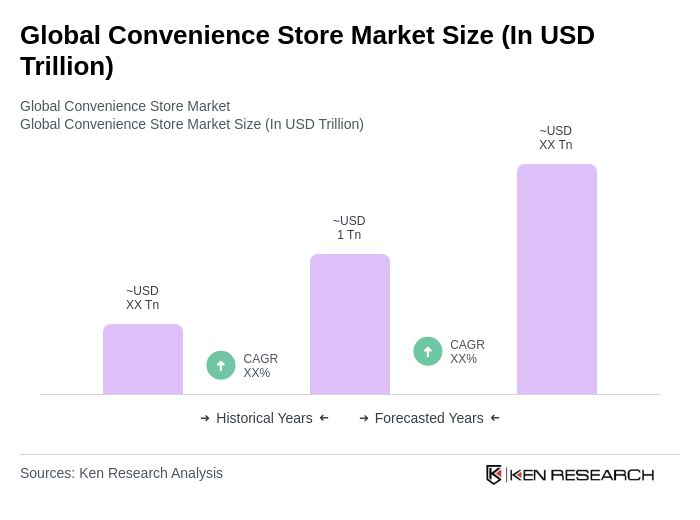
- The Global Convenience Store Market is valued at USD 1 trillion, based on a five-year historical analysis. This growth is primarily driven by the increasing demand for quick and easy access to essential goods, the rise of urbanization, and evolving consumer lifestyles. The convenience of extended operating hours, often 24/7, and the expansion of product offerings—including ready-to-eat foods and personal care items—have further fueled market growth, making convenience stores a preferred shopping destination for time-sensitive consumers. Technological advancements such as self-checkout systems and mobile payment options are also enhancing the customer experience and supporting market expansion .
- Key players in this market include the United States, Japan, and China, which dominate due to their large populations, high urbanization rates, and well-established retail infrastructures. The U.S. market benefits from a strong consumer culture favoring convenience, while Japan's advanced technology integration in retail enhances customer experience. China's rapid urban growth and increasing disposable income also contribute significantly to its market dominance. Regional brands continue to adapt to local preferences and offer specialized products, while global chains leverage economies of scale and digital solutions to maintain competitiveness .
- In 2023, the U.S. government reinforced food safety standards in convenience stores through the Food Safety Modernization Act (FSMA), issued by the U.S. Food and Drug Administration. This regulation requires stores to implement preventive controls, maintain strict recordkeeping, and undergo regular inspections to ensure food safety, thereby improving consumer trust and safety in the convenience store sector .
Global Convenience Store Market Segmentation
By Ownership:
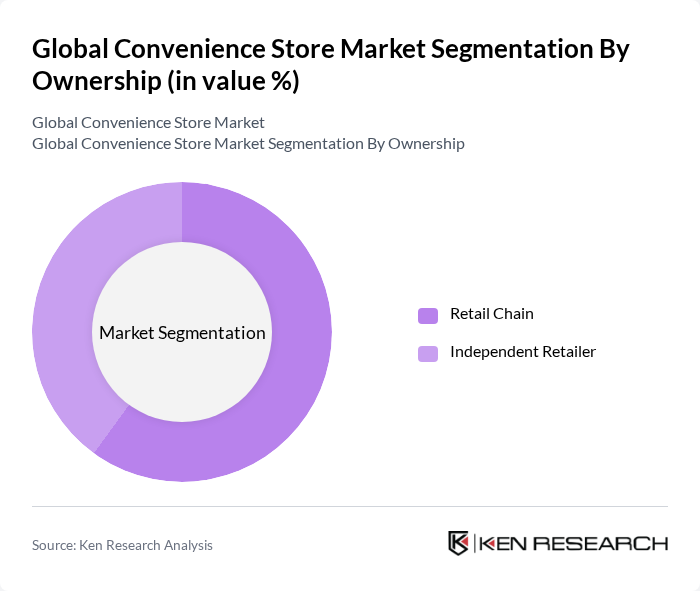
The ownership segment of the market is primarily dominated by retail chains, which benefit from economies of scale, brand recognition, and extensive distribution networks. Retail chains such as 7-Eleven and Circle K have established a strong presence, offering a wide range of products and services that cater to evolving consumer needs. Independent retailers, while significant, often focus on niche markets and personalized service, but face challenges in competing with the pricing and marketing power of larger chains .
By Store Type:
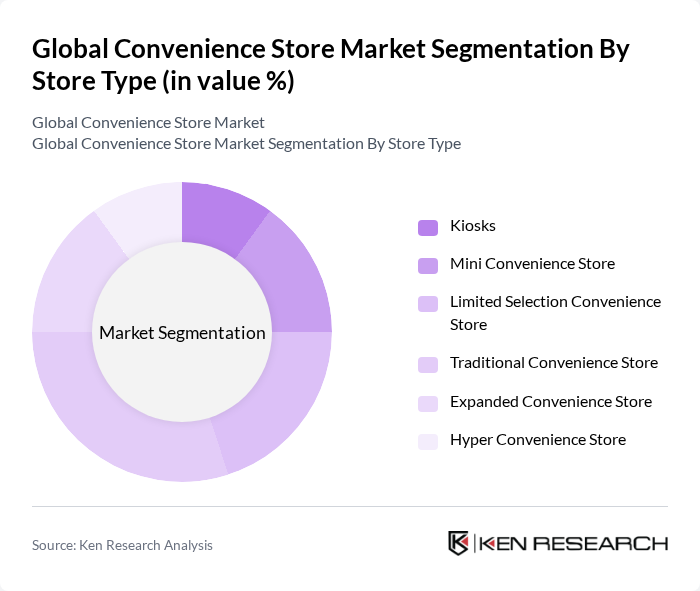
In the store type segmentation, traditional convenience stores lead the market due to their established presence and broad product offerings, including groceries, snacks, and ready-to-eat meals. Limited selection and expanded convenience stores are also gaining traction as they offer specialized products and services, such as healthier food options and digital payment solutions, appealing to evolving consumer preferences. Kiosks and mini convenience stores, while popular, typically serve high-traffic or niche locations, focusing on quick purchases and essential items .
Global Convenience Store Market Competitive Landscape
The Global Convenience Store Market is characterized by a dynamic mix of regional and international players. Leading participants such as 7-Eleven, Inc., Circle K Stores, Inc., Tesco PLC, Alimentation Couche-Tard Inc., Wawa, Inc., BP p.l.c., Shell Oil Company, Speedway LLC, Casey's General Stores, Inc., Kum & Go, L.C., Sheetz, Inc., FamilyMart Co., Ltd., Lawson, Inc., 7-Eleven Japan Co., Ltd., Spar International, OXXO (FEMSA), Murphy USA Inc., Parkland Corporation, Amazon.com, Inc., and Alibaba Group Holding Limited contribute to innovation, geographic expansion, and service delivery in this space .
Global Convenience Store Market Industry Analysis
Growth Drivers
- Increasing Urbanization:The global urban population is projected to reach approximately 5 billion in future, according to the United Nations. This rapid urbanization drives the demand for convenience stores, as urban dwellers seek quick access to essential goods. In metropolitan areas, convenience stores are strategically located to cater to the busy lifestyles of residents, providing easy access to food, beverages, and daily necessities. This trend is particularly pronounced in regions like Asia-Pacific, where urbanization rates are among the highest globally.
- Demand for On-the-Go Products:The global market for on-the-go food products is expected to reach USD 200 billion in future, driven by changing consumer lifestyles. As more individuals adopt fast-paced routines, convenience stores are increasingly stocking ready-to-eat meals, snacks, and beverages that cater to this demand. This shift is evident in the rise of meal kits and portable snacks, which are designed for consumers who prioritize convenience without sacrificing quality. The trend is particularly strong among millennials and Gen Z consumers.
- Expansion of E-commerce:E-commerce sales in the retail sector are projected to exceed USD 5 trillion globally in future, according to eMarketer. This growth is influencing convenience stores to adopt omnichannel strategies, integrating online and offline shopping experiences. Many convenience stores are partnering with delivery platforms to offer online ordering and home delivery services, enhancing customer convenience. This trend not only increases sales but also attracts tech-savvy consumers who prefer shopping from their devices, further driving market growth.
Market Challenges
- Intense Competition:The convenience store sector is characterized by fierce competition, with over 150,000 convenience stores operating in the U.S. alone in future. Major players like 7-Eleven and Circle K dominate the market, making it challenging for smaller retailers to gain market share. This competitive landscape pressures profit margins, as stores must continuously innovate and offer competitive pricing to attract and retain customers. The saturation of the market in urban areas further complicates growth prospects for new entrants.
- Regulatory Compliance:Convenience stores face stringent regulatory requirements, particularly concerning food safety and labor laws. In the U.S., the Food and Drug Administration (FDA) enforces regulations that require compliance with food safety standards, which can be costly and complex for small operators. Additionally, labor regulations, including minimum wage laws and employee benefits, are becoming increasingly stringent, impacting operational costs. Non-compliance can lead to significant fines and damage to brand reputation, posing a substantial challenge for operators.
Global Convenience Store Market Future Outlook
The future of the convenience store market appears promising, driven by evolving consumer preferences and technological advancements. As urbanization continues, convenience stores will likely expand their presence in densely populated areas. Additionally, the integration of smart technology, such as AI-driven inventory management and personalized marketing, will enhance operational efficiency and customer engagement. Sustainability initiatives will also play a crucial role, as consumers increasingly favor brands that prioritize eco-friendly practices and products, shaping the market landscape in the coming years.
Market Opportunities
- Technological Advancements:The adoption of smart technology in convenience stores presents significant opportunities. Implementing AI and IoT solutions can streamline operations, optimize inventory management, and enhance customer experiences. For instance, automated checkout systems can reduce wait times, attracting more customers. As technology continues to evolve, convenience stores that embrace these innovations will likely gain a competitive edge in the market.
- Health-Conscious Product Offerings:The growing trend towards health and wellness is creating opportunities for convenience stores to diversify their product offerings. By introducing organic, gluten-free, and low-calorie options, stores can cater to health-conscious consumers. According to market research, the health food market is expected to reach USD 1 trillion in future, indicating a substantial opportunity for convenience stores to capture this segment and enhance their brand image.
Scope of the Report
| Segment | Sub-Segments |
|---|---|
| By Ownership | Retail Chain Independent Retailer |
| By Store Type | Kiosks Mini Convenience Store Limited Selection Convenience Store Traditional Convenience Store Expanded Convenience Store Hyper Convenience Store |
| By Product Type | Cigarettes and Tobacco Foodservice Packaged Beverages Center Store Low Alcoholic Beverages Other Product Types |
| By Application | Residential Office Buildings School Transportation Hub Others |
| By Region | Asia-Pacific North America Europe South America Middle East & Africa |
Key Target Audience
Investors and Venture Capitalist Firms
Government and Regulatory Bodies (e.g., Food and Drug Administration, Federal Trade Commission)
Manufacturers and Producers
Distributors and Retailers
Franchise Owners and Operators
Supply Chain Management Companies
Real Estate Developers and Property Management Firms
Payment Processing and Fintech Companies
Players Mentioned in the Report:
7-Eleven, Inc.
Circle K Stores, Inc.
Tesco PLC
Alimentation Couche-Tard Inc.
Wawa, Inc.
BP p.l.c.
Shell Oil Company
Speedway LLC
Casey's General Stores, Inc.
Kum & Go, L.C.
Sheetz, Inc.
FamilyMart Co., Ltd.
Lawson, Inc.
7-Eleven Japan Co., Ltd.
Spar International
OXXO (FEMSA)
Murphy USA Inc.
Parkland Corporation
Amazon.com, Inc.
Alibaba Group Holding Limited
Table of Contents
Market Assessment Phase
1. Executive Summary and Approach
2. Global Convenience Store Market Overview
2.1 Key Insights and Strategic Recommendations
2.2 Global Convenience Store Market Overview
2.3 Definition and Scope
2.4 Evolution of Market Ecosystem
2.5 Timeline of Key Regulatory Milestones
2.6 Value Chain & Stakeholder Mapping
2.7 Business Cycle Analysis
2.8 Policy & Incentive Landscape
3. Global Convenience Store Market Analysis
3.1 Growth Drivers
3.1.1 Increasing Urbanization
3.1.2 Demand for On-the-Go Products
3.1.3 Expansion of E-commerce
3.1.4 Consumer Preference for Convenience
3.2 Market Challenges
3.2.1 Intense Competition
3.2.2 Regulatory Compliance
3.2.3 Supply Chain Disruptions
3.2.4 Changing Consumer Preferences
3.3 Market Opportunities
3.3.1 Technological Advancements
3.3.2 Expansion into Emerging Markets
3.3.3 Health-Conscious Product Offerings
3.3.4 Partnerships with Delivery Services
3.4 Market Trends
3.4.1 Rise of Contactless Payments
3.4.2 Focus on Sustainability
3.4.3 Growth of Private Label Products
3.4.4 Integration of Smart Technology
3.5 Government Regulation
3.5.1 Food Safety Standards
3.5.2 Labor Regulations
3.5.3 Environmental Regulations
3.5.4 Licensing Requirements
4. SWOT Analysis
5. Stakeholder Analysis
6. Porter's Five Forces Analysis
7. Global Convenience Store Market Market Size, 2019-2024
7.1 By Value
7.2 By Volume
7.3 By Average Selling Price
8. Global Convenience Store Market Segmentation
8.1 By Ownership
8.1.1 Retail Chain
8.1.2 Independent Retailer
8.2 By Store Type
8.2.1 Kiosks
8.2.2 Mini Convenience Store
8.2.3 Limited Selection Convenience Store
8.2.4 Traditional Convenience Store
8.2.5 Expanded Convenience Store
8.2.6 Hyper Convenience Store
8.3 By Product Type
8.3.1 Cigarettes and Tobacco
8.3.2 Foodservice
8.3.3 Packaged Beverages
8.3.4 Center Store
8.3.5 Low Alcoholic Beverages
8.3.6 Other Product Types
8.4 By Application
8.4.1 Residential
8.4.2 Office Buildings
8.4.3 School
8.4.4 Transportation Hub
8.4.5 Others
8.5 By Region
8.5.1 Asia-Pacific
8.5.2 North America
8.5.3 Europe
8.5.4 South America
8.5.5 Middle East & Africa
9. Global Convenience Store Market Competitive Analysis
9.1 Market Share of Key Players
9.2 KPIs for Cross Comparison of Key Players
9.2.1 Total Number of Stores
9.2.2 Annual Revenue
9.2.3 Revenue Growth Rate
9.2.4 Same-Store Sales Growth
9.2.5 Customer Retention Rate
9.2.6 Average Transaction Value
9.2.7 Store Footprint Expansion Rate
9.2.8 Inventory Turnover Ratio
9.2.9 Market Penetration Rate
9.2.10 Customer Satisfaction Score
9.2.11 Private Label Sales Share
9.2.12 Digital/E-commerce Sales Share
9.3 SWOT Analysis of Top Players
9.4 Pricing Analysis
9.5 List of Major Companies
9.5.1 7-Eleven, Inc.
9.5.2 Circle K Stores, Inc.
9.5.3 Tesco PLC
9.5.4 Alimentation Couche-Tard Inc.
9.5.5 Wawa, Inc.
9.5.6 BP p.l.c.
9.5.7 Shell Oil Company
9.5.8 Speedway LLC
9.5.9 Casey's General Stores, Inc.
9.5.10 Kum & Go, L.C.
9.5.11 Sheetz, Inc.
9.5.12 FamilyMart Co., Ltd.
9.5.13 Lawson, Inc.
9.5.14 7-Eleven Japan Co., Ltd.
9.5.15 Spar International
9.5.16 OXXO (FEMSA)
9.5.17 Murphy USA Inc.
9.5.18 Parkland Corporation
9.5.19 Amazon.com, Inc.
9.5.20 Alibaba Group Holding Limited
10. Global Convenience Store Market End-User Analysis
10.1 Procurement Behavior of Key Ministries
10.1.1 Government Procurement Policies
10.1.2 Budget Allocation Trends
10.1.3 Supplier Selection Criteria
10.2 Corporate Spend on Infrastructure & Energy
10.2.1 Investment in Store Infrastructure
10.2.2 Energy Efficiency Initiatives
10.2.3 Technology Upgrades
10.3 Pain Point Analysis by End-User Category
10.3.1 Accessibility Issues
10.3.2 Product Availability
10.3.3 Pricing Concerns
10.4 User Readiness for Adoption
10.4.1 Awareness of Convenience Store Offerings
10.4.2 Willingness to Pay for Convenience
10.4.3 Adoption of Technology Solutions
10.5 Post-Deployment ROI and Use Case Expansion
10.5.1 Measurement of ROI
10.5.2 Customer Feedback Mechanisms
10.5.3 Opportunities for Service Expansion
11. Global Convenience Store Market Future Size, 2025-2030
11.1 By Value
11.2 By Volume
11.3 By Average Selling Price
Go-To-Market Strategy Phase
1. Whitespace Analysis + Business Model Canvas
1.1 Market Gaps Identification
1.2 Business Model Framework
2. Marketing and Positioning Recommendations
2.1 Branding Strategies
2.2 Product USPs
3. Distribution Plan
3.1 Urban Retail Strategies
3.2 Rural NGO Tie-Ups
4. Channel & Pricing Gaps
4.1 Underserved Routes
4.2 Pricing Bands
5. Unmet Demand & Latent Needs
5.1 Category Gaps
5.2 Consumer Segments
6. Customer Relationship
6.1 Loyalty Programs
6.2 After-Sales Service
7. Value Proposition
7.1 Sustainability Initiatives
7.2 Integrated Supply Chains
8. Key Activities
8.1 Regulatory Compliance
8.2 Branding Efforts
8.3 Distribution Setup
9. Entry Strategy Evaluation
9.1 Domestic Market Entry Strategy
9.1.1 Product Mix
9.1.2 Pricing Band
9.1.3 Packaging Considerations
9.2 Export Entry Strategy
9.2.1 Target Countries
9.2.2 Compliance Roadmap
10. Entry Mode Assessment
10.1 Joint Ventures
10.2 Greenfield Investments
10.3 Mergers & Acquisitions
10.4 Distributor Model
11. Capital and Timeline Estimation
11.1 Capital Requirements
11.2 Timelines
12. Control vs Risk Trade-Off
12.1 Ownership vs Partnerships
13. Profitability Outlook
13.1 Breakeven Analysis
13.2 Long-Term Sustainability
14. Potential Partner List
14.1 Distributors
14.2 Joint Ventures
14.3 Acquisition Targets
15. Execution Roadmap
15.1 Phased Plan for Market Entry
15.1.1 Market Setup
15.1.2 Market Entry
15.1.3 Growth Acceleration
15.1.4 Scale & Stabilize
15.2 Key Activities and Milestones
15.2.1 Milestone Planning
15.2.2 Activity Tracking
Research Methodology
Phase 1: Approach1
Desk Research
- Analysis of industry reports from global convenience store associations and market research firms
- Review of financial statements and annual reports from leading convenience store chains
- Examination of consumer behavior studies and market trends published in trade journals
Primary Research
- Interviews with store managers and franchise owners to gather insights on operational challenges
- Surveys targeting consumers to understand shopping preferences and frequency of visits
- Focus groups with industry experts to discuss emerging trends and innovations in convenience retailing
Validation & Triangulation
- Cross-validation of findings through comparison with historical sales data and growth rates
- Triangulation of insights from primary interviews with secondary data sources
- Sanity checks conducted through expert panel reviews to ensure data reliability
Phase 2: Market Size Estimation1
Top-down Assessment
- Estimation of market size based on national retail sales data and convenience store penetration rates
- Segmentation of the market by product categories such as food, beverages, and non-food items
- Incorporation of demographic trends and urbanization rates influencing convenience store growth
Bottom-up Modeling
- Collection of sales data from a representative sample of convenience stores across various regions
- Analysis of average transaction values and customer footfall metrics
- Estimation of market size based on aggregated data from individual store performance
Forecasting & Scenario Analysis
- Utilization of time-series analysis to project future market growth based on historical trends
- Scenario modeling considering factors such as economic conditions and consumer behavior shifts
- Development of multiple forecasts (baseline, optimistic, and pessimistic) through 2030
Phase 3: CATI Sample Composition1
| Scope Item/Segment | Sample Size | Target Respondent Profiles |
|---|---|---|
| Urban Convenience Store Operations | 150 | Store Managers, Franchise Owners |
| Consumer Shopping Behavior | 120 | Frequent Shoppers, Occasional Customers |
| Product Category Insights | 100 | Category Managers, Merchandising Directors |
| Market Trends and Innovations | 80 | Industry Analysts, Retail Consultants |
| Regional Market Dynamics | 120 | Regional Managers, Local Store Owners |
Frequently Asked Questions
What is the current value of the Global Convenience Store Market?
The Global Convenience Store Market is valued at approximately USD 1 trillion, driven by increasing demand for quick access to essential goods, urbanization, and evolving consumer lifestyles. This market is expected to continue growing as consumer preferences shift towards convenience.
What factors are driving the growth of the convenience store market?
Which countries dominate the Global Convenience Store Market?
What are the main challenges faced by convenience stores?
Other Regional/Country Reports
Indonesia Convenience Store Market
Malaysia Convenience Store Market
APAC Convenience Store Market
SEA Convenience Store Market
Why Buy From Us?

What makes us stand out is that our consultants follow Robust, Refine and Result (RRR) methodology. Robust for clear definitions, approaches and sanity checking, Refine for differentiating respondents' facts and opinions, and Result for presenting data with story.

We have set a benchmark in the industry by offering our clients with syndicated and customized market research reports featuring coverage of entire market as well as meticulous research and analyst insights.

While we don't replace traditional research, we flip the method upside down. Our dual approach of Top Bottom & Bottom Top ensures quality deliverable by not just verifying company fundamentals but also looking at the sector and macroeconomic factors.

With one step in the future, our research team constantly tries to show you the bigger picture. We help with some of the tough questions you may encounter along the way: How is the industry positioned? Best marketing channel? KPI's of competitors? By aligning every element, we help maximize success.

Our report gives you instant access to the answers and sources that other companies might choose to hide. We elaborate each steps of research methodology we have used and showcase you the sample size to earn your trust.

If you need any support, we are here! We pride ourselves on universe strength, data quality, and quick, friendly, and professional service.