Global Cosmetics Personal Care Stores Market

Global Cosmetics Personal Care Stores Market, valued at USD 370-410 billion, is set for growth to $600 billion, fueled by rising disposable incomes, e-commerce expansion, and demand for skincare and personalized products.

Region:Global

Author(s):Dev

Product Code:KRAC0549

Pages:95

Published On:August 2025

About the Report

Base Year 2024

Global Cosmetics Personal Care Stores Market Overview

  • The Global Cosmetics Personal Care Stores Market is valued at approximately USD 370–410 billion, based on a five-year historical analysis of retail revenues reported for specialty cosmetics and personal care store formats. This value reflects sustained growth driven by consumer beauty trends, retail expansion, and social media influence, alongside a continued shift to omnichannel and online retailing that boosts accessibility and sales .
  • Key players in this market include the United States, China, and Japan, reflecting large consumer bases and strong retail infrastructure. North Asia (including China and Japan) represents a substantial share of the global beauty market, and the U.S. remains a leading, innovative market with powerful brands and specialty retail chains; rapid e-commerce growth and social commerce in China further reinforce its weight in the channel .
  • In 2023, the European Union continued to enforce the EU Cosmetics Regulation framework requiring clear ingredient labeling and safety information (INCI lists, responsible person, product safety assessment) as part of Regulation (EC) No 1223/2009 and its 2023 amendments under the EU Chemicals Strategy for Sustainability (e.g., microplastics restriction and updated substance annexes). These measures aim to enhance safety and transparency and affect formulation and labeling strategies for companies operating in the EU .

Global Cosmetics Personal Care Stores Market Segmentation

By Product Category:The product category segmentation includes various segments such as skincare, haircare, makeup/color cosmetics, fragrances & deodorants, bath & body/personal hygiene, men’s grooming, and beauty tools & accessories. Among these, skincare products dominate the market due to increasing awareness of skin health, demand for clean and natural formulations, and growth in dermocosmetics and sun care. Personalization and data-driven recommendations are expanding premium skincare adoption in specialty and chain drug formats .
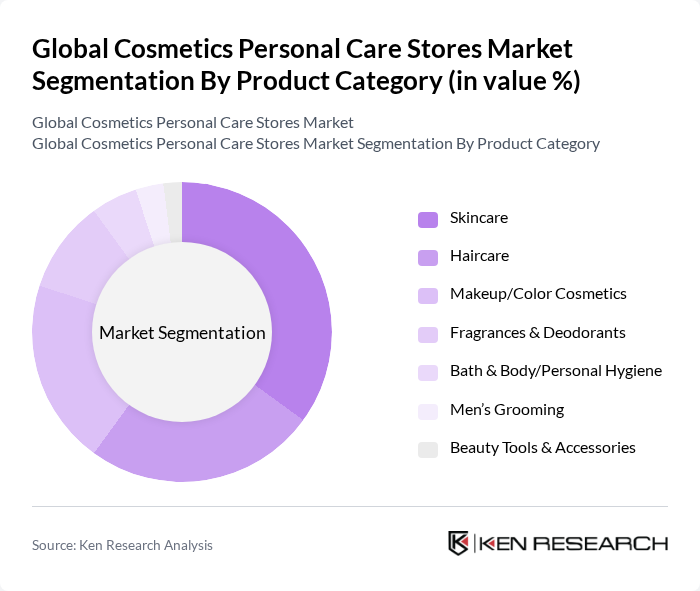
Global Cosmetics Personal Care Stores Market segmentation by Product Category.

By Customer Demographic:The customer demographic segmentation includes women, men, and children & teens. Women represent the largest demographic in cosmetics and personal care specialty retail, spanning skincare, makeup, and fragrance. The men’s segment continues to rise with grooming, hair, beard, and skincare adoption, while children & teens are influenced by social media, K-beauty/J-beauty trends, and age-appropriate skincare awareness, increasingly discovered and purchased via online channels and specialty chains .
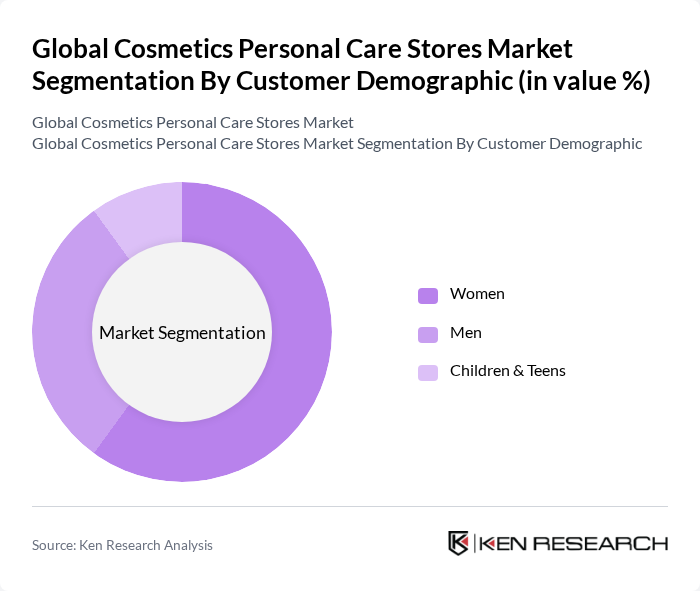
Global Cosmetics Personal Care Stores Market segmentation by Customer Demographic.

Global Cosmetics Personal Care Stores Market Competitive Landscape

The Global Cosmetics Personal Care Stores Market is characterized by a dynamic mix of regional and international players. Leading participants such as Sephora (LVMH), Ulta Beauty, Inc., Bath & Body Works, Inc., The Body Shop International Limited, Douglas GmbH, Watsons (A.S. Watson Group), Boots (Walgreens Boots Alliance), DM-drogerie markt GmbH + Co. KG, Rossmann GmbH, Sally Beauty Holdings, Inc., Marionnaud (CK Hutchison Holdings), Guardian (Dairy Farm Group), Müller Handels GmbH & Co. KG, Eveandboy Co., Ltd., Nykaa (FSN E-Commerce Ventures Ltd.) contribute to innovation, geographic expansion, and service delivery in this space .

Sephora (LVMH)

1969

Paris, France

Ulta Beauty, Inc.

1990

Bolingbrook, Illinois, USA

Bath & Body Works, Inc.

1990

Columbus, Ohio, USA

The Body Shop International Limited

1976

Littlehampton, England

Douglas GmbH

1821

Düsseldorf, Germany

Company

Establishment Year

Headquarters

Store Footprint (Number of Stores, Countries Present)

Retail Sales (Beauty Category, Latest Fiscal Year)

Same-Store Sales/Comparable Sales Growth

Omnichannel Mix (In-Store vs. Click-and-Collect/Online %)

Average Basket Size/Transaction Value

Private-Label Penetration (%)

Global Cosmetics Personal Care Stores Market Industry Analysis

Growth Drivers

  • Increasing Consumer Awareness of Personal Grooming:The global cosmetics personal care market is witnessing a surge in consumer awareness regarding personal grooming, with 75% of consumers in developed regions prioritizing skincare and grooming routines. This trend is supported by a report from the World Bank indicating that the global beauty and personal care market is projected to reach $600 billion, driven by heightened consumer interest in self-care and wellness.
  • Rise in Disposable Income:As disposable income rises, particularly in emerging markets, consumers are increasingly willing to spend on premium personal care products. According to the IMF, global GDP per capita is expected to increase by $1,500, leading to a projected 20% growth in personal care spending. This economic uplift allows consumers to invest in higher-quality cosmetics, enhancing market growth.
  • Expansion of E-commerce Platforms:The rapid expansion of e-commerce platforms is revolutionizing the cosmetics personal care market. In future, online sales are expected to account for 35% of total cosmetics sales, as reported by Statista. This shift is driven by increased internet penetration, with over 5.5 billion global internet users, facilitating easier access to a wider range of products and brands, thus boosting overall market growth.

Market Challenges

  • Intense Competition Among Retailers:The cosmetics personal care market is characterized by intense competition, with over 1,200 brands vying for market share. This saturation leads to price wars and reduced profit margins, as retailers struggle to differentiate their offerings. An analysis by Euromonitor International highlights that 65% of brands are investing heavily in marketing to maintain visibility, further intensifying competition.
  • Regulatory Compliance Issues:Navigating regulatory compliance poses significant challenges for cosmetics retailers. In future, the FDA is expected to enforce stricter regulations on ingredient safety and labeling, impacting over 45% of existing products. Companies must invest in compliance measures, which can divert resources from innovation and marketing, hindering growth potential in a rapidly evolving market landscape.

Global Cosmetics Personal Care Stores Market Future Outlook

The future of the cosmetics personal care market appears promising, driven by evolving consumer preferences and technological advancements. The integration of augmented reality in retail experiences is expected to enhance customer engagement, while the demand for sustainable and clean beauty products will continue to rise. As brands adapt to these trends, they will likely focus on innovation and personalized offerings, ensuring they remain competitive in a dynamic market landscape.

Market Opportunities

  • Growth in Online Shopping:The shift towards online shopping presents a significant opportunity for cosmetics retailers. With e-commerce projected to grow by 25%, brands can leverage digital platforms to reach a broader audience, enhancing sales and brand loyalty. This trend is particularly strong among millennials and Gen Z consumers, who prefer online shopping for convenience and variety.
  • Increasing Demand for Personalized Products:The demand for personalized cosmetics is on the rise, with 50% of consumers expressing interest in tailored products. This trend is supported by advancements in technology, allowing brands to offer customized solutions. Companies that invest in personalization strategies can capture a growing segment of the market, enhancing customer satisfaction and loyalty.

Scope of the Report

SegmentSub-Segments
By Product Category

Skincare

Haircare

Makeup/Color Cosmetics

Fragrances & Deodorants

Bath & Body/Personal Hygiene

Men’s Grooming

Beauty Tools & Accessories

By Customer Demographic

Women

Men

Children & Teens

By Store Format

Specialty Beauty Retailers

Drugstores/Pharmacies

Supermarkets/Hypermarkets

Department Stores

Convenience Stores

By Ownership/Operation Mode

Company-Owned/Flagship Stores

Franchise Stores

Shop-in-Shop/Counters

By Price Tier

Prestige/Luxury

Mass/Mid-Range

Value/Economy

By Brand Type

Global Established Brands

Indie/Emerging Brands

By Product Positioning

Clean/Natural/Organic

Dermatologist-Backed/Clinical

K-Beauty/J-Beauty

Vegan/ Cruelty-Free

Sensitive Skin/Hypoallergenic

By Region

North America

Europe

Asia-Pacific

Latin America

Middle East & Africa

Key Target Audience

Investors and Venture Capitalist Firms

Government and Regulatory Bodies (e.g., Food and Drug Administration, European Commission)

Manufacturers and Producers

Distributors and Retailers

Brand Owners and Private Label Companies

Packaging Suppliers

Market Analysts and Industry Experts

Financial Institutions

Players Mentioned in the Report:

Sephora (LVMH)

Ulta Beauty, Inc.

Bath & Body Works, Inc.

The Body Shop International Limited

Douglas GmbH

Watsons (A.S. Watson Group)

Boots (Walgreens Boots Alliance)

DM-drogerie markt GmbH + Co. KG

Rossmann GmbH

Sally Beauty Holdings, Inc.

Marionnaud (CK Hutchison Holdings)

Guardian (Dairy Farm Group)

Muller Handels GmbH & Co. KG

Eveandboy Co., Ltd.

Nykaa (FSN E-Commerce Ventures Ltd.)

Table of Contents

Market Assessment Phase

1. Executive Summary and Approach


2. Global Cosmetics Personal Care Stores Market Overview

2.1 Key Insights and Strategic Recommendations

2.2 Global Cosmetics Personal Care Stores Market Overview

2.3 Definition and Scope

2.4 Evolution of Market Ecosystem

2.5 Timeline of Key Regulatory Milestones

2.6 Value Chain & Stakeholder Mapping

2.7 Business Cycle Analysis

2.8 Policy & Incentive Landscape


3. Global Cosmetics Personal Care Stores Market Analysis

3.1 Growth Drivers

3.1.1 Increasing consumer awareness of personal grooming
3.1.2 Rise in disposable income
3.1.3 Expansion of e-commerce platforms
3.1.4 Demand for organic and natural products

3.2 Market Challenges

3.2.1 Intense competition among retailers
3.2.2 Regulatory compliance issues
3.2.3 Fluctuating raw material prices
3.2.4 Changing consumer preferences

3.3 Market Opportunities

3.3.1 Growth in online shopping
3.3.2 Increasing demand for personalized products
3.3.3 Expansion into emerging markets
3.3.4 Collaborations with influencers and brands

3.4 Market Trends

3.4.1 Shift towards sustainable packaging
3.4.2 Growth of subscription-based services
3.4.3 Rise of clean beauty products
3.4.4 Integration of technology in retail experiences

3.5 Government Regulation

3.5.1 Labeling requirements for cosmetics
3.5.2 Safety regulations for product ingredients
3.5.3 Environmental regulations on packaging
3.5.4 Import/export regulations for cosmetics

4. SWOT Analysis


5. Stakeholder Analysis


6. Porter's Five Forces Analysis


7. Global Cosmetics Personal Care Stores Market Market Size, 2019-2024

7.1 By Value

7.2 By Volume

7.3 By Average Selling Price


8. Global Cosmetics Personal Care Stores Market Segmentation

8.1 By Product Category

8.1.1 Skincare
8.1.2 Haircare
8.1.3 Makeup/Color Cosmetics
8.1.4 Fragrances & Deodorants
8.1.5 Bath & Body/Personal Hygiene
8.1.6 Men’s Grooming
8.1.7 Beauty Tools & Accessories

8.2 By Customer Demographic

8.2.1 Women
8.2.2 Men
8.2.3 Children & Teens

8.3 By Store Format

8.3.1 Specialty Beauty Retailers
8.3.2 Drugstores/Pharmacies
8.3.3 Supermarkets/Hypermarkets
8.3.4 Department Stores
8.3.5 Convenience Stores

8.4 By Ownership/Operation Mode

8.4.1 Company-Owned/Flagship Stores
8.4.2 Franchise Stores
8.4.3 Shop-in-Shop/Counters

8.5 By Price Tier

8.5.1 Prestige/Luxury
8.5.2 Mass/Mid-Range
8.5.3 Value/Economy

8.6 By Brand Type

8.6.1 Global Established Brands
8.6.2 Indie/Emerging Brands

8.7 By Product Positioning

8.7.1 Clean/Natural/Organic
8.7.2 Dermatologist-Backed/Clinical
8.7.3 K-Beauty/J-Beauty
8.7.4 Vegan/ Cruelty-Free
8.7.5 Sensitive Skin/Hypoallergenic

8.8 By Region

8.8.1 North America
8.8.2 Europe
8.8.3 Asia-Pacific
8.8.4 Latin America
8.8.5 Middle East & Africa

9. Global Cosmetics Personal Care Stores Market Competitive Analysis

9.1 Market Share of Key Players

9.2 Cross Comparison of Key Players

9.2.1 Company Name (Retailer/Operator)
9.2.2 Store Footprint (Number of Stores, Countries Present)
9.2.3 Retail Sales (Beauty Category, Latest Fiscal Year)
9.2.4 Same-Store Sales/Comparable Sales Growth
9.2.5 Omnichannel Mix (In-Store vs. Click-and-Collect/Online %)
9.2.6 Average Basket Size/Transaction Value
9.2.7 Private-Label Penetration (%)
9.2.8 SKU Count/Assortment Breadth
9.2.9 Loyalty Memberships/Active Members
9.2.10 Customer Satisfaction/NPS
9.2.11 Store Productivity (Sales per sq. ft./per sq. meter)
9.2.12 Inventory Turnover/Weeks of Supply
9.2.13 Pricing Positioning (Prestige, Masstige, Mass)
9.2.14 Services Mix (Makeup Services, Skin Diagnostics, Salon)

9.3 SWOT Analysis of Top Players

9.4 Pricing Analysis

9.5 Detailed Profile of Major Companies

9.5.1 Sephora (LVMH)
9.5.2 Ulta Beauty, Inc.
9.5.3 Bath & Body Works, Inc.
9.5.4 The Body Shop International Limited
9.5.5 Douglas GmbH
9.5.6 Watsons (A.S. Watson Group)
9.5.7 Boots (Walgreens Boots Alliance)
9.5.8 DM-drogerie markt GmbH + Co. KG
9.5.9 Rossmann GmbH
9.5.10 Sally Beauty Holdings, Inc.
9.5.11 Marionnaud (CK Hutchison Holdings)
9.5.12 Guardian (Dairy Farm Group)
9.5.13 Müller Handels GmbH & Co. KG
9.5.14 Eveandboy Co., Ltd.
9.5.15 Nykaa (FSN E-Commerce Ventures Ltd.)

10. Global Cosmetics Personal Care Stores Market End-User Analysis

10.1 Procurement Behavior of Key Ministries

10.1.1 Government procurement policies
10.1.2 Budget allocation for personal care products
10.1.3 Supplier selection criteria

10.2 Corporate Spend on Infrastructure & Energy

10.2.1 Investment in retail infrastructure
10.2.2 Energy efficiency initiatives

10.3 Pain Point Analysis by End-User Category

10.3.1 Product availability issues
10.3.2 Price sensitivity among consumers

10.4 User Readiness for Adoption

10.4.1 Awareness of product benefits
10.4.2 Accessibility of products

10.5 Post-Deployment ROI and Use Case Expansion

10.5.1 Measurement of sales growth
10.5.2 Customer feedback mechanisms

11. Global Cosmetics Personal Care Stores Market Future Size, 2025-2030

11.1 By Value

11.2 By Volume

11.3 By Average Selling Price


Go-To-Market Strategy Phase

1. Whitespace Analysis + Business Model Canvas

1.1 Market gaps identification

1.2 Value proposition development

1.3 Revenue model exploration

1.4 Customer segment analysis

1.5 Key partnerships identification

1.6 Cost structure analysis

1.7 Channels of distribution


2. Marketing and Positioning Recommendations

2.1 Branding strategies

2.2 Product USPs

2.3 Target audience segmentation

2.4 Communication strategies

2.5 Digital marketing initiatives


3. Distribution Plan

3.1 Urban retail strategies

3.2 Rural NGO tie-ups

3.3 E-commerce integration

3.4 Logistics optimization


4. Channel & Pricing Gaps

4.1 Underserved routes

4.2 Pricing bands analysis

4.3 Competitor pricing strategies


5. Unmet Demand & Latent Needs

5.1 Category gaps identification

5.2 Consumer segments analysis

5.3 Product innovation opportunities


6. Customer Relationship

6.1 Loyalty programs

6.2 After-sales service

6.3 Customer engagement strategies


7. Value Proposition

7.1 Sustainability initiatives

7.2 Integrated supply chains

7.3 Unique selling propositions


8. Key Activities

8.1 Regulatory compliance

8.2 Branding efforts

8.3 Distribution setup


9. Entry Strategy Evaluation

9.1 Domestic Market Entry Strategy

9.1.1 Product mix considerations
9.1.2 Pricing band strategies
9.1.3 Packaging innovations

9.2 Export Entry Strategy

9.2.1 Target countries analysis
9.2.2 Compliance roadmap development

10. Entry Mode Assessment

10.1 Joint Ventures

10.2 Greenfield investments

10.3 Mergers & Acquisitions

10.4 Distributor Model


11. Capital and Timeline Estimation

11.1 Capital requirements analysis

11.2 Timelines for market entry


12. Control vs Risk Trade-Off

12.1 Ownership considerations

12.2 Partnerships evaluation


13. Profitability Outlook

13.1 Breakeven analysis

13.2 Long-term sustainability strategies


14. Potential Partner List

14.1 Distributors identification

14.2 Joint Ventures opportunities

14.3 Acquisition targets


15. Execution Roadmap

15.1 Phased Plan for Market Entry

15.1.1 Market Setup
15.1.2 Market Entry
15.1.3 Growth Acceleration
15.1.4 Scale & Stabilize

15.2 Key Activities and Milestones

15.2.1 Milestone tracking
15.2.2 Activity scheduling

Research Methodology

ApproachModellingSample

Phase 1: Approach1

Desk Research

  • Analysis of industry reports from market research firms focusing on the global cosmetics personal care sector
  • Review of trade publications and journals for trends in consumer preferences and product innovations
  • Examination of regulatory frameworks and compliance guidelines from health and safety authorities

Primary Research

  • In-depth interviews with brand managers and product developers from leading cosmetics companies
  • Surveys conducted with retail managers in personal care stores to gather insights on consumer behavior
  • Focus group discussions with consumers to understand preferences and purchasing decisions in cosmetics

Validation & Triangulation

  • Cross-validation of findings through multiple data sources, including sales data and consumer surveys
  • Triangulation of insights from industry experts, market reports, and consumer feedback
  • Sanity checks performed through expert panel reviews to ensure data accuracy and relevance

Phase 2: Market Size Estimation1

Top-down Assessment

  • Estimation of market size based on global cosmetics sales data and growth rates
  • Segmentation analysis by product categories, including skincare, haircare, and makeup
  • Incorporation of demographic trends and regional market dynamics into the assessment

Bottom-up Modeling

  • Collection of sales data from a representative sample of personal care stores across various regions
  • Estimation of average transaction values and purchase frequencies among consumers
  • Calculation of market size based on aggregated sales figures from surveyed retail outlets

Forecasting & Scenario Analysis

  • Utilization of time-series analysis to project future market trends based on historical data
  • Scenario modeling to assess the impact of economic factors and consumer trends on market growth
  • Development of baseline, optimistic, and pessimistic forecasts through 2030

Phase 3: CATI Sample Composition1

Scope Item/SegmentSample SizeTarget Respondent Profiles
Skincare Product Sales140Retail Managers, Brand Representatives
Makeup Product Trends120Cosmetic Buyers, Marketing Executives
Haircare Consumer Preferences100Product Development Managers, Sales Directors
Fragrance Market Insights80Retail Analysts, Consumer Insights Managers
Personal Care Store Operations90Store Managers, Operations Supervisors

Frequently Asked Questions

What is the current value of the Global Cosmetics Personal Care Stores Market?

The Global Cosmetics Personal Care Stores Market is valued at approximately USD 370410 billion, reflecting sustained growth driven by consumer beauty trends, retail expansion, and the influence of social media, alongside a shift towards omnichannel and online retailing.

Which regions are the key players in the cosmetics personal care market?

What are the main product categories in the cosmetics personal care market?

How is consumer awareness affecting the cosmetics personal care market?

Other Regional/Country Reports

UAE Cosmetics Personal Care Stores MarketKSA Cosmetics Personal Care Stores Market

Indonesia Cosmetics Personal Care Stores Market

Malaysia Cosmetics Personal Care Stores Market

APAC Cosmetics Personal Care Stores Market

SEA Cosmetics Personal Care Stores Market

Why Buy From Us?

Refine Robust Result (RRR) Framework

What makes us stand out is that our consultants follow Robust, Refine and Result (RRR) methodology. Robust for clear definitions, approaches and sanity checking, Refine for differentiating respondents' facts and opinions, and Result for presenting data with story.

Our Reach Is Unmatched

We have set a benchmark in the industry by offering our clients with syndicated and customized market research reports featuring coverage of entire market as well as meticulous research and analyst insights.

Shifting the Research Paradigm

While we don't replace traditional research, we flip the method upside down. Our dual approach of Top Bottom & Bottom Top ensures quality deliverable by not just verifying company fundamentals but also looking at the sector and macroeconomic factors.

More Insights-Better Decisions

With one step in the future, our research team constantly tries to show you the bigger picture. We help with some of the tough questions you may encounter along the way: How is the industry positioned? Best marketing channel? KPI's of competitors? By aligning every element, we help maximize success.

Transparency and Trust

Our report gives you instant access to the answers and sources that other companies might choose to hide. We elaborate each steps of research methodology we have used and showcase you the sample size to earn your trust.

Round the Clock Support

If you need any support, we are here! We pride ourselves on universe strength, data quality, and quick, friendly, and professional service.

Why Clients Choose Us?

400000+
Reports in repository
150+
Consulting projects a year
100+
Analysts
8000+
Client Queries in 2022








