Global Decoys and Dispensers Market

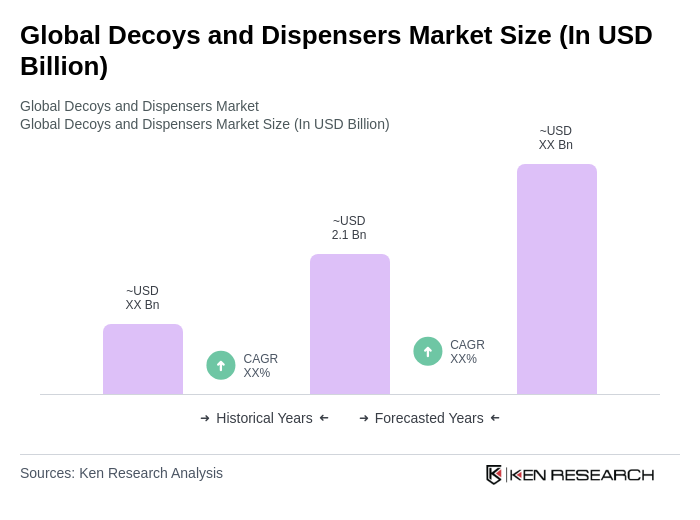
Global Decoys and Dispensers Market, valued at USD 2.1 billion, grows with rising defense investments and innovations in decoys for military and wildlife uses.

Region:Global

Author(s):Shubham

Product Code:KRAB0703

Pages:82

Published On:August 2025
About the Report

Base Year 2024

Global Decoys and Dispensers Market Overview

  • The Global Decoys and Dispensers Market is valued at USD 2.1 billion, based on a five-year historical analysis. This growth is primarily driven by increasing defense budgets across major economies, heightened geopolitical tensions, and the rapid adoption of advanced electronic warfare and countermeasure technologies. Additionally, the market is influenced by the expanding use of decoys and dispensers in hunting and wildlife research, supported by technological advancements and growing outdoor recreation trends .
  • The United States, China, and Russia dominate the Global Decoys and Dispensers Market due to their substantial investments in defense modernization and military technology. The United States leads in technological innovation and product development, while China and Russia emphasize expanding their military capabilities and indigenous manufacturing. These countries benefit from robust supply chains and established defense manufacturing infrastructures, reinforcing their leadership positions .
  • The United States Department of Defense issued the “Military Standard MIL-STD-1290G, 2023” which mandates that all military-grade decoys and dispensers undergo comprehensive testing and certification to ensure compliance with operational safety and performance standards. This regulation requires manufacturers to meet defined reliability thresholds and submit products for periodic evaluation, thereby enhancing the effectiveness and safety of decoy and dispenser systems in defense applications .
Global Decoys and Dispensers Market Size

Global Decoys and Dispensers Market Segmentation

By Type:The market is segmented into Electronic Decoys, Motion Decoys, Static Decoys, Inflatable Decoys, Chaff Dispensers, Flare Dispensers, and Others. Electronic Decoys are gaining significant traction due to their advanced electronic countermeasure capabilities, particularly in military and aerospace applications. Motion Decoys remain popular in hunting and wildlife research, providing realistic movement to attract or divert targets. Chaff and Flare Dispensers are essential in military aircraft and naval defense for protection against radar-guided and infrared-guided threats .
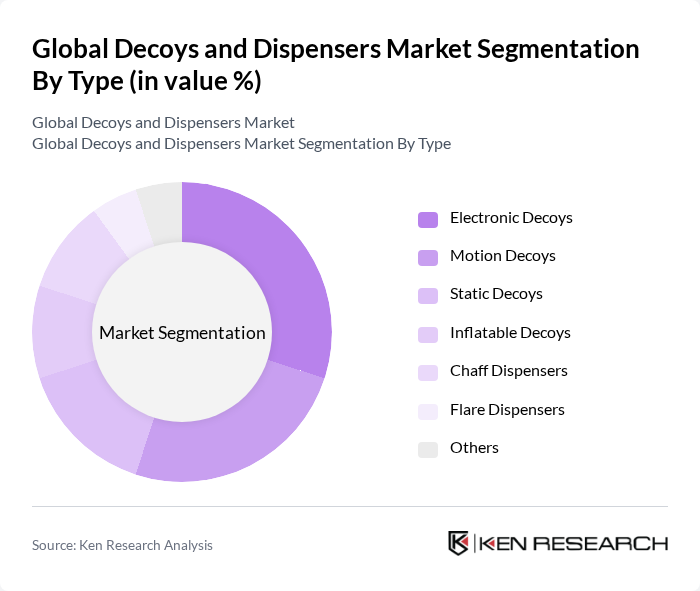
Global Decoys and Dispensers Market segmentation by Type.

By Application:The applications of decoys and dispensers include Hunting, Wildlife Research, Military Aircraft Protection, Naval Defense, Land Vehicle Defense, Pest Control, and Others. The Hunting segment is significant, supported by increased participation in outdoor sports and the demand for technologically advanced hunting tools. Military applications, especially in aircraft and naval defense, are critical as armed forces prioritize survivability and countermeasure effectiveness in modern warfare environments .
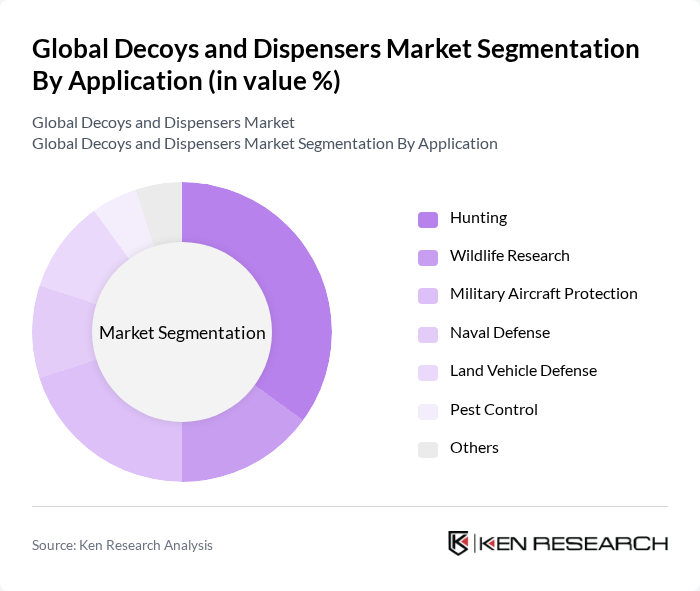
Global Decoys and Dispensers Market segmentation by Application.

Global Decoys and Dispensers Market Competitive Landscape

The Global Decoys and Dispensers Market is characterized by a dynamic mix of regional and international players. Leading participants such as Elbit Systems Ltd., Chemring Group PLC, Rheinmetall AG, Armtec Defense Technologies, BAE Systems plc, LACROIX, Leonardo S.p.A., Saab AB, Raytheon Technologies Corporation, Owen International Pty Ltd, Ordtech, Terma A/S, Bharat Dynamics Limited, Thales Group, Cobham Limited contribute to innovation, geographic expansion, and service delivery in this space.

Elbit Systems Ltd.

1966

Haifa, Israel

Chemring Group PLC

1905

Andover, United Kingdom

Rheinmetall AG

1889

Düsseldorf, Germany

Armtec Defense Technologies

2000

Ontario, Canada

BAE Systems plc

1999

London, United Kingdom

Company

Establishment Year

Headquarters

Group Size (Large, Medium, or Small as per industry convention)

Total Revenue (USD Million)

Revenue Growth Rate (%)

Market Share (%)

Geographic Presence (No. of countries/regions)

R&D Expenditure (% of revenue)

Global Decoys and Dispensers Market Industry Analysis

Growth Drivers

  • Increasing Demand for Wildlife Management:The global wildlife management market is projected to reach USD 1.5 billion in future, driven by the need for effective population control and habitat preservation. This demand is fueled by the increasing human-wildlife conflict, with over 80% of wildlife managers reporting a rise in such incidents. Consequently, the need for decoys and dispensers to manage wildlife populations effectively is becoming critical, supporting the growth of this market segment.
  • Technological Advancements in Decoy Design:Innovations in decoy technology, such as the integration of motion sensors and realistic materials, are enhancing product effectiveness. The global smart hunting equipment market is expected to reach USD 2.3 billion in future, indicating a significant shift towards high-tech solutions. These advancements not only improve hunting success rates but also attract a new generation of hunters, thereby driving demand for advanced decoys and dispensers.
  • Rising Popularity of Hunting and Outdoor Activities:The outdoor recreation industry is projected to generate USD 887 billion in revenue in future, with hunting being a significant contributor. In the United States alone, approximately 15 million people participate in hunting annually, highlighting a robust market for decoys and dispensers. This growing interest in outdoor activities is fostering a favorable environment for the decoys market, as enthusiasts seek effective tools to enhance their experiences.

Market Challenges

  • Environmental Regulations Impacting Production:Stricter environmental regulations are increasingly affecting the production of decoys and dispensers. For instance, the United States Environmental Protection Agency (EPA) has implemented regulations that limit the use of certain materials in manufacturing. Compliance with these regulations can increase production costs by up to 20%, posing a significant challenge for manufacturers aiming to maintain profitability while adhering to environmental standards.
  • Competition from Alternative Wildlife Management Solutions:The rise of alternative wildlife management solutions, such as drones and automated monitoring systems, poses a challenge to traditional decoy and dispenser markets. The global drone market for wildlife management is expected to reach USD 1.2 billion in future, indicating a shift in preference among wildlife managers. This competition necessitates innovation and adaptation from decoy manufacturers to retain market share.

Global Decoys and Dispensers Market Future Outlook

The future of the decoys and dispensers market appears promising, driven by technological innovations and a growing emphasis on sustainable practices. As consumers increasingly prioritize eco-friendly products, manufacturers are likely to invest in developing biodegradable materials and smart technologies. Additionally, the expansion into emerging markets, particularly in Asia and Africa, presents significant growth potential, as these regions experience rising interest in wildlife management and outdoor activities.

Market Opportunities

  • Development of Eco-Friendly Decoy Products:There is a growing market opportunity for manufacturers to create eco-friendly decoys using sustainable materials. With increasing consumer awareness about environmental issues, products that minimize ecological impact can attract a broader customer base, potentially increasing sales by 15% in the next few years.
  • Collaborations with Wildlife Conservation Organizations:Partnering with wildlife conservation organizations can enhance brand reputation and open new distribution channels. Such collaborations can lead to increased funding and support for product development, potentially boosting market presence and sales by leveraging the organizations' established networks and credibility.

Scope of the Report

SegmentSub-Segments
By Type

Electronic Decoys

Motion Decoys

Static Decoys

Inflatable Decoys

Chaff Dispensers

Flare Dispensers

Others

By Application

Hunting

Wildlife Research

Military Aircraft Protection

Naval Defense

Land Vehicle Defense

Pest Control

Others

By Material

Plastic

Fabric

Metal

Foam

Pyrotechnic Compounds

Others

By Distribution Channel

Online Retail

Specialty Stores

Supermarkets

Direct Sales

Defense Contracts

Others

By End-User

Individual Hunters

Government Agencies

Research Institutions

Military (Air Force, Navy, Army)

Defense Contractors

Others

By Price Range

Budget

Mid-Range

Premium

Others

By Region

North America

United States

Canada

Europe

United Kingdom

France

Germany

Russia

Rest of Europe

Asia-Pacific

China

India

Japan

South Korea

Rest of Asia-Pacific

Latin America

Middle East & Africa

Key Target Audience

Investors and Venture Capitalist Firms

Government and Regulatory Bodies (e.g., U.S. Fish and Wildlife Service, European Environment Agency)

Manufacturers and Producers

Distributors and Retailers

Military and Defense Agencies

Wildlife Management Organizations

Environmental Conservation Groups

Insurance Companies and Risk Assessment Firms

Players Mentioned in the Report:

Elbit Systems Ltd.

Chemring Group PLC

Rheinmetall AG

Armtec Defense Technologies

BAE Systems plc

LACROIX

Leonardo S.p.A.

Saab AB

Raytheon Technologies Corporation

Owen International Pty Ltd

Ordtech

Terma A/S

Bharat Dynamics Limited

Thales Group

Cobham Limited

Table of Contents

Market Assessment Phase

1. Executive Summary and Approach


2. Global Decoys and Dispensers Market Overview

2.1 Key Insights and Strategic Recommendations

2.2 Global Decoys and Dispensers Market Overview

2.3 Definition and Scope

2.4 Evolution of Market Ecosystem

2.5 Timeline of Key Regulatory Milestones

2.6 Value Chain & Stakeholder Mapping

2.7 Business Cycle Analysis

2.8 Policy & Incentive Landscape


3. Global Decoys and Dispensers Market Analysis

3.1 Growth Drivers

3.1.1 Increasing demand for wildlife management
3.1.2 Technological advancements in decoy design
3.1.3 Rising popularity of hunting and outdoor activities
3.1.4 Growth in military and defense applications

3.2 Market Challenges

3.2.1 Environmental regulations impacting production
3.2.2 Competition from alternative wildlife management solutions
3.2.3 Fluctuating raw material prices
3.2.4 Seasonal demand variations

3.3 Market Opportunities

3.3.1 Expansion into emerging markets
3.3.2 Development of eco-friendly decoy products
3.3.3 Collaborations with wildlife conservation organizations
3.3.4 Innovations in smart decoy technology

3.4 Market Trends

3.4.1 Increasing use of digital marketing strategies
3.4.2 Growing interest in sustainable hunting practices
3.4.3 Rise of online sales channels
3.4.4 Enhanced focus on product customization

3.5 Government Regulation

3.5.1 Wildlife protection laws
3.5.2 Import/export regulations for hunting equipment
3.5.3 Environmental impact assessments
3.5.4 Licensing requirements for decoy manufacturers

4. SWOT Analysis


5. Stakeholder Analysis


6. Porter's Five Forces Analysis


7. Global Decoys and Dispensers Market Market Size, 2019-2024

7.1 By Value

7.2 By Volume

7.3 By Average Selling Price


8. Global Decoys and Dispensers Market Segmentation

8.1 By Type

8.1.1 Electronic Decoys
8.1.2 Motion Decoys
8.1.3 Static Decoys
8.1.4 Inflatable Decoys
8.1.5 Chaff Dispensers
8.1.6 Flare Dispensers
8.1.7 Others

8.2 By Application

8.2.1 Hunting
8.2.2 Wildlife Research
8.2.3 Military Aircraft Protection
8.2.4 Naval Defense
8.2.5 Land Vehicle Defense
8.2.6 Pest Control
8.2.7 Others

8.3 By Material

8.3.1 Plastic
8.3.2 Fabric
8.3.3 Metal
8.3.4 Foam
8.3.5 Pyrotechnic Compounds
8.3.6 Others

8.4 By Distribution Channel

8.4.1 Online Retail
8.4.2 Specialty Stores
8.4.3 Supermarkets
8.4.4 Direct Sales
8.4.5 Defense Contracts
8.4.6 Others

8.5 By End-User

8.5.1 Individual Hunters
8.5.2 Government Agencies
8.5.3 Research Institutions
8.5.4 Military (Air Force, Navy, Army)
8.5.5 Defense Contractors
8.5.6 Others

8.6 By Price Range

8.6.1 Budget
8.6.2 Mid-Range
8.6.3 Premium
8.6.4 Others

8.7 By Region

8.7.1 North America
8.7.2 United States
8.7.3 Canada
8.7.4 Europe
8.7.5 United Kingdom
8.7.6 France
8.7.7 Germany
8.7.8 Russia
8.7.9 Rest of Europe
8.7.10 Asia-Pacific
8.7.11 China
8.7.12 India
8.7.13 Japan
8.7.14 South Korea
8.7.15 Rest of Asia-Pacific
8.7.16 Latin America
8.7.17 Middle East & Africa

9. Global Decoys and Dispensers Market Competitive Analysis

9.1 Market Share of Key Players

9.2 Cross Comparison of Key Players

9.2.1 Company Name
9.2.2 Group Size (Large, Medium, or Small as per industry convention)
9.2.3 Total Revenue (USD Million)
9.2.4 Revenue Growth Rate (%)
9.2.5 Market Share (%)
9.2.6 Geographic Presence (No. of countries/regions)
9.2.7 R&D Expenditure (% of revenue)
9.2.8 Product Portfolio Breadth (No. of decoy/dispensing products)
9.2.9 Major End-User Segments Served
9.2.10 Key Contracts/Awards (last 3 years)
9.2.11 Supply Chain Integration Level
9.2.12 Technology/Innovation Index
9.2.13 Customer Satisfaction Index

9.3 SWOT Analysis of Top Players

9.4 Pricing Analysis

9.5 Detailed Profile of Major Companies

9.5.1 Elbit Systems Ltd.
9.5.2 Chemring Group PLC
9.5.3 Rheinmetall AG
9.5.4 Armtec Defense Technologies
9.5.5 BAE Systems plc
9.5.6 LACROIX
9.5.7 Leonardo S.p.A.
9.5.8 Saab AB
9.5.9 Raytheon Technologies Corporation
9.5.10 Owen International Pty Ltd
9.5.11 Ordtech
9.5.12 Terma A/S
9.5.13 Bharat Dynamics Limited
9.5.14 Thales Group
9.5.15 Cobham Limited

10. Global Decoys and Dispensers Market End-User Analysis

10.1 Procurement Behavior of Key Ministries

10.1.1 Government procurement processes
10.1.2 Budget allocation for wildlife management
10.1.3 Collaboration with private sector
10.1.4 Evaluation criteria for decoy products

10.2 Corporate Spend on Infrastructure & Energy

10.2.1 Investment in wildlife conservation
10.2.2 Funding for research and development
10.2.3 Expenditure on hunting equipment

10.3 Pain Point Analysis by End-User Category

10.3.1 Challenges faced by individual hunters
10.3.2 Issues for government agencies
10.3.3 Concerns of research institutions

10.4 User Readiness for Adoption

10.4.1 Awareness of decoy technology
10.4.2 Training requirements for effective use
10.4.3 Accessibility of products

10.5 Post-Deployment ROI and Use Case Expansion

10.5.1 Measurement of effectiveness
10.5.2 Feedback mechanisms for improvement
10.5.3 Opportunities for product upgrades

11. Global Decoys and Dispensers Market Future Size, 2025-2030

11.1 By Value

11.2 By Volume

11.3 By Average Selling Price


Go-To-Market Strategy Phase

1. Whitespace Analysis + Business Model Canvas

1.1 Market gaps identification

1.2 Value proposition development

1.3 Revenue model exploration

1.4 Customer segmentation analysis

1.5 Competitive landscape overview

1.6 Key partnerships identification

1.7 Resource allocation strategy


2. Marketing and Positioning Recommendations

2.1 Branding strategies

2.2 Product USPs

2.3 Target audience definition

2.4 Marketing channels selection

2.5 Messaging framework


3. Distribution Plan

3.1 Urban retail strategy

3.2 Rural NGO tie-ups

3.3 E-commerce integration

3.4 Direct sales approach

3.5 Distribution partnerships


4. Channel & Pricing Gaps

4.1 Underserved routes

4.2 Pricing bands analysis

4.3 Competitor pricing comparison

4.4 Customer willingness to pay


5. Unmet Demand & Latent Needs

5.1 Category gaps identification

5.2 Consumer segments analysis

5.3 Product feature requests

5.4 Market entry barriers


6. Customer Relationship

6.1 Loyalty programs design

6.2 After-sales service strategy

6.3 Customer feedback loops

6.4 Community engagement initiatives


7. Value Proposition

7.1 Sustainability initiatives

7.2 Integrated supply chains

7.3 Cost-benefit analysis

7.4 Unique selling points


8. Key Activities

8.1 Regulatory compliance measures

8.2 Branding efforts

8.3 Distribution setup tasks

8.4 Marketing campaign planning


9. Entry Strategy Evaluation

9.1 Domestic Market Entry Strategy

9.1.1 Product mix considerations
9.1.2 Pricing band strategy
9.1.3 Packaging options

9.2 Export Entry Strategy

9.2.1 Target countries selection
9.2.2 Compliance roadmap development

10. Entry Mode Assessment

10.1 Joint Ventures

10.2 Greenfield investments

10.3 Mergers & Acquisitions

10.4 Distributor Model evaluation


11. Capital and Timeline Estimation

11.1 Capital requirements analysis

11.2 Timelines for market entry


12. Control vs Risk Trade-Off

12.1 Ownership considerations

12.2 Partnerships evaluation


13. Profitability Outlook

13.1 Breakeven analysis

13.2 Long-term sustainability strategies


14. Potential Partner List

14.1 Distributors identification

14.2 Joint Ventures opportunities

14.3 Acquisition targets


15. Execution Roadmap

15.1 Phased Plan for Market Entry

15.1.1 Market Setup
15.1.2 Market Entry
15.1.3 Growth Acceleration
15.1.4 Scale & Stabilize

15.2 Key Activities and Milestones

15.2.1 Activity timelines
15.2.2 Milestone tracking

Research Methodology

ApproachModellingSample

Phase 1: Approach1

Desk Research

  • Industry reports from market research firms focusing on decoys and dispensers
  • Analysis of trade publications and journals related to hunting and outdoor activities
  • Government publications on wildlife management and regulations affecting the market

Primary Research

  • Interviews with product managers at leading decoy and dispenser manufacturers
  • Surveys with retailers specializing in hunting and outdoor gear
  • Field interviews with professional hunters and wildlife management experts

Validation & Triangulation

  • Cross-validation of data from multiple sources including sales figures and market trends
  • Triangulation of insights from primary interviews and secondary data sources
  • Sanity checks through expert panels comprising industry veterans and researchers

Phase 2: Market Size Estimation1

Top-down Assessment

  • Market size derived from overall outdoor recreation spending trends
  • Segmentation by product type, including electronic and non-electronic decoys
  • Incorporation of demographic data on hunting participation rates

Bottom-up Modeling

  • Sales volume estimates based on historical data from key manufacturers
  • Cost analysis of production and distribution for various decoy types
  • Volume x price calculations to establish revenue projections

Forecasting & Scenario Analysis

  • Multi-variable regression analysis incorporating factors like hunting regulations and consumer trends
  • Scenario modeling based on environmental changes and technological advancements
  • Baseline, optimistic, and pessimistic forecasts through 2030

Phase 3: CATI Sample Composition1

Scope Item/SegmentSample SizeTarget Respondent Profiles
Retail Sales of Decoys100Store Managers, Product Buyers
Consumer Preferences for Dispensers80Hunting Enthusiasts, Outdoor Gear Reviewers
Market Trends in Electronic Decoys70Product Developers, Technology Specialists
Wildlife Management Practices50Wildlife Biologists, Conservation Officers
Impact of Regulations on Decoy Usage90Policy Makers, Environmental Consultants

Frequently Asked Questions

What is the current value of the Global Decoys and Dispensers Market?

The Global Decoys and Dispensers Market is valued at approximately USD 2.1 billion, driven by increased defense budgets, geopolitical tensions, and advancements in electronic warfare technologies, alongside growing applications in hunting and wildlife research.

Which countries dominate the Global Decoys and Dispensers Market?

What types of decoys and dispensers are available in the market?

What are the primary applications of decoys and dispensers?

Other Regional/Country Reports

Indonesia Global Decoys and Dispensers Market

Malaysia Global Decoys and Dispensers Market

KSA Global Decoys and Dispensers Market

APAC Global Decoys and Dispensers Market

SEA Global Decoys and Dispensers Market

Vietnam Global Decoys and Dispensers Market

Why Buy From Us?

Refine Robust Result (RRR) Framework

What makes us stand out is that our consultants follow Robust, Refine and Result (RRR) methodology. Robust for clear definitions, approaches and sanity checking, Refine for differentiating respondents' facts and opinions, and Result for presenting data with story.

Our Reach Is Unmatched

We have set a benchmark in the industry by offering our clients with syndicated and customized market research reports featuring coverage of entire market as well as meticulous research and analyst insights.

Shifting the Research Paradigm

While we don't replace traditional research, we flip the method upside down. Our dual approach of Top Bottom & Bottom Top ensures quality deliverable by not just verifying company fundamentals but also looking at the sector and macroeconomic factors.

More Insights-Better Decisions

With one step in the future, our research team constantly tries to show you the bigger picture. We help with some of the tough questions you may encounter along the way: How is the industry positioned? Best marketing channel? KPI's of competitors? By aligning every element, we help maximize success.

Transparency and Trust

Our report gives you instant access to the answers and sources that other companies might choose to hide. We elaborate each steps of research methodology we have used and showcase you the sample size to earn your trust.

Round the Clock Support

If you need any support, we are here! We pride ourselves on universe strength, data quality, and quick, friendly, and professional service.

Why Clients Choose Us?

400000+
Reports in repository
150+
Consulting projects a year
100+
Analysts
8000+
Client Queries in 2022








