About the Report
Base Year 2024Listen to the audio summary
Global Dermatology Cro Market Overview
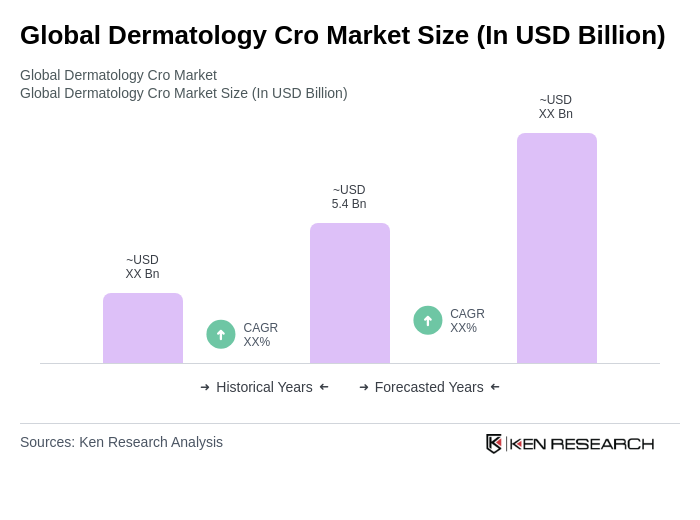
- The Global Dermatology CRO Market is valued at USD 5.4 billion, based on a five-year historical analysis. This value aligns with recent industry reporting that places the market size in the mid–USD 5 billion range and reflects the sustained expansion of dermatology-focused outsourcing driven by trial volume and specialty expertise. The growth is primarily driven by the increasing prevalence of skin disorders (including atopic dermatitis, psoriasis, acne, and skin cancers) and rising demand for dermatological treatments, alongside advances in clinical research operations such as dermatology-specific imaging, digital tools, and decentralized approaches that improve trial efficiency.
- Key players in this market include the United States, Germany, and Japan, which dominate due to robust healthcare and research infrastructures, strong pharmaceutical and biotechnology ecosystems, and a significant burden of skin disease requiring ongoing therapeutic development. North America, in particular, leads dermatology R&D outsourcing due to high trial activity and investment, while Europe (including Germany) and Asia (including Japan) maintain substantial capabilities and sponsor demand.
- In 2023, the U.S. Food and Drug Administration (FDA) advanced guidance emphasizing patient-centric approaches and the use of real-world evidence in submissions, reinforcing broader regulatory trends that affect dermatology trials. FDA finalized and updated multiple guidance documents on patient-focused drug development and real-world evidence during this period, encouraging incorporation of patient-reported outcomes and real-world data to enhance the relevance of clinical evidence packages for dermatologic therapies.
Global Dermatology Cro Market Segmentation
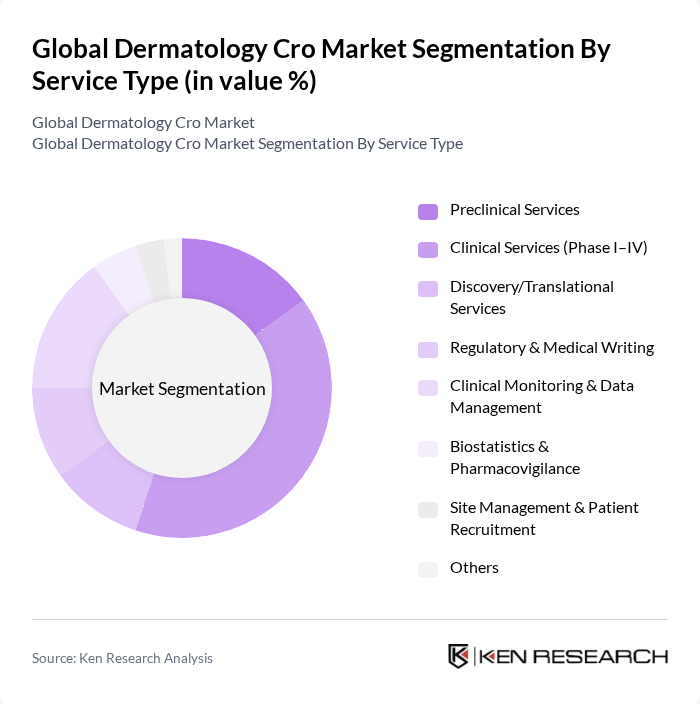
By Service Type:The service type segmentation includes various categories such as preclinical services, clinical services (Phase I–IV), discovery/translational services, regulatory & medical writing, clinical monitoring & data management, biostatistics & pharmacovigilance, site management & patient recruitment, and others. Among these, clinical services (Phase I–IV) dominate the market due to the increasing number and complexity of dermatology trials and the need for specialized oversight, quality, safety, and regulatory compliance in skin-focused studies; recent industry data indicate the clinical segment is the largest component within dermatology CRO services.
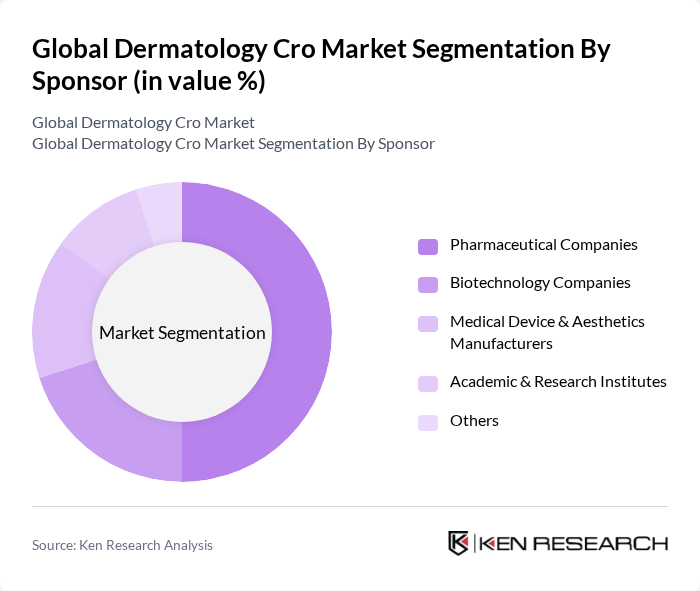
By Sponsor:The sponsor segmentation includes pharmaceutical companies, biotechnology companies, medical device & aesthetics manufacturers, academic & research institutes, and others. Pharmaceutical companies lead this segment, driven by sustained dermatology R&D investment, broad pipelines spanning small molecules, biologics, and topicals, and established global clinical networks that increasingly outsource to specialized CROs. Collaboration between pharma sponsors and CROs continues to expand to accelerate timelines and manage trial complexity.
Global Dermatology Cro Market Competitive Landscape
The Global Dermatology CRO Market is characterized by a dynamic mix of regional and international players. Leading participants such as IQVIA Holdings Inc., Labcorp Drug Development (Laboratory Corporation of America Holdings), PPD, part of Thermo Fisher Scientific Inc., Parexel International Corporation, ICON plc, Syneos Health, Inc., Medpace Holdings, Inc., Charles River Laboratories International, Inc., WuXi AppTec Co., Ltd., Pharmaron Beijing Co., Ltd., Aragen Life Sciences Ltd., CTI Clinical Trial & Consulting Services, Biorasi, LLC, TFS HealthScience, proDERM Institute for Applied Dermatological Research GmbH, bioskin GmbH, Proinnovera GmbH, Javara, Inc., Medidata Solutions, Inc. (a Dassault Systèmes company), CROMSOURCE contribute to innovation, geographic expansion, and service delivery in this space.
Global Dermatology Cro Market Industry Analysis
Growth Drivers
- Increasing Prevalence of Skin Disorders:The World Health Organization reported that skin disorders affect nearly 1 billion people globally, with conditions like acne, eczema, and psoriasis being particularly prevalent. In future, the incidence of skin diseases has risen by 15% over the past five years, driven by factors such as urbanization and environmental changes. This growing patient population is propelling the demand for dermatological services and treatments, thereby stimulating market growth significantly.
- Rising Demand for Dermatological Services:The demand for dermatological services in future has surged, with a reported increase of 25% in consultations over the last two years. This trend is attributed to heightened awareness of skin health and the importance of early diagnosis. Additionally, the increasing number of dermatology clinics, which rose by 15% in the last year, has made these services more accessible, further driving the market's expansion in the region.
- Advancements in Dermatological Research:Investment in dermatological research has reached approximately $1.8 billion in future, reflecting a 12% increase from the previous year. This funding has led to significant breakthroughs in treatment options, including biologics and targeted therapies for chronic skin conditions. The introduction of innovative products and therapies is expected to enhance treatment efficacy, thereby attracting more patients and contributing to market growth in the dermatology sector.
Market Challenges
- High Cost of Dermatological Treatments:The average cost of dermatological treatments in future has increased by 18% over the past three years, making access to care a significant challenge for many patients. This financial barrier often leads to delayed treatment, exacerbating skin conditions and increasing long-term healthcare costs. The high price of advanced therapies, particularly biologics, further complicates the situation, limiting patient access and impacting overall market growth.
- Limited Access to Dermatology Services in Rural Areas:Approximately 35% of the population in future resides in rural areas, where access to dermatology services is severely limited. Many rural regions lack specialized clinics, leading to a disparity in healthcare access. This challenge is compounded by a shortage of dermatology professionals, with only 1 dermatologist available for every 40,000 residents in these areas, hindering timely diagnosis and treatment for skin disorders.
Global Dermatology Cro Market Future Outlook
The future of the dermatology market in future appears promising, driven by technological advancements and a growing focus on preventive care. The integration of artificial intelligence in diagnostics and treatment planning is expected to enhance patient outcomes significantly. Additionally, the increasing popularity of teledermatology is likely to bridge the gap in service accessibility, particularly in underserved areas, fostering a more inclusive healthcare environment and expanding the market's reach.
Market Opportunities
- Expansion of Teledermatology Services:The teledermatology sector in future is projected to grow rapidly, with an estimated increase of 30% in service utilization over the next two years. This growth is driven by the convenience of remote consultations, which can significantly improve access for patients in rural areas, thereby enhancing overall patient engagement and satisfaction.
- Development of Innovative Dermatological Products:The market for innovative dermatological products is set to expand, with investments in research and development projected to reach $600 million in future. This focus on innovation is expected to yield new therapies and products that address unmet medical needs, driving market growth and improving patient outcomes in the dermatology sector.
Scope of the Report
| Segment | Sub-Segments |
|---|---|
| By Service Type | Preclinical Services Clinical Services (Phase I–IV) Discovery/Translational Services Regulatory & Medical Writing Clinical Monitoring & Data Management Biostatistics & Pharmacovigilance Site Management & Patient Recruitment Others |
| By Sponsor | Pharmaceutical Companies Biotechnology Companies Medical Device & Aesthetics Manufacturers Academic & Research Institutes Others |
| By Indication | Acne & Rosacea Psoriasis Atopic Dermatitis & Eczema Skin Cancer (Non-melanoma, Melanoma) Fungal & Infectious Skin Diseases Wound Care & Ulcers Aesthetic/Cosmetic Dermatology Rare & Orphan Dermatological Diseases Others |
| By Trial Phase | Phase I Phase II Phase III Phase IV (Post-Marketing) |
| By Geography | North America Europe Asia-Pacific Latin America Middle East & Africa |
| By Application (Operational) | Laboratory/Imaging Medical Writing Clinical Monitoring Data Management & EDC Patient Recruitment & Retention Others |
| By Client Size | Large Pharma/Biotech Mid-size Pharma/Biotech Emerging Biotech |
Key Target Audience
Investors and Venture Capitalist Firms
Government and Regulatory Bodies (e.g., Food and Drug Administration, European Medicines Agency)
Pharmaceutical Companies
Biotechnology Firms
Contract Research Organizations
Medical Device Manufacturers
Health Insurance Providers
Pharmaceutical Supply Chain Stakeholders
Players Mentioned in the Report:
IQVIA Holdings Inc.
Labcorp Drug Development (Laboratory Corporation of America Holdings)
PPD, part of Thermo Fisher Scientific Inc.
Parexel International Corporation
ICON plc
Syneos Health, Inc.
Medpace Holdings, Inc.
Charles River Laboratories International, Inc.
WuXi AppTec Co., Ltd.
Pharmaron Beijing Co., Ltd.
Aragen Life Sciences Ltd.
CTI Clinical Trial & Consulting Services
Biorasi, LLC
TFS HealthScience
proDERM Institute for Applied Dermatological Research GmbH
bioskin GmbH
Proinnovera GmbH
Javara, Inc.
Medidata Solutions, Inc. (a Dassault Systemes company)
CROMSOURCE
Table of Contents
Market Assessment Phase
1. Executive Summary and Approach
2. Global Dermatology Cro Market Overview
2.1 Key Insights and Strategic Recommendations
2.2 Global Dermatology Cro Market Overview
2.3 Definition and Scope
2.4 Evolution of Market Ecosystem
2.5 Timeline of Key Regulatory Milestones
2.6 Value Chain & Stakeholder Mapping
2.7 Business Cycle Analysis
2.8 Policy & Incentive Landscape
3. Global Dermatology Cro Market Analysis
3.1 Growth Drivers
3.1.1 Increasing prevalence of skin disorders
3.1.2 Rising demand for dermatological services
3.1.3 Advancements in dermatological research
3.1.4 Growing awareness of skin health
3.2 Market Challenges
3.2.1 High cost of dermatological treatments
3.2.2 Limited access to dermatology services in rural areas
3.2.3 Stringent regulatory requirements
3.2.4 Shortage of qualified dermatology professionals
3.3 Market Opportunities
3.3.1 Expansion of teledermatology services
3.3.2 Development of innovative dermatological products
3.3.3 Increasing investment in dermatology research
3.3.4 Collaborations with technology firms for skin health solutions
3.4 Market Trends
3.4.1 Rise in personalized skincare solutions
3.4.2 Growth of minimally invasive dermatological procedures
3.4.3 Increasing use of AI in dermatology
3.4.4 Shift towards preventive dermatology
3.5 Government Regulation
3.5.1 Regulations on dermatological product approvals
3.5.2 Guidelines for teledermatology practices
3.5.3 Standards for dermatology clinics
3.5.4 Policies promoting skin health awareness
4. SWOT Analysis
5. Stakeholder Analysis
6. Porter's Five Forces Analysis
7. Global Dermatology Cro Market Market Size, 2019-2024
7.1 By Value
7.2 By Volume
7.3 By Average Selling Price
8. Global Dermatology Cro Market Segmentation
8.1 By Service Type
8.1.1 Preclinical Services
8.1.2 Clinical Services (Phase I–IV)
8.1.3 Discovery/Translational Services
8.1.4 Regulatory & Medical Writing
8.1.5 Clinical Monitoring & Data Management
8.1.6 Biostatistics & Pharmacovigilance
8.1.7 Site Management & Patient Recruitment
8.1.8 Others
8.2 By Sponsor
8.2.1 Pharmaceutical Companies
8.2.2 Biotechnology Companies
8.2.3 Medical Device & Aesthetics Manufacturers
8.2.4 Academic & Research Institutes
8.2.5 Others
8.3 By Indication
8.3.1 Acne & Rosacea
8.3.2 Psoriasis
8.3.3 Atopic Dermatitis & Eczema
8.3.4 Skin Cancer (Non-melanoma, Melanoma)
8.3.5 Fungal & Infectious Skin Diseases
8.3.6 Wound Care & Ulcers
8.3.7 Aesthetic/Cosmetic Dermatology
8.3.8 Rare & Orphan Dermatological Diseases
8.3.9 Others
8.4 By Trial Phase
8.4.1 Phase I
8.4.2 Phase II
8.4.3 Phase III
8.4.4 Phase IV (Post-Marketing)
8.5 By Geography
8.5.1 North America
8.5.2 Europe
8.5.3 Asia-Pacific
8.5.4 Latin America
8.5.5 Middle East & Africa
8.6 By Application (Operational)
8.6.1 Laboratory/Imaging
8.6.2 Medical Writing
8.6.3 Clinical Monitoring
8.6.4 Data Management & EDC
8.6.5 Patient Recruitment & Retention
8.6.6 Others
8.7 By Client Size
8.7.1 Large Pharma/Biotech
8.7.2 Mid-size Pharma/Biotech
8.7.3 Emerging Biotech
9. Global Dermatology Cro Market Competitive Analysis
9.1 Market Share of Key Players
9.2 Cross Comparison of Key Players
9.2.1 Company Name
9.2.2 Service Breadth (Preclinical, Clinical, Imaging, PV, RWE)
9.2.3 Dermatology Trial Count (Last 3 Years)
9.2.4 Geographic Footprint (Sites/Countries Covered)
9.2.5 Average Dermatology Study Start-up Time (Days)
9.2.6 Patient Recruitment Cycle Time (Screening to Randomization)
9.2.7 Regulatory Submission Lead Time (e.g., IND/CTA Support)
9.2.8 On-time Delivery Rate (% Studies Meeting Milestones)
9.2.9 Data Quality Metrics (Query Rate, eCRF Completion Timeliness)
9.2.10 Repeat Business/Retention from Dermatology Sponsors
9.2.11 Revenue from Dermatology CRO Services
9.2.12 Partnerships/Alliances with Dermatology Sites/Networks
9.3 SWOT Analysis of Top Players
9.4 Pricing Analysis
9.5 Detailed Profile of Major Companies
9.5.1 IQVIA Holdings Inc.
9.5.2 Labcorp Drug Development (Laboratory Corporation of America Holdings)
9.5.3 PPD, part of Thermo Fisher Scientific Inc.
9.5.4 Parexel International Corporation
9.5.5 ICON plc
9.5.6 Syneos Health, Inc.
9.5.7 Medpace Holdings, Inc.
9.5.8 Charles River Laboratories International, Inc.
9.5.9 WuXi AppTec Co., Ltd.
9.5.10 Pharmaron Beijing Co., Ltd.
9.5.11 Aragen Life Sciences Ltd.
9.5.12 CTI Clinical Trial & Consulting Services
9.5.13 Biorasi, LLC
9.5.14 TFS HealthScience
9.5.15 proDERM Institute for Applied Dermatological Research GmbH
9.5.16 bioskin GmbH
9.5.17 Proinnovera GmbH
9.5.18 Javara, Inc.
9.5.19 Medidata Solutions, Inc. (a Dassault Systèmes company)
9.5.20 CROMSOURCE
10. Global Dermatology Cro Market End-User Analysis
10.1 Procurement Behavior of Key Ministries
10.1.1 Budget Allocation for Dermatology
10.1.2 Procurement Processes
10.1.3 Preferred Suppliers
10.2 Corporate Spend on Infrastructure & Energy
10.2.1 Investment in Dermatology Facilities
10.2.2 Spending on Dermatological Equipment
10.2.3 Budget for Research and Development
10.3 Pain Point Analysis by End-User Category
10.3.1 Access to Dermatological Care
10.3.2 Affordability of Treatments
10.3.3 Availability of Qualified Professionals
10.4 User Readiness for Adoption
10.4.1 Awareness of Dermatological Products
10.4.2 Willingness to Pay for Treatments
10.4.3 Acceptance of Teledermatology
10.5 Post-Deployment ROI and Use Case Expansion
10.5.1 Evaluation of Treatment Outcomes
10.5.2 Expansion into New Dermatological Areas
10.5.3 Long-term Patient Engagement Strategies
11. Global Dermatology Cro Market Future Size, 2025-2030
11.1 By Value
11.2 By Volume
11.3 By Average Selling Price
Go-To-Market Strategy Phase
1. Whitespace Analysis + Business Model Canvas
1.1 Identification of Market Gaps
1.2 Business Model Framework
2. Marketing and Positioning Recommendations
2.1 Branding Strategies
2.2 Product USPs
3. Distribution Plan
3.1 Urban Retail Strategies
3.2 Rural NGO Tie-ups
4. Channel & Pricing Gaps
4.1 Underserved Routes
4.2 Pricing Bands
5. Unmet Demand & Latent Needs
5.1 Category Gaps
5.2 Consumer Segments
6. Customer Relationship
6.1 Loyalty Programs
6.2 After-sales Service
7. Value Proposition
7.1 Sustainability Initiatives
7.2 Integrated Supply Chains
8. Key Activities
8.1 Regulatory Compliance
8.2 Branding Efforts
8.3 Distribution Setup
9. Entry Strategy Evaluation
9.1 Domestic Market Entry Strategy
9.1.1 Product Mix
9.1.2 Pricing Band
9.1.3 Packaging Considerations
9.2 Export Entry Strategy
9.2.1 Target Countries
9.2.2 Compliance Roadmap
10. Entry Mode Assessment
10.1 Joint Ventures
10.2 Greenfield Investments
10.3 Mergers & Acquisitions
10.4 Distributor Model
11. Capital and Timeline Estimation
11.1 Capital Requirements
11.2 Timelines for Market Entry
12. Control vs Risk Trade-Off
12.1 Ownership vs Partnerships
13. Profitability Outlook
13.1 Breakeven Analysis
13.2 Long-term Sustainability
14. Potential Partner List
14.1 Distributors
14.2 Joint Ventures
14.3 Acquisition Targets
15. Execution Roadmap
15.1 Phased Plan for Market Entry
15.1.1 Market Setup
15.1.2 Market Entry
15.1.3 Growth Acceleration
15.1.4 Scale & Stabilize
15.2 Key Activities and Milestones
15.2.1 Milestone Planning
15.2.2 Activity Tracking
Research Methodology
Phase 1: Approach1
Desk Research
- Analysis of global dermatology market reports from industry associations and health organizations
- Review of published academic articles and clinical studies on dermatological treatments and innovations
- Examination of regulatory frameworks and guidelines from health authorities such as the FDA and EMA
Primary Research
- Interviews with dermatologists and healthcare professionals specializing in skin disorders
- Surveys conducted with pharmaceutical companies involved in dermatology product development
- Focus groups with patients to understand treatment preferences and experiences
Validation & Triangulation
- Cross-validation of findings through multiple data sources including market reports and expert opinions
- Triangulation of data from clinical studies, market trends, and patient feedback
- Sanity checks through expert panel reviews comprising dermatology specialists and market analysts
Phase 2: Market Size Estimation1
Top-down Assessment
- Estimation of the global dermatology market size based on healthcare expenditure and dermatology-specific spending
- Segmentation of the market by product type, including prescription drugs, over-the-counter products, and medical devices
- Incorporation of demographic trends and prevalence rates of skin conditions globally
Bottom-up Modeling
- Collection of sales data from leading dermatology product manufacturers and distributors
- Estimation of market share based on product volume and pricing strategies
- Analysis of treatment protocols and patient demographics to derive usage rates of dermatological products
Forecasting & Scenario Analysis
- Multi-factor regression analysis incorporating factors such as aging population, rising skin disorders, and healthcare access
- Scenario modeling based on potential market disruptions, including regulatory changes and technological advancements
- Development of baseline, optimistic, and pessimistic forecasts through 2030
Phase 3: CATI Sample Composition1
| Scope Item/Segment | Sample Size | Target Respondent Profiles |
|---|---|---|
| Dermatology Clinics | 140 | Dermatologists, Clinic Managers |
| Pharmaceutical Companies | 90 | Product Managers, R&D Directors |
| Patient Focus Groups | 80 | Patients with chronic skin conditions, Caregivers |
| Healthcare Providers | 120 | General Practitioners, Nurse Practitioners |
| Regulatory Bodies | 40 | Regulatory Affairs Specialists, Policy Makers |
Frequently Asked Questions
What is the current value of the Global Dermatology CRO Market?
The Global Dermatology CRO Market is valued at approximately USD 5.4 billion, reflecting a sustained expansion driven by the increasing prevalence of skin disorders and rising demand for dermatological treatments, alongside advancements in clinical research operations.
What factors are driving the growth of the Dermatology CRO Market?
Which regions dominate the Global Dermatology CRO Market?
What are the main service types offered in the Dermatology CRO Market?
Other Regional/Country Reports
Indonesia Dermatology Cro Market
Malaysia Dermatology Cro Market
APAC Dermatology Cro Market
Why Buy From Us?

What makes us stand out is that our consultants follow Robust, Refine and Result (RRR) methodology. Robust for clear definitions, approaches and sanity checking, Refine for differentiating respondents' facts and opinions, and Result for presenting data with story.

We have set a benchmark in the industry by offering our clients with syndicated and customized market research reports featuring coverage of entire market as well as meticulous research and analyst insights.

While we don't replace traditional research, we flip the method upside down. Our dual approach of Top Bottom & Bottom Top ensures quality deliverable by not just verifying company fundamentals but also looking at the sector and macroeconomic factors.

With one step in the future, our research team constantly tries to show you the bigger picture. We help with some of the tough questions you may encounter along the way: How is the industry positioned? Best marketing channel? KPI's of competitors? By aligning every element, we help maximize success.

Our report gives you instant access to the answers and sources that other companies might choose to hide. We elaborate each steps of research methodology we have used and showcase you the sample size to earn your trust.

If you need any support, we are here! We pride ourselves on universe strength, data quality, and quick, friendly, and professional service.