About the Report
Base Year 2024Listen to the audio summary
Global Digital Art Market Overview
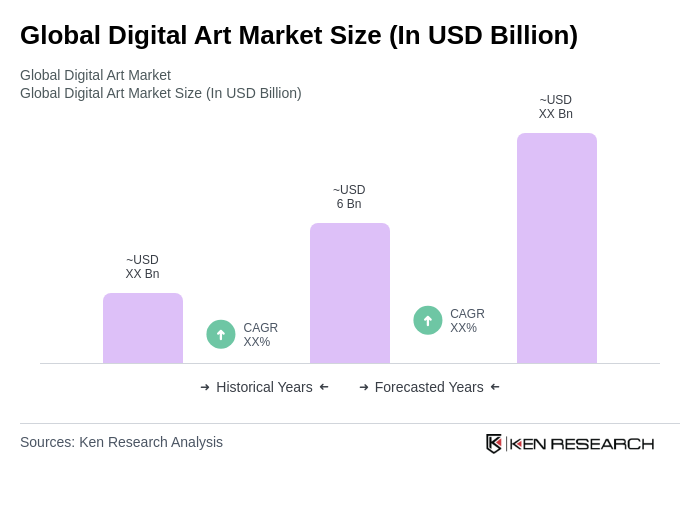
- The Global Digital Art Market is valued at USD 6 billion, based on a five-year historical analysis. This growth is primarily driven by the increasing adoption of digital technologies, the rise of non-fungible tokens (NFTs), the proliferation of online art platforms, and the integration of artificial intelligence (AI) and machine learning tools in creative workflows. The market has seen a surge in interest from both collectors and investors, leading to a vibrant ecosystem of digital artists and platforms .
- Key players in this market are concentrated in major cities such as New York, London, and Tokyo. These cities dominate due to their established art scenes, access to affluent collectors, and a strong presence of technology companies that facilitate digital art transactions. The cultural significance and financial resources available in these urban centers create a conducive environment for the growth of the digital art market .
- In 2023, the U.S. government introduced regulations aimed at enhancing the transparency of NFT transactions. This regulation mandates that platforms facilitating NFT sales must implement Know Your Customer (KYC) protocols to prevent fraud and money laundering. The initiative is designed to protect consumers and ensure the integrity of the digital art market .
Global Digital Art Market Segmentation
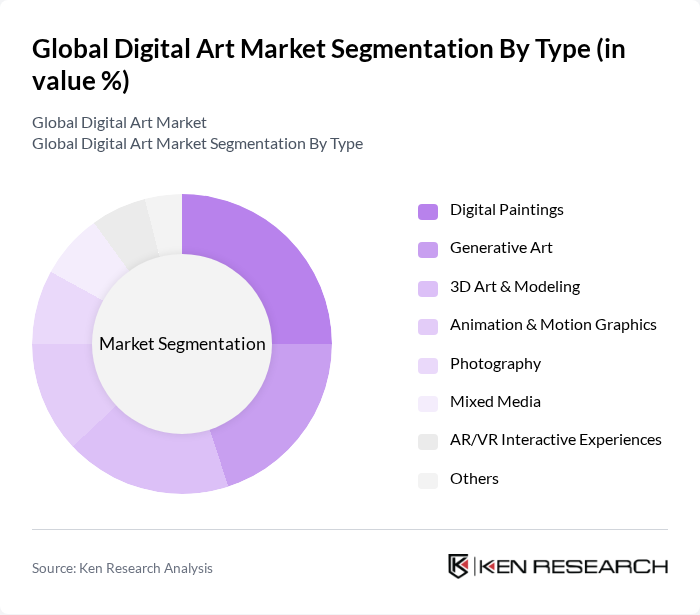
By Type:The digital art market can be segmented into various types, including Digital Paintings, Generative Art, 3D Art & Modeling, Animation & Motion Graphics, Photography, Mixed Media, AR/VR Interactive Experiences, and Others. Among these, Digital Paintings and Generative Art are particularly popular due to their unique appeal and the ability to leverage technology for creative expression. Digital Paintings are widely recognized and collected, while Generative Art is gaining traction for its innovative approach, especially with the adoption of AI-driven creation tools. 3D Art & Modeling and Animation & Motion Graphics are also expanding, supported by advancements in rendering software and immersive media platforms. AR/VR Interactive Experiences are emerging as a niche but rapidly growing segment, driven by increasing use in exhibitions and virtual galleries .
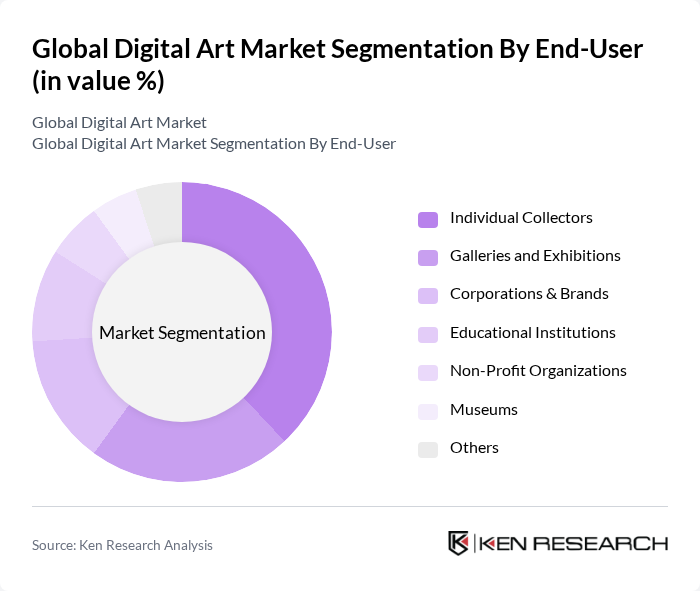
By End-User:The end-users of digital art include Individual Collectors, Galleries and Exhibitions, Corporations & Brands, Educational Institutions, Non-Profit Organizations, Museums, and Others. Individual Collectors remain the largest segment, driven by the growing interest in digital art as a collectible and investment. Corporations and brands are increasingly investing in digital art for marketing, branding, and immersive customer experiences, while galleries and exhibitions are leveraging digital formats for broader audience engagement. Educational Institutions and Museums are adopting digital art for educational purposes and virtual curation, respectively .
Global Digital Art Market Competitive Landscape
The Global Digital Art Market is characterized by a dynamic mix of regional and international players. Leading participants such as SuperRare Labs, Inc., Foundation Labs, Inc., OpenSea, Inc., Rarible, Inc., Nifty Gateway, LLC, Art Blocks, Inc., KnownOrigin, Ltd., Zora, Inc., Async Art, Inc., Mintable, Inc., MakersPlace, Inc., ArtStation, Inc., DeviantArt, Inc., Saatchi Art, Inc., Artsy, Inc., Artron Art Group (China), Sedition Art Ltd., Behance (Adobe Inc.), Pixiv Inc. (Japan), Artfinder Ltd. contribute to innovation, geographic expansion, and service delivery in this space.
Global Digital Art Market Industry Analysis
Growth Drivers
- Increasing Adoption of NFTs:The NFT market has surged, with sales reaching approximately $26 billion in the recent past, and continuing to grow in future. This growth is driven by the increasing number of digital artists and collectors entering the space, with over 3 million active NFT wallets reported in the recent past. The rise of platforms like OpenSea and Rarible has facilitated this trend, allowing artists to monetize their work directly, thus expanding the digital art ecosystem significantly.
- Expansion of Online Art Platforms:The number of online art platforms has increased by approximately 45% in recent years, with over 600 platforms now available for artists and collectors. This expansion has democratized access to art, allowing artists from diverse backgrounds to showcase their work globally. In future, online art sales are projected to exceed $14 billion, driven by the convenience of digital transactions and the growing acceptance of digital art as a legitimate form of investment.
- Growing Interest in Virtual Reality Art:The virtual reality (VR) art market is projected to reach $2 billion in future, fueled by advancements in VR technology and increasing consumer interest. Major art exhibitions are now incorporating VR experiences, attracting a younger audience. In the recent past, over 65% of art institutions reported plans to integrate VR into their exhibitions, highlighting a significant shift towards immersive art experiences that engage viewers in innovative ways.
Market Challenges
- Copyright and Intellectual Property Issues:The digital art market faces significant challenges regarding copyright, with over 75% of artists expressing concerns about unauthorized use of their work. In future, legal disputes related to digital art are expected to increase by approximately 35%, as the lack of clear regulations complicates ownership rights. This uncertainty can deter new artists from entering the market, stifling creativity and innovation in the digital art space.
- Volatility in Cryptocurrency Markets:The digital art market is closely tied to cryptocurrency, which has seen fluctuations of up to 60% in value within short periods. In future, the instability of cryptocurrencies like Bitcoin and Ethereum poses risks for digital art transactions, as many sales are conducted in these currencies. This volatility can lead to unpredictable pricing and may discourage potential buyers from investing in digital art, impacting overall market growth.
Global Digital Art Market Future Outlook
The future of the digital art market appears promising, driven by technological advancements and evolving consumer preferences. As more artists embrace digital mediums, the integration of augmented reality and artificial intelligence in art creation is expected to enhance engagement and accessibility. Additionally, collaborations between digital artists and traditional art institutions are likely to foster greater acceptance of digital art, paving the way for innovative exhibitions and broader market reach in the coming years.
Market Opportunities
- Integration of Augmented Reality in Art:The incorporation of augmented reality (AR) into digital art is gaining traction, with an estimated 30% of digital artists planning to use AR in future. This technology enhances viewer interaction, creating immersive experiences that can attract a wider audience and increase sales potential for artists.
- Development of Art Investment Funds:The establishment of art investment funds is emerging as a significant opportunity, with over $600 million raised in the recent past for funds focused on digital art. These funds provide investors with a structured way to engage with digital art, potentially increasing market liquidity and attracting institutional investors looking for alternative assets.
Scope of the Report
| Segment | Sub-Segments |
|---|---|
| By Type | Digital Paintings Generative Art D Art & Modeling Animation & Motion Graphics Photography Mixed Media AR/VR Interactive Experiences Others |
| By End-User | Individual Collectors Galleries and Exhibitions Corporations & Brands Educational Institutions Non-Profit Organizations Museums Others |
| By Sales Channel | Online Marketplaces (NFT Platforms, Art Platforms) Direct Sales from Artists Auction Houses (Traditional & Digital) Art Fairs & Exhibitions Others |
| By Distribution Mode | Digital Downloads Print on Demand Licensing & Royalties Streaming/Subscription Others |
| By Price Range | Under $100 $100 - $500 $500 - $1,000 Above $1,000 |
| By Art Medium | Digital Illustration D Modeling Video Art AR/VR Art Others |
| By Market Segment | High-End Art (Investment Grade, Blue Chip) Mid-Tier Art Affordable Art Emerging Artists Others |
Key Target Audience
Investors and Venture Capitalist Firms
Government and Regulatory Bodies (e.g., National Endowment for the Arts, Federal Communications Commission)
Art Galleries and Exhibition Spaces
Digital Art Platforms and Marketplaces
Art Collectors and Enthusiasts
Technology Providers and Software Developers
Advertising and Marketing Agencies
Art Auction Houses
Players Mentioned in the Report:
SuperRare Labs, Inc.
Foundation Labs, Inc.
OpenSea, Inc.
Rarible, Inc.
Nifty Gateway, LLC
Art Blocks, Inc.
KnownOrigin, Ltd.
Zora, Inc.
Async Art, Inc.
Mintable, Inc.
MakersPlace, Inc.
ArtStation, Inc.
DeviantArt, Inc.
Saatchi Art, Inc.
Artsy, Inc.
Artron Art Group (China)
Sedition Art Ltd.
Behance (Adobe Inc.)
Pixiv Inc. (Japan)
Artfinder Ltd.
Table of Contents
Market Assessment Phase
1. Executive Summary and Approach
2. Global Digital Art Market Overview
2.1 Key Insights and Strategic Recommendations
2.2 Global Digital Art Market Overview
2.3 Definition and Scope
2.4 Evolution of Market Ecosystem
2.5 Timeline of Key Regulatory Milestones
2.6 Value Chain & Stakeholder Mapping
2.7 Business Cycle Analysis
2.8 Policy & Incentive Landscape
3. Global Digital Art Market Analysis
3.1 Growth Drivers
3.1.1 Increasing Adoption of NFTs
3.1.2 Rise of Digital Collectibles
3.1.3 Expansion of Online Art Platforms
3.1.4 Growing Interest in Virtual Reality Art
3.2 Market Challenges
3.2.1 Copyright and Intellectual Property Issues
3.2.2 Market Saturation and Competition
3.2.3 Volatility in Cryptocurrency Markets
3.2.4 Lack of Standardization in Digital Art Valuation
3.3 Market Opportunities
3.3.1 Integration of Augmented Reality in Art
3.3.2 Collaborations with Traditional Art Institutions
3.3.3 Development of Art Investment Funds
3.3.4 Expansion into Emerging Markets
3.4 Market Trends
3.4.1 Growth of Decentralized Art Platforms
3.4.2 Increasing Use of AI in Art Creation
3.4.3 Shift Towards Eco-Friendly Digital Art
3.4.4 Rise of Community-Driven Art Projects
3.5 Government Regulation
3.5.1 Regulations on Digital Asset Trading
3.5.2 Taxation Policies for Digital Art Sales
3.5.3 Consumer Protection Laws in Digital Transactions
3.5.4 Guidelines for NFT Marketplaces
4. SWOT Analysis
5. Stakeholder Analysis
6. Porter's Five Forces Analysis
7. Global Digital Art Market Market Size, 2019-2024
7.1 By Value
7.2 By Volume
7.3 By Average Selling Price
8. Global Digital Art Market Segmentation
8.1 By Type
8.1.1 Digital Paintings
8.1.2 Generative Art
8.1.3 3D Art & Modeling
8.1.4 Animation & Motion Graphics
8.1.5 Photography
8.1.6 Mixed Media
8.1.7 AR/VR Interactive Experiences
8.1.8 Others
8.2 By End-User
8.2.1 Individual Collectors
8.2.2 Galleries and Exhibitions
8.2.3 Corporations & Brands
8.2.4 Educational Institutions
8.2.5 Non-Profit Organizations
8.2.6 Museums
8.2.7 Others
8.3 By Sales Channel
8.3.1 Online Marketplaces (NFT Platforms, Art Platforms)
8.3.2 Direct Sales from Artists
8.3.3 Auction Houses (Traditional & Digital)
8.3.4 Art Fairs & Exhibitions
8.3.5 Others
8.4 By Distribution Mode
8.4.1 Digital Downloads
8.4.2 Print on Demand
8.4.3 Licensing & Royalties
8.4.4 Streaming/Subscription
8.4.5 Others
8.5 By Price Range
8.5.1 Under $100
8.5.2 $100 - $500
8.5.3 $500 - $1,000
8.5.4 Above $1,000
8.6 By Art Medium
8.6.1 Digital Illustration
8.6.2 3D Modeling
8.6.3 Video Art
8.6.4 AR/VR Art
8.6.5 Others
8.7 By Market Segment
8.7.1 High-End Art (Investment Grade, Blue Chip)
8.7.2 Mid-Tier Art
8.7.3 Affordable Art
8.7.4 Emerging Artists
8.7.5 Others
9. Global Digital Art Market Competitive Analysis
9.1 Market Share of Key Players
9.2 Cross Comparison of Key Players
9.2.1 Company Name
9.2.2 Group Size (Large, Medium, or Small as per industry convention)
9.2.3 Revenue Growth Rate (YoY %)
9.2.4 Gross Merchandise Value (GMV)
9.2.5 Customer Acquisition Cost (CAC)
9.2.6 Average Transaction Value (ATV)
9.2.7 Market Penetration Rate (% of global digital art sales)
9.2.8 Customer Retention Rate (%)
9.2.9 Pricing Strategy (Fixed, Auction, Dynamic, Tiered)
9.2.10 Digital Presence and Engagement (Monthly Active Users, Social Media Followers)
9.2.11 Brand Recognition (Industry Awards, Press Mentions)
9.2.12 Artist Onboarding Rate
9.2.13 International Reach (Number of Countries Served)
9.2.14 NFT Sales Volume (if applicable)
9.2.15 Platform Security & Compliance Metrics
9.3 SWOT Analysis of Top Players
9.4 Pricing Analysis
9.5 Detailed Profile of Major Companies
9.5.1 SuperRare Labs, Inc.
9.5.2 Foundation Labs, Inc.
9.5.3 OpenSea, Inc.
9.5.4 Rarible, Inc.
9.5.5 Nifty Gateway, LLC
9.5.6 Art Blocks, Inc.
9.5.7 KnownOrigin, Ltd.
9.5.8 Zora, Inc.
9.5.9 Async Art, Inc.
9.5.10 Mintable, Inc.
9.5.11 MakersPlace, Inc.
9.5.12 ArtStation, Inc.
9.5.13 DeviantArt, Inc.
9.5.14 Saatchi Art, Inc.
9.5.15 Artsy, Inc.
9.5.16 Artron Art Group (China)
9.5.17 Sedition Art Ltd.
9.5.18 Behance (Adobe Inc.)
9.5.19 Pixiv Inc. (Japan)
9.5.20 Artfinder Ltd.
10. Global Digital Art Market End-User Analysis
10.1 Procurement Behavior of Key Ministries
10.1.1 Government Art Programs
10.1.2 Funding for Digital Art Initiatives
10.1.3 Partnerships with Local Artists
10.2 Corporate Spend on Infrastructure & Energy
10.2.1 Investment in Digital Art Installations
10.2.2 Sponsorship of Art Events
10.2.3 Collaborations with Art Platforms
10.3 Pain Point Analysis by End-User Category
10.3.1 Accessibility of Digital Art
10.3.2 Understanding of Digital Ownership
10.3.3 Quality Assurance in Digital Art
10.4 User Readiness for Adoption
10.4.1 Familiarity with Digital Art Platforms
10.4.2 Willingness to Invest in Digital Art
10.4.3 Education on Digital Art Value
10.5 Post-Deployment ROI and Use Case Expansion
10.5.1 Measuring Success of Digital Art Investments
10.5.2 Expanding Digital Art Collections
10.5.3 Leveraging Digital Art for Marketing
11. Global Digital Art Market Future Size, 2025-2030
11.1 By Value
11.2 By Volume
11.3 By Average Selling Price
Go-To-Market Strategy Phase
1. Whitespace Analysis + Business Model Canvas
1.1 Market Gaps Identification
1.2 Value Proposition Development
1.3 Revenue Streams Analysis
1.4 Cost Structure Evaluation
1.5 Key Partnerships Exploration
1.6 Customer Segmentation
1.7 Channels and Customer Relationships
2. Marketing and Positioning Recommendations
2.1 Branding Strategies
2.2 Product USPs
2.3 Target Audience Identification
2.4 Marketing Channels Selection
2.5 Campaign Planning
3. Distribution Plan
3.1 Urban Retail Strategies
3.2 Rural NGO Tie-Ups
3.3 Online Distribution Channels
3.4 Partnerships with Art Institutions
4. Channel & Pricing Gaps
4.1 Underserved Routes
4.2 Pricing Bands Analysis
4.3 Competitor Pricing Strategies
5. Unmet Demand & Latent Needs
5.1 Category Gaps Identification
5.2 Consumer Segments Analysis
5.3 Emerging Trends Exploration
6. Customer Relationship
6.1 Loyalty Programs Development
6.2 After-Sales Service Strategies
6.3 Customer Feedback Mechanisms
7. Value Proposition
7.1 Sustainability Initiatives
7.2 Integrated Supply Chains
7.3 Unique Selling Points
8. Key Activities
8.1 Regulatory Compliance
8.2 Branding Efforts
8.3 Distribution Setup
9. Entry Strategy Evaluation
9.1 Domestic Market Entry Strategy
9.1.1 Product Mix Considerations
9.1.2 Pricing Band Strategy
9.1.3 Packaging Approaches
9.2 Export Entry Strategy
9.2.1 Target Countries Identification
9.2.2 Compliance Roadmap Development
10. Entry Mode Assessment
10.1 Joint Ventures
10.2 Greenfield Investments
10.3 Mergers & Acquisitions
10.4 Distributor Model Evaluation
11. Capital and Timeline Estimation
11.1 Capital Requirements Analysis
11.2 Timelines for Market Entry
12. Control vs Risk Trade-Off
12.1 Ownership vs Partnerships
13. Profitability Outlook
13.1 Breakeven Analysis
13.2 Long-Term Sustainability Strategies
14. Potential Partner List
14.1 Distributors Identification
14.2 Joint Ventures Opportunities
14.3 Acquisition Targets
15. Execution Roadmap
15.1 Phased Plan for Market Entry
15.1.1 Market Setup
15.1.2 Market Entry
15.1.3 Growth Acceleration
15.1.4 Scale & Stabilize
15.2 Key Activities and Milestones
15.2.1 Milestone Planning
15.2.2 Activity Tracking
Research Methodology
Phase 1: Approach1
Desk Research
- Analysis of market reports from leading digital art platforms and galleries
- Review of academic journals and publications on digital art trends and technologies
- Examination of online sales data from major digital art marketplaces
Primary Research
- Interviews with digital artists to understand their market experiences and challenges
- Surveys targeting art collectors and investors to gauge purchasing behavior
- Focus groups with art curators and gallery owners to discuss market dynamics
Validation & Triangulation
- Cross-validation of findings through multiple data sources, including sales and exhibition data
- Triangulation of insights from artists, collectors, and industry experts
- Sanity checks through expert panel reviews and feedback sessions
Phase 2: Market Size Estimation1
Top-down Assessment
- Estimation of global digital art market size based on overall art market growth trends
- Segmentation by digital art forms, including NFTs, digital prints, and virtual reality art
- Incorporation of emerging markets and their impact on global digital art sales
Bottom-up Modeling
- Analysis of sales data from leading digital art platforms to establish baseline figures
- Estimation of average transaction values and frequency of purchases in the digital art space
- Aggregation of data from independent artists and small galleries to capture niche segments
Forecasting & Scenario Analysis
- Multi-factor regression analysis incorporating technology adoption rates and consumer trends
- Scenario modeling based on regulatory changes affecting digital art ownership and sales
- Development of baseline, optimistic, and pessimistic forecasts through 2030
Phase 3: CATI Sample Composition1
| Scope Item/Segment | Sample Size | Target Respondent Profiles |
|---|---|---|
| Digital Art Collectors | 100 | Art Investors, Private Collectors |
| Digital Artists | 90 | Freelance Artists, Studio Owners |
| Art Gallery Owners | 60 | Gallery Directors, Curators |
| NFT Marketplace Participants | 50 | Crypto Investors, Digital Art Enthusiasts |
| Art Technology Developers | 40 | Software Developers, Tech Entrepreneurs |
Frequently Asked Questions
What is the current value of the Global Digital Art Market?
The Global Digital Art Market is valued at approximately USD 6 billion, driven by the increasing adoption of digital technologies, the rise of non-fungible tokens (NFTs), and the proliferation of online art platforms.
What factors are driving the growth of the digital art market?
How are NFTs impacting the digital art market?
What are the main types of digital art?
Other Regional/Country Reports
Indonesia Digital Art Market
Malaysia Digital Art Market
APAC Digital Art Market
SEA Digital Art Market
Why Buy From Us?

What makes us stand out is that our consultants follow Robust, Refine and Result (RRR) methodology. Robust for clear definitions, approaches and sanity checking, Refine for differentiating respondents' facts and opinions, and Result for presenting data with story.

We have set a benchmark in the industry by offering our clients with syndicated and customized market research reports featuring coverage of entire market as well as meticulous research and analyst insights.

While we don't replace traditional research, we flip the method upside down. Our dual approach of Top Bottom & Bottom Top ensures quality deliverable by not just verifying company fundamentals but also looking at the sector and macroeconomic factors.

With one step in the future, our research team constantly tries to show you the bigger picture. We help with some of the tough questions you may encounter along the way: How is the industry positioned? Best marketing channel? KPI's of competitors? By aligning every element, we help maximize success.

Our report gives you instant access to the answers and sources that other companies might choose to hide. We elaborate each steps of research methodology we have used and showcase you the sample size to earn your trust.

If you need any support, we are here! We pride ourselves on universe strength, data quality, and quick, friendly, and professional service.