Global Digital Glass Military Aircraft Cockpit Systems Market

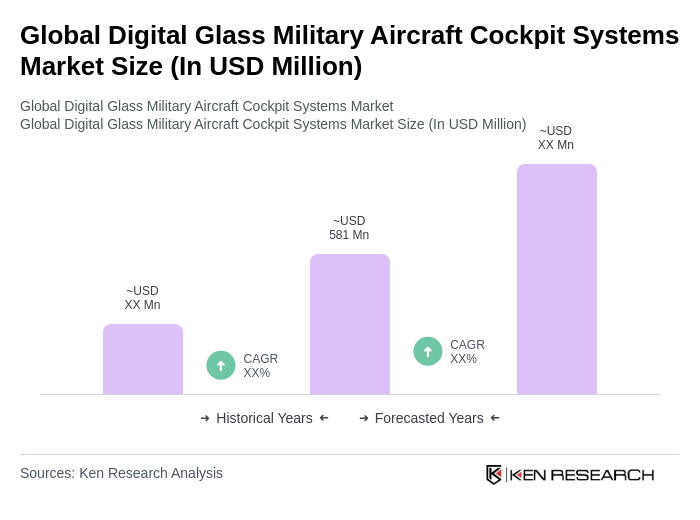
The Global Digital Glass Military Aircraft Cockpit Systems Market, valued at USD 581 million, is driven by demand for enhanced situational awareness and avionics tech, with key growth in North America and Asia Pacific.

Region:Global

Author(s):Rebecca

Product Code:KRAA1352

Pages:94

Published On:August 2025
About the Report

Base Year 2024

Global Digital Glass Military Aircraft Cockpit Systems Market Overview

  • The Global Digital Glass Military Aircraft Cockpit Systems Market is valued at USD 581 million, based on a five-year historical analysis. This growth is primarily driven by advancements in avionics technology, increasing demand for enhanced situational awareness, and the integration of digital systems in military aircraft. The shift towards modernized cockpit systems is also influenced by the need for improved safety and operational efficiency in military operations. Modern glass cockpit systems utilize large LCD panels, integrating primary flight displays, multifunction displays, and engine indication systems to provide pilots with comprehensive, real-time data and improved workflow efficiency .
  • Key players in this market include the United States, China, and several European nations. The dominance of these countries is attributed to their significant defense budgets, ongoing military modernization programs, and a strong focus on research and development in advanced cockpit technologies. North America and Europe maintain leading positions due to established aerospace industries and continuous investment in technological innovation, while Asia Pacific is rapidly emerging with increased defense spending and fleet modernization .
  • In recent years, regulatory initiatives and procurement programs in the United States have accelerated the adoption of advanced cockpit systems in military aircraft. These measures aim to enhance operational capabilities and ensure compliance with modern warfare requirements, thereby driving the demand for digital glass cockpit systems across various military branches. While no specific 2023 regulation is confirmed, ongoing modernization mandates and procurement priorities continue to push digital glass cockpit integration .
Global Digital Glass Military Aircraft Cockpit Systems Market Size

Global Digital Glass Military Aircraft Cockpit Systems Market Segmentation

By Type:The market is segmented into various types of cockpit systems, including Integrated Cockpit Systems, Standalone Display Units, Sensor Fusion Systems, Flight Management Systems, Head-Up Displays (HUDs), Helmet-Mounted Displays (HMDs), and Others. Among these,Integrated Cockpit Systemsare leading the market due to their comprehensive functionality, which combines multiple systems into a single interface, enhancing pilot efficiency and situational awareness. The trend towards integrated solutions is driven by the need for streamlined operations and reduced pilot workload, making them the preferred choice for modern military aircraft. These systems typically feature large LCD panels, digital flight instruments, and advanced sensor integration for improved mission capability .

Global Digital Glass Military Aircraft Cockpit Systems Market segmentation by Type.

By End-User:The end-user segmentation includes Air Force, Army Aviation, Naval Aviation, Special Operations Forces, Defense Contractors, and Others. TheAir Forcesegment dominates the market, driven by the increasing procurement of advanced fighter jets and the modernization of existing fleets. The focus on enhancing aerial combat capabilities and the integration of cutting-edge technologies in air operations are key factors contributing to the Air Force's leading position in the market. Modernization programs and new aircraft acquisitions are particularly strong in North America, Europe, and Asia Pacific .

Global Digital Glass Military Aircraft Cockpit Systems Market segmentation by End-User.

Global Digital Glass Military Aircraft Cockpit Systems Market Competitive Landscape

The Global Digital Glass Military Aircraft Cockpit Systems Market is characterized by a dynamic mix of regional and international players. Leading participants such as Honeywell International Inc., Thales Group, Collins Aerospace (Raytheon Technologies), BAE Systems plc, Northrop Grumman Corporation, Elbit Systems Ltd., L3Harris Technologies, Inc., General Dynamics Mission Systems, Safran Electronics & Defense, Leonardo S.p.A., Mitsubishi Electric Corporation, Saab AB, Textron Inc., Rheinmetall AG, Kongsberg Gruppen ASA contribute to innovation, geographic expansion, and service delivery in this space.

Honeywell International Inc.

1906

Charlotte, North Carolina, USA

Thales Group

2000

La Défense, France

Collins Aerospace (Raytheon Technologies)

2018

Charlotte, North Carolina, USA

BAE Systems plc

1999

London, United Kingdom

Northrop Grumman Corporation

1939

Falls Church, Virginia, USA

Company

Establishment Year

Headquarters

Group Size (Large, Medium, or Small as per industry convention)

Total Revenue (USD, Military Avionics Segment)

Revenue Growth Rate (3-Year CAGR, Military Cockpit Systems)

Market Share in Digital Glass Cockpit Systems (%)

Number of Military Aircraft Platforms Supported

R&D Investment as % of Revenue

Global Digital Glass Military Aircraft Cockpit Systems Market Industry Analysis

Growth Drivers

  • Increasing Demand for Advanced Avionics:The global military avionics market is projected to reach $12.5 billion in future, driven by the need for enhanced operational capabilities. Countries like the U.S. and China are investing heavily in modernizing their fleets, with the U.S. Department of Defense allocating approximately $800 billion for military expenditures in future. This trend underscores the growing demand for sophisticated cockpit systems that integrate advanced technologies, improving mission effectiveness and pilot performance.
  • Rising Military Budgets Globally:Military budgets worldwide are expected to exceed $2.2 trillion in future, reflecting a 3% increase from previous years. Nations are prioritizing defense spending to address geopolitical tensions and enhance national security. For instance, NATO members are committing to spend at least 2% of their GDP on defense, which translates to increased investments in modern cockpit systems, thereby driving market growth in the digital glass cockpit segment.
  • Technological Advancements in Cockpit Systems:The integration of cutting-edge technologies such as augmented reality (AR) and artificial intelligence (AI) is revolutionizing military cockpit systems. In future, the global AR market in aviation is projected to reach $1.5 billion, indicating a significant shift towards immersive technologies. These advancements enhance situational awareness and decision-making capabilities for pilots, making modern cockpit systems more attractive to military forces worldwide.

Market Challenges

  • High Initial Investment Costs:The upfront costs associated with upgrading to digital glass cockpit systems can be substantial, often exceeding $1.2 million per aircraft. This financial barrier poses a significant challenge for many military organizations, particularly in developing nations where defense budgets are constrained. The need for cost-effective solutions is critical to ensure that modernization efforts do not compromise overall military readiness.
  • Integration Complexities with Legacy Systems:Many military aircraft still rely on outdated avionics, making integration with new digital systems complex and time-consuming. For example, approximately 60% of military aircraft in service today are over 30 years old, complicating modernization efforts. This challenge necessitates extensive retrofitting and testing, which can delay deployment and increase costs, hindering the overall market growth for advanced cockpit systems.

Global Digital Glass Military Aircraft Cockpit Systems Market Future Outlook

The future of digital glass military aircraft cockpit systems is poised for significant transformation, driven by rapid technological advancements and increasing defense budgets. As military forces prioritize modernization, the adoption of AI and AR technologies will enhance pilot training and operational efficiency. Furthermore, the shift towards modular cockpit systems will facilitate easier upgrades and integration, allowing for more flexible and cost-effective solutions. This evolution will likely attract new players and foster innovation within the industry, ensuring sustained growth in the coming years.

Market Opportunities

  • Growth in Unmanned Aerial Vehicle (UAV) Applications:The UAV market is expected to reach $30 billion in future, presenting significant opportunities for cockpit system manufacturers. As military forces increasingly deploy UAVs for reconnaissance and combat missions, the demand for advanced cockpit systems tailored for these platforms will rise, driving innovation and investment in this segment.
  • Expansion in Emerging Markets:Emerging markets, particularly in Asia-Pacific and Latin America, are ramping up their defense capabilities, with military spending projected to grow by 5% annually. This trend opens avenues for cockpit system providers to enter new markets, offering tailored solutions that meet the specific needs of these regions, thereby enhancing their global footprint and revenue potential.

Scope of the Report

SegmentSub-Segments
By Type

Integrated Cockpit Systems

Standalone Display Units

Sensor Fusion Systems

Flight Management Systems

Head-Up Displays (HUDs)

Helmet-Mounted Displays (HMDs)

Others

By End-User

Air Force

Army Aviation

Naval Aviation

Special Operations Forces

Defense Contractors

Others

By Component

Primary Flight Displays (PFDs)

Multifunction Displays (MFDs)

Engine Indication and Crew Alerting Systems (EICAS)

Control Panels & Input Devices

Communication Systems

Navigation Systems

Mission Computers

Others

By Application

Fighter Aircraft

Transport Aircraft

Helicopters

UAVs

Trainer Aircraft

Others

By Sales Channel

Direct Sales

System Integrators

Distributors

Others

By Distribution Mode

Domestic Distribution

International Distribution

Direct Shipping

Others

By Price Range

Premium

Mid-Range

Budget

Others

Key Target Audience

Investors and Venture Capitalist Firms

Government and Regulatory Bodies (e.g., Federal Aviation Administration, Department of Defense)

Military Procurement Agencies

Defense Contractors

Aerospace and Defense Manufacturers

Technology Providers and Software Developers

Industry Associations (e.g., Aerospace Industries Association)

Financial Institutions and Investment Banks

Players Mentioned in the Report:

Honeywell International Inc.

Thales Group

Collins Aerospace (Raytheon Technologies)

BAE Systems plc

Northrop Grumman Corporation

Elbit Systems Ltd.

L3Harris Technologies, Inc.

General Dynamics Mission Systems

Safran Electronics & Defense

Leonardo S.p.A.

Mitsubishi Electric Corporation

Saab AB

Textron Inc.

Rheinmetall AG

Kongsberg Gruppen ASA

Table of Contents

Market Assessment Phase

1. Executive Summary and Approach


2. Global Digital Glass Military Aircraft Cockpit Systems Market Overview

2.1 Key Insights and Strategic Recommendations

2.2 Global Digital Glass Military Aircraft Cockpit Systems Market Overview

2.3 Definition and Scope

2.4 Evolution of Market Ecosystem

2.5 Timeline of Key Regulatory Milestones

2.6 Value Chain & Stakeholder Mapping

2.7 Business Cycle Analysis

2.8 Policy & Incentive Landscape


3. Global Digital Glass Military Aircraft Cockpit Systems Market Analysis

3.1 Growth Drivers

3.1.1 Increasing demand for advanced avionics
3.1.2 Rising military budgets globally
3.1.3 Technological advancements in cockpit systems
3.1.4 Enhanced focus on pilot safety and situational awareness

3.2 Market Challenges

3.2.1 High initial investment costs
3.2.2 Integration complexities with legacy systems
3.2.3 Regulatory compliance hurdles
3.2.4 Limited availability of skilled personnel

3.3 Market Opportunities

3.3.1 Growth in unmanned aerial vehicle (UAV) applications
3.3.2 Expansion in emerging markets
3.3.3 Development of modular cockpit systems
3.3.4 Partnerships with technology firms for innovation

3.4 Market Trends

3.4.1 Shift towards digitalization in military aviation
3.4.2 Increasing use of artificial intelligence in cockpit systems
3.4.3 Adoption of open architecture systems
3.4.4 Focus on sustainability and energy efficiency

3.5 Government Regulation

3.5.1 Compliance with international aviation standards
3.5.2 National security regulations impacting procurement
3.5.3 Export control laws for military technologies
3.5.4 Environmental regulations affecting manufacturing processes

4. SWOT Analysis


5. Stakeholder Analysis


6. Porter's Five Forces Analysis


7. Global Digital Glass Military Aircraft Cockpit Systems Market Market Size, 2019-2024

7.1 By Value

7.2 By Volume

7.3 By Average Selling Price


8. Global Digital Glass Military Aircraft Cockpit Systems Market Segmentation

8.1 By Type

8.1.1 Integrated Cockpit Systems
8.1.2 Standalone Display Units
8.1.3 Sensor Fusion Systems
8.1.4 Flight Management Systems
8.1.5 Head-Up Displays (HUDs)
8.1.6 Helmet-Mounted Displays (HMDs)
8.1.7 Others

8.2 By End-User

8.2.1 Air Force
8.2.2 Army Aviation
8.2.3 Naval Aviation
8.2.4 Special Operations Forces
8.2.5 Defense Contractors
8.2.6 Others

8.3 By Component

8.3.1 Primary Flight Displays (PFDs)
8.3.2 Multifunction Displays (MFDs)
8.3.3 Engine Indication and Crew Alerting Systems (EICAS)
8.3.4 Control Panels & Input Devices
8.3.5 Communication Systems
8.3.6 Navigation Systems
8.3.7 Mission Computers
8.3.8 Others

8.4 By Application

8.4.1 Fighter Aircraft
8.4.2 Transport Aircraft
8.4.3 Helicopters
8.4.4 UAVs
8.4.5 Trainer Aircraft
8.4.6 Others

8.5 By Sales Channel

8.5.1 Direct Sales
8.5.2 System Integrators
8.5.3 Distributors
8.5.4 Others

8.6 By Distribution Mode

8.6.1 Domestic Distribution
8.6.2 International Distribution
8.6.3 Direct Shipping
8.6.4 Others

8.7 By Price Range

8.7.1 Premium
8.7.2 Mid-Range
8.7.3 Budget
8.7.4 Others

9. Global Digital Glass Military Aircraft Cockpit Systems Market Competitive Analysis

9.1 Market Share of Key Players

9.2 Cross Comparison of Key Players

9.2.1 Company Name
9.2.2 Group Size (Large, Medium, or Small as per industry convention)
9.2.3 Total Revenue (USD, Military Avionics Segment)
9.2.4 Revenue Growth Rate (3-Year CAGR, Military Cockpit Systems)
9.2.5 Market Share in Digital Glass Cockpit Systems (%)
9.2.6 Number of Military Aircraft Platforms Supported
9.2.7 R&D Investment as % of Revenue
9.2.8 Product Certification/Compliance (e.g., MIL-STD, DO-178C)
9.2.9 Average Product Lifecycle (Years)
9.2.10 Number of Patents/Proprietary Technologies
9.2.11 Major Defense Contracts Won (Last 5 Years)
9.2.12 Customer Base (Number of Countries/Forces)
9.2.13 Aftermarket Support Capability
9.2.14 Cybersecurity Features/Certifications
9.2.15 Sustainability Initiatives (e.g., energy efficiency, recyclability)

9.3 SWOT Analysis of Top Players

9.4 Pricing Analysis

9.5 Detailed Profile of Major Companies

9.5.1 Honeywell International Inc.
9.5.2 Thales Group
9.5.3 Collins Aerospace (Raytheon Technologies)
9.5.4 BAE Systems plc
9.5.5 Northrop Grumman Corporation
9.5.6 Elbit Systems Ltd.
9.5.7 L3Harris Technologies, Inc.
9.5.8 General Dynamics Mission Systems
9.5.9 Safran Electronics & Defense
9.5.10 Leonardo S.p.A.
9.5.11 Mitsubishi Electric Corporation
9.5.12 Saab AB
9.5.13 Textron Inc.
9.5.14 Rheinmetall AG
9.5.15 Kongsberg Gruppen ASA

10. Global Digital Glass Military Aircraft Cockpit Systems Market End-User Analysis

10.1 Procurement Behavior of Key Ministries

10.1.1 Defense Ministries
10.1.2 Aviation Authorities
10.1.3 Research and Development Agencies

10.2 Corporate Spend on Infrastructure & Energy

10.2.1 Investment in Modernization
10.2.2 Budget Allocation for R&D
10.2.3 Expenditure on Training Programs

10.3 Pain Point Analysis by End-User Category

10.3.1 Budget Constraints
10.3.2 Integration Issues
10.3.3 Maintenance Challenges

10.4 User Readiness for Adoption

10.4.1 Training Needs
10.4.2 Technology Familiarity
10.4.3 Support Infrastructure

10.5 Post-Deployment ROI and Use Case Expansion

10.5.1 Performance Metrics
10.5.2 User Feedback Mechanisms
10.5.3 Future Upgrade Paths

11. Global Digital Glass Military Aircraft Cockpit Systems Market Future Size, 2025-2030

11.1 By Value

11.2 By Volume

11.3 By Average Selling Price


Go-To-Market Strategy Phase

1. Whitespace Analysis + Business Model Canvas

1.1 Market Gaps Identification

1.2 Business Model Framework


2. Marketing and Positioning Recommendations

2.1 Branding Strategies

2.2 Product USPs


3. Distribution Plan

3.1 Urban Retail Strategies

3.2 Rural NGO Tie-ups


4. Channel & Pricing Gaps

4.1 Underserved Routes

4.2 Pricing Bands


5. Unmet Demand & Latent Needs

5.1 Category Gaps

5.2 Consumer Segments


6. Customer Relationship

6.1 Loyalty Programs

6.2 After-sales Service


7. Value Proposition

7.1 Sustainability Initiatives

7.2 Integrated Supply Chains


8. Key Activities

8.1 Regulatory Compliance

8.2 Branding Efforts

8.3 Distribution Setup


9. Entry Strategy Evaluation

9.1 Domestic Market Entry Strategy

9.1.1 Product Mix
9.1.2 Pricing Band
9.1.3 Packaging Strategies

9.2 Export Entry Strategy

9.2.1 Target Countries
9.2.2 Compliance Roadmap

10. Entry Mode Assessment

10.1 Joint Ventures

10.2 Greenfield Investments

10.3 Mergers & Acquisitions

10.4 Distributor Model


11. Capital and Timeline Estimation

11.1 Capital Requirements

11.2 Timelines for Implementation


12. Control vs Risk Trade-Off

12.1 Ownership vs Partnerships


13. Profitability Outlook

13.1 Breakeven Analysis

13.2 Long-term Sustainability


14. Potential Partner List

14.1 Distributors

14.2 Joint Ventures

14.3 Acquisition Targets


15. Execution Roadmap

15.1 Phased Plan for Market Entry

15.1.1 Market Setup
15.1.2 Market Entry
15.1.3 Growth Acceleration
15.1.4 Scale & Stabilize

15.2 Key Activities and Milestones

15.2.1 Activity Timeline
15.2.2 Milestone Tracking

Research Methodology

ApproachModellingSample

Phase 1: Approach1

Desk Research

  • Analysis of industry reports from defense and aerospace organizations
  • Review of government publications on military procurement and technology trends
  • Examination of academic journals focusing on cockpit systems and avionics innovations

Primary Research

  • Interviews with military procurement officers and defense contractors
  • Surveys with avionics engineers and cockpit system designers
  • Field interviews with pilots and operational personnel using digital cockpit systems

Validation & Triangulation

  • Cross-validation of findings through multiple expert interviews
  • Triangulation of data from industry reports, expert opinions, and market trends
  • Sanity checks through feedback from a panel of industry veterans

Phase 2: Market Size Estimation1

Top-down Assessment

  • Estimation of market size based on global defense budgets and spending on avionics
  • Segmentation by military aircraft types and their respective cockpit system requirements
  • Incorporation of trends in digital transformation within military aviation

Bottom-up Modeling

  • Volume estimates derived from production rates of military aircraft
  • Cost analysis based on component pricing and integration expenses
  • Assessment of aftermarket services and upgrades for existing cockpit systems

Forecasting & Scenario Analysis

  • Multi-variable forecasting using defense spending trends and technological advancements
  • Scenario analysis based on geopolitical factors and military modernization initiatives
  • Baseline, optimistic, and pessimistic projections through 2035

Phase 3: CATI Sample Composition1

Scope Item/SegmentSample SizeTarget Respondent Profiles
Military Aircraft Procurement60Procurement Officers, Defense Analysts
Avionics System Development50Avionics Engineers, Product Managers
Pilot Feedback on Cockpit Systems40Active Pilots, Flight Instructors
Military Aviation Technology Trends45Defense Technology Researchers, Policy Makers
Aftermarket Services for Cockpit Systems40Service Managers, Maintenance Engineers

Frequently Asked Questions

What is the current value of the Global Digital Glass Military Aircraft Cockpit Systems Market?

The Global Digital Glass Military Aircraft Cockpit Systems Market is valued at approximately USD 581 million, reflecting significant growth driven by advancements in avionics technology and the increasing demand for enhanced situational awareness in military operations.

What factors are driving the growth of the digital glass cockpit systems market?

Which countries are leading in the digital glass military aircraft cockpit systems market?

What are the main types of digital glass cockpit systems available?

Other Regional/Country Reports

Indonesia Global Digital Glass Military Aircraft Cockpit Systems Market

Malaysia Global Digital Glass Military Aircraft Cockpit Systems Market

KSA Global Digital Glass Military Aircraft Cockpit Systems Market

APAC Global Digital Glass Military Aircraft Cockpit Systems Market

SEA Global Digital Glass Military Aircraft Cockpit Systems Market

Vietnam Global Digital Glass Military Aircraft Cockpit Systems Market

Why Buy From Us?

Refine Robust Result (RRR) Framework

What makes us stand out is that our consultants follow Robust, Refine and Result (RRR) methodology. Robust for clear definitions, approaches and sanity checking, Refine for differentiating respondents' facts and opinions, and Result for presenting data with story.

Our Reach Is Unmatched

We have set a benchmark in the industry by offering our clients with syndicated and customized market research reports featuring coverage of entire market as well as meticulous research and analyst insights.

Shifting the Research Paradigm

While we don't replace traditional research, we flip the method upside down. Our dual approach of Top Bottom & Bottom Top ensures quality deliverable by not just verifying company fundamentals but also looking at the sector and macroeconomic factors.

More Insights-Better Decisions

With one step in the future, our research team constantly tries to show you the bigger picture. We help with some of the tough questions you may encounter along the way: How is the industry positioned? Best marketing channel? KPI's of competitors? By aligning every element, we help maximize success.

Transparency and Trust

Our report gives you instant access to the answers and sources that other companies might choose to hide. We elaborate each steps of research methodology we have used and showcase you the sample size to earn your trust.

Round the Clock Support

If you need any support, we are here! We pride ourselves on universe strength, data quality, and quick, friendly, and professional service.

Why Clients Choose Us?

400000+
Reports in repository
150+
Consulting projects a year
100+
Analysts
8000+
Client Queries in 2022








