About the Report
Base Year 2024Listen to the audio summary
Global Digital Music Market Overview
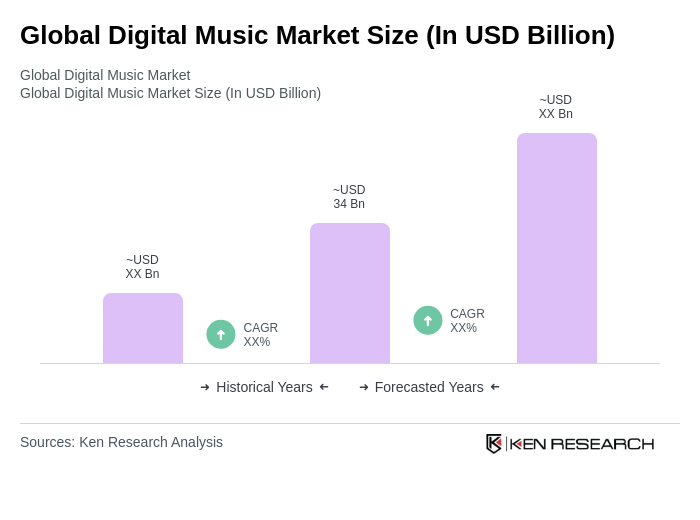
- The Global Digital Music Market is valued at USD 34 billion, based on a five-year historical analysis, reflecting the scale of paid streaming, downloads, and related digital music revenues reported by leading industry trackers . This growth is primarily driven by the increasing adoption of streaming services, the proliferation of smartphones, and the rise of social platforms that facilitate music discovery and sharing . The shift from physical sales to digital formats has also significantly contributed to the market’s expansion .
- Key players in this market include the United States, the United Kingdom, Germany, and Japan, alongside major regional markets such as China. These countries lead due to advanced connectivity, high internet penetration, and strong music consumption cultures, reinforced by the presence of global labels and large streaming platforms .
- In 2023, the European Union implemented the Digital Services Act, a horizontal regulation for online platforms (including very large online platforms) that mandates transparency in content moderation, advertising, and user data handling, with enforcement beginning that year and obligations applying broadly from 2024 . These rules affect music platforms operating in the EU by setting due diligence and transparency requirements intended to ensure fairer and safer platform operations .
Global Digital Music Market Segmentation
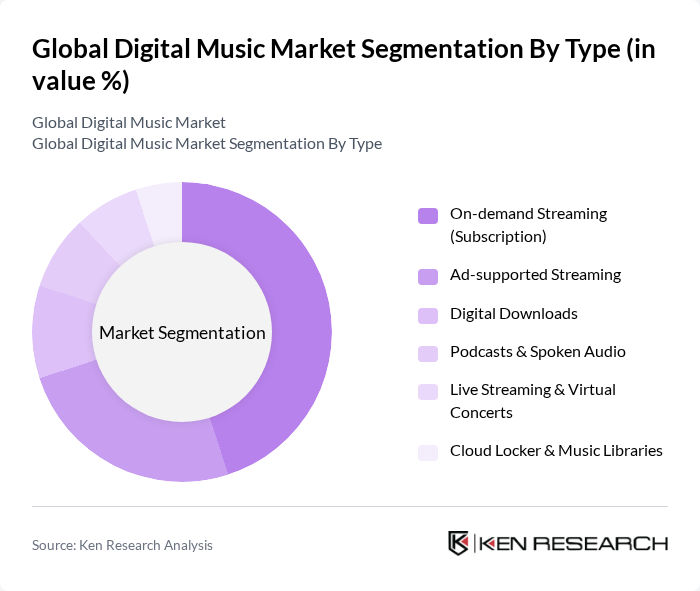
By Type:The digital music market is segmented into various types, including On-demand Streaming (Subscription), Ad-supported Streaming, Digital Downloads, Podcasts & Spoken Audio, Live Streaming & Virtual Concerts, and Cloud Locker & Music Libraries. Among these, On-demand Streaming (Subscription) has emerged as the dominant segment, driven by consumer preferences for personalized experiences, curated recommendations, and ubiquitous access across devices; streaming platforms account for the clear majority of digital music revenues globally .
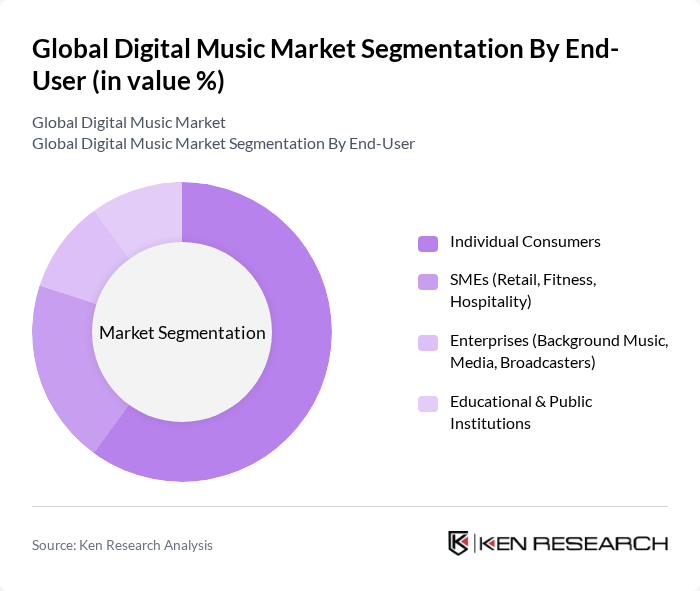
By End-User:The end-user segmentation includes Individual Consumers, SMEs (Retail, Fitness, Hospitality), Enterprises (Background Music, Media, Broadcasters), and Educational & Public Institutions. Individual Consumers represent the largest segment, as mass-market streaming adoption via smartphones and smart speakers has made music access ubiquitous, with personalized playlists, algorithmic discovery, and offline listening reinforcing usage frequency .
Global Digital Music Market Competitive Landscape
The Global Digital Music Market is characterized by a dynamic mix of regional and international players. Leading participants such as Spotify Technology S.A., Apple Inc. (Apple Music), Amazon.com, Inc. (Amazon Music), YouTube Music (Google LLC), TIDAL Music AS, Deezer S.A., SoundCloud Global Limited & Co. KG, Pandora Media, LLC (Sirius XM Holdings Inc.), iHeartMedia, Inc. (iHeartRadio), Tencent Music Entertainment Group, NetEase Cloud Music Inc., Universal Music Group N.V., Sony Music Entertainment (Sony Group Corporation), Warner Music Group Corp., Believe S.A., TuneCore, Inc. (Believe), DistroKid, Inc., Bandcamp, Inc. (Songtradr, Inc.), Anghami plc, JioSaavn LLC contribute to innovation, geographic expansion, and service delivery in this space.
Global Digital Music Market Industry Analysis
Growth Drivers
- Increasing Smartphone Penetration:The global smartphone user base is estimated at approximately 5.5 billion in future, representing a significant increase from 6.4 billion in future. This surge in smartphone adoption facilitates access to digital music platforms, enabling users to stream and download music conveniently. With 80% of smartphone users engaging with music apps, the demand for digital music content is expected to rise, driving revenue growth in the digital music sector. Enhanced mobile internet connectivity further supports this trend.
- Rise of Streaming Services:The number of global music streaming subscribers is projected to exceed 600 million by the end of future, up from 500 million in future. This growth is fueled by the increasing popularity of platforms like Spotify, Apple Music, and Amazon Music, which collectively generated over $25 billion in revenue in future. The shift from ownership to access models in music consumption is reshaping the industry, leading to higher engagement and sustained revenue streams for digital music providers.
- Expansion of Social Media Platforms:In future, social media platforms are expected to have over 5 billion active users, with a significant portion engaging with music-related content. Platforms like TikTok and Instagram have become vital for music discovery, driving user engagement and promoting new artists. The integration of music into social media experiences has led to a 30% increase in music-related content sharing, creating new avenues for artists and labels to reach audiences and monetize their work effectively.
Market Challenges
- Copyright Issues:The digital music industry faces ongoing challenges related to copyright infringement, with losses estimated at $12 billion annually due to piracy and unauthorized distribution. In future, the enforcement of copyright laws remains inconsistent across regions, complicating the monetization of digital music. This legal uncertainty can deter investment in new music ventures and hinder the growth of legitimate streaming services, impacting overall market stability and artist revenues.
- Intense Competition:The digital music landscape is characterized by fierce competition, with over 50 major streaming services vying for market share. This saturation leads to aggressive pricing strategies, which can erode profit margins. In future, the average revenue per user (ARPU) for streaming services is projected to decline by 5%, as companies offer more competitive pricing and promotional deals to attract subscribers. This competitive pressure poses a significant challenge for sustaining profitability in the industry.
Global Digital Music Market Future Outlook
The digital music market is poised for transformative growth, driven by technological advancements and evolving consumer behaviors. As artificial intelligence continues to enhance music curation and personalization, platforms will increasingly leverage data analytics to tailor user experiences. Additionally, the rise of live streaming concerts and virtual events is expected to create new revenue streams. These trends indicate a dynamic future for the industry, with opportunities for innovation and collaboration among artists, labels, and technology providers.
Market Opportunities
- Emerging Markets:Emerging markets, particularly in Asia and Africa, present significant growth opportunities for digital music. With a combined population of over 5 billion, these regions are experiencing rapid smartphone adoption and internet penetration. By future, the number of digital music users in these markets is expected to increase by 40%, providing a fertile ground for music streaming services to expand their reach and diversify their user base.
- Technological Advancements:Innovations in technology, such as blockchain and AI, are set to revolutionize the digital music landscape. Blockchain can enhance transparency in royalty distribution, potentially increasing artist revenues by 20% in future. Meanwhile, AI-driven music recommendation systems are expected to improve user engagement, leading to higher subscription retention rates. These advancements will create new business models and opportunities for growth in the digital music sector.
Scope of the Report
| Segment | Sub-Segments |
|---|---|
| By Type | On-demand Streaming (Subscription) Ad-supported Streaming Digital Downloads Podcasts & Spoken Audio Live Streaming & Virtual Concerts Cloud Locker & Music Libraries |
| By End-User | Individual Consumers SMEs (Retail, Fitness, Hospitality) Enterprises (Background Music, Media, Broadcasters) Educational & Public Institutions |
| By Genre | Pop Rock Hip-Hop/Rap Electronic/Dance Classical/Jazz/World |
| By Distribution Channel | Pure-play DSPs (Music Apps) Super Apps & Telco Bundles Smart Speakers, Connected Cars & Wearables Social & Short-video Platforms |
| By Pricing Model | Freemium Individual & Family Subscriptions Student & Discounted Plans Pay-Per-Download/Own Enterprise Licensing (B2B) |
| By Region | North America Europe Asia-Pacific Latin America Middle East & Africa |
| By User Demographics | Age Groups Gender Income Levels Listening Time & Device Mix |
Key Target Audience
Investors and Venture Capitalist Firms
Government and Regulatory Bodies (e.g., Federal Communications Commission, Copyright Office)
Music Labels and Record Companies
Streaming Service Providers
Digital Distribution Platforms
Music Licensing Organizations
Advertising Agencies
Telecommunications Companies
Players Mentioned in the Report:
Spotify Technology S.A.
Apple Inc. (Apple Music)
Amazon.com, Inc. (Amazon Music)
YouTube Music (Google LLC)
TIDAL Music AS
Deezer S.A.
SoundCloud Global Limited & Co. KG
Pandora Media, LLC (Sirius XM Holdings Inc.)
iHeartMedia, Inc. (iHeartRadio)
Tencent Music Entertainment Group
NetEase Cloud Music Inc.
Universal Music Group N.V.
Sony Music Entertainment (Sony Group Corporation)
Warner Music Group Corp.
Believe S.A.
TuneCore, Inc. (Believe)
DistroKid, Inc.
Bandcamp, Inc. (Songtradr, Inc.)
Anghami plc
JioSaavn LLC
Table of Contents
Market Assessment Phase
1. Executive Summary and Approach
2. Global Digital Music Market Overview
2.1 Key Insights and Strategic Recommendations
2.2 Global Digital Music Market Overview
2.3 Definition and Scope
2.4 Evolution of Market Ecosystem
2.5 Timeline of Key Regulatory Milestones
2.6 Value Chain & Stakeholder Mapping
2.7 Business Cycle Analysis
2.8 Policy & Incentive Landscape
3. Global Digital Music Market Analysis
3.1 Growth Drivers
3.1.1 Increasing smartphone penetration
3.1.2 Rise of streaming services
3.1.3 Growth in digital advertising
3.1.4 Expansion of social media platforms
3.2 Market Challenges
3.2.1 Copyright issues
3.2.2 Intense competition
3.2.3 Market saturation
3.2.4 Changing consumer preferences
3.3 Market Opportunities
3.3.1 Emerging markets
3.3.2 Technological advancements
3.3.3 Collaborations with artists
3.3.4 Diversification of revenue streams
3.4 Market Trends
3.4.1 Growth of personalized playlists
3.4.2 Integration of AI in music curation
3.4.3 Rise of live streaming concerts
3.4.4 Increased focus on user-generated content
3.5 Government Regulation
3.5.1 Copyright laws
3.5.2 Data protection regulations
3.5.3 Anti-piracy measures
3.5.4 Taxation policies on digital services
4. SWOT Analysis
5. Stakeholder Analysis
6. Porter's Five Forces Analysis
7. Global Digital Music Market Market Size, 2019-2024
7.1 By Value
7.2 By Volume
7.3 By Average Selling Price
8. Global Digital Music Market Segmentation
8.1 By Type
8.1.1 On-demand Streaming (Subscription)
8.1.2 Ad-supported Streaming
8.1.3 Digital Downloads
8.1.4 Podcasts & Spoken Audio
8.1.5 Live Streaming & Virtual Concerts
8.1.6 Cloud Locker & Music Libraries
8.2 By End-User
8.2.1 Individual Consumers
8.2.2 SMEs (Retail, Fitness, Hospitality)
8.2.3 Enterprises (Background Music, Media, Broadcasters)
8.2.4 Educational & Public Institutions
8.3 By Genre
8.3.1 Pop
8.3.2 Rock
8.3.3 Hip-Hop/Rap
8.3.4 Electronic/Dance
8.3.5 Classical/Jazz/World
8.4 By Distribution Channel
8.4.1 Pure-play DSPs (Music Apps)
8.4.2 Super Apps & Telco Bundles
8.4.3 Smart Speakers, Connected Cars & Wearables
8.4.4 Social & Short-video Platforms
8.5 By Pricing Model
8.5.1 Freemium
8.5.2 Individual & Family Subscriptions
8.5.3 Student & Discounted Plans
8.5.4 Pay-Per-Download/Own
8.5.5 Enterprise Licensing (B2B)
8.6 By Region
8.6.1 North America
8.6.2 Europe
8.6.3 Asia-Pacific
8.6.4 Latin America
8.6.5 Middle East & Africa
8.7 By User Demographics
8.7.1 Age Groups
8.7.2 Gender
8.7.3 Income Levels
8.7.4 Listening Time & Device Mix
9. Global Digital Music Market Competitive Analysis
9.1 Market Share of Key Players
9.2 Cross Comparison of Key Players
9.2.1 Platform Scale (MAUs/Monthly Active Users)
9.2.2 Subscribers (Paid) and Net Adds
9.2.3 Revenue Growth Rate (YoY)
9.2.4 ARPU (Monthly/Annual)
9.2.5 Churn Rate
9.2.6 Licensing and Content Cost as % of Revenue
9.2.7 Gross Margin and Contribution Margin
9.2.8 Catalog Depth (Tracks/Podcasts, Local Repertoire Share)
9.2.9 User Engagement (DAU/MAU, Hours Streamed per User)
9.2.10 Geographic Footprint (Markets Served, Top Regions)
9.2.11 Pricing Strategy (Plan Mix: Individual/Family/Student, Bundles)
9.2.12 Partner Ecosystem (Telco/Device Bundles, Auto/Smart Speaker)
9.2.13 Ad Monetization KPIs (Ad-supported MAUs, Ad Load, eCPM)
9.2.14 Product Differentiators (HiFi/Dolby, AI DJ, Social Features)
9.3 SWOT Analysis of Top Players
9.4 Pricing Analysis
9.5 Detailed Profile of Major Companies
9.5.1 Spotify Technology S.A.
9.5.2 Apple Inc. (Apple Music)
9.5.3 Amazon.com, Inc. (Amazon Music)
9.5.4 YouTube Music (Google LLC)
9.5.5 TIDAL Music AS
9.5.6 Deezer S.A.
9.5.7 SoundCloud Global Limited & Co. KG
9.5.8 Pandora Media, LLC (Sirius XM Holdings Inc.)
9.5.9 iHeartMedia, Inc. (iHeartRadio)
9.5.10 Tencent Music Entertainment Group
9.5.11 NetEase Cloud Music Inc.
9.5.12 Universal Music Group N.V.
9.5.13 Sony Music Entertainment (Sony Group Corporation)
9.5.14 Warner Music Group Corp.
9.5.15 Believe S.A.
9.5.16 TuneCore, Inc. (Believe)
9.5.17 DistroKid, Inc.
9.5.18 Bandcamp, Inc. (Songtradr, Inc.)
9.5.19 Anghami plc
9.5.20 JioSaavn LLC
10. Global Digital Music Market End-User Analysis
10.1 Procurement Behavior of Key Ministries
10.1.1 Government Contracts
10.1.2 Budget Allocations
10.1.3 Compliance Requirements
10.2 Corporate Spend on Infrastructure & Energy
10.2.1 Investment in Digital Platforms
10.2.2 Spending on Licensing
10.2.3 Marketing Expenditures
10.3 Pain Point Analysis by End-User Category
10.3.1 Content Accessibility
10.3.2 Pricing Concerns
10.3.3 Quality of Service
10.4 User Readiness for Adoption
10.4.1 Technology Familiarity
10.4.2 Willingness to Pay
10.4.3 Preference for Platforms
10.5 Post-Deployment ROI and Use Case Expansion
10.5.1 Revenue Growth
10.5.2 User Engagement Metrics
10.5.3 Market Expansion Opportunities
11. Global Digital Music Market Future Size, 2025-2030
11.1 By Value
11.2 By Volume
11.3 By Average Selling Price
Go-To-Market Strategy Phase
1. Whitespace Analysis + Business Model Canvas
1.1
2. Marketing and Positioning Recommendations
2.1
3. Distribution Plan
3.1
4. Channel & Pricing Gaps
4.1
5. Unmet Demand & Latent Needs
5.1
6. Customer Relationship
6.1
7. Value Proposition
7.1
8. Key Activities
8.1
9. Entry Strategy Evaluation
9.1 Domestic Market Entry Strategy
9.1.1
9.2 Export Entry Strategy
9.2.1
10. Entry Mode Assessment
10.1
11. Capital and Timeline Estimation
11.1
12. Control vs Risk Trade-Off
12.1
13. Profitability Outlook
13.1
14. Potential Partner List
14.1
15. Execution Roadmap
15.1 Phased Plan for Market Entry
15.1.1
15.2 Key Activities and Milestones
15.2.1
Research Methodology
Phase 1: Approach1
Desk Research
- Analysis of industry reports from organizations like IFPI and RIAA
- Review of market trends and consumer behavior studies published in music industry journals
- Examination of digital music sales data from platforms such as Spotify, Apple Music, and YouTube Music
Primary Research
- Interviews with executives from major record labels and independent music distributors
- Surveys targeting music streaming service users to gather insights on preferences and usage patterns
- Focus groups with music industry professionals, including artists, producers, and marketers
Validation & Triangulation
- Cross-validation of findings through multiple data sources, including sales figures and user engagement metrics
- Triangulation of qualitative insights from interviews with quantitative data from surveys
- Sanity checks conducted through expert panel reviews comprising industry veterans and analysts
Phase 2: Market Size Estimation1
Top-down Assessment
- Estimation of total digital music revenue based on global music market growth rates
- Segmentation of revenue by genre, region, and distribution channel (streaming vs. downloads)
- Incorporation of emerging trends such as NFTs and virtual concerts into revenue projections
Bottom-up Modeling
- Analysis of subscription and ad-supported revenue models from leading streaming platforms
- Estimation of average revenue per user (ARPU) across different demographics and regions
- Volume x pricing analysis for digital music sales and licensing agreements
Forecasting & Scenario Analysis
- Multi-factor regression analysis incorporating variables such as internet penetration and smartphone adoption rates
- Scenario modeling based on potential regulatory changes and shifts in consumer behavior
- Development of baseline, optimistic, and pessimistic forecasts through 2030
Phase 3: CATI Sample Composition1
| Scope Item/Segment | Sample Size | Target Respondent Profiles |
|---|---|---|
| Streaming Service Users | 150 | Active Subscribers, Casual Listeners |
| Record Label Executives | 60 | CEOs, Marketing Directors |
| Independent Artists | 100 | Musicians, Producers |
| Music Industry Analysts | 50 | Market Researchers, Consultants |
| Digital Music Distributors | 70 | Distribution Managers, Sales Executives |
Frequently Asked Questions
What is the current value of the Global Digital Music Market?
The Global Digital Music Market is valued at approximately USD 34 billion, reflecting significant growth driven by the rise of streaming services, smartphone adoption, and the shift from physical sales to digital formats.
What are the main segments of the Global Digital Music Market?
Which countries are leading in the Global Digital Music Market?
How has the Digital Services Act impacted the music industry in the EU?
Other Regional/Country Reports
Indonesia Digital Music Market
Malaysia Digital Music Market
APAC Digital Music Market
SEA Digital Music Market
Why Buy From Us?

What makes us stand out is that our consultants follow Robust, Refine and Result (RRR) methodology. Robust for clear definitions, approaches and sanity checking, Refine for differentiating respondents' facts and opinions, and Result for presenting data with story.

We have set a benchmark in the industry by offering our clients with syndicated and customized market research reports featuring coverage of entire market as well as meticulous research and analyst insights.

While we don't replace traditional research, we flip the method upside down. Our dual approach of Top Bottom & Bottom Top ensures quality deliverable by not just verifying company fundamentals but also looking at the sector and macroeconomic factors.

With one step in the future, our research team constantly tries to show you the bigger picture. We help with some of the tough questions you may encounter along the way: How is the industry positioned? Best marketing channel? KPI's of competitors? By aligning every element, we help maximize success.

Our report gives you instant access to the answers and sources that other companies might choose to hide. We elaborate each steps of research methodology we have used and showcase you the sample size to earn your trust.

If you need any support, we are here! We pride ourselves on universe strength, data quality, and quick, friendly, and professional service.