About the Report
Base Year 2024Global Drones Market Overview
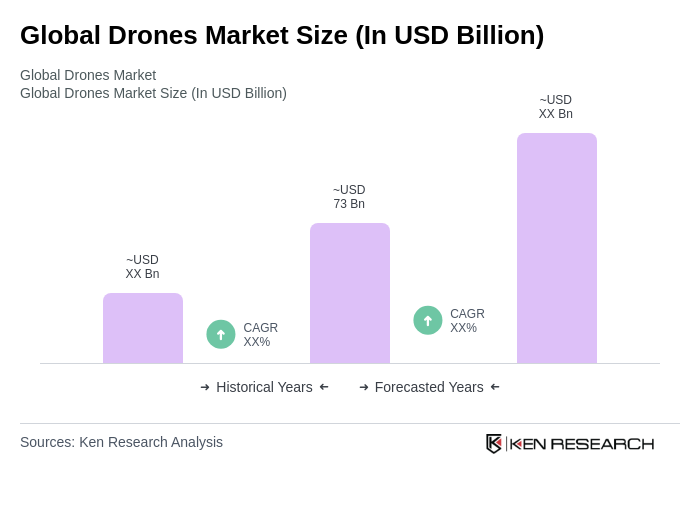
- The Global Drones Market is valued at USD 73 billion, based on a five-year historical analysis. This growth is primarily driven by advancements in autonomous navigation, battery energy density, AI-enabled analytics, and sensor payloads, alongside expanding use cases in inspection, mapping, public safety, and delivery services. The market has witnessed sustained investment in R&D and commercialization, enhancing flight endurance, imaging quality, and BVLOS capabilities .
- Key players in this market include the United States, China, and Germany, supported by strong technology ecosystems, industrial supply chains, and evolving regulatory frameworks. The U.S. leads in defense and enterprise/commercial applications, China is a major force in consumer and prosumer platforms and components manufacturing, and Germany exhibits strength in industrial and mapping-grade systems and consulting-led enterprise deployments .
- In 2023, the Federal Aviation Administration in the United States advanced integration of drones into the national airspace by enforcing Remote Identification requirements for most drones and expanding operational permissions under Part 107 waivers, aimed at improving traceability and safety of commercial operations .
Global Drones Market Segmentation
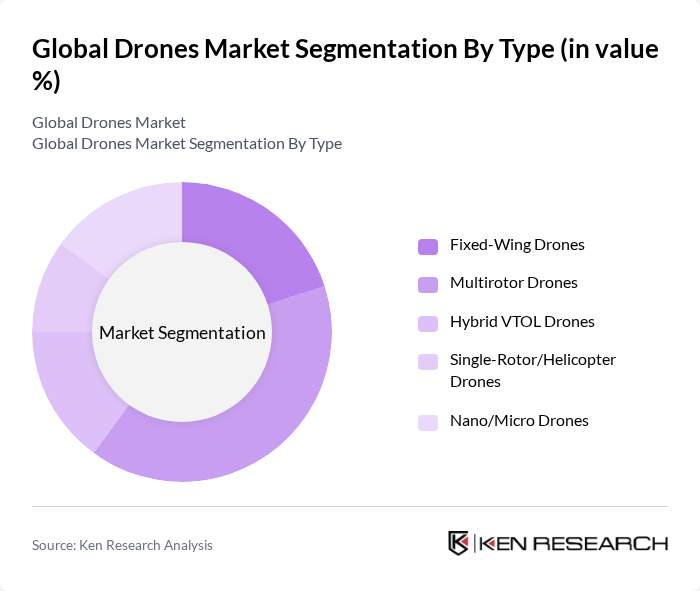
By Type:The drones market is segmented into various types, including Fixed-Wing Drones, Multirotor Drones, Hybrid VTOL Drones, Single-Rotor/Helicopter Drones, and Nano/Micro Drones. Among these, Multirotor Drones are currently dominating the market due to their versatility, ease of deployment, lower acquisition and operating cost, and suitability for close-range inspection, mapping, and imaging. They are widely adopted in sectors such as agriculture (field scouting, spraying), surveillance and public safety, construction progress monitoring, and logistics pilots, making them a preferred choice for commercial and recreational users .
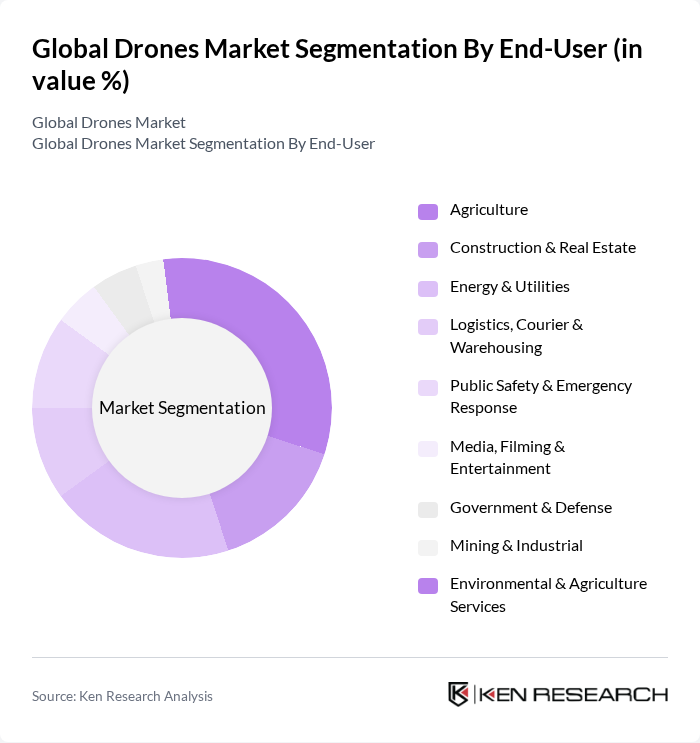
By End-User:The market is further segmented by end-user applications, including Agriculture, Construction & Real Estate, Energy & Utilities, Logistics, Public Safety, Media, Government & Defense, Mining & Industrial, and Environmental Services. The Agriculture sector is a leading commercial adopter, driven by precision farming, multispectral crop scouting, and targeted spraying for inputs optimization. Drones are being utilized for variable-rate spraying, plant health mapping, soil and moisture analysis, and yield estimation, while Energy & Utilities, Construction, and Public Safety also show rapid adoption for inspection, progress monitoring, and incident response .
Global Drones Market Competitive Landscape
The Global Drones Market is characterized by a dynamic mix of regional and international players. Leading participants such as DJI Technology Co., Ltd., SZ DJI Technology Co., Ltd. (DJI Enterprise), Parrot Drones S.A., Skydio, Inc., Autel Robotics Co., Ltd., Yuneec International Co., Ltd., AeroVironment, Inc., Insitu, Inc. (a Boeing Company), The Boeing Company (Defense, Space & Security), Northrop Grumman Corporation, General Atomics Aeronautical Systems, Inc. (GA-ASI), Textron Systems Corporation, Teledyne FLIR LLC (FLIR Systems), EHang Holdings Limited, Quantum-Systems GmbH, senseFly SA (AgEagle Aerial Systems, Inc.), Delair SAS, Flyability SA, AgEagle Aerial Systems, Inc., Zipline International Inc., Wing (Alphabet Inc.), Matternet, Inc., Percepto Robotics Ltd., Airobotics Ltd. (Ondas Holdings), DroneShield Ltd. contribute to innovation, geographic expansion, and service delivery in this space.
Global Drones Market Industry Analysis
Growth Drivers
- Increasing Demand for Aerial Surveillance:The global demand for aerial surveillance has surged, with the market for drone surveillance systems projected to reach $4.5 billion in future. This growth is driven by heightened security concerns, particularly in urban areas, where crime rates have increased by 15% over the past three years. Governments and private sectors are investing heavily in drone technology to enhance surveillance capabilities, leading to a projected increase in drone deployments by 30% annually in the future.
- Advancements in Drone Technology:Technological advancements in drone capabilities, such as improved imaging systems and enhanced flight stability, are propelling market growth. In future, the global drone technology market is expected to exceed $10 billion, with innovations like 4K cameras and real-time data transmission becoming standard. These advancements are crucial for industries like agriculture and logistics, where precision and efficiency are paramount, leading to a 25% increase in drone usage across various sectors in future.
- Expanding Applications in Various Industries:Drones are increasingly being adopted across diverse sectors, including agriculture, construction, and logistics. In agriculture alone, the use of drones for crop monitoring and precision farming is projected to grow by 40% in future, driven by the need for sustainable practices. The construction industry is also expected to see a 20% rise in drone utilization for site surveys and inspections, reflecting a broader trend of integrating drones into operational workflows in future.
Market Challenges
- Regulatory Hurdles:The drone industry faces significant regulatory challenges, particularly concerning airspace management and operational guidelines. In future, the regulatory framework is still evolving, with only 60% of drone operators compliant with existing regulations as of 2023. This lack of compliance can hinder market growth, as companies may face fines or operational restrictions, limiting their ability to leverage drone technology effectively in various applications.
- High Initial Investment Costs:The high initial costs associated with drone acquisition and setup pose a barrier to entry for many businesses. In future, the average cost of a commercial-grade drone can exceed $10,000, which is prohibitive for small and medium enterprises. This financial barrier limits the adoption of drone technology, particularly in sectors where budget constraints are prevalent, thereby slowing overall market growth in the region.
Global Drones Market Future Outlook
The future of the drone market in future appears promising, driven by technological advancements and increasing applications across various sectors. As regulatory frameworks become more defined, businesses are expected to adopt drones more widely, particularly in logistics and agriculture. The integration of AI and machine learning will further enhance drone capabilities, making them indispensable tools for data collection and analysis. This evolution will likely lead to a more robust market environment, fostering innovation and investment in drone technologies.
Market Opportunities
- Growth in E-commerce Delivery Services:The rise of e-commerce has created a significant opportunity for drone delivery services. With online retail sales projected to reach $6 trillion in future, companies are increasingly exploring drone logistics to enhance delivery efficiency. This shift could reduce delivery times by up to 50%, making drones a vital component of the e-commerce supply chain in future.
- Integration with AI and Machine Learning:The integration of AI and machine learning technologies into drone operations presents a substantial market opportunity. In future, AI-driven drones are expected to improve operational efficiency by 30%, enabling real-time data analysis and decision-making. This advancement will enhance applications in sectors like agriculture and surveillance, driving further adoption of drones in future.
Scope of the Report
| Segment | Sub-Segments |
|---|---|
| By Type | Fixed-Wing Drones Multirotor Drones Hybrid VTOL Drones Single-Rotor/Helicopter Drones Nano/Micro Drones |
| By End-User | Agriculture Construction & Real Estate Energy & Utilities (Oil & Gas, Power, Renewables) Logistics, Courier & Warehousing Public Safety & Emergency Response Media, Filming & Entertainment Government & Defense Mining & Industrial Environmental & Agriculture Services (Forestry, Wildlife, Conservation) |
| By Application | Mapping & Surveying Inspection & Monitoring Aerial Photography & Videography Precision Agriculture (Spraying, Seeding, Crop Health) Public Safety (Search & Rescue, Fire/Disaster Response) Cargo & Last-Mile Delivery Remote Sensing & Environmental Monitoring Others |
| By Distribution Channel | Direct (Manufacturer to Enterprise/Government) Specialized Distributors/Resellers Online Retail (Brand Stores & Marketplaces) Offline Retail (Electronics & Hobby Stores) |
| By Payload Capacity | Less than 2 kg kg to 5 kg kg to 25 kg More than 25 kg |
| By Power/Propulsion | Electric (LiPo, Li-ion) Hybrid (Engine-Electric) Internal Combustion/Jet Hydrogen Fuel Cell |
| By Price Range | Below $500 (Consumer/Recreational) $500 to $1,500 (Prosumer) $1,500 to $10,000 (Enterprise) Above $10,000 (Industrial/Defense) |
Key Target Audience
Investors and Venture Capitalist Firms
Government and Regulatory Bodies (e.g., Federal Aviation Administration, European Union Aviation Safety Agency)
Manufacturers and Producers
Distributors and Retailers
Aerospace and Defense Contractors
Logistics and Delivery Companies
Telecommunications Providers
Insurance Companies
Players Mentioned in the Report:
DJI Technology Co., Ltd.
SZ DJI Technology Co., Ltd. (DJI Enterprise)
Parrot Drones S.A.
Skydio, Inc.
Autel Robotics Co., Ltd.
Yuneec International Co., Ltd.
AeroVironment, Inc.
Insitu, Inc. (a Boeing Company)
The Boeing Company (Defense, Space & Security)
Northrop Grumman Corporation
General Atomics Aeronautical Systems, Inc. (GA-ASI)
Textron Systems Corporation
Teledyne FLIR LLC (FLIR Systems)
EHang Holdings Limited
Quantum-Systems GmbH
senseFly SA (AgEagle Aerial Systems, Inc.)
Delair SAS
Flyability SA
AgEagle Aerial Systems, Inc.
Zipline International Inc.
Wing (Alphabet Inc.)
Matternet, Inc.
Percepto Robotics Ltd.
Airobotics Ltd. (Ondas Holdings)
DroneShield Ltd.
Table of Contents
Market Assessment Phase
1. Executive Summary and Approach
2. Global Drones Market Overview
2.1 Key Insights and Strategic Recommendations
2.2 Global Drones Market Overview
2.3 Definition and Scope
2.4 Evolution of Market Ecosystem
2.5 Timeline of Key Regulatory Milestones
2.6 Value Chain & Stakeholder Mapping
2.7 Business Cycle Analysis
2.8 Policy & Incentive Landscape
3. Global Drones Market Analysis
3.1 Growth Drivers
3.1.1 Increasing Demand for Aerial Surveillance
3.1.2 Advancements in Drone Technology
3.1.3 Expanding Applications in Various Industries
3.1.4 Rising Investment in Drone Startups
3.2 Market Challenges
3.2.1 Regulatory Hurdles
3.2.2 High Initial Investment Costs
3.2.3 Privacy Concerns
3.2.4 Limited Battery Life
3.3 Market Opportunities
3.3.1 Growth in E-commerce Delivery Services
3.3.2 Integration with AI and Machine Learning
3.3.3 Expansion in Agricultural Applications
3.3.4 Development of Drone Delivery Networks
3.4 Market Trends
3.4.1 Increasing Use of Drones in Disaster Management
3.4.2 Rise of Drone-as-a-Service (DaaS)
3.4.3 Adoption of Autonomous Drones
3.4.4 Growing Popularity of Racing Drones
3.5 Government Regulation
3.5.1 FAA Regulations on Drone Operations
3.5.2 Privacy Laws Affecting Drone Usage
3.5.3 Airspace Management Policies
3.5.4 Safety Standards for Commercial Drones
4. SWOT Analysis
5. Stakeholder Analysis
6. Porter's Five Forces Analysis
7. Global Drones Market Market Size, 2019-2024
7.1 By Value
7.2 By Volume
7.3 By Average Selling Price
8. Global Drones Market Segmentation
8.1 By Type
8.1.1 Fixed-Wing Drones
8.1.2 Multirotor Drones
8.1.3 Hybrid VTOL Drones
8.1.4 Single-Rotor/Helicopter Drones
8.1.5 Nano/Micro Drones
8.2 By End-User
8.2.1 Agriculture
8.2.2 Construction & Real Estate
8.2.3 Energy & Utilities (Oil & Gas, Power, Renewables)
8.2.4 Logistics, Courier & Warehousing
8.2.5 Public Safety & Emergency Response
8.2.6 Media, Filming & Entertainment
8.2.7 Government & Defense
8.2.8 Mining & Industrial
8.2.9 Environmental & Agriculture Services (Forestry, Wildlife, Conservation)
8.3 By Application
8.3.1 Mapping & Surveying
8.3.2 Inspection & Monitoring
8.3.3 Aerial Photography & Videography
8.3.4 Precision Agriculture (Spraying, Seeding, Crop Health)
8.3.5 Public Safety (Search & Rescue, Fire/Disaster Response)
8.3.6 Cargo & Last-Mile Delivery
8.3.7 Remote Sensing & Environmental Monitoring
8.3.8 Others
8.4 By Distribution Channel
8.4.1 Direct (Manufacturer to Enterprise/Government)
8.4.2 Specialized Distributors/Resellers
8.4.3 Online Retail (Brand Stores & Marketplaces)
8.4.4 Offline Retail (Electronics & Hobby Stores)
8.5 By Payload Capacity
8.5.1 Less than 2 kg
8.5.2 2 kg to 5 kg
8.5.3 5 kg to 25 kg
8.5.4 More than 25 kg
8.6 By Power/Propulsion
8.6.1 Electric (LiPo, Li-ion)
8.6.2 Hybrid (Engine-Electric)
8.6.3 Internal Combustion/Jet
8.6.4 Hydrogen Fuel Cell
8.7 By Price Range
8.7.1 Below $500 (Consumer/Recreational)
8.7.2 $500 to $1,500 (Prosumer)
8.7.3 $1,500 to $10,000 (Enterprise)
8.7.4 Above $10,000 (Industrial/Defense)
9. Global Drones Market Competitive Analysis
9.1 Market Share of Key Players
9.2 Cross Comparison of Key Players
9.2.1 Company Name
9.2.2 Company Scale (Global, Regional, Niche)
9.2.3 Total Revenue and Drone-Segment Revenue
9.2.4 Year-over-Year Revenue Growth (Drone Segment)
9.2.5 Installed Base / Fleet Size (Active Units)
9.2.6 Geographic Footprint (Regions Served)
9.2.7 Product Portfolio Breadth (Consumer, Enterprise, Defense, eVTOL)
9.2.8 Average Selling Price Range (by Category)
9.2.9 R&D Intensity (% of Revenue)
9.2.10 Certifications & Waivers (BVLOS, Type Certifications)
9.2.11 Strategic Partnerships (e.g., with OEMs, Telcos, Cloud/AI)
9.2.12 Software Capabilities (Autonomy, Mapping, Fleet Management)
9.2.13 Services Mix (% Hardware, % Software, % Services)
9.2.14 Contract Wins/Backlog (Notably Defense & Enterprise)
9.2.15 Unit Shipment Volume (Latest Year)
9.2.16 Regulatory/Compliance Track Record (Incidents, Recalls)
9.2.17 Customer Concentration (Top 3 share)
9.2.18 Gross Margin (Hardware vs Services)
9.2.19 Warranty/Return Rate
9.2.20 Net Revenue Retention (Software/Services)
9.3 SWOT Analysis of Top Players
9.4 Pricing Analysis
9.5 Detailed Profile of Major Companies
9.5.1 DJI Technology Co., Ltd.
9.5.2 SZ DJI Technology Co., Ltd. (DJI Enterprise)
9.5.3 Parrot Drones S.A.
9.5.4 Skydio, Inc.
9.5.5 Autel Robotics Co., Ltd.
9.5.6 Yuneec International Co., Ltd.
9.5.7 AeroVironment, Inc.
9.5.8 Insitu, Inc. (a Boeing Company)
9.5.9 The Boeing Company (Defense, Space & Security)
9.5.10 Northrop Grumman Corporation
9.5.11 General Atomics Aeronautical Systems, Inc. (GA-ASI)
9.5.12 Textron Systems Corporation
9.5.13 Teledyne FLIR LLC (FLIR Systems)
9.5.14 EHang Holdings Limited
9.5.15 Quantum-Systems GmbH
9.5.16 senseFly SA (AgEagle Aerial Systems, Inc.)
9.5.17 Delair SAS
9.5.18 Flyability SA
9.5.19 AgEagle Aerial Systems, Inc.
9.5.20 Zipline International Inc.
9.5.21 Wing (Alphabet Inc.)
9.5.22 Matternet, Inc.
9.5.23 Percepto Robotics Ltd.
9.5.24 Airobotics Ltd. (Ondas Holdings)
9.5.25 DroneShield Ltd.
10. Global Drones Market End-User Analysis
10.1 Procurement Behavior of Key Ministries
10.1.1 Government Procurement Trends
10.1.2 Budget Allocations for Drone Technology
10.1.3 Decision-Making Processes
10.2 Corporate Spend on Infrastructure & Energy
10.2.1 Investment in Drone Infrastructure
10.2.2 Corporate Partnerships with Drone Manufacturers
10.2.3 Funding for Drone Research and Development
10.3 Pain Point Analysis by End-User Category
10.3.1 Challenges Faced by Agricultural Users
10.3.2 Issues in Construction Applications
10.3.3 Limitations in Logistics and Delivery
10.4 User Readiness for Adoption
10.4.1 Awareness of Drone Benefits
10.4.2 Training and Skill Development Needs
10.4.3 Infrastructure Readiness
10.5 Post-Deployment ROI and Use Case Expansion
10.5.1 Measuring ROI in Agriculture
10.5.2 Expanding Use Cases in Logistics
10.5.3 Long-term Benefits in Infrastructure Inspection
11. Global Drones Market Future Size, 2025-2030
11.1 By Value
11.2 By Volume
11.3 By Average Selling Price
Go-To-Market Strategy Phase
1. Whitespace Analysis + Business Model Canvas
1.1 Market Gaps Identification
1.2 Value Proposition Development
1.3 Revenue Streams Analysis
1.4 Cost Structure Evaluation
1.5 Key Partnerships Exploration
1.6 Customer Segmentation
1.7 Channels of Distribution
2. Marketing and Positioning Recommendations
2.1 Branding Strategies
2.2 Product USPs
2.3 Target Audience Identification
2.4 Marketing Channels Selection
2.5 Messaging and Communication
3. Distribution Plan
3.1 Urban Retail Strategies
3.2 Rural NGO Tie-ups
3.3 E-commerce Distribution
3.4 Direct Sales Approaches
4. Channel & Pricing Gaps
4.1 Underserved Routes
4.2 Pricing Bands Analysis
4.3 Competitor Pricing Comparison
5. Unmet Demand & Latent Needs
5.1 Category Gaps Identification
5.2 Consumer Segments Analysis
5.3 Emerging Trends Exploration
6. Customer Relationship
6.1 Loyalty Programs Development
6.2 After-sales Service Strategies
6.3 Customer Feedback Mechanisms
7. Value Proposition
7.1 Sustainability Initiatives
7.2 Integrated Supply Chains
7.3 Unique Selling Points
8. Key Activities
8.1 Regulatory Compliance
8.2 Branding Initiatives
8.3 Distribution Setup
9. Entry Strategy Evaluation
9.1 Domestic Market Entry Strategy
9.1.1 Product Mix Considerations
9.1.2 Pricing Band Strategy
9.1.3 Packaging Approaches
9.2 Export Entry Strategy
9.2.1 Target Countries Identification
9.2.2 Compliance Roadmap Development
10. Entry Mode Assessment
10.1 Joint Ventures
10.2 Greenfield Investments
10.3 Mergers & Acquisitions
10.4 Distributor Model Evaluation
11. Capital and Timeline Estimation
11.1 Capital Requirements Analysis
11.2 Timelines for Market Entry
12. Control vs Risk Trade-Off
12.1 Ownership vs Partnerships
12.2 Risk Management Strategies
13. Profitability Outlook
13.1 Breakeven Analysis
13.2 Long-term Sustainability Strategies
14. Potential Partner List
14.1 Distributors Identification
14.2 Joint Ventures Opportunities
14.3 Acquisition Targets
15. Execution Roadmap
15.1 Phased Plan for Market Entry</h
Research Methodology
Phase 1: Approach1
Desk Research
- Analysis of industry reports from global drone associations and market research firms
- Review of government publications and regulations affecting drone usage and sales
- Examination of academic journals and white papers on drone technology advancements
Primary Research
- Interviews with executives from leading drone manufacturing companies
- Surveys targeting end-users in sectors such as agriculture, logistics, and surveillance
- Field interviews with drone service providers and operators to gather insights on market trends
Validation & Triangulation
- Cross-validation of data through multiple sources including trade publications and expert opinions
- Triangulation of findings from primary interviews and secondary data sources
- Sanity checks conducted through expert panel reviews to ensure data accuracy
Phase 2: Market Size Estimation1
Top-down Assessment
- Estimation of total addressable market based on global drone sales and usage statistics
- Segmentation of market size by application areas such as commercial, military, and recreational
- Incorporation of growth trends influenced by technological advancements and regulatory changes
Bottom-up Modeling
- Collection of sales data from key drone manufacturers and service providers
- Estimation of market size based on unit sales and average selling prices across segments
- Analysis of regional market dynamics to refine local market size estimates
Forecasting & Scenario Analysis
- Multi-variable forecasting models incorporating factors such as consumer adoption rates and regulatory impacts
- Scenario analysis based on potential market disruptions and technological innovations
- Development of baseline, optimistic, and pessimistic forecasts through 2030
Phase 3: CATI Sample Composition1
| Scope Item/Segment | Sample Size | Target Respondent Profiles |
|---|---|---|
| Agricultural Drone Applications | 120 | Agronomists, Farm Managers |
| Logistics and Delivery Drones | 100 | Logistics Coordinators, Supply Chain Managers |
| Military Drone Utilization | 80 | Defense Analysts, Military Procurement Officers |
| Drone Photography and Videography | 70 | Creative Directors, Media Producers |
| Drone Maintenance and Repair Services | 60 | Service Technicians, Operations Managers |
Frequently Asked Questions
What is the current value of the Global Drones Market?
The Global Drones Market is valued at approximately USD 73 billion, driven by advancements in technology and increasing applications across various sectors such as inspection, mapping, public safety, and delivery services.
What are the key drivers of growth in the Global Drones Market?
Which countries are leading in the Global Drones Market?
What are the main types of drones in the market?
Other Regional/Country Reports
Indonesia Drones Market
Malaysia Drones Market
KSA Drones Market
APAC Drones Market
SEA Drones Market
Vietnam Drones Market
Why Buy From Us?

What makes us stand out is that our consultants follow Robust, Refine and Result (RRR) methodology. Robust for clear definitions, approaches and sanity checking, Refine for differentiating respondents' facts and opinions, and Result for presenting data with story.

We have set a benchmark in the industry by offering our clients with syndicated and customized market research reports featuring coverage of entire market as well as meticulous research and analyst insights.

While we don't replace traditional research, we flip the method upside down. Our dual approach of Top Bottom & Bottom Top ensures quality deliverable by not just verifying company fundamentals but also looking at the sector and macroeconomic factors.

With one step in the future, our research team constantly tries to show you the bigger picture. We help with some of the tough questions you may encounter along the way: How is the industry positioned? Best marketing channel? KPI's of competitors? By aligning every element, we help maximize success.

Our report gives you instant access to the answers and sources that other companies might choose to hide. We elaborate each steps of research methodology we have used and showcase you the sample size to earn your trust.

If you need any support, we are here! We pride ourselves on universe strength, data quality, and quick, friendly, and professional service.