About the Report
Base Year 2024Global Duty Free And Travel Retail Market Overview
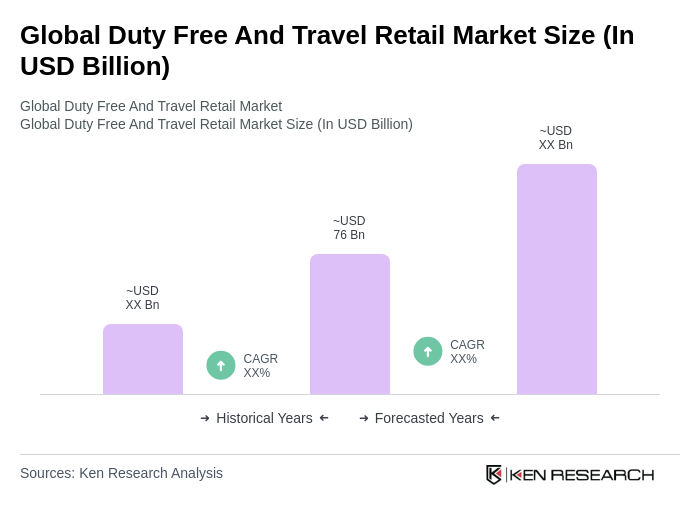
- The Global Duty Free and Travel Retail Market is valued at USD 76 billion, based on a five-year historical analysis. This growth is primarily driven by the increasing number of international travelers, rising disposable incomes, and the growing demand for luxury and premium goods among consumers. The market has seen a significant rebound post-pandemic, with a surge in travel activities, expansion of airport infrastructure, and digital innovation—such as contactless payments and app-based ordering—contributing to its expansion. Enhanced digital engagement and improved customer targeting are also supporting market growth.
- Key players in this market include major cities and countries such as Dubai, Singapore, and London, which dominate due to their strategic locations as international travel hubs. These regions benefit from high passenger traffic, a diverse range of retail offerings, and favorable government policies that promote tourism and duty-free shopping. Asia-Pacific currently holds the largest market share, driven by robust travel activity and infrastructure investment.
- Recent regulatory initiatives in the European Union have aimed to streamline duty-free allowances and harmonize traveler experiences, enhancing consumer confidence and encouraging spending in duty-free shops. These efforts are designed to support the recovery and growth of the travel retail sector by making cross-border shopping more convenient and transparent for international travelers.
Global Duty Free And Travel Retail Market Segmentation
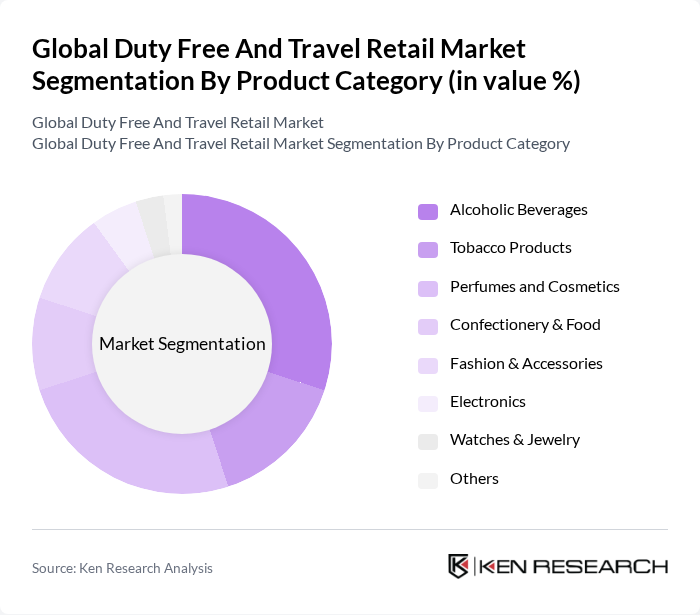
By Product Category:The product categories in the duty-free and travel retail market encompass a broad selection of items tailored to international travelers. The primary subsegments are Alcoholic Beverages, Tobacco Products, Perfumes and Cosmetics, Confectionery & Food, Fashion & Accessories, Electronics, Watches & Jewelry, and Others. Among these, Alcoholic Beverages and Perfumes and Cosmetics remain the most sought-after, reflecting the high demand for luxury and premium products in travel retail environments.
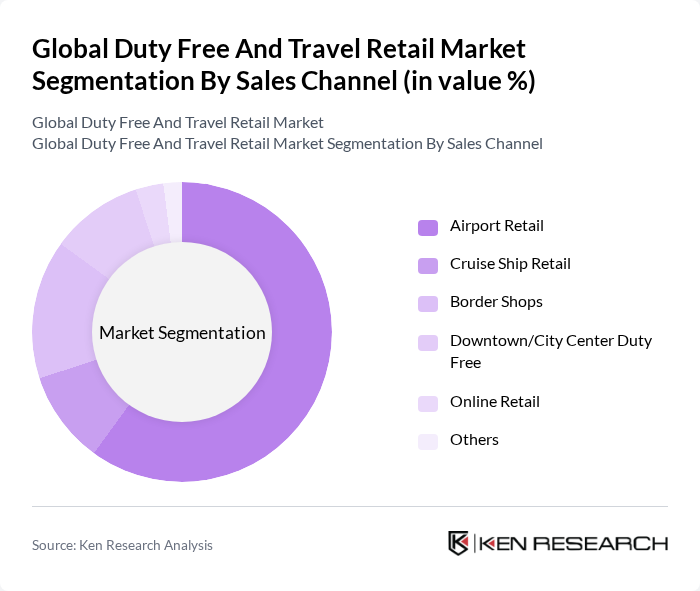
By Sales Channel:The sales channels in the duty-free and travel retail market include Airport Retail, Cruise Ship Retail, Border Shops, Downtown/City Center Duty Free, Online Retail, and Others. Airport Retail is the dominant channel, driven by the high volume of international travelers and the convenience of shopping before departure or upon arrival. Cruise ship and border shop retail also play significant roles, particularly in regions with high cross-border travel or cruise tourism. Online retail is emerging, supported by digital transformation and pre-order services.
Global Duty Free And Travel Retail Market Competitive Landscape
The Global Duty Free And Travel Retail Market is characterized by a dynamic mix of regional and international players. Leading participants such as Dufry AG, Lotte Duty Free, DFS Group, Gebr. Heinemann SE & Co. KG, Lagardère Travel Retail, King Power International Co., Ltd., The Shilla Duty Free, China Duty Free Group Co., Ltd., Duty Free Americas, Inc., Aelia Duty Free (Lagardère Travel Retail), Nuance Group (Dufry AG), World Duty Free Group (Dufry AG), Travel Retail Norway AS, T Galleria by DFS, Flemingo International Ltd. contribute to innovation, geographic expansion, and service delivery in this space.
Global Duty Free And Travel Retail Market Industry Analysis
Growth Drivers
- Increase in International Travel:The number of international tourist arrivals reached approximately 1.3 billion, according to the United Nations World Tourism Organization (UNWTO). This surge in travel is expected to continue, with projections indicating a rise to approximately 1.8 billion in future. Increased travel directly correlates with higher foot traffic in duty-free shops, leading to increased sales. Additionally, the average spend per traveler in duty-free outlets is estimated at $100, further driving revenue growth in the sector.
- Rising Disposable Incomes:Global disposable income is projected to increase by approximately $3 trillion in future, according to the World Bank. This rise in disposable income, particularly in emerging markets, is expected to enhance consumer spending on luxury goods and travel retail products. As consumers have more disposable income, they are more likely to indulge in duty-free shopping, which is often perceived as a premium experience, thus boosting overall market growth.
- Expansion of Retail Outlets in Airports:As of 2023, there are over 2,000 duty-free retail outlets in airports worldwide, with a projected increase of approximately 10% in future. This expansion is driven by airport authorities seeking to enhance passenger experience and increase non-aeronautical revenue. The growing number of retail outlets provides travelers with more shopping options, thereby increasing the likelihood of purchases and contributing to the overall growth of the duty-free market.
Market Challenges
- Regulatory Restrictions:Regulatory frameworks governing duty-free sales vary significantly across countries, creating challenges for retailers. For instance, the European Union has strict regulations on the sale of tobacco and alcohol, limiting quantities that can be sold to travelers. These restrictions can hinder sales potential, as consumers may seek alternatives in local markets where regulations are less stringent, impacting overall revenue in the duty-free sector.
- Economic Uncertainty:Global economic uncertainty, exacerbated by geopolitical tensions and inflationary pressures, poses a significant challenge to the duty-free market. The International Monetary Fund (IMF) forecasts global GDP growth to slow to approximately 2.8% in future, which may lead to reduced consumer spending on non-essential items, including luxury goods. This economic climate can adversely affect the travel retail sector, as consumers prioritize essential expenditures over discretionary purchases.
Global Duty Free And Travel Retail Market Future Outlook
The future of the duty-free and travel retail market appears promising, driven by increasing international travel and rising disposable incomes. As more travelers seek unique shopping experiences, retailers are likely to enhance their offerings through personalized services and exclusive products. Additionally, the integration of technology, such as mobile payment solutions and augmented reality, will further enrich the shopping experience, making it more convenient and engaging for consumers. This evolution will likely attract a broader customer base and stimulate market growth.
Market Opportunities
- Expansion into Emerging Markets:Emerging markets, particularly in Asia and Africa, present significant growth opportunities for duty-free retailers. With a projected increase in middle-class consumers, estimated to reach approximately 1.5 billion in future, retailers can tap into this demographic's growing purchasing power, enhancing their market presence and sales potential in these regions.
- Development of Exclusive Product Lines:Creating exclusive product lines tailored for duty-free shoppers can drive sales and enhance brand loyalty. Retailers can collaborate with luxury brands to offer limited-edition items, appealing to travelers seeking unique products. This strategy not only boosts sales but also enhances the overall shopping experience, making duty-free outlets more attractive to consumers.
Scope of the Report
| Segment | Sub-Segments |
|---|---|
| By Product Category | Alcoholic Beverages Tobacco Products Perfumes and Cosmetics Confectionery & Food Fashion & Accessories Electronics Watches & Jewelry Others |
| By Sales Channel | Airport Retail Cruise Ship Retail Border Shops Downtown/City Center Duty Free Online Retail Others |
| By Consumer Demographics | Age Group (18-30, 31-50, 51+) Gender Income Level Travel Frequency |
| By Region | North America Europe Asia-Pacific Latin America Middle East & Africa |
| By Product Origin | Domestic Products Imported Products |
| By Packaging Type | Standard Packaging Gift Packaging Eco-friendly Packaging |
| By Price Range | Budget Mid-range Premium |
Key Target Audience
Investors and Venture Capitalist Firms
Government and Regulatory Bodies (e.g., International Air Transport Association, Customs and Border Protection)
Manufacturers and Producers
Distributors and Retailers
Airport Authorities
Travel and Tourism Boards
Logistics and Supply Chain Companies
Brand Owners and Marketers
Players Mentioned in the Report:
Dufry AG
Lotte Duty Free
DFS Group
Gebr. Heinemann SE & Co. KG
Lagardere Travel Retail
King Power International Co., Ltd.
The Shilla Duty Free
China Duty Free Group Co., Ltd.
Duty Free Americas, Inc.
Aelia Duty Free (Lagardere Travel Retail)
Nuance Group (Dufry AG)
World Duty Free Group (Dufry AG)
Travel Retail Norway AS
T Galleria by DFS
Flemingo International Ltd.
Table of Contents
Market Assessment Phase
1. Executive Summary and Approach
2. Global Duty Free And Travel Retail Market Overview
2.1 Key Insights and Strategic Recommendations
2.2 Global Duty Free And Travel Retail Market Overview
2.3 Definition and Scope
2.4 Evolution of Market Ecosystem
2.5 Timeline of Key Regulatory Milestones
2.6 Value Chain & Stakeholder Mapping
2.7 Business Cycle Analysis
2.8 Policy & Incentive Landscape
3. Global Duty Free And Travel Retail Market Analysis
3.1 Growth Drivers
3.1.1 Increase in International Travel
3.1.2 Rising Disposable Incomes
3.1.3 Expansion of Retail Outlets in Airports
3.1.4 Growth in E-commerce for Travel Retail
3.2 Market Challenges
3.2.1 Regulatory Restrictions
3.2.2 Economic Uncertainty
3.2.3 Competition from Local Retailers
3.2.4 Fluctuating Currency Exchange Rates
3.3 Market Opportunities
3.3.1 Expansion into Emerging Markets
3.3.2 Development of Exclusive Product Lines
3.3.3 Integration of Technology in Retail Experience
3.3.4 Collaborations with Airlines and Hotels
3.4 Market Trends
3.4.1 Personalization of Shopping Experience
3.4.2 Sustainability Initiatives
3.4.3 Digital Payment Solutions
3.4.4 Growth of Health and Wellness Products
3.5 Government Regulation
3.5.1 Duty-Free Allowance Policies
3.5.2 Import Tariffs on Luxury Goods
3.5.3 Health and Safety Regulations
3.5.4 Advertising Restrictions in Airports
4. SWOT Analysis
5. Stakeholder Analysis
6. Porter's Five Forces Analysis
7. Global Duty Free And Travel Retail Market Market Size, 2019-2024
7.1 By Value
7.2 By Volume
7.3 By Average Selling Price
8. Global Duty Free And Travel Retail Market Segmentation
8.1 By Product Category
8.1.1 Alcoholic Beverages
8.1.2 Tobacco Products
8.1.3 Perfumes and Cosmetics
8.1.4 Confectionery & Food
8.1.5 Fashion & Accessories
8.1.6 Electronics
8.1.7 Watches & Jewelry
8.1.8 Others
8.2 By Sales Channel
8.2.1 Airport Retail
8.2.2 Cruise Ship Retail
8.2.3 Border Shops
8.2.4 Downtown/City Center Duty Free
8.2.5 Online Retail
8.2.6 Others
8.3 By Consumer Demographics
8.3.1 Age Group (18-30, 31-50, 51+)
8.3.2 Gender
8.3.3 Income Level
8.3.4 Travel Frequency
8.4 By Region
8.4.1 North America
8.4.2 Europe
8.4.3 Asia-Pacific
8.4.4 Latin America
8.4.5 Middle East & Africa
8.5 By Product Origin
8.5.1 Domestic Products
8.5.2 Imported Products
8.6 By Packaging Type
8.6.1 Standard Packaging
8.6.2 Gift Packaging
8.6.3 Eco-friendly Packaging
8.7 By Price Range
8.7.1 Budget
8.7.2 Mid-range
8.7.3 Premium
9. Global Duty Free And Travel Retail Market Competitive Analysis
9.1 Market Share of Key Players
9.2 KPIs for Cross Comparison of Key Players
9.2.1 Company Name
9.2.2 Group Size (Large, Medium, or Small as per industry convention)
9.2.3 Total Revenue (USD)
9.2.4 Revenue Growth Rate (%)
9.2.5 Market Share (%)
9.2.6 Number of Retail Outlets
9.2.7 Geographic Footprint (Number of Countries/Regions)
9.2.8 Average Transaction Value (USD)
9.2.9 Product Category Diversification Index
9.2.10 Digital Sales Share (%)
9.2.11 Customer Retention Rate (%)
9.2.12 Brand Equity Score
9.2.13 Supply Chain Efficiency Index
9.3 SWOT Analysis of Top Players
9.4 Pricing Analysis
9.5 Detailed Profile of Major Companies
9.5.1 Dufry AG
9.5.2 Lotte Duty Free
9.5.3 DFS Group
9.5.4 Gebr. Heinemann SE & Co. KG
9.5.5 Lagardère Travel Retail
9.5.6 King Power International Co., Ltd.
9.5.7 The Shilla Duty Free
9.5.8 China Duty Free Group Co., Ltd.
9.5.9 Duty Free Americas, Inc.
9.5.10 Aelia Duty Free (Lagardère Travel Retail)
9.5.11 Nuance Group (Dufry AG)
9.5.12 World Duty Free Group (Dufry AG)
9.5.13 Travel Retail Norway AS
9.5.14 T Galleria by DFS
9.5.15 Flemingo International Ltd.
10. Global Duty Free And Travel Retail Market End-User Analysis
10.1 Procurement Behavior of Key Ministries
10.1.1 Government Procurement Policies
10.1.2 Budget Allocations for Travel Retail
10.1.3 Supplier Selection Criteria
10.2 Corporate Spend on Infrastructure & Energy
10.2.1 Investment in Retail Infrastructure
10.2.2 Energy Consumption Patterns
10.2.3 Sustainability Initiatives
10.3 Pain Point Analysis by End-User Category
10.3.1 Price Sensitivity
10.3.2 Product Availability
10.3.3 Quality Concerns
10.4 User Readiness for Adoption
10.4.1 Awareness of Duty-Free Benefits
10.4.2 Familiarity with Online Shopping
10.4.3 Acceptance of Digital Payment Methods
10.5 Post-Deployment ROI and Use Case Expansion
10.5.1 Measurement of Customer Satisfaction
10.5.2 Analysis of Repeat Purchases
10.5.3 Expansion into New Product Categories
11. Global Duty Free And Travel Retail Market Future Size, 2025-2030
11.1 By Value
11.2 By Volume
11.3 By Average Selling Price
Go-To-Market Strategy Phase
1. Whitespace Analysis + Business Model Canvas
1.1 Market Gaps Identification
1.2 Value Proposition Development
1.3 Revenue Streams Analysis
1.4 Cost Structure Evaluation
1.5 Key Partnerships Exploration
1.6 Customer Segmentation
1.7 Channels of Distribution
2. Marketing and Positioning Recommendations
2.1 Branding Strategies
2.2 Product USPs
2.3 Target Audience Identification
2.4 Communication Strategy
2.5 Digital Marketing Approaches
3. Distribution Plan
3.1 Urban Retail Strategies
3.2 Rural NGO Tie-ups
3.3 Online Distribution Channels
3.4 Partnerships with Airlines
4. Channel & Pricing Gaps
4.1 Underserved Routes
4.2 Pricing Bands Analysis
4.3 Competitor Pricing Strategies
5. Unmet Demand & Latent Needs
5.1 Category Gaps Identification
5.2 Consumer Segments Analysis
5.3 Emerging Trends Exploration
6. Customer Relationship
6.1 Loyalty Programs
6.2 After-sales Service
6.3 Customer Feedback Mechanisms
7. Value Proposition
7.1 Sustainability Initiatives
7.2 Integrated Supply Chains
7.3 Unique Selling Points
8. Key Activities
8.1 Regulatory Compliance
8.2 Branding Initiatives
8.3 Distribution Setup
9. Entry Strategy Evaluation
9.1 Domestic Market Entry Strategy
9.1.1 Product Mix Considerations
9.1.2 Pricing Band Strategy
9.1.3 Packaging Options
9.2 Export Entry Strategy
9.2.1 Target Countries Identification
9.2.2 Compliance Roadmap Development
10. Entry Mode Assessment
10.1 Joint Ventures
10.2 Greenfield Investments
10.3 Mergers & Acquisitions
10.4 Distributor Model Evaluation
11. Capital and Timeline Estimation
11.1 Capital Requirements
11.2 Timelines for Implementation
12. Control vs Risk Trade-Off
12.1 Ownership vs Partnerships
13. Profitability Outlook
13.1 Breakeven Analysis
13.2 Long-term Sustainability Strategies
14. Potential Partner List
14.1 Distributors
14.2 Joint Ventures
14.3 Acquisition Targets
15. Execution Roadmap
15.1 Phased Plan for Market Entry
15.1.1 Market Setup
15.1.2 Market Entry
15.1.3 Growth Acceleration
15.1.4 Scale & Stabilize
15.2 Key Activities and Milestones
15.2.1 Activity Planning
15.2.2 Milestone Tracking
Research Methodology
Phase 1: Approach1
Desk Research
- Analysis of global duty-free sales data from industry reports and trade associations
- Review of travel retail market trends through publications from airports and airlines
- Examination of consumer behavior studies related to travel shopping patterns
Primary Research
- Interviews with key stakeholders in the duty-free sector, including airport retail managers
- Surveys conducted with frequent travelers to understand purchasing preferences
- Focus groups with industry experts to gather insights on emerging trends
Validation & Triangulation
- Cross-validation of findings with multiple data sources, including sales figures and consumer surveys
- Triangulation of qualitative insights from interviews with quantitative data from market reports
- Sanity checks through expert panel reviews to ensure data accuracy and relevance
Phase 2: Market Size Estimation1
Top-down Assessment
- Estimation of total market size based on global travel statistics and duty-free sales growth rates
- Segmentation of the market by product categories such as cosmetics, alcohol, and tobacco
- Incorporation of regional growth trends and economic factors influencing travel retail
Bottom-up Modeling
- Collection of sales data from leading duty-free retailers and airport shops
- Estimation of average transaction values and customer footfall in major airports
- Volume x price analysis to derive revenue projections for each product category
Forecasting & Scenario Analysis
- Multi-factor regression analysis incorporating variables such as tourism growth and economic conditions
- Scenario modeling based on potential impacts of global events on travel behavior
- Development of baseline, optimistic, and pessimistic forecasts through 2030
Phase 3: CATI Sample Composition1
| Scope Item/Segment | Sample Size | Target Respondent Profiles |
|---|---|---|
| Airport Retail Managers | 60 | Retail Operations Managers, Marketing Directors |
| Frequent Travelers | 100 | Business Travelers, Leisure Tourists |
| Duty-Free Product Suppliers | 40 | Brand Managers, Sales Executives |
| Travel Retail Analysts | 40 | Market Researchers, Industry Consultants |
| Airport Authority Representatives | 40 | Airport Operations Managers, Policy Makers |
Frequently Asked Questions
What is the current value of the Global Duty Free and Travel Retail Market?
The Global Duty Free and Travel Retail Market is valued at approximately USD 76 billion, reflecting a significant rebound post-pandemic, driven by increased international travel and consumer demand for luxury goods.
What factors are driving the growth of the duty-free and travel retail market?
Which regions dominate the Global Duty Free and Travel Retail Market?
What are the main product categories in the duty-free and travel retail market?
Other Regional/Country Reports
Indonesia Duty Free And Travel Retail Market
Malaysia Duty Free And Travel Retail Market
APAC Duty Free And Travel Retail Market
SEA Duty Free And Travel Retail Market
Why Buy From Us?

What makes us stand out is that our consultants follow Robust, Refine and Result (RRR) methodology. Robust for clear definitions, approaches and sanity checking, Refine for differentiating respondents' facts and opinions, and Result for presenting data with story.

We have set a benchmark in the industry by offering our clients with syndicated and customized market research reports featuring coverage of entire market as well as meticulous research and analyst insights.

While we don't replace traditional research, we flip the method upside down. Our dual approach of Top Bottom & Bottom Top ensures quality deliverable by not just verifying company fundamentals but also looking at the sector and macroeconomic factors.

With one step in the future, our research team constantly tries to show you the bigger picture. We help with some of the tough questions you may encounter along the way: How is the industry positioned? Best marketing channel? KPI's of competitors? By aligning every element, we help maximize success.

Our report gives you instant access to the answers and sources that other companies might choose to hide. We elaborate each steps of research methodology we have used and showcase you the sample size to earn your trust.

If you need any support, we are here! We pride ourselves on universe strength, data quality, and quick, friendly, and professional service.