Global E Cargo Bike Market

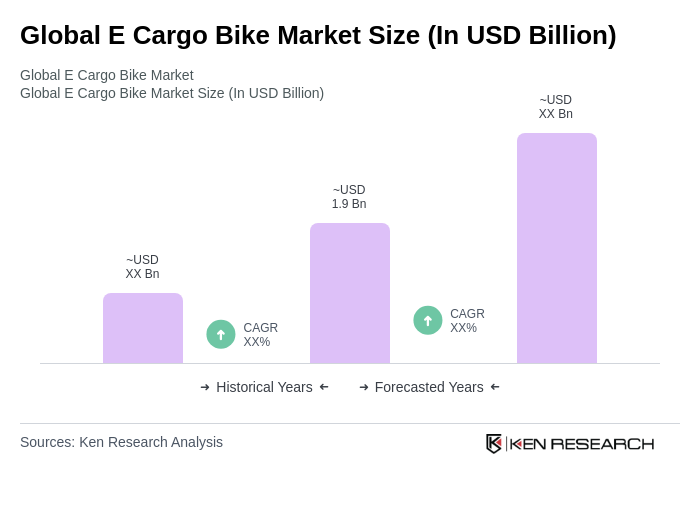
Global E Cargo Bike Market, valued at USD 1.9 billion, is growing rapidly due to urban logistics needs, environmental regulations, and e-commerce expansion.

Region:Global

Author(s):Shubham

Product Code:KRAA1800

Pages:92

Published On:August 2025
About the Report

Base Year 2024

Global E Cargo Bike Market Overview

  • The Global E Cargo Bike Market is valued at USD 1.9 billion, based on a five-year historical analysis. This update aligns with multiple industry sources reporting market sizes around the low-to-high USD 1 billion range in the latest period and up to approximately USD 1.9–2.0 billion globally, driven by rapid recent growth in electric cargo bike adoption for commercial and family use .
  • Key geographic leaders include countries such as the Netherlands and Germany in Europe and a growing base in the United States, supported by advanced cycling infrastructure, municipal and national purchase incentives, and strong last?mile logistics adoption; Germany is frequently cited as a top market by value and policy maturity, with premium brands and city logistics programs accelerating uptake .
  • The European regulatory framework for e-bikes, including cargo bikes, centers on harmonized standards such as EN 15194 and type-approval exclusions for pedelecs up to 25 km/h, with ongoing EU safety and environmental compliance requirements influencing design and market access; market analysts emphasize that policy support and standardization have underpinned safer products and broader adoption in recent years .
Global E Cargo Bike Market Size

Global E Cargo Bike Market Segmentation

By Type:The market is segmented into various types of e cargo bikes, including two-wheeled, three-wheeled, four-wheeled, and speed pedelec cargo bikes. Among these, two-wheeled cargo bikes, particularly longtail and long john models, are gaining popularity due to their versatility, maneuverability, and suitability for dense urban streets and bike lanes. The three-wheeled segment is also significant, appealing to users seeking stability, larger box volumes, and higher payloads for commercial logistics and family transport. Four-wheeled formats are emerging for heavy-duty urban logistics niches. Speed pedelec cargo models exist in some markets but face regulatory constraints and licensing requirements that limit their share compared to standard 25 km/h pedelecs .
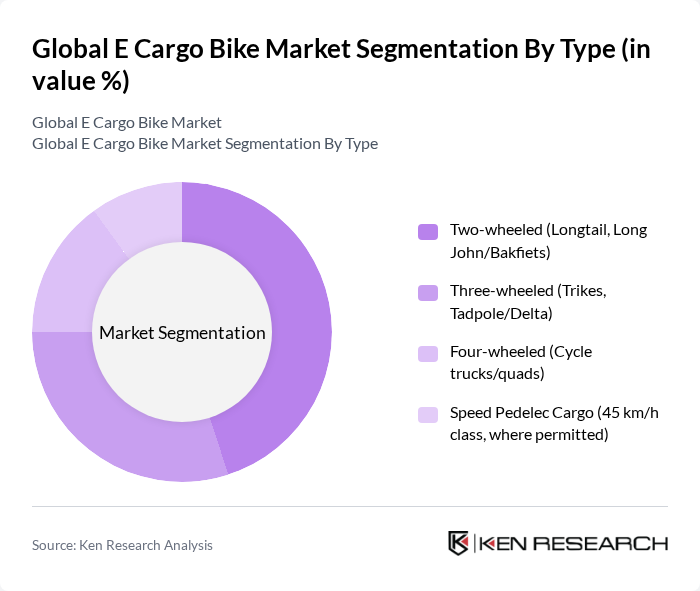
Global E Cargo Bike Market segmentation by Type.

By End-User:The e cargo bike market serves various end-users, including courier and parcel services, grocery and food delivery, retail and large suppliers, municipal and public services, and personal use. The courier and parcel segment is the largest, propelled by e-commerce growth and the cost-efficiency of replacing urban van routes with e-cargo bikes. Grocery and food delivery continues to expand as Q?commerce and restaurant delivery adopt e-cargo bikes for speed and sustainability. Municipal services use e-cargo bikes for maintenance, parks, and waste collection pilots, while personal and family use is growing, encouraged by local subsidies and family-oriented designs .

Global E Cargo Bike Market segmentation by End-User.

Global E Cargo Bike Market Competitive Landscape

The Global E Cargo Bike Market is characterized by a dynamic mix of regional and international players. Leading participants such as Rad Power Bikes, Tern Bicycles, Yuba Bicycles, Riese & Müller, Urban Arrow, Bakfiets.nl, Larry vs Harry (Bullitt), CERO Bikes, Douze Cycles, Babboe, Xtracycle, Benno Bikes, Carla Cargo, Butchers & Bicycles, Triobike contribute to innovation, geographic expansion, and service delivery in this space .

Rad Power Bikes

2007

Seattle, USA

Tern Bicycles

2011

Taipei, Taiwan

Yuba Bicycles

2006

California, USA

Riese & Müller

1993

Darmstadt, Germany

Urban Arrow

2010

Amsterdam, Netherlands

Company

Establishment Year

Headquarters

Scale (Global, Regional, Niche)

Revenue Growth Rate (YoY, last 3 years)

Installed Fleet/Units-in-Field

Market Penetration (countries served/dealer count)

Average Selling Price (ASP) Band

Product Portfolio Breadth (2W/3W/4W; family vs. commercial)

Global E Cargo Bike Market Industry Analysis

Growth Drivers

  • Increasing Urbanization:Urban areas are projected to housenearly 70% of the global population in future, according to the United Nations. This rapid urbanization leads to increased traffic congestion, prompting cities to seek efficient delivery solutions. E-cargo bikes, which can navigate through narrow streets and reduce delivery times, are becoming essential. In cities like Amsterdam, e-cargo bike usage has surged by30%in the last year, showcasing their growing acceptance as a viable urban transport solution.
  • Environmental Concerns:With global carbon emissions reaching36.4 billion metric tons, there is a pressing need for sustainable transport solutions. E-cargo bikes produce zero emissions, making them an attractive alternative for last-mile delivery. Cities are increasingly adopting green policies, with over50%of urban areas implementing low-emission zones in future. This shift is driving demand for e-cargo bikes as businesses seek to comply with environmental regulations and enhance their sustainability profiles.
  • Rising E-commerce Demand:The global e-commerce market is expected to reach$6.4 trillion, according to Statista. This surge in online shopping is creating a significant demand for efficient delivery methods. E-cargo bikes offer a flexible and cost-effective solution for last-mile delivery, particularly in urban settings. Companies like Amazon are investing in e-cargo bike fleets, with plans to deploy over10,000e-bikes in major cities in future, further driving market growth.

Market Challenges

  • High Initial Investment Costs:The average cost of an e-cargo bike ranges from$3,000 to $7,000, which can be a significant barrier for small businesses. Additionally, the cost of necessary infrastructure, such as charging stations and maintenance facilities, can further strain budgets. According to the European Cyclists' Federation, only20%of small businesses can afford the upfront investment required for e-cargo bikes, limiting market penetration and adoption rates.
  • Limited Infrastructure:Many urban areas lack the necessary infrastructure to support e-cargo bikes, such as dedicated bike lanes and parking facilities. A report from the World Bank indicates that only30%of cities worldwide have adequate cycling infrastructure. This deficiency can hinder the operational efficiency of e-cargo bikes, making it challenging for businesses to integrate them into their logistics systems effectively, thus slowing market growth.

Global E Cargo Bike Market Future Outlook

The future of the e-cargo bike market appears promising, driven by increasing urbanization and a growing emphasis on sustainability. As cities continue to implement stricter environmental regulations, the demand for zero-emission delivery solutions will rise. Additionally, advancements in battery technology and smart logistics systems are expected to enhance the efficiency and appeal of e-cargo bikes. Companies are likely to invest in innovative designs and features, making e-cargo bikes a staple in urban logistics in future.

Market Opportunities

  • Expansion into Emerging Markets:Emerging markets, particularly in Asia and Africa, are witnessing rapid urbanization and e-commerce growth. With a projected increase in urban populations by1.5 billion, there is a significant opportunity for e-cargo bike adoption. Companies can capitalize on this trend by establishing local partnerships and adapting their offerings to meet regional needs, potentially increasing market share in these high-growth areas.
  • Technological Advancements:Innovations in battery technology and smart connectivity are set to revolutionize the e-cargo bike market. The development of longer-lasting batteries and integrated GPS systems can enhance operational efficiency and user experience. As technology continues to evolve, companies that invest in R&D will be well-positioned to capture market share and meet the growing demand for efficient, high-tech delivery solutions.

Scope of the Report

SegmentSub-Segments
By Type

Two-wheeled (Longtail, Long John/Bakfiets)

Three-wheeled (Trikes, Tadpole/Delta)

Four-wheeled (Cycle trucks/quads)

Speed Pedelec Cargo (45 km/h class, where permitted)

By End-User

Courier & Parcel/Express (CEP)

Grocery & Food Delivery (Q-commerce, restaurants)

Retail & Large Suppliers (B2B intra-city)

Municipal & Public Services (waste, parks, utilities)

Personal & Family Use

By Payload Capacity

Up to 100 kg

–200 kg

–300 kg

Above 300 kg

By Battery Type

Lithium-ion (NMC, NCA, LFP)

Lead-acid

Nickel-based (NiMH/NiCd)

Swappable Battery Systems

By Sales Channel

Direct-to-Consumer (Online)

Dealer/Showroom (Offline Retail)

Direct B2B & Fleet Sales

By Distribution Mode

Direct Distribution

Third-party Logistics

Subscription/Leasing & Bike-as-a-Service

By Price Range

Budget (Under USD 2,500)

Mid-range (USD 2,500–5,000)

Premium (Above USD 5,000)

Key Target Audience

Investors and Venture Capitalist Firms

Government and Regulatory Bodies (e.g., Department of Transportation, Environmental Protection Agency)

Manufacturers and Producers

Distributors and Retailers

Logistics and Delivery Companies

Urban Planning Authorities

Environmental NGOs and Advocacy Groups

Fleet Management Companies

Players Mentioned in the Report:

Rad Power Bikes

Tern Bicycles

Yuba Bicycles

Riese & Muller

Urban Arrow

Bakfiets.nl

Larry vs Harry (Bullitt)

CERO Bikes

Douze Cycles

Babboe

Xtracycle

Benno Bikes

Carla Cargo

Butchers & Bicycles

Triobike

Table of Contents

Market Assessment Phase

1. Executive Summary and Approach


2. Global E Cargo Bike Market Overview

2.1 Key Insights and Strategic Recommendations

2.2 Global E Cargo Bike Market Overview

2.3 Definition and Scope

2.4 Evolution of Market Ecosystem

2.5 Timeline of Key Regulatory Milestones

2.6 Value Chain & Stakeholder Mapping

2.7 Business Cycle Analysis

2.8 Policy & Incentive Landscape


3. Global E Cargo Bike Market Analysis

3.1 Growth Drivers

3.1.1 Increasing Urbanization
3.1.2 Environmental Concerns
3.1.3 Government Incentives for Sustainable Transport
3.1.4 Rising E-commerce Demand

3.2 Market Challenges

3.2.1 High Initial Investment Costs
3.2.2 Limited Infrastructure
3.2.3 Regulatory Hurdles
3.2.4 Competition from Traditional Delivery Methods

3.3 Market Opportunities

3.3.1 Expansion into Emerging Markets
3.3.2 Technological Advancements
3.3.3 Partnerships with E-commerce Platforms
3.3.4 Customization and Personalization Trends

3.4 Market Trends

3.4.1 Adoption of Smart Technologies
3.4.2 Growth of Last-Mile Delivery Solutions
3.4.3 Increasing Popularity of Cargo E-bikes
3.4.4 Focus on Sustainability and Green Logistics

3.5 Government Regulation

3.5.1 Emission Standards
3.5.2 Safety Regulations for E-bikes
3.5.3 Subsidies for Electric Vehicles
3.5.4 Zoning Laws for Delivery Vehicles

4. SWOT Analysis


5. Stakeholder Analysis


6. Porter's Five Forces Analysis


7. Global E Cargo Bike Market Market Size, 2019-2024

7.1 By Value

7.2 By Volume

7.3 By Average Selling Price


8. Global E Cargo Bike Market Segmentation

8.1 By Type

8.1.1 Two-wheeled (Longtail, Long John/Bakfiets)
8.1.2 Three-wheeled (Trikes, Tadpole/Delta)
8.1.3 Four-wheeled (Cycle trucks/quads)
8.1.4 Speed Pedelec Cargo (45 km/h class, where permitted)

8.2 By End-User

8.2.1 Courier & Parcel/Express (CEP)
8.2.2 Grocery & Food Delivery (Q-commerce, restaurants)
8.2.3 Retail & Large Suppliers (B2B intra-city)
8.2.4 Municipal & Public Services (waste, parks, utilities)
8.2.5 Personal & Family Use

8.3 By Payload Capacity

8.3.1 Up to 100 kg
8.3.2 101–200 kg
8.3.3 201–300 kg
8.3.4 Above 300 kg

8.4 By Battery Type

8.4.1 Lithium-ion (NMC, NCA, LFP)
8.4.2 Lead-acid
8.4.3 Nickel-based (NiMH/NiCd)
8.4.4 Swappable Battery Systems

8.5 By Sales Channel

8.5.1 Direct-to-Consumer (Online)
8.5.2 Dealer/Showroom (Offline Retail)
8.5.3 Direct B2B & Fleet Sales

8.6 By Distribution Mode

8.6.1 Direct Distribution
8.6.2 Third-party Logistics
8.6.3 Subscription/Leasing & Bike-as-a-Service

8.7 By Price Range

8.7.1 Budget (Under USD 2,500)
8.7.2 Mid-range (USD 2,500–5,000)
8.7.3 Premium (Above USD 5,000)

9. Global E Cargo Bike Market Competitive Analysis

9.1 Market Share of Key Players

9.2 Cross Comparison of Key Players

9.2.1 Company Name
9.2.2 Scale (Global, Regional, Niche)
9.2.3 Revenue Growth Rate (YoY, last 3 years)
9.2.4 Installed Fleet/Units-in-Field
9.2.5 Market Penetration (countries served/dealer count)
9.2.6 Average Selling Price (ASP) Band
9.2.7 Product Portfolio Breadth (2W/3W/4W; family vs. commercial)
9.2.8 Motor & Battery Specs (mid-drive vs. hub; kWh; swappable)
9.2.9 Certification & Compliance (EN 15194, cargo standards)
9.2.10 After-sales & Service Coverage (service partners, SLAs)
9.2.11 Distribution Model (D2C, dealer, B2B fleet, leasing)
9.2.12 Innovation Pipeline (new models, connectivity, telematics)
9.2.13 Strategic Partnerships (logistics, motor/battery OEMs)
9.2.14 Warranty & TCO Metrics (battery warranty, maintenance cost)
9.2.15 Sustainability KPIs (recycled content, end-of-life programs)

9.3 SWOT Analysis of Top Players

9.4 Pricing Analysis

9.5 Detailed Profile of Major Companies

9.5.1 Rad Power Bikes
9.5.2 Tern Bicycles
9.5.3 Yuba Bicycles
9.5.4 Riese & Müller
9.5.5 Urban Arrow
9.5.6 Bakfiets.nl
9.5.7 Larry vs Harry (Bullitt)
9.5.8 CERO Bikes
9.5.9 Douze Cycles
9.5.10 Babboe
9.5.11 Xtracycle
9.5.12 Benno Bikes
9.5.13 Carla Cargo
9.5.14 Butchers & Bicycles
9.5.15 Triobike

10. Global E Cargo Bike Market End-User Analysis

10.1 Procurement Behavior of Key Ministries

10.1.1 Government Procurement Policies
10.1.2 Budget Allocations for Sustainable Transport
10.1.3 Evaluation Criteria for E Cargo Bikes

10.2 Corporate Spend on Infrastructure & Energy

10.2.1 Investment in Green Logistics
10.2.2 Budget for Fleet Expansion
10.2.3 Spending on Maintenance and Upgrades

10.3 Pain Point Analysis by End-User Category

10.3.1 Delivery Time Constraints
10.3.2 Cost of Ownership
10.3.3 Infrastructure Limitations

10.4 User Readiness for Adoption

10.4.1 Awareness of E Cargo Bikes
10.4.2 Training and Support Needs
10.4.3 Perceived Benefits vs. Costs

10.5 Post-Deployment ROI and Use Case Expansion

10.5.1 Measurement of Cost Savings
10.5.2 Expansion into New Markets
10.5.3 User Feedback and Iteration

11. Global E Cargo Bike Market Future Size, 2025-2030

11.1 By Value

11.2 By Volume

11.3 By Average Selling Price


Go-To-Market Strategy Phase

1. Whitespace Analysis + Business Model Canvas

1.1 Market Gaps Identification

1.2 Value Proposition Development

1.3 Revenue Streams Analysis

1.4 Cost Structure Evaluation

1.5 Key Partnerships Exploration

1.6 Customer Segmentation

1.7 Channels and Customer Relationships


2. Marketing and Positioning Recommendations

2.1 Branding Strategies

2.2 Product USPs

2.3 Target Audience Identification

2.4 Communication Strategy

2.5 Digital Marketing Tactics


3. Distribution Plan

3.1 Urban Retail Strategies

3.2 Rural NGO Tie-ups

3.3 Online Distribution Channels

3.4 Partnerships with Local Businesses


4. Channel & Pricing Gaps

4.1 Underserved Routes Analysis

4.2 Pricing Bands Evaluation

4.3 Competitor Pricing Comparison


5. Unmet Demand & Latent Needs

5.1 Category Gaps Identification

5.2 Consumer Segments Analysis

5.3 Emerging Trends Exploration


6. Customer Relationship

6.1 Loyalty Programs Development

6.2 After-sales Service Strategies

6.3 Customer Feedback Mechanisms


7. Value Proposition

7.1 Sustainability Initiatives

7.2 Integrated Supply Chains

7.3 Unique Selling Points


8. Key Activities

8.1 Regulatory Compliance

8.2 Branding Initiatives

8.3 Distribution Setup


9. Entry Strategy Evaluation

9.1 Domestic Market Entry Strategy

9.1.1 Product Mix Considerations
9.1.2 Pricing Band Strategy
9.1.3 Packaging Solutions

9.2 Export Entry Strategy

9.2.1 Target Countries Identification
9.2.2 Compliance Roadmap Development

10. Entry Mode Assessment

10.1 Joint Ventures

10.2 Greenfield Investments

10.3 Mergers & Acquisitions

10.4 Distributor Model Evaluation


11. Capital and Timeline Estimation

11.1 Capital Requirements Analysis

11.2 Timelines for Market Entry


12. Control vs Risk Trade-Off

12.1 Ownership Considerations

12.2 Partnerships Evaluation


13. Profitability Outlook

13.1 Breakeven Analysis

13.2 Long-term Sustainability Strategies


14. Potential Partner List

14.1 Distributors Identification

14.2 Joint Ventures Opportunities

14.3 Acquisition Targets


15. Execution Roadmap

15.1 Phased Plan for Market Entry

15.1.1 Market Setup
15.1.2 Market Entry
15.1.3 Growth Acceleration
15.1.4 Scale & Stabilize

15.2 Key Activities and Milestones

15.2.1 Milestone Planning
15.2.2 Activity Tracking

Research Methodology

ApproachModellingSample

Phase 1: Approach1

Desk Research

  • Industry reports from global e-commerce and logistics associations
  • Market analysis publications from environmental and transportation agencies
  • Statistical data from government transportation departments and urban planning offices

Primary Research

  • Interviews with fleet managers at logistics companies utilizing e-cargo bikes
  • Surveys with urban planners and city officials on e-cargo bike initiatives
  • Focus groups with end-users, including delivery personnel and consumers

Validation & Triangulation

  • Cross-validation of findings through multiple industry expert interviews
  • Triangulation of data from market reports, surveys, and expert opinions
  • Sanity checks through comparative analysis with similar markets

Phase 2: Market Size Estimation1

Top-down Assessment

  • Analysis of urban logistics spending and its allocation to e-cargo solutions
  • Segmentation of the market by geographic regions and application sectors
  • Incorporation of government incentives for sustainable transportation

Bottom-up Modeling

  • Volume estimates based on sales data from e-cargo bike manufacturers
  • Cost analysis derived from operational expenses of logistics providers
  • Estimation of market penetration rates across different urban areas

Forecasting & Scenario Analysis

  • Multi-variable forecasting using urbanization rates and environmental policies
  • Scenario modeling based on potential shifts in consumer behavior and regulations
  • Development of baseline, optimistic, and pessimistic market growth scenarios through 2030

Phase 3: CATI Sample Composition1

Scope Item/SegmentSample SizeTarget Respondent Profiles
Urban Delivery Services120Logistics Coordinators, Delivery Fleet Managers
Municipal Transportation Initiatives90City Planners, Transportation Policy Makers
Retail Distribution Networks70Supply Chain Managers, Retail Operations Directors
Environmental NGOs and Advocacy Groups50Sustainability Advocates, Program Directors
Consumer Feedback on E-Cargo Bikes80End-users, Delivery Personnel, Urban Commuters

Frequently Asked Questions

What is the current value of the Global E Cargo Bike Market?

The Global E Cargo Bike Market is valued at approximately USD 1.9 billion, reflecting significant growth driven by increased adoption for both commercial and family use, as well as supportive policies and infrastructure in key regions like Europe and the United States.

Which countries are leading in the e-cargo bike market?

What types of e-cargo bikes are available in the market?

Who are the primary end-users of e-cargo bikes?

Other Regional/Country Reports

Indonesia Global E Cargo Bike Market

Malaysia Global E Cargo Bike Market

KSA Global E Cargo Bike Market

APAC Global E Cargo Bike Market

SEA Global E Cargo Bike Market

Vietnam Global E Cargo Bike Market

Why Buy From Us?

Refine Robust Result (RRR) Framework

What makes us stand out is that our consultants follow Robust, Refine and Result (RRR) methodology. Robust for clear definitions, approaches and sanity checking, Refine for differentiating respondents' facts and opinions, and Result for presenting data with story.

Our Reach Is Unmatched

We have set a benchmark in the industry by offering our clients with syndicated and customized market research reports featuring coverage of entire market as well as meticulous research and analyst insights.

Shifting the Research Paradigm

While we don't replace traditional research, we flip the method upside down. Our dual approach of Top Bottom & Bottom Top ensures quality deliverable by not just verifying company fundamentals but also looking at the sector and macroeconomic factors.

More Insights-Better Decisions

With one step in the future, our research team constantly tries to show you the bigger picture. We help with some of the tough questions you may encounter along the way: How is the industry positioned? Best marketing channel? KPI's of competitors? By aligning every element, we help maximize success.

Transparency and Trust

Our report gives you instant access to the answers and sources that other companies might choose to hide. We elaborate each steps of research methodology we have used and showcase you the sample size to earn your trust.

Round the Clock Support

If you need any support, we are here! We pride ourselves on universe strength, data quality, and quick, friendly, and professional service.

Why Clients Choose Us?

400000+
Reports in repository
150+
Consulting projects a year
100+
Analysts
8000+
Client Queries in 2022








