About the Report
Base Year 2024Global E Reader Market Overview
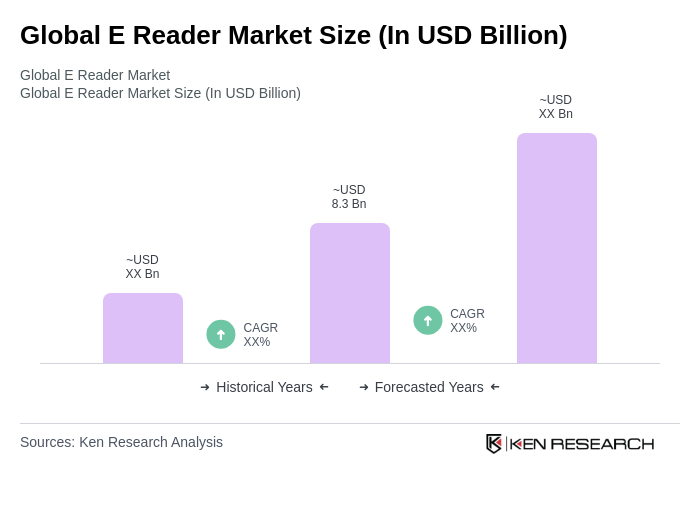
- The Global E Reader Market is valued at USD 8.3 billion, based on a five-year historical analysis. This growth is primarily driven by the increasing adoption of digital reading solutions, the proliferation of e-books, and the convenience offered by e-readers for avid readers. The market has seen a surge in demand due to the growing trend of remote learning, digital content consumption, and the integration of e-readers into educational institutions for cost-effective and efficient access to learning materials. Additional growth drivers include advancements in E-Ink technology, longer battery life, and enhanced accessibility features such as adjustable fonts and built-in dictionaries, catering to a broad demographic including students, professionals, and seniors .
- Key players in this market include the United States, Japan, and Germany, which dominate due to their advanced technological infrastructure, high literacy rates, and a strong culture of reading. The presence of major e-reader manufacturers and a robust distribution network further enhance their market position, making these countries pivotal in the global e-reader landscape .
- In 2023, the European Union implemented regulations aimed at enhancing the sustainability of electronic devices, including e-readers. This regulation mandates that manufacturers adhere to strict recycling and waste management protocols, ensuring that e-readers are designed for longevity and can be easily recycled at the end of their life cycle, promoting environmental responsibility in the tech industry .
Global E Reader Market Segmentation
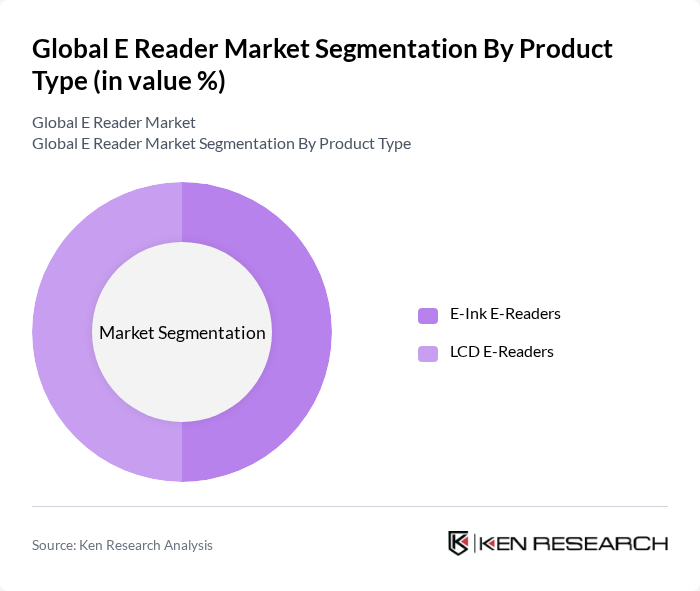
By Product Type:The e-reader market is segmented into two primary product types: E-Ink E-Readers and LCD E-Readers. E-Ink E-Readers are favored for their paper-like display, which reduces eye strain and enhances battery life, making them ideal for long reading sessions. LCD E-Readers, while offering vibrant color displays, are less popular for extended reading due to their backlit screens. The E-Ink segment dominates the market due to its advantages in reading comfort, battery efficiency, and glare-free screens, which are particularly valued by frequent readers and students .
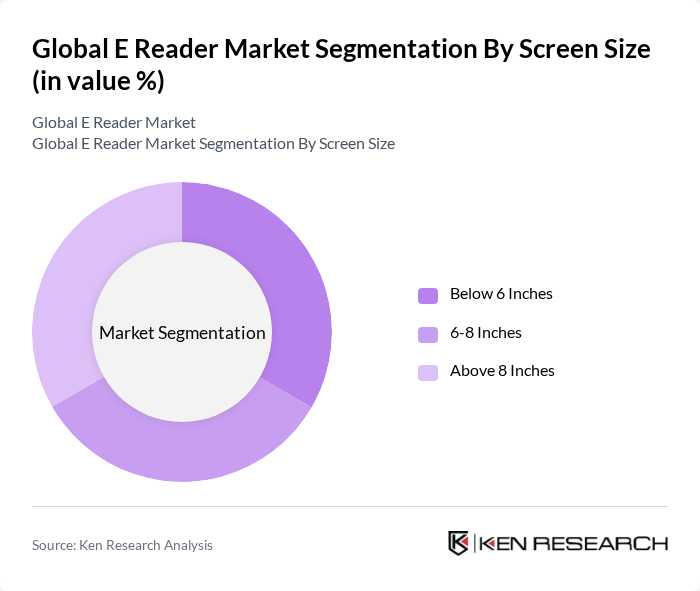
By Screen Size:The market is further segmented by screen size into Below 6 Inches, 6-8 Inches, and Above 8 Inches. The 6-8 inches segment is the most popular among consumers, as it strikes a balance between portability and readability. Devices in this range are lightweight and easy to carry, making them suitable for both casual and avid readers. The demand for larger screens is also growing, particularly among users who prefer a more immersive reading experience or require larger fonts for accessibility. Compact models below 6 inches appeal to users prioritizing portability, while above 8 inches cater to those seeking enhanced visual comfort for graphic-rich content .
Global E Reader Market Competitive Landscape
The Global E Reader Market is characterized by a dynamic mix of regional and international players. Leading participants such as Amazon (Kindle), Rakuten Kobo Inc., Barnes & Noble (Nook), PocketBook International S.A., Onyx International Inc. (Boox), Sony Corporation, Bookeen, Tolino Alliance, reMarkable AS, Hanvon Technology Co., Ltd., Ectaco Inc., Aluratek Inc., iRiver (Dreamus Company), PocketBook Readers, Boyue Technology (Likebook) contribute to innovation, geographic expansion, and service delivery in this space.
Global E Reader Market Industry Analysis
Growth Drivers
- Increasing Adoption of Digital Reading:The global digital reading market is projected to reach approximately 1.2 billion users in future, driven by the convenience of accessing vast libraries of content. The World Bank reports that internet penetration in developing regions is expected to rise to approximately 60% in future, facilitating digital reading adoption. Additionally, the rise of mobile internet usage, which is forecasted to reach 5.3 billion users globally in future, supports the shift towards e-readers as a primary reading medium.
- Rising Demand for Portable Reading Devices:The demand for portable reading devices is surging, with the portable electronics market expected to grow to $1.5 trillion in future. This growth is fueled by the increasing number of commuters and travelers seeking lightweight, easy-to-carry devices. According to the International Air Transport Association, global air passenger numbers are projected to reach 4.3 billion in future, highlighting the need for portable reading solutions like e-readers during travel.
- Technological Advancements in Display Technology:Innovations in display technology, such as E Ink and color e-paper, are enhancing the reading experience. The global e-paper display market is expected to grow to $10 billion in future, driven by advancements that improve readability and reduce eye strain. Furthermore, the introduction of flexible displays is anticipated to create new opportunities for e-reader manufacturers, allowing for more versatile and user-friendly designs.
Market Challenges
- Competition from Tablets and Smartphones:The e-reader market faces significant competition from tablets and smartphones, which are projected to reach 2.5 billion units sold globally in future. These devices offer multifunctionality, including web browsing and gaming, which can detract from e-reader sales. As consumers increasingly prefer all-in-one devices, e-reader manufacturers must innovate to differentiate their products and maintain market share.
- Limited Content Availability in Certain Regions:Content availability remains a challenge, particularly in emerging markets where e-book distribution is limited. For instance, only 30% of e-books are available in regions like Sub-Saharan Africa, according to the International Publishers Association. This lack of access can hinder the growth of e-reader adoption, as consumers are less likely to invest in devices without a robust library of available titles.
Global E Reader Market Future Outlook
The future of the e-reader market appears promising, driven by technological advancements and changing consumer preferences. As digital literacy improves and internet access expands, particularly in emerging markets, the adoption of e-readers is expected to increase. Additionally, the integration of AI and personalized reading experiences will likely enhance user engagement, making e-readers more appealing. Companies that adapt to these trends and focus on innovative features will be well-positioned for growth in the coming years.
Market Opportunities
- Expansion into Emerging Markets:There is significant potential for e-reader manufacturers to expand into emerging markets, where internet access is rapidly increasing. With over 1 billion new internet users expected in future, companies can tap into this growing consumer base by offering affordable e-readers tailored to local preferences and content needs.
- Growth of Subscription-Based E-Book Services:The rise of subscription-based e-book services presents a lucrative opportunity for e-reader manufacturers. With the global subscription e-book market projected to reach $3 billion in future, partnerships with service providers can enhance the value proposition of e-readers, attracting more users and driving sales through bundled offerings.
Scope of the Report
| Segment | Sub-Segments |
|---|---|
| By Product Type | E-Ink E-Readers LCD E-Readers |
| By Screen Size | Below 6 Inches 8 Inches Above 8 Inches |
| By Connectivity | Wi-Fi Only Wi-Fi + Cellular (3G/4G) |
| By End-User | Individual Consumers Educational Institutions Libraries Corporates/Commercial |
| By Distribution Channel | Online Retail Offline Retail Direct Sales |
| By Price Range | Budget E-Readers Mid-Range E-Readers Premium E-Readers |
| By Region | North America Europe Asia Pacific Latin America Middle East & Africa |
Key Target Audience
Investors and Venture Capitalist Firms
Government and Regulatory Bodies (e.g., Federal Communications Commission, European Commission)
Manufacturers and Producers
Distributors and Retailers
Content Publishers and Authors
Technology Providers
Industry Associations
Financial Institutions
Players Mentioned in the Report:
Amazon (Kindle)
Rakuten Kobo Inc.
Barnes & Noble (Nook)
PocketBook International S.A.
Onyx International Inc. (Boox)
Sony Corporation
Bookeen
Tolino Alliance
reMarkable AS
Hanvon Technology Co., Ltd.
Ectaco Inc.
Aluratek Inc.
iRiver (Dreamus Company)
PocketBook Readers
Boyue Technology (Likebook)
Table of Contents
Market Assessment Phase
1. Executive Summary and Approach
2. Global E Reader Market Overview
2.1 Key Insights and Strategic Recommendations
2.2 Global E Reader Market Overview
2.3 Definition and Scope
2.4 Evolution of Market Ecosystem
2.5 Timeline of Key Regulatory Milestones
2.6 Value Chain & Stakeholder Mapping
2.7 Business Cycle Analysis
2.8 Policy & Incentive Landscape
3. Global E Reader Market Analysis
3.1 Growth Drivers
3.1.1 Increasing Adoption of Digital Reading
3.1.2 Rising Demand for Portable Reading Devices
3.1.3 Growth of E-Book Publishing
3.1.4 Technological Advancements in Display Technology
3.2 Market Challenges
3.2.1 Competition from Tablets and Smartphones
3.2.2 Limited Content Availability in Certain Regions
3.2.3 Price Sensitivity Among Consumers
3.2.4 Rapid Technological Changes
3.3 Market Opportunities
3.3.1 Expansion into Emerging Markets
3.3.2 Development of Multi-Functional E Readers
3.3.3 Partnerships with Educational Institutions
3.3.4 Growth of Subscription-Based E-Book Services
3.4 Market Trends
3.4.1 Increasing Popularity of Audiobooks
3.4.2 Integration of AI and Machine Learning
3.4.3 Focus on Eco-Friendly Materials
3.4.4 Rise of Personalized Reading Experiences
3.5 Government Regulation
3.5.1 Copyright Laws Affecting E-Book Distribution
3.5.2 Regulations on Digital Content Accessibility
3.5.3 Import Tariffs on Electronic Devices
3.5.4 Data Privacy Regulations Impacting User Data
4. SWOT Analysis
5. Stakeholder Analysis
6. Porter's Five Forces Analysis
7. Global E Reader Market Market Size, 2019-2024
7.1 By Value
7.2 By Volume
7.3 By Average Selling Price
8. Global E Reader Market Segmentation
8.1 By Product Type
8.1.1 E-Ink E-Readers
8.1.2 LCD E-Readers
8.2 By Screen Size
8.2.1 Below 6 Inches
8.2.2 6-8 Inches
8.2.3 Above 8 Inches
8.3 By Connectivity
8.3.1 Wi-Fi Only
8.3.2 Wi-Fi + Cellular (3G/4G)
8.4 By End-User
8.4.1 Individual Consumers
8.4.2 Educational Institutions
8.4.3 Libraries
8.4.4 Corporates/Commercial
8.5 By Distribution Channel
8.5.1 Online Retail
8.5.2 Offline Retail
8.5.3 Direct Sales
8.6 By Price Range
8.6.1 Budget E-Readers
8.6.2 Mid-Range E-Readers
8.6.3 Premium E-Readers
8.7 By Region
8.7.1 North America
8.7.2 Europe
8.7.3 Asia Pacific
8.7.4 Latin America
8.7.5 Middle East & Africa
9. Global E Reader Market Competitive Analysis
9.1 Market Share of Key Players
9.2 KPIs for Cross Comparison of Key Players
9.2.1 Company Name
9.2.2 Market Share (%)
9.2.3 Revenue (USD Million)
9.2.4 Revenue Growth Rate (%)
9.2.5 Geographic Presence (No. of Countries/Regions)
9.2.6 Product Portfolio Breadth (No. of Models)
9.2.7 R&D Investment (% of Revenue)
9.2.8 Average Selling Price (USD)
9.2.9 Customer Satisfaction Score (NPS or Equivalent)
9.2.10 Distribution Channel Mix (%)
9.2.11 After-Sales Service Coverage (Regions/Score)
9.2.12 Sustainability Initiatives (Qualitative/Quantitative)
9.3 SWOT Analysis of Top Players
9.4 Pricing Analysis
9.5 Detailed Profile of Major Companies
9.5.1 Amazon (Kindle)
9.5.2 Rakuten Kobo Inc.
9.5.3 Barnes & Noble (Nook)
9.5.4 PocketBook International S.A.
9.5.5 Onyx International Inc. (Boox)
9.5.6 Sony Corporation
9.5.7 Bookeen
9.5.8 Tolino Alliance
9.5.9 reMarkable AS
9.5.10 Hanvon Technology Co., Ltd.
9.5.11 Ectaco Inc.
9.5.12 Aluratek Inc.
9.5.13 iRiver (Dreamus Company)
9.5.14 PocketBook Readers
9.5.15 Boyue Technology (Likebook)
10. Global E Reader Market End-User Analysis
10.1 Procurement Behavior of Key Ministries
10.1.1 Budget Allocation for E-Readers
10.1.2 Decision-Making Process
10.1.3 Preferred Brands
10.1.4 Usage Statistics
10.2 Corporate Spend on Infrastructure & Energy
10.2.1 Investment in Digital Learning Tools
10.2.2 Budget for E-Reader Procurement
10.2.3 Trends in Corporate E-Reader Usage
10.3 Pain Point Analysis by End-User Category
10.3.1 Content Accessibility Issues
10.3.2 Device Compatibility Challenges
10.3.3 User Interface Concerns
10.4 User Readiness for Adoption
10.4.1 Awareness of E-Readers
10.4.2 Training Needs
10.4.3 Support Requirements
10.5 Post-Deployment ROI and Use Case Expansion
10.5.1 Measurement of ROI
10.5.2 Expansion into New Use Cases
10.5.3 User Feedback Mechanisms
11. Global E Reader Market Future Size, 2025-2030
11.1 By Value
11.2 By Volume
11.3 By Average Selling Price
Go-To-Market Strategy Phase
1. Whitespace Analysis + Business Model Canvas
1.1 Market Gaps Identification
1.2 Value Proposition Development
1.3 Revenue Streams Analysis
1.4 Cost Structure Evaluation
1.5 Key Partnerships Exploration
1.6 Customer Segmentation
1.7 Channels of Distribution
2. Marketing and Positioning Recommendations
2.1 Branding Strategies
2.2 Product USPs
2.3 Target Audience Identification
2.4 Marketing Channels
2.5 Promotional Strategies
3. Distribution Plan
3.1 Urban Retail Strategies
3.2 Rural NGO Tie-Ups
3.3 Online Distribution Channels
3.4 Partnerships with Retailers
4. Channel & Pricing Gaps
4.1 Underserved Routes
4.2 Pricing Bands Analysis
4.3 Competitor Pricing Strategies
5. Unmet Demand & Latent Needs
5.1 Category Gaps
5.2 Consumer Segments Analysis
5.3 Emerging Trends
6. Customer Relationship
6.1 Loyalty Programs
6.2 After-Sales Service
6.3 Customer Feedback Mechanisms
7. Value Proposition
7.1 Sustainability Initiatives
7.2 Integrated Supply Chains
7.3 Unique Selling Points
8. Key Activities
8.1 Regulatory Compliance
8.2 Branding Efforts
8.3 Distribution Setup
9. Entry Strategy Evaluation
9.1 Domestic Market Entry Strategy
9.1.1 Product Mix Considerations
9.1.2 Pricing Band Strategy
9.1.3 Packaging Options
9.2 Export Entry Strategy
9.2.1 Target Countries
9.2.2 Compliance Roadmap
10. Entry Mode Assessment
10.1 Joint Ventures
10.2 Greenfield Investments
10.3 Mergers & Acquisitions
10.4 Distributor Model
11. Capital and Timeline Estimation
11.1 Capital Requirements
11.2 Timelines for Market Entry
12. Control vs Risk Trade-Off
12.1 Ownership vs Partnerships
13. Profitability Outlook
13.1 Breakeven Analysis
13.2 Long-Term Sustainability
14. Potential Partner List
14.1 Distributors
14.2 Joint Ventures
14.3 Acquisition Targets
15. Execution Roadmap
15.1 Phased Plan for Market Entry
15.1.1 Market Setup
15.1.2 Market Entry
15.1.3 Growth Acceleration
15.1.4 Scale & Stabilize
15.2 Key Activities and Milestones
15.2.1 Milestone Planning
15.2.2 Activity Tracking
Research Methodology
Phase 1: Approach1
Desk Research
- Market reports from industry associations and e-reader manufacturers
- Analysis of consumer behavior studies and digital reading trends
- Review of technological advancements in e-reader devices and software
Primary Research
- Interviews with product managers at leading e-reader companies
- Surveys targeting end-users to understand preferences and usage patterns
- Focus groups with educators and students to gauge market needs
Validation & Triangulation
- Cross-validation of findings with sales data from major e-commerce platforms
- Triangulation of insights from consumer surveys and expert interviews
- Sanity checks through feedback from industry experts and analysts
Phase 2: Market Size Estimation1
Top-down Assessment
- Estimation of total addressable market based on global digital content consumption
- Segmentation by geographical regions and demographic profiles
- Incorporation of trends in digital education and remote learning
Bottom-up Modeling
- Sales volume data from major e-reader manufacturers and retailers
- Average selling price analysis across different e-reader models
- Estimation of market penetration rates in various consumer segments
Forecasting & Scenario Analysis
- Multi-variable forecasting based on technological adoption rates and market growth
- Scenario analysis considering economic factors and consumer spending behavior
- Baseline, optimistic, and pessimistic projections through 2030
Phase 3: CATI Sample Composition1
| Scope Item/Segment | Sample Size | Target Respondent Profiles |
|---|---|---|
| Consumer E-Reader Usage | 120 | Frequent Readers, Casual Users |
| Educational Institutions Adoption | 80 | Teachers, School Administrators |
| Library Digital Lending Programs | 60 | Librarians, Program Coordinators |
| Retail Market Insights | 90 | Retail Managers, Sales Associates |
| Content Providers and Publishers | 70 | Publishing Executives, Content Strategists |
Frequently Asked Questions
What is the current value of the Global E Reader Market?
The Global E Reader Market is valued at approximately USD 8.3 billion, reflecting a significant growth trend driven by the increasing adoption of digital reading solutions and the rising demand for e-books and portable reading devices.
What factors are driving the growth of the Global E Reader Market?
Which countries dominate the Global E Reader Market?
What are the main product types in the Global E Reader Market?
Other Regional/Country Reports
Indonesia E Reader Market
Malaysia E Reader Market
APAC E Reader Market
SEA E Reader Market
Why Buy From Us?

What makes us stand out is that our consultants follow Robust, Refine and Result (RRR) methodology. Robust for clear definitions, approaches and sanity checking, Refine for differentiating respondents' facts and opinions, and Result for presenting data with story.

We have set a benchmark in the industry by offering our clients with syndicated and customized market research reports featuring coverage of entire market as well as meticulous research and analyst insights.

While we don't replace traditional research, we flip the method upside down. Our dual approach of Top Bottom & Bottom Top ensures quality deliverable by not just verifying company fundamentals but also looking at the sector and macroeconomic factors.

With one step in the future, our research team constantly tries to show you the bigger picture. We help with some of the tough questions you may encounter along the way: How is the industry positioned? Best marketing channel? KPI's of competitors? By aligning every element, we help maximize success.

Our report gives you instant access to the answers and sources that other companies might choose to hide. We elaborate each steps of research methodology we have used and showcase you the sample size to earn your trust.

If you need any support, we are here! We pride ourselves on universe strength, data quality, and quick, friendly, and professional service.