About the Report
Base Year 2024Listen to the audio summary
Global Edutainment Market Overview
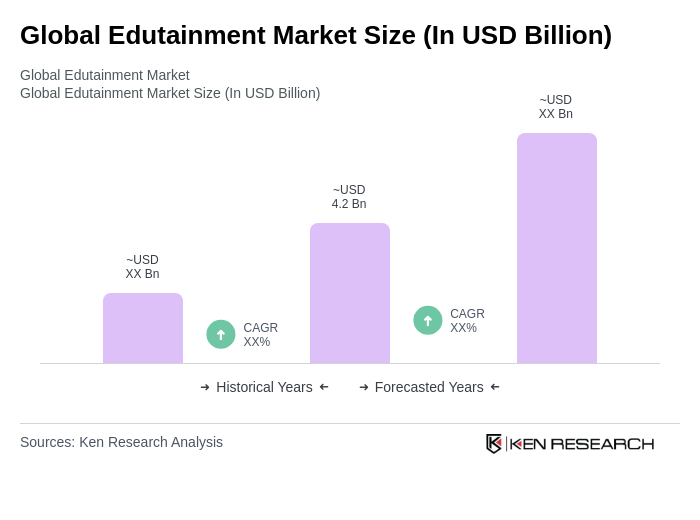
- The Global Edutainment Market is valued at USD 4.2 billion, based on a five-year historical analysis. This growth is primarily driven by the increasing integration of technology in education, the rising demand for interactive learning experiences, and the growing popularity of gamified learning solutions among various age groups .
- Key players in this market include the United States, China, and Germany, which dominate due to their advanced technological infrastructure, significant investments in educational technology, and a strong consumer base that values innovative learning methods. These countries have established themselves as leaders in the edutainment sector by fostering a culture of creativity and learning .
- In 2023, the European Union implemented regulations aimed at enhancing digital education accessibility. This initiative mandates that all educational content must be inclusive and accessible to individuals with disabilities, ensuring that edutainment products cater to a diverse audience and promote equal learning opportunities .
Global Edutainment Market Segmentation
By Type:The edutainment market is segmented into various types, including Educational Games (digital and physical), Interactive Learning Apps, Online Courses & MOOCs, Virtual Reality (VR) Learning Experiences, Augmented Reality (AR) Applications, Simulation & Gamified Learning Tools, and Edutainment Centers & Location-Based Experiences. Among these, Online Courses & MOOCs have emerged as the leading sub-segment due to the increasing demand for flexible learning options and the rise of remote education. The convenience and accessibility of online courses have attracted a wide range of learners, from students to professionals seeking to upskill .

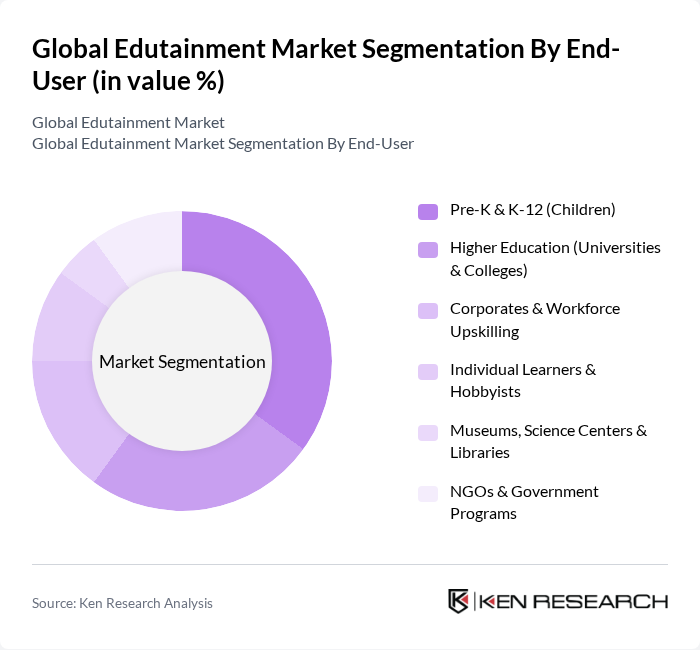
By End-User:The end-user segmentation includes Pre-K & K-12 (Children), Higher Education (Universities & Colleges), Corporates & Workforce Upskilling, Individual Learners & Hobbyists, Museums, Science Centers & Libraries, and NGOs & Government Programs. The Pre-K & K-12 segment is currently the most dominant, driven by the increasing adoption of technology in early education and the growing emphasis on interactive learning methods that engage young learners effectively. This segment benefits from a strong push towards STEM education and the integration of digital tools in classrooms .
Global Edutainment Market Competitive Landscape
The Global Edutainment Market is characterized by a dynamic mix of regional and international players. Leading participants such as KidZania, Merlin Entertainments (LEGOLAND Discovery Center), Sesame Workshop, ABCmouse.com (Age of Learning, Inc.), Kahoot! ASA, Duolingo, Inc., Coursera Inc., Quizlet Inc., BYJU'S, Osmo (Tangible Play Inc.), LeapFrog Enterprises, Inc., National Geographic Kids, Discovery Kids, CurioCity Group Inc., EON Reality, Inc. contribute to innovation, geographic expansion, and service delivery in this space.
Global Edutainment Market Industry Analysis
Growth Drivers
- Increasing Demand for Interactive Learning Experiences:The global edutainment sector is witnessing a surge in demand for interactive learning experiences, driven by a 30% increase in the adoption of e-learning platforms from 2020 to 2023. According to the World Bank, educational institutions are increasingly integrating technology into curricula, with over 60% of schools in developed regions utilizing interactive tools. This shift is supported by a growing recognition of the effectiveness of experiential learning, which enhances student engagement and retention rates.
- Rise in Digital Content Consumption:Digital content consumption has skyrocketed, with global internet users reaching 5.4 billion in future, according to the International Telecommunication Union. This trend is particularly evident in the education sector, where online video consumption has increased by 80% since 2020. The proliferation of smartphones and tablets has facilitated access to educational content, enabling learners to engage with edutainment resources anytime, anywhere, thus driving market growth significantly.
- Growth of Gamification in Education:The incorporation of gamification in educational settings has gained traction, with a reported 70% of educators using game-based learning techniques in their classrooms. Research from the Institute for Educational Sciences indicates that gamified learning can improve student motivation and performance by up to 50%. This trend is bolstered by the increasing availability of gamified edutainment platforms, which cater to diverse learning styles and preferences, enhancing overall educational outcomes.
Market Challenges
- High Competition Among Content Providers:The edutainment market is characterized by intense competition, with over 1,500 companies offering various educational content and platforms. This saturation leads to challenges in differentiation and customer retention. According to a report by IBISWorld, the average profit margin in the educational content sector is only 10%, making it difficult for new entrants to establish a foothold without significant investment in marketing and innovation.
- Rapid Technological Changes:The fast-paced evolution of technology poses a significant challenge for edutainment providers. With advancements in artificial intelligence, virtual reality, and mobile applications occurring at an unprecedented rate, companies must continuously adapt their offerings. A survey by Deloitte found that 65% of educational technology firms struggle to keep up with technological advancements, risking obsolescence and loss of market share if they fail to innovate effectively.
Global Edutainment Market Future Outlook
The future of the edutainment market appears promising, driven by ongoing technological advancements and a growing emphasis on personalized learning experiences. As educational institutions increasingly adopt innovative tools, the integration of augmented and virtual reality is expected to enhance engagement. Furthermore, the rise of artificial intelligence in edutainment solutions will facilitate tailored learning paths, catering to individual student needs. This evolution will likely lead to a more dynamic and interactive educational landscape, fostering improved learning outcomes across diverse demographics.
Market Opportunities
- Increasing Investment in Educational Technology:Investment in educational technology is projected to reach USD 400 billion in future, according to HolonIQ. This influx of capital presents significant opportunities for edutainment providers to develop innovative solutions that enhance learning experiences. Companies that capitalize on this trend can create cutting-edge products that meet the evolving demands of educators and learners alike.
- Partnerships with Educational Institutions:Collaborations between edutainment companies and educational institutions are on the rise, with over 40% of schools seeking partnerships to enhance their curriculum. These alliances can lead to the co-creation of tailored content that addresses specific educational needs, providing a competitive edge. Such partnerships not only expand market reach but also foster innovation in educational methodologies.
Scope of the Report
| Segment | Sub-Segments |
|---|---|
| By Type | Educational Games (digital and physical) Interactive Learning Apps Online Courses & MOOCs Virtual Reality (VR) Learning Experiences Augmented Reality (AR) Applications Simulation & Gamified Learning Tools Edutainment Centers & Location-Based Experiences |
| By End-User | Pre-K & K-12 (Children) Higher Education (Universities & Colleges) Corporates & Workforce Upskilling Individual Learners & Hobbyists Museums, Science Centers & Libraries NGOs & Government Programs |
| By Content Format | Video & Animated Content Text & Interactive eBooks Audio & Podcasts Quizzes, Puzzles & Assessments Simulations & Serious Games Mixed Reality (AR/VR/MR) Content |
| By Distribution Channel | Online Platforms & Marketplaces Mobile Applications (iOS/Android) Physical Venues (Edutainment Centers, Museums) Direct Enterprise/Education Sales Partnerships with Educational Institutions OEM/Device Bundles & Others |
| By Pricing Model | Subscription (B2C/B2B, SaaS) One-Time Purchase/Lifetime License Freemium with In-App Purchases Pay-Per-Use/Transaction Advertising-Driven & Sponsorship |
| By Age Group | Children (0-12 years) Teenagers (13-19 years) Young Adults (20-35 years) Adults (36-60 years) Seniors (60+ years) |
| By Geographic Focus | North America Europe Asia-Pacific Latin America Middle East & Africa Others |
Key Target Audience
Investors and Venture Capitalist Firms
Government and Regulatory Bodies (e.g., U.S. Department of Education, European Commission)
Manufacturers and Producers
Distributors and Retailers
Content Creators and Developers
Technology Providers
Industry Associations
Financial Institutions
Players Mentioned in the Report:
KidZania
Merlin Entertainments (LEGOLAND Discovery Center)
Sesame Workshop
ABCmouse.com (Age of Learning, Inc.)
Kahoot! ASA
Duolingo, Inc.
Coursera Inc.
Quizlet Inc.
BYJU'S
Osmo (Tangible Play Inc.)
LeapFrog Enterprises, Inc.
National Geographic Kids
Discovery Kids
CurioCity Group Inc.
EON Reality, Inc.
Table of Contents
Market Assessment Phase
1. Executive Summary and Approach
2. Global Edutainment Market Overview
2.1 Key Insights and Strategic Recommendations
2.2 Global Edutainment Market Overview
2.3 Definition and Scope
2.4 Evolution of Market Ecosystem
2.5 Timeline of Key Regulatory Milestones
2.6 Value Chain & Stakeholder Mapping
2.7 Business Cycle Analysis
2.8 Policy & Incentive Landscape
3. Global Edutainment Market Analysis
3.1 Growth Drivers
3.1.1 Increasing demand for interactive learning experiences
3.1.2 Rise in digital content consumption
3.1.3 Growth of gamification in education
3.1.4 Expansion of mobile learning platforms
3.2 Market Challenges
3.2.1 High competition among content providers
3.2.2 Rapid technological changes
3.2.3 Limited access to technology in developing regions
3.2.4 Regulatory hurdles in content distribution
3.3 Market Opportunities
3.3.1 Increasing investment in educational technology
3.3.2 Partnerships with educational institutions
3.3.3 Growth in online learning platforms
3.3.4 Expansion into emerging markets
3.4 Market Trends
3.4.1 Shift towards personalized learning experiences
3.4.2 Integration of AR/VR in educational content
3.4.3 Focus on STEAM education initiatives
3.4.4 Increasing use of AI in edutainment solutions
3.5 Government Regulation
3.5.1 Standards for educational content quality
3.5.2 Data privacy regulations for student information
3.5.3 Funding programs for educational technology
3.5.4 Compliance requirements for online platforms
4. SWOT Analysis
5. Stakeholder Analysis
6. Porter's Five Forces Analysis
7. Global Edutainment Market Market Size, 2019-2024
7.1 By Value
7.2 By Volume
7.3 By Average Selling Price
8. Global Edutainment Market Segmentation
8.1 By Type
8.1.1 Educational Games (digital and physical)
8.1.2 Interactive Learning Apps
8.1.3 Online Courses & MOOCs
8.1.4 Virtual Reality (VR) Learning Experiences
8.1.5 Augmented Reality (AR) Applications
8.1.6 Simulation & Gamified Learning Tools
8.1.7 Edutainment Centers & Location-Based Experiences
8.2 By End-User
8.2.1 Pre-K & K-12 (Children)
8.2.2 Higher Education (Universities & Colleges)
8.2.3 Corporates & Workforce Upskilling
8.2.4 Individual Learners & Hobbyists
8.2.5 Museums, Science Centers & Libraries
8.2.6 NGOs & Government Programs
8.3 By Content Format
8.3.1 Video & Animated Content
8.3.2 Text & Interactive eBooks
8.3.3 Audio & Podcasts
8.3.4 Quizzes, Puzzles & Assessments
8.3.5 Simulations & Serious Games
8.3.6 Mixed Reality (AR/VR/MR) Content
8.4 By Distribution Channel
8.4.1 Online Platforms & Marketplaces
8.4.2 Mobile Applications (iOS/Android)
8.4.3 Physical Venues (Edutainment Centers, Museums)
8.4.4 Direct Enterprise/Education Sales
8.4.5 Partnerships with Educational Institutions
8.4.6 OEM/Device Bundles & Others
8.5 By Pricing Model
8.5.1 Subscription (B2C/B2B, SaaS)
8.5.2 One-Time Purchase/Lifetime License
8.5.3 Freemium with In-App Purchases
8.5.4 Pay-Per-Use/Transaction
8.5.5 Advertising-Driven & Sponsorship
8.6 By Age Group
8.6.1 Children (0-12 years)
8.6.2 Teenagers (13-19 years)
8.6.3 Young Adults (20-35 years)
8.6.4 Adults (36-60 years)
8.6.5 Seniors (60+ years)
8.7 By Geographic Focus
8.7.1 North America
8.7.2 Europe
8.7.3 Asia-Pacific
8.7.4 Latin America
8.7.5 Middle East & Africa
8.7.6 Others
9. Global Edutainment Market Competitive Analysis
9.1 Market Share of Key Players
9.2 Cross Comparison of Key Players
9.2.1 Company Name
9.2.2 Company Type (Digital Platform, Edutainment Center, Hardware-Integrated, Content Studio)
9.2.3 Revenue Growth Rate (YoY %)
9.2.4 Monthly Active Users (MAUs) / Visitor Footfall
9.2.5 Customer Acquisition Cost (CAC)
9.2.6 Customer Retention/Churn Rate
9.2.7 ARPU/ARPPU (Average Revenue per User/Paid User)
9.2.8 Conversion Rate (Free-to-Paid)
9.2.9 Content Release Velocity (new titles/modules per quarter)
9.2.10 Engagement Depth (session length, days-7/30 retention)
9.2.11 Geographic Reach (countries, languages supported)
9.2.12 Unit Economics (LTV:CAC ratio)
9.3 SWOT Analysis of Top Players
9.4 Pricing Analysis
9.5 Detailed Profile of Major Companies
9.5.1 KidZania
9.5.2 Merlin Entertainments (LEGOLAND Discovery Center)
9.5.3 Sesame Workshop
9.5.4 ABCmouse.com (Age of Learning, Inc.)
9.5.5 Kahoot! ASA
9.5.6 Duolingo, Inc.
9.5.7 Coursera Inc.
9.5.8 Quizlet Inc.
9.5.9 BYJU'S
9.5.10 Osmo (Tangible Play Inc.)
9.5.11 LeapFrog Enterprises, Inc.
9.5.12 National Geographic Kids
9.5.13 Discovery Kids
9.5.14 CurioCity Group Inc.
9.5.15 EON Reality, Inc.
10. Global Edutainment Market End-User Analysis
10.1 Procurement Behavior of Key Ministries
10.1.1 Budget Allocation for Edutainment
10.1.2 Decision-Making Processes
10.1.3 Preferred Content Formats
10.1.4 Evaluation Criteria for Suppliers
10.2 Corporate Spend on Infrastructure & Energy
10.2.1 Investment in Learning Technologies
10.2.2 Budget Trends for Edutainment Solutions
10.2.3 Spending on Employee Training Programs
10.3 Pain Point Analysis by End-User Category
10.3.1 Content Accessibility Issues
10.3.2 Engagement Challenges
10.3.3 Technology Integration Difficulties
10.4 User Readiness for Adoption
10.4.1 Awareness of Edutainment Solutions
10.4.2 Willingness to Invest in New Technologies
10.4.3 Training Needs for Effective Use
10.5 Post-Deployment ROI and Use Case Expansion
10.5.1 Measurement of Learning Outcomes
10.5.2 User Feedback Mechanisms
10.5.3 Opportunities for Upselling
11. Global Edutainment Market Future Size, 2025-2030
11.1 By Value
11.2 By Volume
11.3 By Average Selling Price
Go-To-Market Strategy Phase
1. Whitespace Analysis + Business Model Canvas
1.1 Market Gaps Identification
1.2 Value Proposition Development
1.3 Revenue Streams Analysis
1.4 Cost Structure Evaluation
1.5 Key Partnerships Exploration
1.6 Customer Segmentation
1.7 Channels of Distribution
2. Marketing and Positioning Recommendations
2.1 Branding Strategies
2.2 Product USPs
2.3 Target Audience Identification
2.4 Communication Strategies
2.5 Digital Marketing Approaches
3. Distribution Plan
3.1 Urban Retail Strategies
3.2 Rural NGO Tie-Ups
3.3 Online Distribution Channels
3.4 Partnerships with Educational Institutions
4. Channel & Pricing Gaps
4.1 Underserved Routes
4.2 Pricing Bands Analysis
4.3 Competitor Pricing Strategies
5. Unmet Demand & Latent Needs
5.1 Category Gaps Identification
5.2 Consumer Segments Analysis
5.3 Emerging Trends Exploration
6. Customer Relationship
6.1 Loyalty Programs
6.2 After-Sales Service
6.3 Customer Feedback Mechanisms
7. Value Proposition
7.1 Sustainability Initiatives
7.2 Integrated Supply Chains
7.3 Unique Selling Points
8. Key Activities
8.1 Regulatory Compliance
8.2 Branding Efforts
8.3 Distribution Setup
9. Entry Strategy Evaluation
9.1 Domestic Market Entry Strategy
9.1.1 Product Mix Considerations
9.1.2 Pricing Band Strategy
9.1.3 Packaging Options
9.2 Export Entry Strategy
9.2.1 Target Countries Identification
9.2.2 Compliance Roadmap Development
10. Entry Mode Assessment
10.1 Joint Ventures
10.2 Greenfield Investments
10.3 Mergers & Acquisitions
10.4 Distributor Model Evaluation
11. Capital and Timeline Estimation
11.1 Capital Requirements Analysis
11.2 Timelines for Market Entry
12. Control vs Risk Trade-Off
12.1 Ownership vs Partnerships
13. Profitability Outlook
13.1 Breakeven Analysis
13.2 Long-Term Sustainability Strategies
14. Potential Partner List
14.1 Distributors
14.2 Joint Ventures
14.3 Acquisition Targets
15. Execution Roadmap
15.1 Phased Plan for Market Entry
15.1.1 Market Setup
15.1.2 Market Entry
15.1.3 Growth Acceleration
15.1.4 Scale & Stabilize
15.2 Key Activities and Milestones
15.2.1 Milestone Planning
15.2.2 Activity Tracking
Research Methodology
Phase 1: Approach1
Desk Research
- Analysis of industry reports from educational technology associations and market research firms
- Review of academic publications and white papers on edutainment trends and consumer behavior
- Examination of government and NGO reports on educational initiatives and funding in edutainment
Primary Research
- Interviews with key stakeholders in the edutainment sector, including content creators and platform developers
- Surveys targeting educators and parents to understand preferences and usage patterns
- Focus groups with children and young adults to gather insights on engagement and learning outcomes
Validation & Triangulation
- Cross-validation of findings through multiple data sources, including sales data and user feedback
- Triangulation of qualitative insights from interviews with quantitative data from surveys
- Sanity checks conducted through expert panel reviews comprising industry veterans and academic professionals
Phase 2: Market Size Estimation1
Top-down Assessment
- Estimation of the global edutainment market size based on overall education technology spending
- Segmentation analysis by geographic regions and demographic profiles of users
- Incorporation of trends in digital learning and gamification in educational content
Bottom-up Modeling
- Collection of data on revenue from leading edutainment platforms and applications
- Estimation of user engagement metrics and average revenue per user (ARPU) across segments
- Volume x pricing analysis for subscription models and one-time purchases in edutainment
Forecasting & Scenario Analysis
- Multi-factor regression analysis incorporating technological advancements and changing educational paradigms
- Scenario modeling based on potential shifts in consumer preferences and regulatory impacts
- Development of baseline, optimistic, and pessimistic forecasts through 2030
Phase 3: CATI Sample Composition1
| Scope Item/Segment | Sample Size | Target Respondent Profiles |
|---|---|---|
| Edutainment Content Providers | 90 | Content Developers, Educational Technologists |
| Educational Institutions | 70 | School Administrators, Curriculum Designers |
| Parents of School-aged Children | 110 | Parents, Guardians, Caregivers |
| Students (Ages 6-18) | 140 | Students, Young Learners |
| EdTech Investors | 40 | Venture Capitalists, Angel Investors |
Frequently Asked Questions
What is the current value of the Global Edutainment Market?
The Global Edutainment Market is currently valued at approximately USD 4.2 billion, reflecting a significant growth trend driven by technological integration in education and the demand for interactive learning experiences.
What factors are driving the growth of the Edutainment Market?
Which countries are leading in the Edutainment Market?
What are the main segments of the Edutainment Market?
Other Regional/Country Reports
Indonesia Edutainment Market
Malaysia Edutainment Market
APAC Edutainment Market
SEA Edutainment Market
Why Buy From Us?

What makes us stand out is that our consultants follow Robust, Refine and Result (RRR) methodology. Robust for clear definitions, approaches and sanity checking, Refine for differentiating respondents' facts and opinions, and Result for presenting data with story.

We have set a benchmark in the industry by offering our clients with syndicated and customized market research reports featuring coverage of entire market as well as meticulous research and analyst insights.

While we don't replace traditional research, we flip the method upside down. Our dual approach of Top Bottom & Bottom Top ensures quality deliverable by not just verifying company fundamentals but also looking at the sector and macroeconomic factors.

With one step in the future, our research team constantly tries to show you the bigger picture. We help with some of the tough questions you may encounter along the way: How is the industry positioned? Best marketing channel? KPI's of competitors? By aligning every element, we help maximize success.

Our report gives you instant access to the answers and sources that other companies might choose to hide. We elaborate each steps of research methodology we have used and showcase you the sample size to earn your trust.

If you need any support, we are here! We pride ourselves on universe strength, data quality, and quick, friendly, and professional service.