Region:Global
Author(s):Rebecca
Product Code:KRAD0295
Pages:96
Published On:August 2025
By Type:The market is segmented into four types of converters: Isolated DC-DC Converters, Non-Isolated DC-DC Converters, Bidirectional DC-DC Converters, and Multi-phase DC-DC Converters. Non-Isolated DC-DC Converters are widely adopted due to their cost-effectiveness, straightforward design, and suitability for applications where galvanic isolation is not required. Their efficiency in power conversion and compact form factor align with the trend toward lighter, more energy-efficient electric vehicles. Isolated converters remain essential for safety-critical applications, while bidirectional and multi-phase converters are gaining traction in advanced EV architectures and fast-charging scenarios .

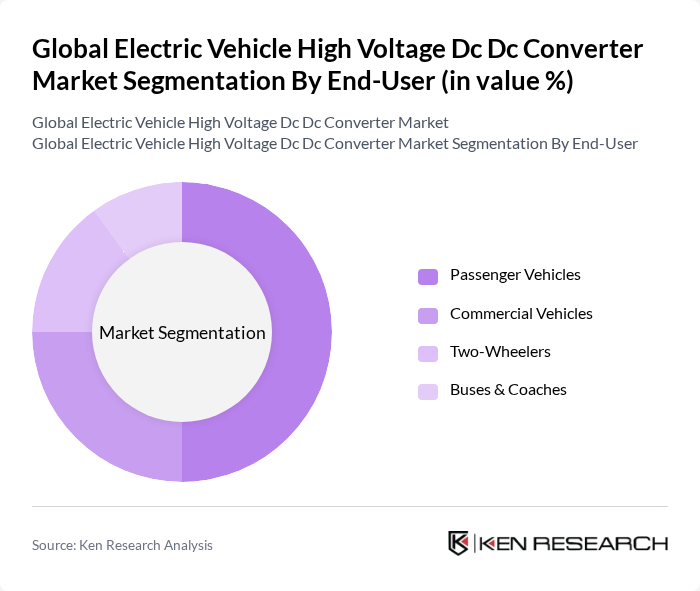
By End-User:The market is categorized into Passenger Vehicles, Commercial Vehicles, Two-Wheelers, and Buses & Coaches. The Passenger Vehicles segment holds the largest share, driven by rising consumer preference for electric cars, the expanding portfolio of EV models from global automakers, and supportive government incentives. Commercial vehicles, including light and heavy-duty trucks, are also experiencing increased adoption of high voltage DC-DC converters due to electrification trends in logistics and public transportation. Two-wheelers and buses & coaches represent emerging segments, particularly in Asia-Pacific and urban mobility markets .
The Global Electric Vehicle High Voltage Dc Dc Converter Market is characterized by a dynamic mix of regional and international players. Leading participants such as Tesla, Inc., Robert Bosch GmbH, Infineon Technologies AG, Denso Corporation, TDK Corporation, Toyota Industries Corporation, HELLA GmbH & Co. KGaA, Mitsubishi Electric Corporation, Valeo SA, Eaton Corporation PLC, STMicroelectronics N.V., ON Semiconductor Corporation, NXP Semiconductors N.V., Texas Instruments Incorporated, ABB Ltd. contribute to innovation, geographic expansion, and service delivery in this space.
The future of the electric vehicle high voltage DC-DC converter market appears promising, driven by technological advancements and increasing regulatory support. As battery technologies evolve, converters will need to adapt to higher efficiency standards, enhancing vehicle performance. Additionally, the integration of renewable energy sources into the charging infrastructure will create new opportunities for DC-DC converters, facilitating a more sustainable energy ecosystem. The collaboration between automotive manufacturers and technology providers will further accelerate innovation in this sector.
| Segment | Sub-Segments |
|---|---|
| By Type | Isolated DC-DC Converters Non-Isolated DC-DC Converters Bidirectional DC-DC Converters Multi-phase DC-DC Converters |
| By End-User | Passenger Vehicles Commercial Vehicles Two-Wheelers Buses & Coaches |
| By Application | Battery Management Systems Power Distribution Electric Drive Systems Onboard Charging Systems |
| By Component | Transformers Capacitors Inductors Power Semiconductors (SiC, GaN, IGBT, MOSFET) |
| By Sales Channel | Direct Sales Distributors Online Sales System Integrators |
| By Distribution Mode | Retail Distribution Wholesale Distribution E-commerce Distribution OEM Supply |
| By Price Range | Low Price Range Mid Price Range High Price Range Premium/Custom Solutions |
| Scope Item/Segment | Sample Size | Target Respondent Profiles |
|---|---|---|
| Passenger Electric Vehicles | 120 | Product Managers, Engineers |
| Commercial Electric Vehicles | 80 | Fleet Managers, Procurement Officers |
| DC-DC Converter Manufacturers | 60 | Technical Directors, R&D Managers |
| Battery Technology Developers | 50 | Battery Engineers, Product Development Leads |
| Charging Infrastructure Providers | 70 | Operations Managers, Business Development Executives |
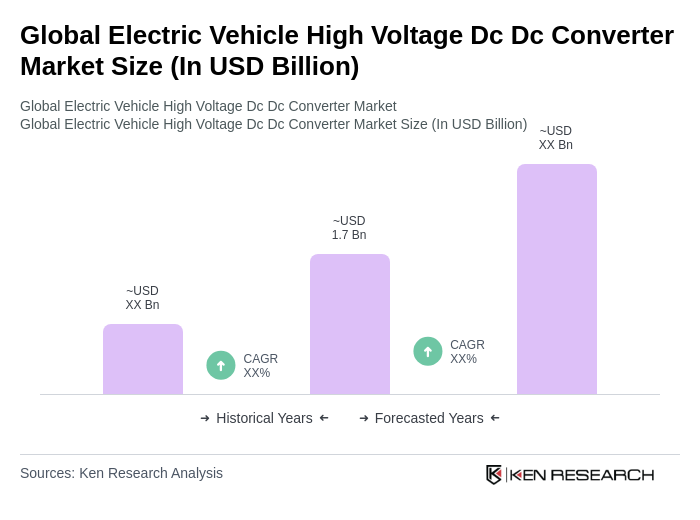
The Global Electric Vehicle High Voltage DC-DC Converter Market is valued at approximately USD 1.7 billion, driven by the increasing adoption of electric vehicles, advancements in battery technology, and the demand for efficient power management systems in automotive applications.

What makes us stand out is that our consultants follow Robust, Refine and Result (RRR) methodology. Robust for clear definitions, approaches and sanity checking, Refine for differentiating respondents' facts and opinions, and Result for presenting data with story.

We have set a benchmark in the industry by offering our clients with syndicated and customized market research reports featuring coverage of entire market as well as meticulous research and analyst insights.

While we don't replace traditional research, we flip the method upside down. Our dual approach of Top Bottom & Bottom Top ensures quality deliverable by not just verifying company fundamentals but also looking at the sector and macroeconomic factors.

With one step in the future, our research team constantly tries to show you the bigger picture. We help with some of the tough questions you may encounter along the way: How is the industry positioned? Best marketing channel? KPI's of competitors? By aligning every element, we help maximize success.

Our report gives you instant access to the answers and sources that other companies might choose to hide. We elaborate each steps of research methodology we have used and showcase you the sample size to earn your trust.

If you need any support, we are here! We pride ourselves on universe strength, data quality, and quick, friendly, and professional service.













