Region:Global
Author(s):Dev
Product Code:KRAD3304
Pages:81
Published On:November 2025
 Market.png "Global Electronic Lab Notebook (ELN) Market Size")
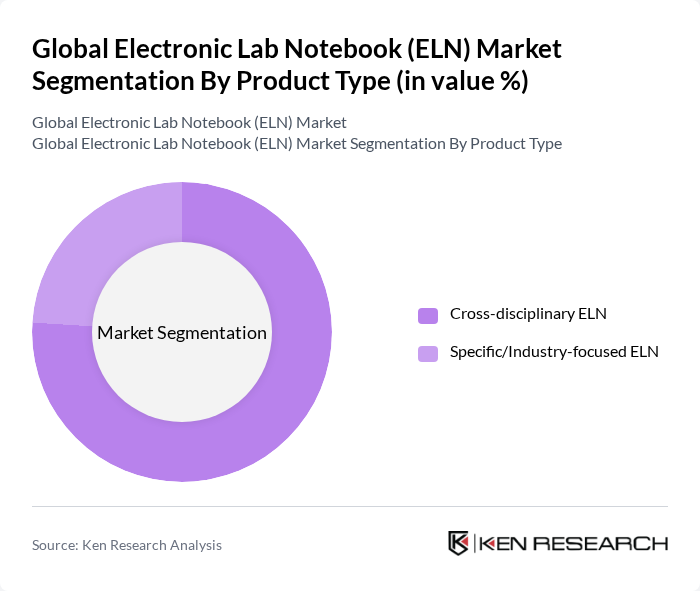
By Product Type:The market is segmented into Cross-disciplinary ELN and Specific/Industry-focused ELN. Cross-disciplinary ELNs are gaining traction due to their versatility, allowing various scientific fields to utilize a single platform for data management. Specific/Industry-focused ELNs cater to niche markets, providing tailored features that meet the unique requirements of specific industries, such as pharmaceuticals and biotechnology. The demand for Cross-disciplinary ELNs is particularly strong, as they facilitate collaboration across different research domains, making them the leading subsegment in the market.
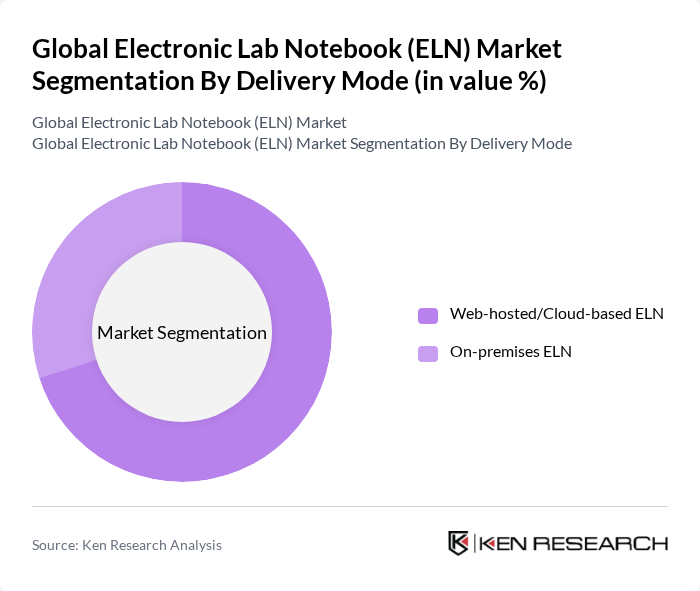
By Delivery Mode:The market is divided into Web-hosted/Cloud-based ELN and On-premises ELN. The Web-hosted/Cloud-based ELN segment is experiencing significant growth due to its scalability, ease of access, and lower upfront costs, making it attractive for organizations of all sizes. On-premises ELNs, while still relevant, are facing challenges due to the increasing preference for cloud solutions that offer enhanced collaboration and data sharing capabilities. The Web-hosted/Cloud-based ELN is the dominant subsegment, driven by the growing trend of remote work, digital collaboration, and integration with other laboratory informatics systems.
The Global Electronic Lab Notebook (ELN) Market is characterized by a dynamic mix of regional and international players. Leading participants such as LabArchives, Benchling, PerkinElmer (Signals Notebook), Thermo Fisher Scientific (Core Informatics), Agilent Technologies, LabWare, Labfolder, RSpace, SciNote, BioData (Labguru), Dassault Systèmes (BIOVIA Notebook), Eppendorf (eLabJournal), Abbott Informatics (STARLIMS), Sapio Sciences (Exemplar ELN), LabVantage Solutions contribute to innovation, geographic expansion, and service delivery in this space.
The future of the electronic lab notebook market appears promising, driven by technological advancements and evolving research methodologies. The integration of artificial intelligence and machine learning is expected to enhance data analysis capabilities, making ELNs more valuable for researchers. Additionally, the rise of remote work and virtual labs will further accelerate the adoption of digital solutions, as organizations seek to maintain productivity and collaboration in a changing work environment, fostering innovation and efficiency in research.
| Segment | Sub-Segments |
|---|---|
| By Product Type | Cross-disciplinary ELN Specific/Industry-focused ELN |
| By Delivery Mode | Web-hosted/Cloud-based ELN On-premises ELN |
| By License Type | Proprietary ELN Open-source ELN |
| By End Use | Life Sciences Contract Research Organizations (CROs) Chemical Industry Food & Beverage and Agriculture Environmental Testing Labs Petrochemical Refineries & Oil and Gas Industry Other Industries |
| By Region | North America Europe Asia-Pacific Latin America Middle East & Africa |
| Scope Item/Segment | Sample Size | Target Respondent Profiles |
|---|---|---|
| Pharmaceutical Research Labs | 100 | Lab Managers, R&D Directors |
| Biotechnology Firms | 60 | IT Managers, Compliance Officers |
| Academic Institutions | 50 | Professors, Research Coordinators |
| Contract Research Organizations (CROs) | 40 | Project Managers, Data Analysts |
| Quality Control Laboratories | 40 | Quality Assurance Managers, Lab Technicians |
The Global Electronic Lab Notebook (ELN) Market is valued at approximately USD 740 million, reflecting a significant growth trend driven by the increasing demand for digital solutions in research and development across various industries.

What makes us stand out is that our consultants follow Robust, Refine and Result (RRR) methodology. Robust for clear definitions, approaches and sanity checking, Refine for differentiating respondents' facts and opinions, and Result for presenting data with story.

We have set a benchmark in the industry by offering our clients with syndicated and customized market research reports featuring coverage of entire market as well as meticulous research and analyst insights.

While we don't replace traditional research, we flip the method upside down. Our dual approach of Top Bottom & Bottom Top ensures quality deliverable by not just verifying company fundamentals but also looking at the sector and macroeconomic factors.

With one step in the future, our research team constantly tries to show you the bigger picture. We help with some of the tough questions you may encounter along the way: How is the industry positioned? Best marketing channel? KPI's of competitors? By aligning every element, we help maximize success.

Our report gives you instant access to the answers and sources that other companies might choose to hide. We elaborate each steps of research methodology we have used and showcase you the sample size to earn your trust.

If you need any support, we are here! We pride ourselves on universe strength, data quality, and quick, friendly, and professional service.













