About the Report
Base Year 2024Global Energy Logistics Market Overview
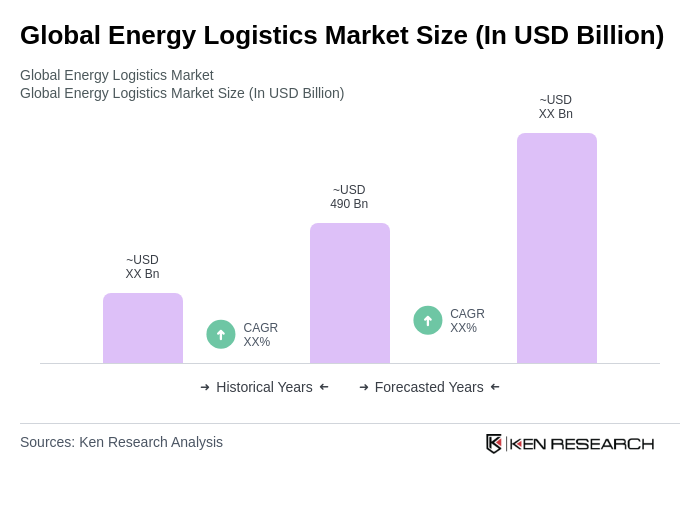
- The Global Energy Logistics Market is valued at USD 490 billion, based on a five-year historical analysis. This reflects consolidation of multiple industry estimates that place the market in the mid-hundreds of billions rather than the trillion range, aligning with recent global reports on energy logistics size and scope . Recent growth is driven by increasing energy demand, the rapid build-out of renewables (wind, solar, and grid-scale storage), and greater emphasis on resilient, tech-enabled supply chains across upstream, midstream, and power sectors . The market has seen increased investments in multimodal capacity, heavy-lift/project logistics, port terminals, and digital orchestration (control towers, IoT/AI) to improve delivery performance and lower operating costs .
- Key players in this market include the United States, China, and Germany, supported by advanced infrastructure, technology leadership, and large energy value chains. The United States remains a leader in oil and gas logistics given its large upstream and midstream footprint; China is scaling renewable energy logistics and component flows; and Germany’s energy transition policies and equipment manufacturing base reinforce its role in sustainable energy logistics .
- In 2023, the European Union advanced the European Green Deal with measures such as the Fit for 55 package and FuelEU Maritime and expanded ETS for shipping, which target emissions reductions in transport and logistics and incentivize adoption of low?carbon technologies across supply chains, materially influencing energy logistics strategies .
Global Energy Logistics Market Segmentation
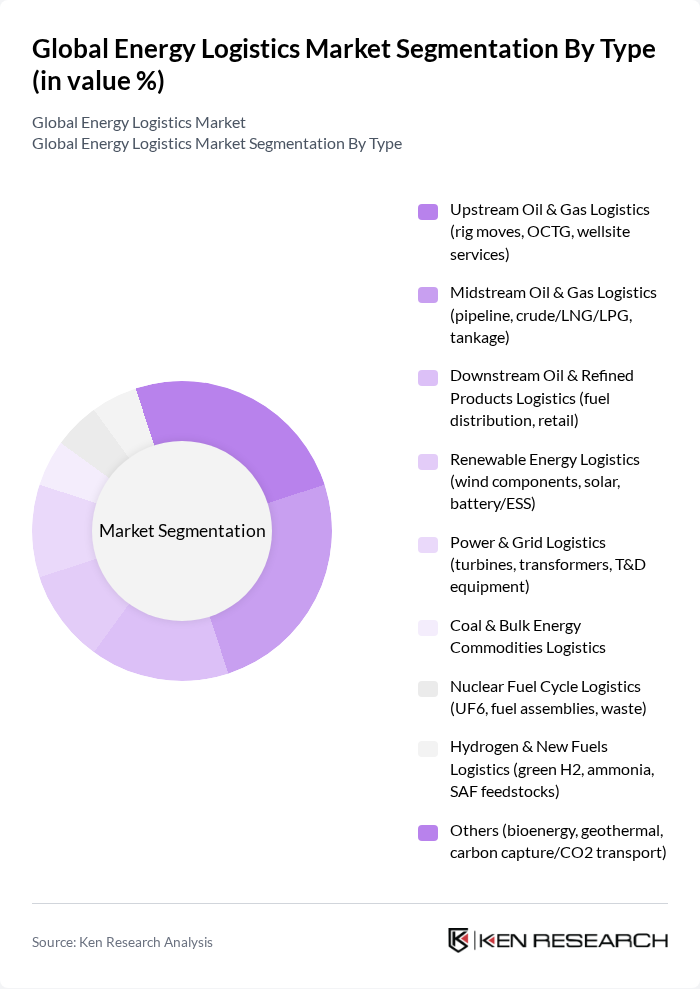
By Type:The market is segmented into various types, including upstream oil & gas logistics, midstream oil & gas logistics, downstream oil & refined products logistics, renewable energy logistics, power & grid logistics, coal & bulk energy commodities logistics, nuclear fuel cycle logistics, hydrogen & new fuels logistics, and others. Each segment plays a crucial role in the overall logistics framework, catering to specific energy needs and operational requirements .
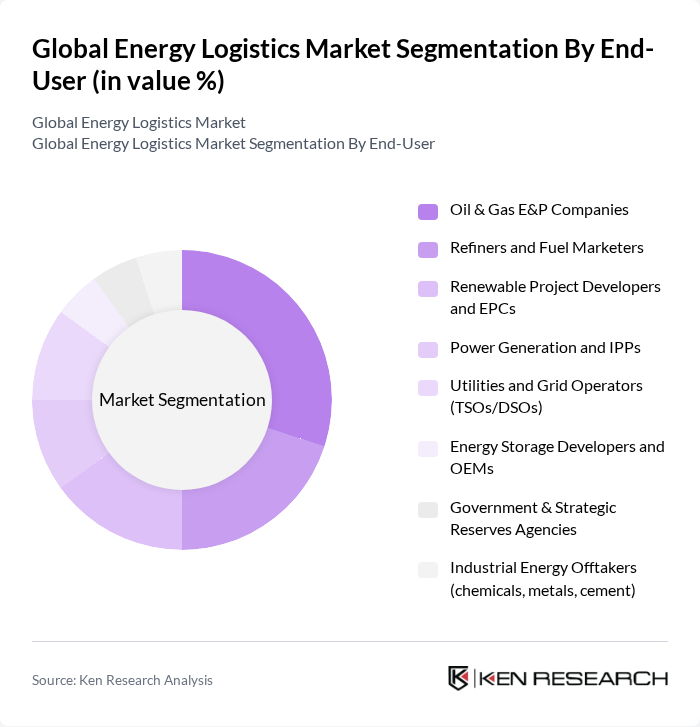
By End-User:The end-user segmentation includes oil & gas E&P companies, refiners and fuel marketers, renewable project developers and EPCs, power generation and IPPs, utilities and grid operators, energy storage developers and OEMs, government & strategic reserves agencies, and industrial energy offtakers. Each end-user category has distinct logistics requirements based on their operational needs and energy sourcing strategies, with growing needs for heavy-lift, specialized transport, and multimodal coordination for renewables and grid equipment .
Global Energy Logistics Market Competitive Landscape
The Global Energy Logistics Market is characterized by a dynamic mix of regional and international players. Leading participants such as DHL Supply Chain & Global Forwarding, Kuehne+Nagel, DB Schenker, C.H. Robinson, GXO Logistics, Expeditors International of Washington, GEODIS, CEVA Logistics, DSV, A.P. Møller – Maersk, SNCF Geodis (Rail & Logistics), Bolloré Logistics, UPS Supply Chain Solutions, Agility Logistics, Tidewater, Mammoet, Sarens, Pacific Drilling Logistics (Transocean/Offshore support), GAC Group, Hellmann Worldwide Logistics contribute to innovation, geographic expansion, and service delivery in this space.
Global Energy Logistics Market Industry Analysis
Growth Drivers
- Increasing Demand for Renewable Energy Sources:The global renewable energy sector is projected to reach $2 trillion in future, driven by a 20% annual increase in solar and wind energy installations. This surge necessitates efficient logistics solutions to transport renewable energy components, such as wind turbines and solar panels, to various locations. Countries like China and the U.S. are leading this transition, with investments exceeding $150 billion in renewable infrastructure, thereby boosting energy logistics demand significantly.
- Technological Advancements in Logistics:The logistics sector is experiencing a technological revolution, with investments in automation and AI expected to exceed $100 billion in future. These advancements enhance operational efficiency, reduce delivery times, and lower costs. For instance, the adoption of AI-driven route optimization can decrease transportation costs by up to 20%, making logistics more efficient and responsive to the growing energy sector's needs, particularly in renewable energy logistics.
- Global Energy Transition Initiatives:Governments worldwide are committing to energy transition initiatives, with over 150 countries pledging to achieve net-zero emissions in future. This commitment is supported by financial backing of approximately $2 trillion in green energy projects. Such initiatives create a robust demand for energy logistics services, as the transition requires extensive supply chain management for renewable energy resources, thereby driving market growth in logistics tailored for energy.
Market Challenges
- Regulatory Compliance Issues:The energy logistics sector faces stringent regulatory frameworks, with compliance costs estimated at $75 billion annually across major markets. These regulations often vary by region, complicating logistics operations. Companies must invest in compliance management systems to navigate these complexities, which can divert resources from core logistics functions and increase operational costs, thereby posing a significant challenge to market growth.
- High Operational Costs:The logistics industry is grappling with rising operational costs, which have surged by 25% over the past two years due to fuel price volatility and labor shortages. In future, average logistics costs are projected to reach $2 trillion globally. These escalating expenses can hinder profitability and limit the ability of logistics providers to invest in innovative solutions, ultimately affecting service delivery in the energy sector.
Global Energy Logistics Market Future Outlook
The future of the energy logistics market is poised for transformative growth, driven by the increasing integration of digital technologies and a strong focus on sustainability. As companies adopt smart logistics solutions, operational efficiencies will improve, reducing costs and enhancing service delivery. Furthermore, the ongoing global push for decarbonization will necessitate innovative logistics strategies, ensuring that energy logistics remains a critical component of the renewable energy supply chain, adapting to evolving market demands and regulatory landscapes.
Market Opportunities
- Expansion into Emerging Markets:Emerging markets, particularly in Asia and Africa, are witnessing rapid urbanization and energy demand growth, with energy consumption expected to rise by 40% in future. This presents significant opportunities for logistics providers to establish operations in these regions, catering to the increasing need for efficient energy transportation and distribution networks.
- Development of Smart Logistics Solutions:The rise of smart logistics solutions, including IoT and AI technologies, is set to revolutionize the energy logistics landscape. In future, investments in smart logistics are projected to reach $75 billion, enabling real-time tracking and predictive analytics. This innovation will enhance supply chain visibility and efficiency, providing logistics companies with a competitive edge in the energy sector.
Scope of the Report
| Segment | Sub-Segments |
|---|---|
| By Type | Upstream Oil & Gas Logistics (rig moves, OCTG, wellsite services) Midstream Oil & Gas Logistics (pipeline, crude/LNG/LPG, tankage) Downstream Oil & Refined Products Logistics (fuel distribution, retail) Renewable Energy Logistics (wind components, solar, battery/ESS) Power & Grid Logistics (turbines, transformers, T&D equipment) Coal & Bulk Energy Commodities Logistics Nuclear Fuel Cycle Logistics (UF6, fuel assemblies, waste) Hydrogen & New Fuels Logistics (green H2, ammonia, SAF feedstocks) Others (bioenergy, geothermal, carbon capture/CO2 transport) |
| By End-User | Oil & Gas E&P Companies Refiners and Fuel Marketers Renewable Project Developers and EPCs Power Generation and IPPs Utilities and Grid Operators (TSOs/DSOs) Energy Storage Developers and OEMs Government & Strategic Reserves Agencies Industrial Energy Offtakers (chemicals, metals, cement) |
| By Mode of Transport | Road (heavy-haul, last-mile fuels) Rail (unit trains, project cargo) Maritime & Inland Waterways (tankers, heavy-lift, Ro-Ro, barges) Air (time-critical spares, remote sites) Pipeline (crude, products, gas, CO2, hydrogen) |
| By Service Type | Freight Forwarding & Project Logistics Contract Logistics & Warehousing (laydown yards, spares hubs) Marine Services (chartering, port agency, offshore support) Supply Chain Management & Control Tower Customs, Compliance & Dangerous Goods Handling Consulting & Engineering (route surveys, rigging, decommissioning) |
| By Geographic Coverage | Domestic Logistics International & Cross-Border Logistics |
| By Technology Integration | Automation & Robotics (ports, warehouses, inspection) Advanced Analytics & Digital Twins IoT/Telematics & Real-time Visibility Platforms Blockchain & E-documentation Emissions Monitoring & Optimization (MRV, route optimization) |
| By Policy Support | Subsidies for Renewable & Grid Logistics Tax Incentives for Low-Carbon Transport (LNG/e-fuels) Regulatory Support for Hydrogen/LNG/Battery Supply Chains Safety & Dangerous Goods Regulations (IMO/ADR/IATA/ICAO/NRC) |
Key Target Audience
Investors and Venture Capitalist Firms
Government and Regulatory Bodies (e.g., International Energy Agency, U.S. Department of Energy)
Energy Producers and Suppliers
Logistics and Transportation Companies
Energy Infrastructure Developers
Environmental Agencies (e.g., Environmental Protection Agency)
Energy Trading Firms
Utility Companies
Players Mentioned in the Report:
DHL Supply Chain & Global Forwarding
Kuehne+Nagel
DB Schenker
C.H. Robinson
GXO Logistics
Expeditors International of Washington
GEODIS
CEVA Logistics
DSV
A.P. Mller Maersk
SNCF Geodis (Rail & Logistics)
Bollore Logistics
UPS Supply Chain Solutions
Agility Logistics
Tidewater
Mammoet
Sarens
Pacific Drilling Logistics (Transocean/Offshore support)
GAC Group
Hellmann Worldwide Logistics
Table of Contents
Market Assessment Phase
1. Executive Summary and Approach
2. Global Energy Logistics Market Overview
2.1 Key Insights and Strategic Recommendations
2.2 Global Energy Logistics Market Overview
2.3 Definition and Scope
2.4 Evolution of Market Ecosystem
2.5 Timeline of Key Regulatory Milestones
2.6 Value Chain & Stakeholder Mapping
2.7 Business Cycle Analysis
2.8 Policy & Incentive Landscape
3. Global Energy Logistics Market Analysis
3.1 Growth Drivers
3.1.1 Increasing Demand for Renewable Energy Sources
3.1.2 Technological Advancements in Logistics
3.1.3 Global Energy Transition Initiatives
3.1.4 Rising Investments in Infrastructure Development
3.2 Market Challenges
3.2.1 Regulatory Compliance Issues
3.2.2 High Operational Costs
3.2.3 Supply Chain Disruptions
3.2.4 Environmental Concerns and Sustainability Pressures
3.3 Market Opportunities
3.3.1 Expansion into Emerging Markets
3.3.2 Development of Smart Logistics Solutions
3.3.3 Partnerships with Renewable Energy Providers
3.3.4 Adoption of Digital Technologies
3.4 Market Trends
3.4.1 Shift Towards Decarbonization
3.4.2 Integration of AI and IoT in Logistics
3.4.3 Increased Focus on Sustainability
3.4.4 Growth of E-commerce and Its Impact on Logistics
3.5 Government Regulation
3.5.1 Emission Reduction Targets
3.5.2 Renewable Energy Incentives
3.5.3 Safety and Compliance Standards
3.5.4 International Trade Agreements
4. SWOT Analysis
5. Stakeholder Analysis
6. Porter's Five Forces Analysis
7. Global Energy Logistics Market Market Size, 2019-2024
7.1 By Value
7.2 By Volume
7.3 By Average Selling Price
8. Global Energy Logistics Market Segmentation
8.1 By Type
8.1.1 Upstream Oil & Gas Logistics (rig moves, OCTG, wellsite services)
8.1.2 Midstream Oil & Gas Logistics (pipeline, crude/LNG/LPG, tankage)
8.1.3 Downstream Oil & Refined Products Logistics (fuel distribution, retail)
8.1.4 Renewable Energy Logistics (wind components, solar, battery/ESS)
8.1.5 Power & Grid Logistics (turbines, transformers, T&D equipment)
8.1.6 Coal & Bulk Energy Commodities Logistics
8.1.7 Nuclear Fuel Cycle Logistics (UF6, fuel assemblies, waste)
8.1.8 Hydrogen & New Fuels Logistics (green H2, ammonia, SAF feedstocks)
8.1.9 Others (bioenergy, geothermal, carbon capture/CO2 transport)
8.2 By End-User
8.2.1 Oil & Gas E&P Companies
8.2.2 Refiners and Fuel Marketers
8.2.3 Renewable Project Developers and EPCs
8.2.4 Power Generation and IPPs
8.2.5 Utilities and Grid Operators (TSOs/DSOs)
8.2.6 Energy Storage Developers and OEMs
8.2.7 Government & Strategic Reserves Agencies
8.2.8 Industrial Energy Offtakers (chemicals, metals, cement)
8.3 By Mode of Transport
8.3.1 Road (heavy-haul, last-mile fuels)
8.3.2 Rail (unit trains, project cargo)
8.3.3 Maritime & Inland Waterways (tankers, heavy-lift, Ro-Ro, barges)
8.3.4 Air (time-critical spares, remote sites)
8.3.5 Pipeline (crude, products, gas, CO2, hydrogen)
8.4 By Service Type
8.4.1 Freight Forwarding & Project Logistics
8.4.2 Contract Logistics & Warehousing (laydown yards, spares hubs)
8.4.3 Marine Services (chartering, port agency, offshore support)
8.4.4 Supply Chain Management & Control Tower
8.4.5 Customs, Compliance & Dangerous Goods Handling
8.4.6 Consulting & Engineering (route surveys, rigging, decommissioning)
8.5 By Geographic Coverage
8.5.1 Domestic Logistics
8.5.2 International & Cross-Border Logistics
8.6 By Technology Integration
8.6.1 Automation & Robotics (ports, warehouses, inspection)
8.6.2 Advanced Analytics & Digital Twins
8.6.3 IoT/Telematics & Real-time Visibility Platforms
8.6.4 Blockchain & E-documentation
8.6.5 Emissions Monitoring & Optimization (MRV, route optimization)
8.7 By Policy Support
8.7.1 Subsidies for Renewable & Grid Logistics
8.7.2 Tax Incentives for Low-Carbon Transport (LNG/e-fuels)
8.7.3 Regulatory Support for Hydrogen/LNG/Battery Supply Chains
8.7.4 Safety & Dangerous Goods Regulations (IMO/ADR/IATA/ICAO/NRC)
9. Global Energy Logistics Market Competitive Analysis
9.1 Market Share of Key Players
9.2 Cross Comparison of Key Players
9.2.1 Company Name
9.2.2 Segment Focus (O&G, Renewables, Power/Grid, New Fuels)
9.2.3 Energy Logistics Revenue and Share of Total Revenue
9.2.4 Project Logistics Backlog (USD) and Win Rate
9.2.5 Geographic Footprint (countries, key energy corridors)
9.2.6 Fleet & Assets (heavy-lift vessels, SPMTs, modules yards, ISO tanks)
9.2.7 On-time Delivery and Transit-time Reliability
9.2.8 HSE Performance (TRIR/LTIFR) and Compliance Certifications
9.2.9 Emissions Intensity (gCO2e/ton-km) and Net-zero Roadmap
9.2.10 Gross Margin and EBITDA Margin (Energy segment)
9.2.11 Working Capital Days and Cash Conversion Cycle
9.2.12 Digital Capabilities (visibility, control tower, eB/L, IoT)
9.2.13 Customer Concentration (Top-10 share) and Retention
9.2.14 Innovation & Capex Intensity (capex/revenue; new fuels, vessels)
9.3 SWOT Analysis of Top Players
9.4 Pricing Analysis
9.5 Detailed Profile of Major Companies
9.5.1 DHL Supply Chain & Global Forwarding
9.5.2 Kuehne+Nagel
9.5.3 DB Schenker
9.5.4 C.H. Robinson
9.5.5 GXO Logistics
9.5.6 Expeditors International of Washington
9.5.7 GEODIS
9.5.8 CEVA Logistics
9.5.9 DSV
9.5.10 A.P. Møller – Maersk
9.5.11 SNCF Geodis (Rail & Logistics)
9.5.12 Bolloré Logistics
9.5.13 UPS Supply Chain Solutions
9.5.14 Agility Logistics
9.5.15 Tidewater
9.5.16 Mammoet
9.5.17 Sarens
9.5.18 Pacific Drilling Logistics (Transocean/Offshore support)
9.5.19 GAC Group
9.5.20 Hellmann Worldwide Logistics
10. Global Energy Logistics Market End-User Analysis
10.1 Procurement Behavior of Key Ministries
10.1.1 Energy Procurement Strategies
10.1.2 Budget Allocation Trends
10.1.3 Supplier Selection Criteria
10.2 Corporate Spend on Infrastructure & Energy
10.2.1 Investment Trends in Energy Infrastructure
10.2.2 Budgeting for Renewable Energy Projects
10.2.3 Cost Management Strategies
10.3 Pain Point Analysis by End-User Category
10.3.1 Supply Chain Inefficiencies
10.3.2 Regulatory Compliance Challenges
10.3.3 Cost Overruns
10.4 User Readiness for Adoption
10.4.1 Technology Adoption Rates
10.4.2 Training and Development Needs
10.4.3 Infrastructure Readiness
10.5 Post-Deployment ROI and Use Case Expansion
10.5.1 Measurement of ROI
10.5.2 Case Studies of Successful Deployments
10.5.3 Future Use Case Opportunities
11. Global Energy Logistics Market Future Size, 2025-2030
11.1 By Value
11.2 By Volume
11.3 By Average Selling Price
Go-To-Market Strategy Phase
1. Whitespace Analysis + Business Model Canvas
1.1 Market Gaps Identification
1.2 Business Model Development
2. Marketing and Positioning Recommendations
2.1 Branding Strategies
2.2 Product USPs
3. Distribution Plan
3.1 Urban Retail Strategies
3.2 Rural NGO Tie-ups
4. Channel & Pricing Gaps
4.1 Underserved Routes
4.2 Pricing Bands Analysis
5. Unmet Demand & Latent Needs
5.1 Category Gaps
5.2 Consumer Segments
6. Customer Relationship
6.1 Loyalty Programs
6.2 After-sales Service
7. Value Proposition
7.1 Sustainability Initiatives
7.2 Integrated Supply Chains
8. Key Activities
8.1 Regulatory Compliance
8.2 Branding Efforts
8.3 Distribution Setup
9. Entry Strategy Evaluation
9.1 Domestic Market Entry Strategy
9.1.1 Product Mix Considerations
9.1.2 Pricing Band Strategy
9.1.3 Packaging Solutions
9.2 Export Entry Strategy
9.2.1 Target Countries
9.2.2 Compliance Roadmap
10. Entry Mode Assessment
10.1 Joint Ventures
10.2 Greenfield Investments
10.3 Mergers & Acquisitions
10.4 Distributor Model
11. Capital and Timeline Estimation
11.1 Capital Requirements
11.2 Timelines for Implementation
12. Control vs Risk Trade-Off
12.1 Ownership vs Partnerships
13. Profitability Outlook
13.1 Breakeven Analysis
13.2 Long-term Sustainability
14. Potential Partner List
14.1 Distributors
14.2 Joint Ventures
14.3 Acquisition Targets
15. Execution Roadmap
15.1 Phased Plan for Market Entry
15.1.1 Market Setup
15.1.2 Market Entry
15.1.3 Growth Acceleration
15.1.4 Scale & Stabilize
15.2 Key Activities and Milestones
15.2.1 Milestone Planning
15.2.2 Activity Tracking
Research Methodology
Phase 1: Approach1
Desk Research
- Analysis of global energy logistics reports from industry associations and governmental bodies
- Review of market studies and white papers published by energy sector think tanks
- Examination of trade publications and journals focusing on energy supply chain dynamics
Primary Research
- Interviews with logistics managers at major energy companies and utilities
- Surveys targeting supply chain analysts specializing in energy logistics
- Field interviews with operations directors at energy distribution centers
Validation & Triangulation
- Cross-validation of findings through multiple data sources including government statistics and industry reports
- Triangulation of insights from primary interviews with secondary data trends
- Sanity checks conducted through expert panels comprising industry veterans
Phase 2: Market Size Estimation1
Top-down Assessment
- Estimation of total energy logistics market size based on global energy consumption data
- Segmentation by energy type (renewable vs. non-renewable) and logistics service type
- Incorporation of regional growth trends and government energy policies
Bottom-up Modeling
- Collection of operational data from leading logistics providers in the energy sector
- Cost analysis based on service pricing models for transportation and storage
- Volume estimates derived from energy production and consumption statistics
Forecasting & Scenario Analysis
- Multi-variable regression analysis incorporating factors such as energy transition and technological advancements
- Scenario modeling based on potential regulatory changes and market disruptions
- Development of baseline, optimistic, and pessimistic forecasts through 2030
Phase 3: CATI Sample Composition1
| Scope Item/Segment | Sample Size | Target Respondent Profiles |
|---|---|---|
| Oil & Gas Logistics | 120 | Logistics Coordinators, Supply Chain Managers |
| Renewable Energy Supply Chains | 100 | Project Managers, Operations Directors |
| Energy Storage Solutions | 80 | Technical Managers, Product Development Leads |
| Coal Transportation Logistics | 60 | Procurement Managers, Logistics Analysts |
| Natural Gas Distribution | 90 | Distribution Managers, Regulatory Affairs Specialists |
Frequently Asked Questions
What is the current value of the Global Energy Logistics Market?
The Global Energy Logistics Market is valued at approximately USD 490 billion, based on a five-year historical analysis. This valuation reflects a consolidation of various industry estimates, indicating significant growth driven by increasing energy demand and advancements in logistics technology.
What are the key drivers of growth in the energy logistics market?
Which countries are leading in the Global Energy Logistics Market?
What are the main segments of the Global Energy Logistics Market?
Other Regional/Country Reports
Indonesia Energy Logistics Market
Malaysia Energy Logistics Market
APAC Energy Logistics Market
SEA Energy Logistics Market
Why Buy From Us?

What makes us stand out is that our consultants follow Robust, Refine and Result (RRR) methodology. Robust for clear definitions, approaches and sanity checking, Refine for differentiating respondents' facts and opinions, and Result for presenting data with story.

We have set a benchmark in the industry by offering our clients with syndicated and customized market research reports featuring coverage of entire market as well as meticulous research and analyst insights.

While we don't replace traditional research, we flip the method upside down. Our dual approach of Top Bottom & Bottom Top ensures quality deliverable by not just verifying company fundamentals but also looking at the sector and macroeconomic factors.

With one step in the future, our research team constantly tries to show you the bigger picture. We help with some of the tough questions you may encounter along the way: How is the industry positioned? Best marketing channel? KPI's of competitors? By aligning every element, we help maximize success.

Our report gives you instant access to the answers and sources that other companies might choose to hide. We elaborate each steps of research methodology we have used and showcase you the sample size to earn your trust.

If you need any support, we are here! We pride ourselves on universe strength, data quality, and quick, friendly, and professional service.