About the Report
Base Year 2024Listen to the audio summary
Global Engine Oil Market Overview
- The Global Engine Oil Market is valued at approximately USD 41 billion, based on a five-year historical analysis.
- Key countries shaping demand include the United States, China, and Germany. Asia Pacific is the largest regional market, underpinned by China’s large vehicle parc and manufacturing base, while the United States has one of the world’s highest vehicle ownership levels, and Germany’s automotive industry and stringent performance standards sustain premium lubricant demand.
- The European Union continues to tighten vehicle emission limits and lubricant performance requirements through Euro standards and ACEA oil sequences (e.g., ACEA 2021/2023 updates), which push low-SAPS, fuel?efficient, and catalyst?compatible formulations; however, there is no EU-wide mandate specifically requiring bio?based engine oils. These regulatory pressures are accelerating adoption of advanced synthetic oils and lower?emission formulations.

Global Engine Oil Market Segmentation
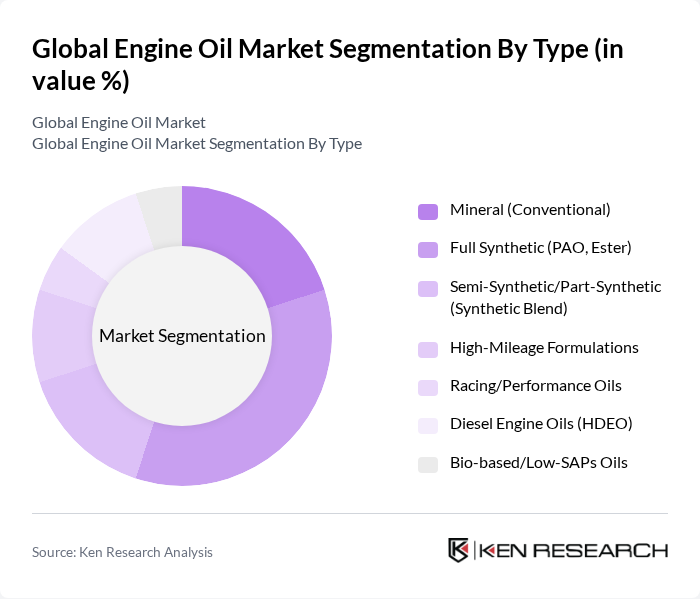
By Type:The engine oil market is segmented into various types, including Mineral (Conventional), Full Synthetic (PAO, Ester), Semi-Synthetic/Part-Synthetic (Synthetic Blend), High-Mileage Formulations, Racing/Performance Oils, Diesel Engine Oils (HDEO), and Bio-based/Low-SAPs Oils. Among these, Full Synthetic oils are gaining traction due to their superior performance, fuel economy benefits, and longer drain intervals, aligned with tighter emission/fuel-efficiency requirements and modern engine designs (e.g., turbocharged GDI).
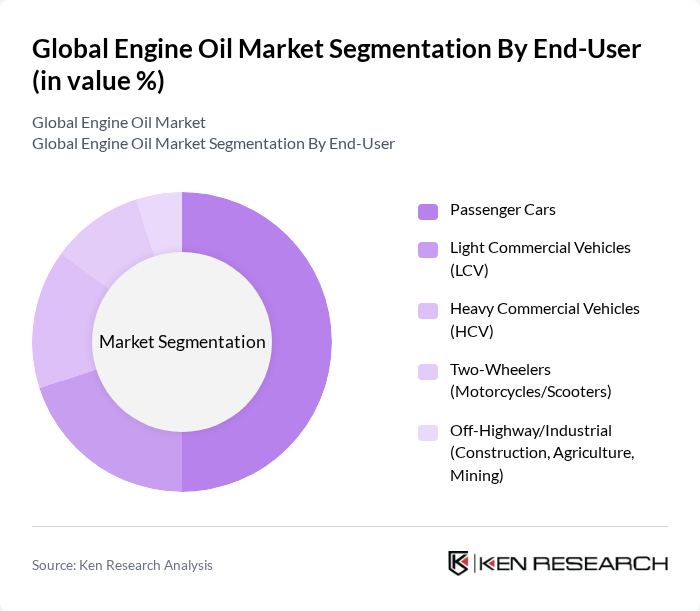
By End-User:The market is segmented by end-user into Passenger Cars, Light Commercial Vehicles (LCV), Heavy Commercial Vehicles (HCV), Two-Wheelers (Motorcycles/Scooters), and Off-Highway/Industrial (Construction, Agriculture, Mining). Passenger Cars account for the largest share, supported by the sizeable global passenger vehicle parc and maintenance demand, while commercial and off-highway segments require higher-robustness HDEO formulations for extended operations.
Global Engine Oil Market Competitive Landscape
The Global Engine Oil Market is characterized by a dynamic mix of regional and international players. Leading participants such as Exxon Mobil Corporation (Mobil), Shell plc (Shell Helix, Rotella), BP p.l.c. (Castrol), Chevron Corporation (Havoline, Delo), TotalEnergies SE (Quartz), Valvoline Inc., FUCHS SE (FUCHS Lubricants), AMSOIL Inc., MOTUL S.A., Idemitsu Kosan Co., Ltd., PETRONAS Lubricants International (PLI), China Petrochemical Corporation (Sinopec), Indian Oil Corporation Ltd. (SERVO), PJSC LUKOIL, Eni S.p.A. (eni i-Sint, Agip), Repsol S.A., PKN ORLEN S.A. (ORLEN Oil), GS Caltex Corporation (Kixx), Phillips 66 Company (Kendall, Phillips 66 Lubricants), Gulf Oil International Ltd. contribute to innovation, geographic expansion, and service delivery in this space.
Global Engine Oil Market Industry Analysis
Growth Drivers
- Increasing Vehicle Production:The global vehicle production was approximately 93 million units most recently reported by the International Organization of Motor Vehicle Manufacturers, indicating recovery above pre-pandemic levels. This surge is driven by economic recovery and increased consumer spending, particularly in emerging markets. As vehicle production escalates, the demand for engine oil will correspondingly increase, with estimates suggesting a need for over 2 billion liters of engine oil annually to support this growth, thereby bolstering the market significantly.
- Rising Demand for High-Performance Engine Oils:The demand for high-performance engine oils is projected to grow, with a market value of USD 15 billion in the immediate term expected to rise to USD 18 billion in the future. This growth is fueled by advancements in automotive technology and consumer preferences for enhanced vehicle performance and fuel efficiency. High-performance oils, which offer superior protection and longevity, are becoming increasingly popular among consumers, driving manufacturers to innovate and expand their product lines.
- Growing Awareness of Engine Maintenance:Awareness regarding the importance of regular engine maintenance has increased significantly, with a significant percentage of vehicle owners now recognizing its impact on vehicle longevity. This trend is supported by educational campaigns and service promotions from automotive service providers. As a result, the demand for quality engine oils is expected to rise, with an estimated increase in oil change frequency, translating to an additional 1 billion liters of engine oil required annually.
Market Challenges
- Fluctuating Raw Material Prices:The engine oil industry faces significant challenges due to fluctuating raw material prices, particularly crude oil, which saw a price range of USD 70 to USD 90 per barrel in the immediate term. This volatility affects production costs and profit margins for manufacturers. As raw material prices remain unpredictable, companies may struggle to maintain competitive pricing, potentially leading to reduced market share and profitability in the engine oil sector.
- Stringent Environmental Regulations:Increasingly stringent environmental regulations are impacting the engine oil market, with new standards requiring lower emissions and improved biodegradability. For instance, the European Union's new regulations mandate a significant reduction in harmful emissions from automotive oils in the future. Compliance with these regulations necessitates significant investment in research and development, which can strain resources for smaller manufacturers and limit their market competitiveness.
Global Engine Oil Market Future Outlook
The future of the engine oil market appears promising, driven by technological advancements and evolving consumer preferences. The shift towards synthetic oils and eco-friendly products is expected to gain momentum, with synthetic oil sales projected to account for a significant share of the market in the future. Additionally, the integration of smart oil monitoring systems will enhance maintenance practices, leading to increased oil usage. As the automotive landscape evolves, manufacturers must adapt to these trends to remain competitive and meet consumer demands effectively.
Market Opportunities
- Growth in Electric Vehicle Market:The electric vehicle (EV) market is projected to grow significantly, with sales expected to reach a substantial number of units in the future. This growth presents opportunities for engine oil manufacturers to develop specialized lubricants for EV components, such as electric motors and batteries, thereby diversifying their product offerings and tapping into a new revenue stream.
- Development of Bio-based Engine Oils:The demand for bio-based engine oils is on the rise, with a market value of USD 2 billion in the immediate term expected to increase to USD 3 billion in the future. This trend is driven by consumer preferences for sustainable products and government incentives promoting bio-based oil production. Manufacturers can capitalize on this opportunity by investing in R&D to create innovative, eco-friendly oil formulations that meet regulatory standards.
Scope of the Report
| Segment | Sub-Segments |
|---|---|
| By Type | Mineral (Conventional) Full Synthetic (PAO, Ester) Semi?Synthetic/Part?Synthetic (Synthetic Blend) High?Mileage Formulations Racing/Performance Oils Diesel Engine Oils (HDEO) Bio?based/Low?SAPs Oils |
| By End-User | Passenger Cars Light Commercial Vehicles (LCV) Heavy Commercial Vehicles (HCV) Two?Wheelers (Motorcycles/Scooters) Off?Highway/Industrial (Construction, Agriculture, Mining) |
| By Application | Automotive On?road (Gasoline, Diesel) Marine Engines Aviation Piston Engines Power Generation and Heavy Equipment |
| By Distribution Channel | Retail/Aftermarket (Auto Parts Stores, Mass Retail) Online/E?commerce Service Workshops & Quick?Lube Centers OEM/Dealer Networks |
| By Viscosity Grade (SAE) | W?16/0W?20 W?20/5W?30 W?30/10W?40 W?40/20W?50 Others (e.g., 0W?40, 5W?40) |
| By Packaging Type | Bottles (1–5 Liters) Drums/IBCs Bulk/Bulk Tanker |
| By Price Tier | Economy Mid?Range Premium |
Key Target Audience
Investors and Venture Capitalist Firms
Government and Regulatory Bodies (e.g., Environmental Protection Agency, Department of Transportation)
Manufacturers and Producers
Distributors and Retailers
Automotive OEMs (Original Equipment Manufacturers)
Oil and Gas Companies
Industry Associations (e.g., American Petroleum Institute)
Financial Institutions
Players Mentioned in the Report:
Exxon Mobil Corporation (Mobil)
Shell plc (Shell Helix, Rotella)
BP p.l.c. (Castrol)
Chevron Corporation (Havoline, Delo)
TotalEnergies SE (Quartz)
Valvoline Inc.
FUCHS SE (FUCHS Lubricants)
AMSOIL Inc.
MOTUL S.A.
Idemitsu Kosan Co., Ltd.
PETRONAS Lubricants International (PLI)
China Petrochemical Corporation (Sinopec)
Indian Oil Corporation Ltd. (SERVO)
PJSC LUKOIL
Eni S.p.A. (eni iSint, Agip)
Repsol S.A.
PKN ORLEN S.A. (ORLEN Oil)
GS Caltex Corporation (Kixx)
Phillips 66 Company (Kendall, Phillips 66 Lubricants)
Gulf Oil International Ltd.
Table of Contents
Market Assessment Phase
1. Executive Summary and Approach
2. Global Engine Oil Market Overview
2.1 Key Insights and Strategic Recommendations
2.2 Global Engine Oil Market Overview
2.3 Definition and Scope
2.4 Evolution of Market Ecosystem
2.5 Timeline of Key Regulatory Milestones
2.6 Value Chain & Stakeholder Mapping
2.7 Business Cycle Analysis
2.8 Policy & Incentive Landscape
3. Global Engine Oil Market Analysis
3.1 Growth Drivers
3.1.1 Increasing Vehicle Production
3.1.2 Rising Demand for High-Performance Engine Oils
3.1.3 Growing Awareness of Engine Maintenance
3.1.4 Expansion of Automotive Aftermarket
3.2 Market Challenges
3.2.1 Fluctuating Raw Material Prices
3.2.2 Stringent Environmental Regulations
3.2.3 Competition from Alternative Fuels
3.2.4 Market Saturation in Developed Regions
3.3 Market Opportunities
3.3.1 Growth in Electric Vehicle Market
3.3.2 Development of Bio-based Engine Oils
3.3.3 Expansion in Emerging Markets
3.3.4 Technological Advancements in Oil Formulation
3.4 Market Trends
3.4.1 Shift Towards Synthetic Engine Oils
3.4.2 Increasing Use of Smart Oil Monitoring Systems
3.4.3 Rising Popularity of Subscription Services for Oil Changes
3.4.4 Focus on Sustainability and Eco-friendly Products
3.5 Government Regulation
3.5.1 Emission Standards for Automotive Oils
3.5.2 Regulations on Oil Disposal and Recycling
3.5.3 Incentives for Bio-based Oil Production
3.5.4 Compliance with International Standards (API, ACEA)
4. SWOT Analysis
5. Stakeholder Analysis
6. Porter's Five Forces Analysis
7. Global Engine Oil Market Market Size, 2019-2024
7.1 By Value
7.2 By Volume
7.3 By Average Selling Price
8. Global Engine Oil Market Segmentation
8.1 By Type
8.1.1 Mineral (Conventional)
8.1.2 Full Synthetic (PAO, Ester)
8.1.3 Semi?Synthetic/Part?Synthetic (Synthetic Blend)
8.1.4 High?Mileage Formulations
8.1.5 Racing/Performance Oils
8.1.6 Diesel Engine Oils (HDEO)
8.1.7 Bio?based/Low?SAPs Oils
8.2 By End-User
8.2.1 Passenger Cars
8.2.2 Light Commercial Vehicles (LCV)
8.2.3 Heavy Commercial Vehicles (HCV)
8.2.4 Two?Wheelers (Motorcycles/Scooters)
8.2.5 Off?Highway/Industrial (Construction, Agriculture, Mining)
8.3 By Application
8.3.1 Automotive On?road (Gasoline, Diesel)
8.3.2 Marine Engines
8.3.3 Aviation Piston Engines
8.3.4 Power Generation and Heavy Equipment
8.4 By Distribution Channel
8.4.1 Retail/Aftermarket (Auto Parts Stores, Mass Retail)
8.4.2 Online/E?commerce
8.4.3 Service Workshops & Quick?Lube Centers
8.4.4 OEM/Dealer Networks
8.5 By Viscosity Grade (SAE)
8.5.1 0W?16/0W?20
8.5.2 5W?20/5W?30
8.5.3 10W?30/10W?40
8.5.4 15W?40/20W?50
8.5.5 Others (e.g., 0W?40, 5W?40)
8.6 By Packaging Type
8.6.1 Bottles (1–5 Liters)
8.6.2 Drums/IBCs
8.6.3 Bulk/Bulk Tanker
8.7 By Price Tier
8.7.1 Economy
8.7.2 Mid?Range
8.7.3 Premium
9. Global Engine Oil Market Competitive Analysis
9.1 Market Share of Key Players
9.2 Cross Comparison of Key Players
9.2.1 Company Name
9.2.2 Segment Focus (PCMO, HDEO, 2W)
9.2.3 Global Engine Oil Revenue and Share
9.2.4 3?Year Revenue CAGR (Engine Oil)
9.2.5 Regional Footprint (APAC/NA/EU/MEA/LatAm mix)
9.2.6 OEM Approvals Count (API/ILSAC/ACEA/OEM specs)
9.2.7 Product Portfolio Breadth (Viscosity/Type coverage)
9.2.8 Synthetic Mix (% of sales)
9.2.9 Average Drain Interval Offering (km/miles)
9.2.10 Distribution Reach (channels, quick?lube presence)
9.2.11 Pricing Positioning (Economy/Mid/Premium)
9.2.12 R&D Intensity (% of sales; additive alliances)
9.2.13 Sustainability KPIs (re-refined content, CO? per liter, recyclability)
9.2.14 Brand Equity/Consumer Awareness Index
9.2.15 Warranty Tie?ups/Aftermarket Programs
9.3 SWOT Analysis of Top Players
9.4 Pricing Analysis
9.5 Detailed Profile of Major Companies
9.5.1 Exxon Mobil Corporation (Mobil)
9.5.2 Shell plc (Shell Helix, Rotella)
9.5.3 BP p.l.c. (Castrol)
9.5.4 Chevron Corporation (Havoline, Delo)
9.5.5 TotalEnergies SE (Quartz)
9.5.6 Valvoline Inc.
9.5.7 FUCHS SE (FUCHS Lubricants)
9.5.8 AMSOIL Inc.
9.5.9 MOTUL S.A.
9.5.10 Idemitsu Kosan Co., Ltd.
9.5.11 PETRONAS Lubricants International (PLI)
9.5.12 China Petrochemical Corporation (Sinopec)
9.5.13 Indian Oil Corporation Ltd. (SERVO)
9.5.14 PJSC LUKOIL
9.5.15 Eni S.p.A. (eni i?Sint, Agip)
9.5.16 Repsol S.A.
9.5.17 PKN ORLEN S.A. (ORLEN Oil)
9.5.18 GS Caltex Corporation (Kixx)
9.5.19 Phillips 66 Company (Kendall, Phillips 66 Lubricants)
9.5.20 Gulf Oil International Ltd.
10. Global Engine Oil Market End-User Analysis
10.1 Procurement Behavior of Key Ministries
10.1.1 Government Fleet Maintenance
10.1.2 Public Transport Vehicle Requirements
10.1.3 Regulatory Compliance for Government Vehicles
10.2 Corporate Spend on Infrastructure & Energy
10.2.1 Investment in Fleet Upgrades
10.2.2 Budget Allocation for Maintenance
10.2.3 Energy Efficiency Initiatives
10.3 Pain Point Analysis by End-User Category
10.3.1 Cost of Maintenance
10.3.2 Availability of Quality Products
10.3.3 Environmental Compliance Issues
10.4 User Readiness for Adoption
10.4.1 Awareness of Engine Oil Benefits
10.4.2 Readiness to Switch to Synthetic Oils
10.4.3 Adoption of Smart Oil Monitoring
10.5 Post-Deployment ROI and Use Case Expansion
10.5.1 Cost Savings from Improved Efficiency
10.5.2 Enhanced Engine Longevity
10.5.3 Opportunities for Upselling Services
11. Global Engine Oil Market Future Size, 2025-2030
11.1 By Value
11.2 By Volume
11.3 By Average Selling Price
Go-To-Market Strategy Phase
1. Whitespace Analysis + Business Model Canvas
1.1 Market Gaps Identification
1.2 Value Proposition Development
1.3 Revenue Streams Analysis
1.4 Customer Segmentation
1.5 Key Partnerships
1.6 Cost Structure
1.7 Channels of Distribution
2. Marketing and Positioning Recommendations
2.1 Branding Strategies
2.2 Product USPs
2.3 Target Market Positioning
2.4 Communication Strategy
2.5 Digital Marketing Approaches
3. Distribution Plan
3.1 Urban Retail Strategies
3.2 Rural NGO Tie-ups
3.3 E-commerce Integration
3.4 Direct Sales Channels
4. Channel & Pricing Gaps
4.1 Underserved Routes
4.2 Pricing Bands Analysis
4.3 Competitor Pricing Strategies
5. Unmet Demand & Latent Needs
5.1 Category Gaps
5.2 Consumer Segments Analysis
5.3 Emerging Trends Identification
6. Customer Relationship
6.1 Loyalty Programs
6.2 After-sales Service
6.3 Customer Feedback Mechanisms
7. Value Proposition
7.1 Sustainability Initiatives
7.2 Integrated Supply Chains
7.3 Customer-Centric Innovations
8. Key Activities
8.1 Regulatory Compliance
8.2 Branding Efforts
8.3 Distribution Setup
9. Entry Strategy Evaluation
9.1 Domestic Market Entry Strategy
9.1.1 Product Mix
9.1.2 Pricing Band
9.1.3 Packaging Considerations
9.2 Export Entry Strategy
9.2.1 Target Countries
9.2.2 Compliance Roadmap
10. Entry Mode Assessment
10.1 Joint Ventures
10.2 Greenfield Investments
10.3 Mergers & Acquisitions
10.4 Distributor Model
11. Capital and Timeline Estimation
11.1 Capital Requirements
11.2 Timelines for Implementation
12. Control vs Risk Trade-Off
12.1 Ownership vs Partnerships
13. Profitability Outlook
13.1 Breakeven Analysis
13.2 Long-term Sustainability
14. Potential Partner List
14.1 Distributors
14.2 Joint Ventures
14.3 Acquisition Targets
15. Execution Roadmap
15.1 Phased Plan for Market Entry
15.1.1 Market Setup
15.1.2 Market Entry
15.1.3 Growth Acceleration
15.1.4 Scale & Stabilize
15.2 Key Activities and Milestones
15.2.1 Milestone Planning
15.2.2 Activity Tracking
Research Methodology
Phase 1: Approach1
Desk Research
- Analysis of industry reports from automotive associations and lubricant manufacturers
- Review of market trends and forecasts from trade publications and market research databases
- Examination of regulatory frameworks and environmental guidelines impacting engine oil formulations
Primary Research
- Interviews with product managers at leading engine oil brands
- Surveys with automotive service providers and repair shop owners
- Field interviews with automotive engineers and lubricant formulators
Validation & Triangulation
- Cross-validation of findings through multiple data sources including sales data and market reports
- Triangulation of insights from primary interviews with secondary research findings
- Sanity checks conducted through expert panels comprising industry veterans
Phase 2: Market Size Estimation1
Top-down Assessment
- Estimation of total market size based on global automotive sales and average oil consumption per vehicle
- Segmentation by oil type (synthetic, semi-synthetic, mineral) and application (passenger cars, commercial vehicles)
- Incorporation of regional market dynamics and growth rates from emerging markets
Bottom-up Modeling
- Volume estimates derived from sales data of major engine oil manufacturers
- Cost analysis based on pricing strategies and distribution channels
- Calculation of market size using unit sales multiplied by average selling prices across segments
Forecasting & Scenario Analysis
- Multi-variable regression analysis incorporating factors such as vehicle production rates and oil change intervals
- Scenario modeling based on potential shifts in consumer preferences towards eco-friendly lubricants
- Development of baseline, optimistic, and pessimistic forecasts through 2030
Phase 3: CATI Sample Composition1
| Scope Item/Segment | Sample Size | Target Respondent Profiles |
|---|---|---|
| Passenger Vehicle Engine Oil Usage | 150 | Automotive Service Managers, Vehicle Owners |
| Commercial Fleet Oil Management | 100 | Fleet Managers, Maintenance Supervisors |
| Oil Change Service Providers | 80 | Service Station Owners, Technicians |
| Lubricant Retail Sector Insights | 70 | Retail Managers, Product Buyers |
| Automotive Industry Experts | 60 | Automotive Engineers, Industry Analysts |
Frequently Asked Questions
What is the current value of the Global Engine Oil Market?
The Global Engine Oil Market is valued at approximately USD 41 billion, reflecting a robust demand driven by vehicle production and maintenance needs. This valuation is based on a comprehensive five-year historical analysis of the market.
Which regions are the largest consumers of engine oil?
What types of engine oils are available in the market?
What factors are driving the growth of the engine oil market?
Other Regional/Country Reports
Indonesia Engine Oil Market
Malaysia Engine Oil Market
APAC Engine Oil Market
SEA Engine Oil Market
Why Buy From Us?

What makes us stand out is that our consultants follow Robust, Refine and Result (RRR) methodology. Robust for clear definitions, approaches and sanity checking, Refine for differentiating respondents' facts and opinions, and Result for presenting data with story.

We have set a benchmark in the industry by offering our clients with syndicated and customized market research reports featuring coverage of entire market as well as meticulous research and analyst insights.

While we don't replace traditional research, we flip the method upside down. Our dual approach of Top Bottom & Bottom Top ensures quality deliverable by not just verifying company fundamentals but also looking at the sector and macroeconomic factors.

With one step in the future, our research team constantly tries to show you the bigger picture. We help with some of the tough questions you may encounter along the way: How is the industry positioned? Best marketing channel? KPI's of competitors? By aligning every element, we help maximize success.

Our report gives you instant access to the answers and sources that other companies might choose to hide. We elaborate each steps of research methodology we have used and showcase you the sample size to earn your trust.

If you need any support, we are here! We pride ourselves on universe strength, data quality, and quick, friendly, and professional service.