Global Engineering Plastic Recycling Market

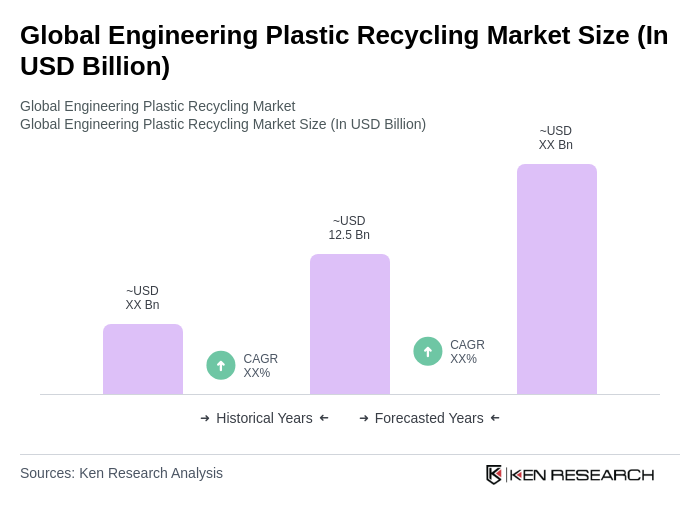
The global engineering plastic recycling market, valued at $12.5 billion, is growing due to strict regulations, consumer sustainability awareness, and demand in key industries like automotive.

Region:Global

Author(s):Shubham

Product Code:KRAD0665

Pages:87

Published On:August 2025
About the Report

Base Year 2024

Global Engineering Plastic Recycling Market Overview

  • The Global Engineering Plastic Recycling Market is valued at USD 12.5 billion, based on a five?year historical analysis. This growth is primarily driven by increasing environmental regulations, rising consumer awareness regarding sustainability, and the growing demand for recycled materials in various industries. The market is witnessing a shift towards circular economy practices, which further propels the need for effective recycling solutions.
  • Key players in this market include the United States, Germany, and China, which dominate due to their advanced recycling technologies, robust manufacturing sectors, and strong regulatory frameworks supporting recycling initiatives. These countries have established themselves as leaders in engineering plastic recycling, driven by significant investments in infrastructure and innovation.
  • In 2023, the European Union implemented the Circular Economy Action Plan, which mandates that all plastic packaging in the EU must be recyclable or reusable by 2030. This regulation aims to reduce plastic waste and promote recycling, significantly impacting the engineering plastic recycling market by encouraging companies to adopt sustainable practices.
Global Engineering Plastic Recycling Market Size

Global Engineering Plastic Recycling Market Segmentation

By Type:The engineering plastic recycling market is segmented into various types, including Polycarbonate (PC), Polyamide (PA, including PA6 and PA66), Polyethylene Terephthalate (PET), Acrylonitrile Butadiene Styrene (ABS), Polyoxymethylene (POM), Polybutylene Terephthalate (PBT), Polyphenylene Ether/oxide (PPE/PPO), Polyetheretherketone (PEEK) and High-performance Polyketones, and Others (e.g., PMMA, PPS, LCP, PC/ABS blends). Among these, Polyethylene Terephthalate (PET) is the leading subsegment due to its widespread use in packaging and textiles, coupled with strong consumer demand for recycled PET in sustainable products.
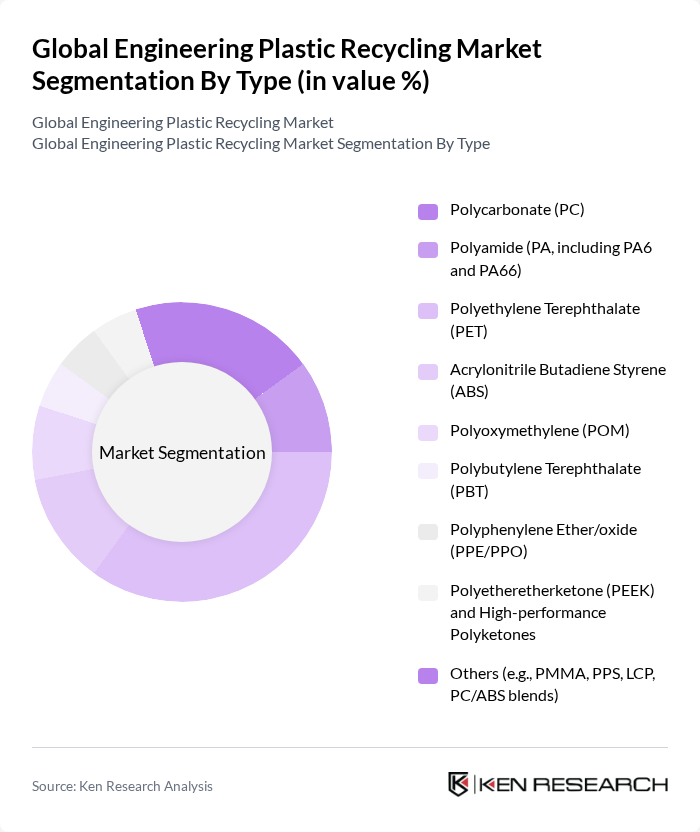
Global Engineering Plastic Recycling Market segmentation by Type.

By End-User:The market is also segmented by end-user industries, including Automotive and Mobility (including EVs), Electrical & Electronics, Consumer Goods & Appliances, Aerospace & Defense, Medical Devices & Healthcare, Building & Construction, and Others (industrial machinery, 3D printing, etc.). The Automotive and Mobility sector is the dominant end-user, driven by the increasing adoption of lightweight materials and the push for sustainability in vehicle manufacturing.
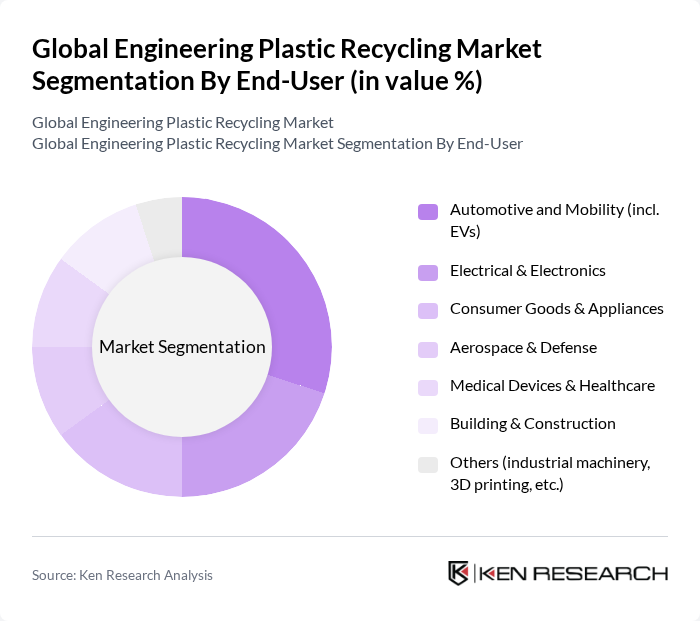
Global Engineering Plastic Recycling Market segmentation by End-User.

Global Engineering Plastic Recycling Market Competitive Landscape

The Global Engineering Plastic Recycling Market is characterized by a dynamic mix of regional and international players. Leading participants such as MBA Polymers, Inc., Veolia Environnement S.A. (Veolia Recycling & Recovery), SUEZ SA (SUEZ Recycling & Recovery), REMONDIS SE & Co. KG, PLASTIPAK Holdings, Inc. (Clean Tech UK) – rPET engineering applications, Indorama Ventures Public Company Limited (IVL) – PET recycling, Covestro AG – circular polycarbonates (mechanical & chemical), SABIC – TRUCIRCLE recycled engineering resins, BASF SE – ChemCycling and recycled engineering compounds, Eastman Chemical Company – molecular recycling (PET/PBT), INEOS Styrolution Group GmbH – recycled ABS/PS (e.g., ECO line), Solvay S.A. – recycled high-performance polymers (PA, PEEK blends), Celanese Corporation – recycled/renewable engineered materials, LANXESS AG (now Envalior via JV with Advent; with DSM Engineering Materials) – engineering recyclate compounds, Ascend Performance Materials – recycled PA66 solutions, Aquafil S.p.A. – ECONYL regenerated nylon (PA6), Kingfa Sci. & Tech. Co., Ltd. – recycled engineering plastics compounding, ULTRON (formerly Mitsubishi Engineering-Plastics; now part of Covestro/engineering plastics consolidation), Teijin Limited – recycled PC and specialty resins, RTP Company – recycled content engineering compounds contribute to innovation, geographic expansion, and service delivery in this space.

MBA Polymers, Inc.

1998

Richmond, California, USA

Veolia Environnement S.A.

1853

Paris, France

SUEZ SA

1869

Paris, France

REMONDIS SE & Co. KG

1934

Lünen, Germany

PLASTIPAK Holdings, Inc.

1967

Warren, Michigan, USA

Company

Establishment Year

Headquarters

Group Size (Large, Medium, or Small as per industry convention)

Revenue from Recycled Engineering Plastics (USD)

Recycled Output Volume (kt per year)

Feedstock Mix (% post?consumer vs post?industrial)

Geographic Footprint (No. of recycling/compounding sites)

End?market Exposure (% auto, E&E, consumer, construction)

Global Engineering Plastic Recycling Market Industry Analysis

Growth Drivers

  • Increasing Environmental Regulations:The global push for stricter environmental regulations is a significant driver for the engineering plastic recycling market. In future, over 50 countries are expected to implement new regulations aimed at reducing plastic waste, with an estimated 20% increase in compliance costs for manufacturers. This regulatory environment compels companies to adopt recycling practices, as non-compliance could lead to fines exceeding $1 million, thus incentivizing investment in recycling technologies.
  • Rising Demand for Sustainable Materials:The demand for sustainable materials is projected to reach $600 billion in future, driven by consumer preferences for eco-friendly products. Major brands are increasingly committing to sustainability, with 60% of consumers willing to pay a premium for recycled products. This shift is prompting manufacturers to invest in engineering plastic recycling, as they seek to align their offerings with consumer expectations and regulatory requirements, thereby enhancing their market competitiveness.
  • Technological Advancements in Recycling Processes:Innovations in recycling technologies are transforming the engineering plastic recycling landscape. In future, investments in advanced recycling technologies are expected to exceed $3 billion, significantly improving the efficiency of plastic recovery processes. Enhanced sorting and processing technologies can increase recycling rates by up to 50%, making it economically viable for companies to recycle engineering plastics, thus driving market growth and reducing environmental impact.

Market Challenges

  • High Initial Investment Costs:One of the primary challenges facing the engineering plastic recycling market is the high initial investment required for advanced recycling facilities. In future, the average cost to establish a state-of-the-art recycling plant is estimated at $12 million. This financial barrier limits entry for smaller companies and can deter investment in necessary technologies, ultimately hindering the growth of the recycling sector and its capacity to meet increasing demand.
  • Limited Recycling Infrastructure:The lack of adequate recycling infrastructure remains a significant challenge. In future, it is estimated that only 25% of plastic waste is effectively recycled globally, with many regions lacking the necessary facilities. This limitation not only affects the availability of recycled materials but also increases the reliance on virgin plastics, undermining sustainability efforts. Addressing this infrastructure gap is crucial for enhancing recycling rates and achieving environmental goals.

Global Engineering Plastic Recycling Market Future Outlook

The future of the engineering plastic recycling market appears promising, driven by increasing regulatory pressures and consumer demand for sustainable products. As technological advancements continue to improve recycling efficiency, the market is likely to see a rise in the adoption of closed-loop systems. Additionally, the growing emphasis on circular economy initiatives will encourage collaboration between industries and governments, fostering innovation and investment in recycling infrastructure, ultimately leading to a more sustainable future for engineering plastics.

Market Opportunities

  • Expansion of Recycling Technologies:The ongoing development of innovative recycling technologies presents a significant opportunity for market growth. By future, advancements in chemical recycling methods could increase the recovery rate of engineering plastics by 60%, enabling the transformation of previously unrecyclable plastics into valuable raw materials, thus enhancing the overall sustainability of the industry.
  • Partnerships with Government and NGOs:Collaborations with government bodies and non-governmental organizations (NGOs) can create substantial opportunities for the engineering plastic recycling market. In future, partnerships aimed at promoting recycling initiatives are expected to receive over $600 million in funding, facilitating the development of educational programs and infrastructure improvements that can significantly boost recycling rates and consumer participation.

Scope of the Report

SegmentSub-Segments
By Type

Polycarbonate (PC)

Polyamide (PA, including PA6 and PA66)

Polyethylene Terephthalate (PET)

Acrylonitrile Butadiene Styrene (ABS)

Polyoxymethylene (POM)

Polybutylene Terephthalate (PBT)

Polyphenylene Ether/oxide (PPE/PPO)

Polyetheretherketone (PEEK) and High?performance Polyketones

Others (e.g., PMMA, PPS, LCP, PC/ABS blends)

By End-User

Automotive and Mobility (incl. EVs)

Electrical & Electronics

Consumer Goods & Appliances

Aerospace & Defense

Medical Devices & Healthcare

Building & Construction

Others (industrial machinery, 3D printing, etc.)

By Application

Packaging (rigid, specialty trays, bottles for automotive fluids, E&E logistics)

Construction Components (profiles, sheets, glazing, insulation housings)

Automotive Parts (interiors, under?the?hood, exterior trims)

Electrical Components (enclosures, connectors, battery components)

Industrial Components (gears, bearings, valves)

Others

By Collection Method

Post?consumer Collection (curbside, drop?off, DRS)

Post?industrial Collection (factory scrap, offcuts, sprues)

Take?back/Closed?Loop Programs (OEM reverse logistics)

Others

By Recycling Process

Mechanical Recycling (sorting, shredding, regranulation, compounding)

Chemical Recycling (depolymerization, solvolysis, pyrolysis, glycolysis)

Upcycling and Alloying (additive?aided property restoration/blending)

Energy Recovery

Others

By Region

North America

Europe

Asia-Pacific

Latin America

Middle East & Africa

By Policy Support

EPR & Recycled-Content Mandates

Tax Incentives/Capital Grants for Advanced Recycling

Green Public Procurement & OEM Take?Back Requirements

Others

Key Target Audience

Investors and Venture Capitalist Firms

Government and Regulatory Bodies (e.g., Environmental Protection Agency, European Chemicals Agency)

Manufacturers and Producers of Engineering Plastics

Recycling Facility Operators

Material Recovery Facilities

Industry Associations (e.g., Plastics Industry Association)

Logistics and Supply Chain Companies

Financial Institutions and Investment Banks

Players Mentioned in the Report:

MBA Polymers, Inc.

Veolia Environnement S.A. (Veolia Recycling & Recovery)

SUEZ SA (SUEZ Recycling & Recovery)

REMONDIS SE & Co. KG

PLASTIPAK Holdings, Inc. (Clean Tech UK) rPET engineering applications

Indorama Ventures Public Company Limited (IVL) PET recycling

Covestro AG circular polycarbonates (mechanical & chemical)

SABIC TRUCIRCLE recycled engineering resins

BASF SE ChemCycling and recycled engineering compounds

Eastman Chemical Company molecular recycling (PET/PBT)

INEOS Styrolution Group GmbH recycled ABS/PS (e.g., ECO line)

Solvay S.A. recycled highperformance polymers (PA, PEEK blends)

Celanese Corporation recycled/renewable engineered materials

LANXESS AG (now Envalior via JV with Advent; with DSM Engineering Materials) engineering recyclate compounds

Ascend Performance Materials recycled PA66 solutions

Aquafil S.p.A. ECONYL regenerated nylon (PA6)

Kingfa Sci. & Tech. Co., Ltd. recycled engineering plastics compounding

ULTRON (formerly Mitsubishi EngineeringPlastics; now part of Covestro/engineering plastics consolidation)

Teijin Limited recycled PC and specialty resins

RTP Company recycled content engineering compounds

Table of Contents

Market Assessment Phase

1. Executive Summary and Approach


2. Global Engineering Plastic Recycling Market Overview

2.1 Key Insights and Strategic Recommendations

2.2 Global Engineering Plastic Recycling Market Overview

2.3 Definition and Scope

2.4 Evolution of Market Ecosystem

2.5 Timeline of Key Regulatory Milestones

2.6 Value Chain & Stakeholder Mapping

2.7 Business Cycle Analysis

2.8 Policy & Incentive Landscape


3. Global Engineering Plastic Recycling Market Analysis

3.1 Growth Drivers

3.1.1 Increasing Environmental Regulations
3.1.2 Rising Demand for Sustainable Materials
3.1.3 Technological Advancements in Recycling Processes
3.1.4 Growing Consumer Awareness on Plastic Waste

3.2 Market Challenges

3.2.1 High Initial Investment Costs
3.2.2 Limited Recycling Infrastructure
3.2.3 Fluctuating Raw Material Prices
3.2.4 Lack of Consumer Participation in Recycling Programs

3.3 Market Opportunities

3.3.1 Expansion of Recycling Technologies
3.3.2 Partnerships with Government and NGOs
3.3.3 Development of Biodegradable Engineering Plastics
3.3.4 Increasing Investment in Circular Economy Initiatives

3.4 Market Trends

3.4.1 Growth of E-commerce and Its Impact on Packaging Waste
3.4.2 Shift Towards Closed-Loop Recycling Systems
3.4.3 Innovations in Material Recovery Facilities
3.4.4 Rise of Consumer Brands Committing to Sustainability

3.5 Government Regulation

3.5.1 Extended Producer Responsibility (EPR) Policies
3.5.2 Plastic Waste Management Rules
3.5.3 Incentives for Recycling Investments
3.5.4 Bans on Single-Use Plastics

4. SWOT Analysis


5. Stakeholder Analysis


6. Porter's Five Forces Analysis


7. Global Engineering Plastic Recycling Market Market Size, 2019-2024

7.1 By Value

7.2 By Volume

7.3 By Average Selling Price


8. Global Engineering Plastic Recycling Market Segmentation

8.1 By Type

8.1.1 Polycarbonate (PC)
8.1.2 Polyamide (PA, including PA6 and PA66)
8.1.3 Polyethylene Terephthalate (PET)
8.1.4 Acrylonitrile Butadiene Styrene (ABS)
8.1.5 Polyoxymethylene (POM)
8.1.6 Polybutylene Terephthalate (PBT)
8.1.7 Polyphenylene Ether/oxide (PPE/PPO)
8.1.8 Polyetheretherketone (PEEK) and High?performance Polyketones
8.1.9 Others (e.g., PMMA, PPS, LCP, PC/ABS blends)

8.2 By End-User

8.2.1 Automotive and Mobility (incl. EVs)
8.2.2 Electrical & Electronics
8.2.3 Consumer Goods & Appliances
8.2.4 Aerospace & Defense
8.2.5 Medical Devices & Healthcare
8.2.6 Building & Construction
8.2.7 Others (industrial machinery, 3D printing, etc.)

8.3 By Application

8.3.1 Packaging (rigid, specialty trays, bottles for automotive fluids, E&E logistics)
8.3.2 Construction Components (profiles, sheets, glazing, insulation housings)
8.3.3 Automotive Parts (interiors, under?the?hood, exterior trims)
8.3.4 Electrical Components (enclosures, connectors, battery components)
8.3.5 Industrial Components (gears, bearings, valves)
8.3.6 Others

8.4 By Collection Method

8.4.1 Post?consumer Collection (curbside, drop?off, DRS)
8.4.2 Post?industrial Collection (factory scrap, offcuts, sprues)
8.4.3 Take?back/Closed?Loop Programs (OEM reverse logistics)
8.4.4 Others

8.5 By Recycling Process

8.5.1 Mechanical Recycling (sorting, shredding, regranulation, compounding)
8.5.2 Chemical Recycling (depolymerization, solvolysis, pyrolysis, glycolysis)
8.5.3 Upcycling and Alloying (additive?aided property restoration/blending)
8.5.4 Energy Recovery
8.5.5 Others

8.6 By Region

8.6.1 North America
8.6.2 Europe
8.6.3 Asia-Pacific
8.6.4 Latin America
8.6.5 Middle East & Africa

8.7 By Policy Support

8.7.1 EPR & Recycled-Content Mandates
8.7.2 Tax Incentives/Capital Grants for Advanced Recycling
8.7.3 Green Public Procurement & OEM Take?Back Requirements
8.7.4 Others

9. Global Engineering Plastic Recycling Market Competitive Analysis

9.1 Market Share of Key Players(Micro, Small, Medium, Large Enterprises)

9.2 Cross Comparison of Key Players

9.2.1 Company Name
9.2.2 Group Size (Large, Medium, or Small as per industry convention)
9.2.3 Revenue from Recycled Engineering Plastics (USD)
9.2.4 Recycled Output Volume (kt per year)
9.2.5 Feedstock Mix (% post?consumer vs post?industrial)
9.2.6 Geographic Footprint (No. of recycling/compounding sites)
9.2.7 End?market Exposure (% auto, E&E, consumer, construction)
9.2.8 Technology Capability (mechanical vs chemical; depolymerization methods)
9.2.9 PCR Content Achieved in Grades (average %, max %)
9.2.10 Certifications & Compliance (e.g., ISCC PLUS, UL, OEM approvals)
9.2.11 Supply Agreements/LOIs with OEMs (count, duration)
9.2.12 Innovation Rate (new r?grades launched per year, patents)
9.2.13 EBITDA Margin from Recycling Segment (%)
9.2.14 Scope 1&2 Emissions Intensity (tCO?e per ton processed)
9.2.15 Circularity KPIs (collection rate, yield loss, reprocessing cycles)

9.3 SWOT Analysis of Top Players

9.4 Pricing Analysis(By Class and Payload)

9.5 Detailed Profile of Major Companies

9.5.1 MBA Polymers, Inc.
9.5.2 Veolia Environnement S.A. (Veolia Recycling & Recovery)
9.5.3 SUEZ SA (SUEZ Recycling & Recovery)
9.5.4 REMONDIS SE & Co. KG
9.5.5 PLASTIPAK Holdings, Inc. (Clean Tech UK) – rPET engineering applications
9.5.6 Indorama Ventures Public Company Limited (IVL) – PET recycling
9.5.7 Covestro AG – circular polycarbonates (mechanical & chemical)
9.5.8 SABIC – TRUCIRCLE recycled engineering resins
9.5.9 BASF SE – ChemCycling and recycled engineering compounds
9.5.10 Eastman Chemical Company – molecular recycling (PET/PBT)
9.5.11 INEOS Styrolution Group GmbH – recycled ABS/PS (e.g., ECO line)
9.5.12 Solvay S.A. – recycled high?performance polymers (PA, PEEK blends)
9.5.13 Celanese Corporation – recycled/renewable engineered materials
9.5.14 LANXESS AG (now Envalior via JV with Advent; with DSM Engineering Materials) – engineering recyclate compounds
9.5.15 Ascend Performance Materials – recycled PA66 solutions
9.5.16 Aquafil S.p.A. – ECONYL regenerated nylon (PA6)
9.5.17 Kingfa Sci. & Tech. Co., Ltd. – recycled engineering plastics compounding
9.5.18 ULTRON (formerly Mitsubishi Engineering?Plastics; now part of Covestro/engineering plastics consolidation)
9.5.19 Teijin Limited – recycled PC and specialty resins
9.5.20 RTP Company – recycled content engineering compounds

10. Global Engineering Plastic Recycling Market End-User Analysis

10.1 Procurement Behavior of Key Ministries

10.1.1 Government Procurement Policies
10.1.2 Budget Allocations for Recycling Initiatives
10.1.3 Collaboration with Private Sector

10.2 Corporate Spend on Infrastructure & Energy

10.2.1 Investment in Recycling Facilities
10.2.2 Funding for Research and Development
10.2.3 Expenditure on Sustainable Practices

10.3 Pain Point Analysis by End-User Category

10.3.1 Cost of Recycling Services
10.3.2 Quality of Recycled Materials
10.3.3 Availability of Recycling Options

10.4 User Readiness for Adoption

10.4.1 Awareness of Recycling Benefits
10.4.2 Accessibility of Recycling Programs
10.4.3 Willingness to Pay for Sustainable Options

10.5 Post-Deployment ROI and Use Case Expansion

10.5.1 Measurement of Cost Savings
10.5.2 Impact on Brand Image
10.5.3 Opportunities for New Applications

11. Global Engineering Plastic Recycling Market Future Size, 2025-2030

11.1 By Value

11.2 By Volume

11.3 By Average Selling Price


Go-To-Market Strategy Phase

1. Whitespace Analysis + Business Model Canvas

1.1 Market Gaps Identification

1.2 Value Proposition Development

1.3 Revenue Streams Analysis

1.4 Cost Structure Evaluation

1.5 Key Partnerships Exploration

1.6 Customer Segmentation

1.7 Channels of Distribution


2. Marketing and Positioning Recommendations

2.1 Branding Strategies

2.2 Product USPs

2.3 Target Market Identification

2.4 Communication Strategies

2.5 Digital Marketing Approaches


3. Distribution Plan

3.1 Urban Retail Strategies

3.2 Rural NGO Tie-ups

3.3 E-commerce Integration

3.4 Logistics and Supply Chain Management


4. Channel & Pricing Gaps

4.1 Underserved Routes

4.2 Pricing Bands Analysis

4.3 Competitor Pricing Strategies


5. Unmet Demand & Latent Needs

5.1 Category Gaps Identification

5.2 Consumer Segments Analysis

5.3 Emerging Trends Exploration


6. Customer Relationship

6.1 Loyalty Programs Development

6.2 After-sales Service Strategies

6.3 Customer Feedback Mechanisms


7. Value Proposition

7.1 Sustainability Initiatives

7.2 Integrated Supply Chains

7.3 Competitive Advantages


8. Key Activities

8.1 Regulatory Compliance

8.2 Branding Initiatives

8.3 Distribution Setup


9. Entry Strategy Evaluation

9.1 Domestic Market Entry Strategy

9.1.1 Product Mix Considerations
9.1.2 Pricing Band Strategy
9.1.3 Packaging Solutions

9.2 Export Entry Strategy

9.2.1 Target Countries Identification
9.2.2 Compliance Roadmap Development

10. Entry Mode Assessment

10.1 Joint Ventures

10.2 Greenfield Investments

10.3 Mergers & Acquisitions

10.4 Distributor Model Evaluation


11. Capital and Timeline Estimation

11.1 Capital Requirements Analysis

11.2 Timelines for Implementation


12. Control vs Risk Trade-Off

12.1 Ownership vs Partnerships

12.2 Risk Management Strategies


13. Profitability Outlook

13.1 Breakeven Analysis

13.2 Long-term Sustainability Strategies


14. Potential Partner List

14.1 Distributors Identification

14.2 Joint Ventures Opportunities

14.3 Acquisition Targets


15. Execution Roadmap

15.1 Phased Plan for Market Entry

15.1.1 Market Setup
15.1.2 Market Entry
15.1.3 Growth Acceleration
15.1.4 Scale & Stabilize

15.2 Key Activities and Milestones

15.2.1 Milestone Plannin

Research Methodology

ApproachModellingSample

Phase 1: Approach1

Desk Research

  • Industry reports from global recycling associations and engineering plastic organizations
  • Market analysis publications from environmental agencies and sustainability think tanks
  • Statistical data from government databases on plastic waste management and recycling rates

Primary Research

  • Interviews with executives from leading engineering plastic manufacturers
  • Surveys with recycling facility operators and waste management experts
  • Focus groups with sustainability consultants and environmental policymakers

Validation & Triangulation

  • Cross-validation of findings through multiple industry reports and expert opinions
  • Triangulation of data from primary interviews and secondary sources
  • Sanity checks conducted through expert panel discussions and feedback sessions

Phase 2: Market Size Estimation1

Top-down Assessment

  • Analysis of global plastic production and waste generation statistics
  • Segmentation of the market by engineering plastic types and recycling methods
  • Incorporation of trends in circular economy practices and regulatory frameworks

Bottom-up Modeling

  • Volume estimates based on recycling rates of specific engineering plastics
  • Cost analysis derived from operational expenses of recycling facilities
  • Estimation of market size based on projected growth in demand for recycled materials

Forecasting & Scenario Analysis

  • Scenario modeling based on varying levels of regulatory enforcement and consumer behavior
  • Multi-variable forecasting incorporating technological advancements in recycling processes
  • Development of baseline, optimistic, and pessimistic market growth scenarios through 2030

Phase 3: CATI Sample Composition1

Scope Item/SegmentSample SizeTarget Respondent Profiles
Engineering Plastic Manufacturers100Production Managers, R&D Directors
Recycling Facility Operators80Operations Managers, Facility Supervisors
Environmental Policymakers50Government Officials, Regulatory Analysts
Sustainability Consultants70Consultants, Project Managers
End-User Industries (Automotive, Electronics)90Supply Chain Managers, Procurement Officers

Frequently Asked Questions

What is the current value of the Global Engineering Plastic Recycling Market?

The Global Engineering Plastic Recycling Market is valued at approximately USD 12.5 billion, reflecting a significant growth trend driven by environmental regulations, consumer awareness of sustainability, and the demand for recycled materials across various industries.

What factors are driving the growth of the engineering plastic recycling market?

Which countries are leading in engineering plastic recycling?

What are the main types of engineering plastics being recycled?

Other Regional/Country Reports

UAE Engineering Plastic Recycling MarketKSA Engineering Plastic Recycling Market

Indonesia Engineering Plastic Recycling Market

Malaysia Engineering Plastic Recycling Market

APAC Engineering Plastic Recycling Market

SEA Engineering Plastic Recycling Market

Why Buy From Us?

Refine Robust Result (RRR) Framework

What makes us stand out is that our consultants follow Robust, Refine and Result (RRR) methodology. Robust for clear definitions, approaches and sanity checking, Refine for differentiating respondents' facts and opinions, and Result for presenting data with story.

Our Reach Is Unmatched

We have set a benchmark in the industry by offering our clients with syndicated and customized market research reports featuring coverage of entire market as well as meticulous research and analyst insights.

Shifting the Research Paradigm

While we don't replace traditional research, we flip the method upside down. Our dual approach of Top Bottom & Bottom Top ensures quality deliverable by not just verifying company fundamentals but also looking at the sector and macroeconomic factors.

More Insights-Better Decisions

With one step in the future, our research team constantly tries to show you the bigger picture. We help with some of the tough questions you may encounter along the way: How is the industry positioned? Best marketing channel? KPI's of competitors? By aligning every element, we help maximize success.

Transparency and Trust

Our report gives you instant access to the answers and sources that other companies might choose to hide. We elaborate each steps of research methodology we have used and showcase you the sample size to earn your trust.

Round the Clock Support

If you need any support, we are here! We pride ourselves on universe strength, data quality, and quick, friendly, and professional service.

Why Clients Choose Us?

400000+
Reports in repository
150+
Consulting projects a year
100+
Analysts
8000+
Client Queries in 2022








