About the Report
Base Year 2024Global Enterprise Augmented Reality Software Market Overview
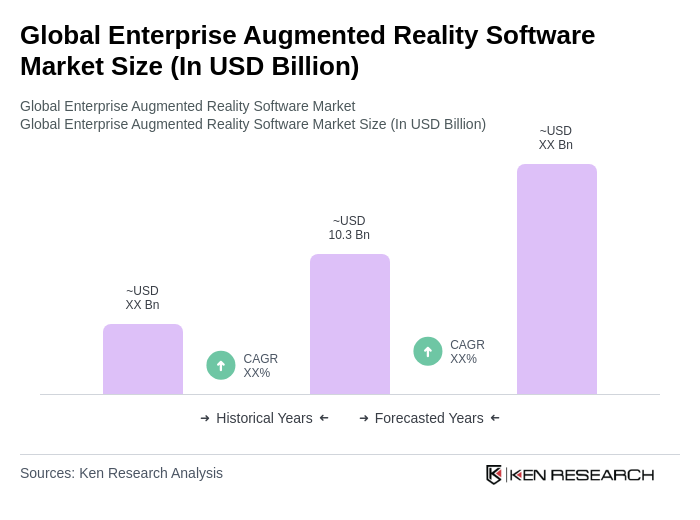
- The Global Enterprise Augmented Reality Software Market is valued at USD 10.3 billion, based on a five-year historical analysis, reflecting enterprise software revenues within the broader AR market and aligned with recent industry sizing of enterprise AR software from reputable industry trackers .
- Key players in this market are predominantly located in North America and Europe, with the United States and Germany leading due to strong technological infrastructure, high R&D investment, and concentration of AR platforms such as ARKit, ARCore, Vuforia, Unity, and enterprise suites from Microsoft and TeamViewer that anchor substantial ecosystems in these regions .
- In 2023, the European Union implemented the Digital Services Act to regulate digital platforms and enhance user safety; its obligations on data handling and platform accountability influence AR software compliance practices alongside existing GDPR, pushing vendors to adopt stronger privacy-by-design and security controls in AR applications .
Global Enterprise Augmented Reality Software Market Segmentation
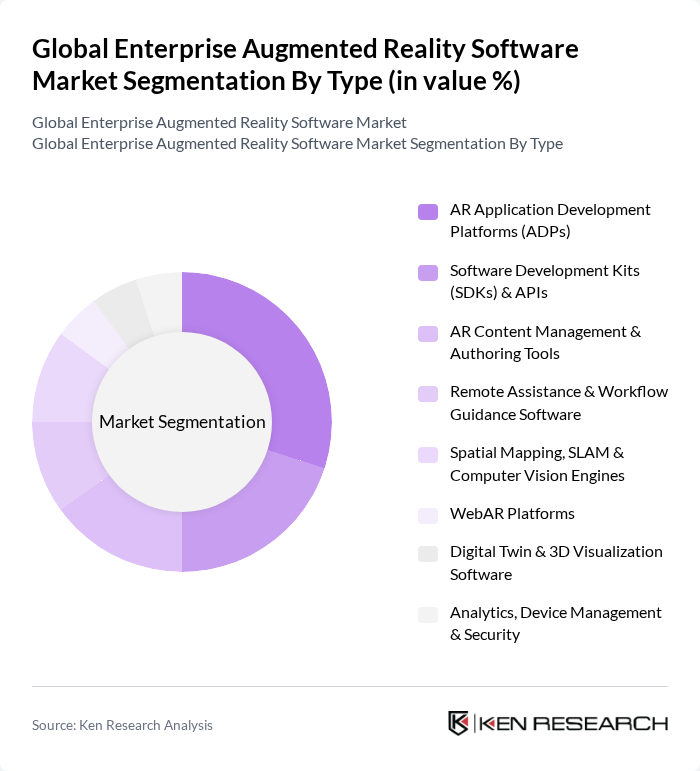
By Type:The market is segmented into various types of software solutions that cater to different needs within the enterprise environment. The subsegments include AR Application Development Platforms (ADPs), Software Development Kits (SDKs) & APIs, AR Content Management & Authoring Tools, Remote Assistance & Workflow Guidance Software, Spatial Mapping, SLAM & Computer Vision Engines, WebAR Platforms, Digital Twin & 3D Visualization Software, and Analytics, Device Management & Security. Among these, AR Application Development Platforms (ADPs) are currently dominating the market due to their ability to provide comprehensive tools for developers to create customized AR applications tailored to specific business needs .
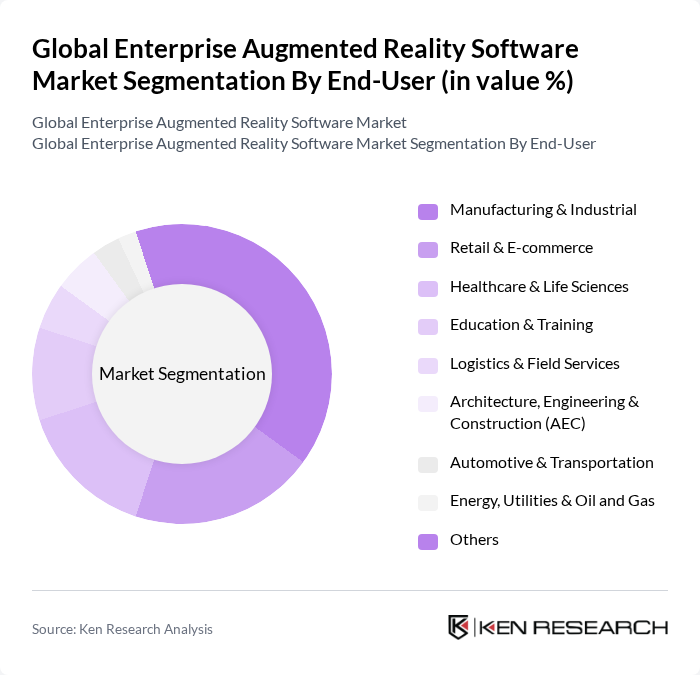
By End-User:The end-user segmentation includes various industries that leverage augmented reality software for operational improvements. Key segments are Manufacturing & Industrial, Retail & E-commerce, Healthcare & Life Sciences, Education & Training, Logistics & Field Services, Architecture, Engineering & Construction (AEC), Automotive & Transportation, Energy, Utilities & Oil and Gas, and Others. The Manufacturing & Industrial sector is leading this segment, driven by the need for enhanced training, maintenance, and operational efficiency through AR technologies; enterprise deployments often emphasize remote assistance, workflow guidance, and training use cases in factories and field service .
Global Enterprise Augmented Reality Software Market Competitive Landscape
The Global Enterprise Augmented Reality Software Market is characterized by a dynamic mix of regional and international players. Leading participants such as PTC Inc. (Vuforia), Microsoft Corporation (Dynamics 365 Guides/Remote Assist), Google LLC (ARCore/Geospatial Creator/Niantic 8th Wall), Unity Technologies (Unity Industry/Unity MARS), Apple Inc. (ARKit/RealityKit), TeamViewer SE (Frontline), Scope AR, BILT Incorporated, Upskill (formerly, now part of TeamViewer), Librestream Technologies, RE’FLEKT GmbH, Magic Leap, Inc., Niantic, Inc. (8th Wall), Wikitude GmbH (an Almer company), Zappar Ltd contribute to innovation, geographic expansion, and service delivery in this space .
Global Enterprise Augmented Reality Software Market Industry Analysis
Growth Drivers
- Increasing Demand for Remote Collaboration Tools:The global shift towards remote work has led to a significant increase in demand for collaboration tools, with the remote work market projected to reach $100 billion in future. Companies are increasingly adopting augmented reality (AR) solutions to enhance virtual meetings and collaborative projects. For instance, AR platforms can facilitate real-time interaction, allowing teams to visualize complex data and designs, thus improving productivity and engagement in remote settings.
- Rising Adoption of AR in Training and Education:The education sector is witnessing a surge in AR adoption, with the global AR in education market expected to reach $6 billion in future. Educational institutions are leveraging AR to create immersive learning experiences, enhancing student engagement and retention. For example, AR applications in medical training allow students to practice procedures in a risk-free environment, significantly improving learning outcomes and preparing them for real-world scenarios.
- Growth in E-commerce and Virtual Shopping Experiences:The e-commerce sector is projected to surpass $7 trillion in sales in future, driving the need for innovative shopping experiences. Retailers are increasingly integrating AR technologies to provide virtual try-ons and interactive product displays, enhancing customer engagement. For instance, AR applications enable consumers to visualize products in their own environment, leading to higher conversion rates and reduced return rates, thus benefiting both retailers and consumers.
Market Challenges
- High Development and Implementation Costs:The initial investment required for developing and implementing AR solutions can be substantial, often exceeding $600,000 for comprehensive systems. This financial barrier can deter small and medium-sized enterprises from adopting AR technologies. Additionally, ongoing maintenance and updates can further strain budgets, making it challenging for organizations to justify the costs against potential returns on investment.
- Data Privacy and Security Concerns:As AR applications often require access to sensitive user data, concerns regarding data privacy and security are paramount. In future, it is estimated that data breaches could cost businesses over $6 trillion globally. Companies must navigate complex regulations and ensure robust security measures are in place to protect user information, which can complicate AR implementation and deter potential users from embracing the technology.
Global Enterprise Augmented Reality Software Market Future Outlook
The future of the enterprise augmented reality software market appears promising, driven by technological advancements and increasing integration across various sectors. As 5G technology becomes more widespread, it will enhance AR experiences by providing faster data transmission and lower latency. Furthermore, the shift towards cloud-based solutions will facilitate easier access and scalability for businesses, allowing for more widespread adoption. Companies are likely to invest in tailored AR solutions that cater to specific industry needs, fostering innovation and growth in the sector.
Market Opportunities
- Expansion in Emerging Markets:Emerging markets present significant growth opportunities for AR software, with countries like India and Brazil projected to see a 25% increase in technology adoption in future. This growth is driven by rising smartphone penetration and increasing internet access, enabling businesses to leverage AR for various applications, from retail to training, thus expanding their market reach.
- Partnerships with Hardware Manufacturers:Collaborations between AR software developers and hardware manufacturers can enhance product offerings and market penetration. In future, partnerships are expected to streamline the integration of AR solutions with devices like smart glasses and mobile phones, improving user experience and accessibility. This synergy can lead to innovative applications and broaden the customer base for AR technologies.
Scope of the Report
| Segment | Sub-Segments |
|---|---|
| By Type | AR Application Development Platforms (ADPs) Software Development Kits (SDKs) & APIs AR Content Management & Authoring Tools Remote Assistance & Workflow Guidance Software Spatial Mapping, SLAM & Computer Vision Engines WebAR Platforms Digital Twin & 3D Visualization Software Analytics, Device Management & Security |
| By End-User | Manufacturing & Industrial Retail & E-commerce Healthcare & Life Sciences Education & Training Logistics & Field Services Architecture, Engineering & Construction (AEC) Automotive & Transportation Energy, Utilities & Oil and Gas Others |
| By Application | Training, Onboarding & Simulation Maintenance, Repair & Operations (MRO) Remote Expert Support & Collaboration Marketing, Sales Enablement & Retail Experience Product Design, Prototyping & Visualization Quality Inspection & Compliance Warehouse Picking & Workflow Guidance Customer Service & Aftermarket Support Others |
| By Deployment Mode | Cloud-Based (SaaS) On-Premises Hybrid |
| By Industry Vertical | Industrial & Manufacturing Aerospace & Defense Automotive AEC (Architecture, Engineering & Construction) Retail & Consumer Goods Healthcare Energy & Utilities Logistics & Transportation Others |
| By Region | North America Europe Asia-Pacific Latin America Middle East & Africa |
| By Pricing Model | Subscription (Per-User/Per-Device) Enterprise License (Annual/Multiyear) Usage-Based (Events/Views/Minutes) Freemium & Developer Tiers One-Time Perpetual License |
Key Target Audience
Investors and Venture Capitalist Firms
Government and Regulatory Bodies (e.g., Federal Communications Commission, National Institute of Standards and Technology)
Manufacturers and Producers
Distributors and Retailers
Technology Providers
Industry Associations
Financial Institutions
Telecommunications Companies
Players Mentioned in the Report:
PTC Inc. (Vuforia)
Microsoft Corporation (Dynamics 365 Guides/Remote Assist)
Google LLC (ARCore/Geospatial Creator/Niantic 8th Wall)
Unity Technologies (Unity Industry/Unity MARS)
Apple Inc. (ARKit/RealityKit)
TeamViewer SE (Frontline)
Scope AR
BILT Incorporated
Upskill (formerly, now part of TeamViewer)
Librestream Technologies
REFLEKT GmbH
Magic Leap, Inc.
Niantic, Inc. (8th Wall)
Wikitude GmbH (an Almer company)
Zappar Ltd
Table of Contents
Market Assessment Phase
1. Executive Summary and Approach
2. Global Enterprise Augmented Reality Software Market Overview
2.1 Key Insights and Strategic Recommendations
2.2 Global Enterprise Augmented Reality Software Market Overview
2.3 Definition and Scope
2.4 Evolution of Market Ecosystem
2.5 Timeline of Key Regulatory Milestones
2.6 Value Chain & Stakeholder Mapping
2.7 Business Cycle Analysis
2.8 Policy & Incentive Landscape
3. Global Enterprise Augmented Reality Software Market Analysis
3.1 Growth Drivers
3.1.1 Increasing demand for remote collaboration tools
3.1.2 Rising adoption of AR in training and education
3.1.3 Enhanced user experience through immersive technologies
3.1.4 Growth in e-commerce and virtual shopping experiences
3.2 Market Challenges
3.2.1 High development and implementation costs
3.2.2 Limited awareness and understanding of AR technology
3.2.3 Data privacy and security concerns
3.2.4 Integration with existing systems and processes
3.3 Market Opportunities
3.3.1 Expansion in emerging markets
3.3.2 Development of industry-specific AR solutions
3.3.3 Partnerships with hardware manufacturers
3.3.4 Increasing investment in AR startups
3.4 Market Trends
3.4.1 Growth of 5G technology enabling better AR experiences
3.4.2 Shift towards cloud-based AR solutions
3.4.3 Rise of AR in healthcare and medical training
3.4.4 Increasing use of AR in marketing and advertising
3.5 Government Regulation
3.5.1 Data protection regulations impacting AR applications
3.5.2 Standards for AR content and user safety
3.5.3 Incentives for technology adoption in education
3.5.4 Regulations on AR in public spaces
4. SWOT Analysis
5. Stakeholder Analysis
6. Porter's Five Forces Analysis
7. Global Enterprise Augmented Reality Software Market Market Size, 2019-2024
7.1 By Value
7.2 By Volume
7.3 By Average Selling Price
8. Global Enterprise Augmented Reality Software Market Segmentation
8.1 By Type
8.1.1 AR Application Development Platforms (ADPs)
8.1.2 Software Development Kits (SDKs) & APIs
8.1.3 AR Content Management & Authoring Tools
8.1.4 Remote Assistance & Workflow Guidance Software
8.1.5 Spatial Mapping, SLAM & Computer Vision Engines
8.1.6 WebAR Platforms
8.1.7 Digital Twin & 3D Visualization Software
8.1.8 Analytics, Device Management & Security
8.2 By End-User
8.2.1 Manufacturing & Industrial
8.2.2 Retail & E-commerce
8.2.3 Healthcare & Life Sciences
8.2.4 Education & Training
8.2.5 Logistics & Field Services
8.2.6 Architecture, Engineering & Construction (AEC)
8.2.7 Automotive & Transportation
8.2.8 Energy, Utilities & Oil and Gas
8.2.9 Others
8.3 By Application
8.3.1 Training, Onboarding & Simulation
8.3.2 Maintenance, Repair & Operations (MRO)
8.3.3 Remote Expert Support & Collaboration
8.3.4 Marketing, Sales Enablement & Retail Experience
8.3.5 Product Design, Prototyping & Visualization
8.3.6 Quality Inspection & Compliance
8.3.7 Warehouse Picking & Workflow Guidance
8.3.8 Customer Service & Aftermarket Support
8.3.9 Others
8.4 By Deployment Mode
8.4.1 Cloud-Based (SaaS)
8.4.2 On-Premises
8.4.3 Hybrid
8.5 By Industry Vertical
8.5.1 Industrial & Manufacturing
8.5.2 Aerospace & Defense
8.5.3 Automotive
8.5.4 AEC (Architecture, Engineering & Construction)
8.5.5 Retail & Consumer Goods
8.5.6 Healthcare
8.5.7 Energy & Utilities
8.5.8 Logistics & Transportation
8.5.9 Others
8.6 By Region
8.6.1 North America
8.6.2 Europe
8.6.3 Asia-Pacific
8.6.4 Latin America
8.6.5 Middle East & Africa
8.7 By Pricing Model
8.7.1 Subscription (Per-User/Per-Device)
8.7.2 Enterprise License (Annual/Multiyear)
8.7.3 Usage-Based (Events/Views/Minutes)
8.7.4 Freemium & Developer Tiers
8.7.5 One-Time Perpetual License
9. Global Enterprise Augmented Reality Software Market Competitive Analysis
9.1 Market Share of Key Players
9.2 Cross Comparison of Key Players
9.2.1 Company Name
9.2.2 Company Size (Employees/Revenue Band)
9.2.3 ARR from AR Software (USD)
9.2.4 YoY Revenue Growth (%)
9.2.5 Active Enterprise Customers
9.2.6 Average Deal Size (USD)
9.2.7 Gross Margin (%)
9.2.8 Net Dollar Retention (NDR) (%)
9.2.9 Customer Acquisition Cost (CAC) (USD)
9.2.10 Payback Period (Months)
9.2.11 Deployment Mix (Cloud/On-Prem/Hybrid %)
9.2.12 Geographic Revenue Mix (% by Region)
9.2.13 Product Breadth (Modules/APIs/Integrations)
9.2.14 Average Implementation Time (Days)
9.2.15 SLA/Uptime (%)
9.2.16 Security/Compliance (SOC 2/ISO 27001/ FedRAMP)
9.2.17 Partner Ecosystem Size (ISVs/SIs/Resellers)
9.2.18 R&D Intensity (% of Revenue)
9.2.19 Patents/Proprietary Tech (CV/SLAM/WebAR)
9.2.20 Customer Satisfaction (NPS/CSAT)
9.3 SWOT Analysis of Top Players
9.4 Pricing Analysis
9.5 Detailed Profile of Major Companies
9.5.1 PTC Inc. (Vuforia)
9.5.2 Microsoft Corporation (Dynamics 365 Guides/Remote Assist)
9.5.3 Google LLC (ARCore/Geospatial Creator/Niantic 8th Wall)
9.5.4 Unity Technologies (Unity Industry/Unity MARS)
9.5.5 Apple Inc. (ARKit/RealityKit)
9.5.6 TeamViewer SE (Frontline)
9.5.7 Scope AR
9.5.8 BILT Incorporated
9.5.9 Upskill (formerly, now part of TeamViewer)
9.5.10 Librestream Technologies
9.5.11 RE’FLEKT GmbH
9.5.12 Magic Leap, Inc.
9.5.13 Niantic, Inc. (8th Wall)
9.5.14 Wikitude GmbH (an Almer company)
9.5.15 Zappar Ltd
10. Global Enterprise Augmented Reality Software Market End-User Analysis
10.1 Procurement Behavior of Key Ministries
10.1.1 Government contracts for AR solutions
10.1.2 Budget allocation for technology upgrades
10.1.3 Collaboration with tech providers
10.2 Corporate Spend on Infrastructure & Energy
10.2.1 Investment in AR for operational efficiency
10.2.2 Budgeting for training and development
10.2.3 Spending on customer engagement technologies
10.3 Pain Point Analysis by End-User Category
10.3.1 Need for enhanced training methods
10.3.2 Challenges in remote collaboration
10.3.3 Demand for improved customer experiences
10.4 User Readiness for Adoption
10.4.1 Familiarity with AR technologies
10.4.2 Training requirements for staff
10.4.3 Infrastructure readiness for AR deployment
10.5 Post-Deployment ROI and Use Case Expansion
10.5.1 Measurement of training effectiveness
10.5.2 Expansion of AR applications in business processes
10.5.3 Long-term benefits of AR integration
11. Global Enterprise Augmented Reality Software Market Future Size, 2025-2030
11.1 By Value
11.2 By Volume
11.3 By Average Selling Price
Go-To-Market Strategy Phase
1. Whitespace Analysis + Business Model Canvas
1.1 Market gaps and opportunities
2. Marketing and Positioning Recommendations
2.1 Branding strategies and Product USPs
3. Distribution Plan
3.1 Urban retail vs rural NGO tie-ups
4. Channel & Pricing Gaps
4.1 Underserved routes and Pricing bands
5. Unmet Demand & Latent Needs
5.1 Category gaps and Consumer segments
6. Customer Relationship
6.1 Loyalty programs and After-sales service
7. Value Proposition
7.1 Sustainability and Integrated supply chains
8. Key Activities
8.1 Regulatory compliance and Branding
9. Entry Strategy Evaluation
9.1 Domestic Market Entry Strategy
9.1.1 Product mix and Pricing band
9.2 Export Entry Strategy
9.2.1 Target countries and Compliance roadmap
10. Entry Mode Assessment
10.1 JV, Greenfield, M&A, Distributor Model
11. Capital and Timeline Estimation
11.1 Capital requirements and Timelines
12. Control vs Risk Trade-Off
12.1 Ownership vs Partnerships
13. Profitability Outlook
13.1 Breakeven analysis and Long-term sustainability
14. Potential Partner List
14.1 Distributors, JVs, Acquisition targets
15. Execution Roadmap
15.1 Phased Plan for Market Entry
15.1.1 Market Setup ? Market Entry ? Growth Acceleration ? Scale & Stabilize
15.2 Key Activities and Milestones
15.2.1 Milestone tracking and Activity planning
Research Methodology
Phase 1: Approach1
Desk Research
- Industry reports from leading market research firms focusing on augmented reality software trends
- Analysis of market dynamics through white papers and publications from technology associations
- Review of financial reports and press releases from key players in the augmented reality software market
Primary Research
- Interviews with product managers and technology leads at major AR software companies
- Surveys targeting end-users in sectors such as retail, healthcare, and manufacturing
- Focus group discussions with industry experts and AR technology consultants
Validation & Triangulation
- Cross-validation of findings through multiple data sources including market reports and expert opinions
- Triangulation of quantitative data with qualitative insights from interviews
- Sanity checks conducted through expert panel reviews to ensure data accuracy
Phase 2: Market Size Estimation1
Top-down Assessment
- Estimation of market size based on global AR software revenue and growth rates
- Segmentation analysis by industry verticals and geographical regions
- Incorporation of macroeconomic factors influencing AR adoption rates
Bottom-up Modeling
- Data collection from leading AR software vendors regarding their sales figures
- Estimation of market penetration rates across different sectors
- Calculation of average revenue per user (ARPU) based on customer segments
Forecasting & Scenario Analysis
- Multi-variable forecasting models incorporating technological advancements and user adoption trends
- Scenario analysis based on varying levels of investment in AR technology by enterprises
- Development of baseline, optimistic, and pessimistic market growth projections through 2030
Phase 3: CATI Sample Composition1
| Scope Item/Segment | Sample Size | Target Respondent Profiles |
|---|---|---|
| Retail Sector AR Applications | 100 | Marketing Managers, IT Directors |
| Healthcare AR Solutions | 80 | Healthcare Administrators, Medical Technology Specialists |
| Manufacturing AR Integration | 70 | Operations Managers, Production Engineers |
| Education Sector AR Tools | 60 | Curriculum Developers, Educational Technology Coordinators |
| Real Estate AR Visualization | 90 | Real Estate Agents, Property Developers |
Frequently Asked Questions
What is the current value of the Global Enterprise Augmented Reality Software Market?
The Global Enterprise Augmented Reality Software Market is valued at approximately USD 10.3 billion, reflecting a comprehensive analysis of enterprise software revenues within the broader augmented reality sector, as reported by various industry trackers.
Which regions are leading in the Enterprise Augmented Reality Software Market?
What are the key types of software solutions in the Enterprise Augmented Reality Market?
What industries are the primary end-users of Enterprise Augmented Reality Software?
Other Regional/Country Reports
Indonesia Enterprise Augmented Reality Software Market
Malaysia Enterprise Augmented Reality Software Market
APAC Enterprise Augmented Reality Software Market
SEA Enterprise Augmented Reality Software Market
Why Buy From Us?

What makes us stand out is that our consultants follow Robust, Refine and Result (RRR) methodology. Robust for clear definitions, approaches and sanity checking, Refine for differentiating respondents' facts and opinions, and Result for presenting data with story.

We have set a benchmark in the industry by offering our clients with syndicated and customized market research reports featuring coverage of entire market as well as meticulous research and analyst insights.

While we don't replace traditional research, we flip the method upside down. Our dual approach of Top Bottom & Bottom Top ensures quality deliverable by not just verifying company fundamentals but also looking at the sector and macroeconomic factors.

With one step in the future, our research team constantly tries to show you the bigger picture. We help with some of the tough questions you may encounter along the way: How is the industry positioned? Best marketing channel? KPI's of competitors? By aligning every element, we help maximize success.

Our report gives you instant access to the answers and sources that other companies might choose to hide. We elaborate each steps of research methodology we have used and showcase you the sample size to earn your trust.

If you need any support, we are here! We pride ourselves on universe strength, data quality, and quick, friendly, and professional service.