Region:Global
Author(s):Shubham
Product Code:KRAC0802
Pages:99
Published On:August 2025
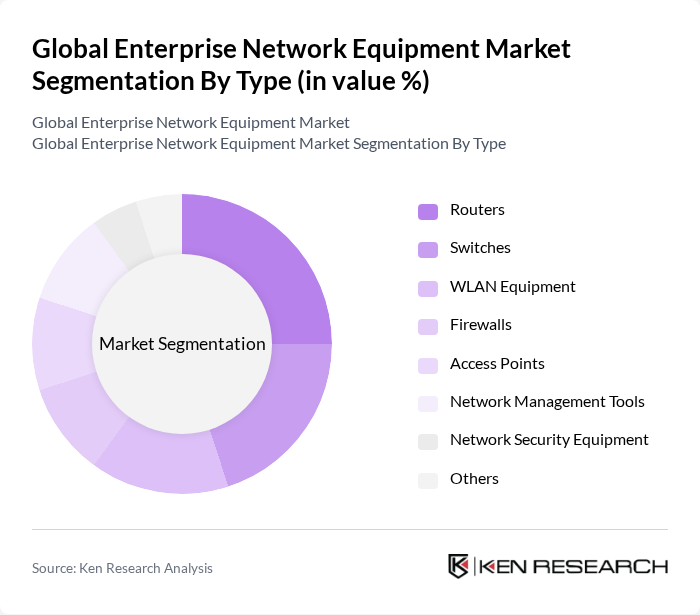
By Type:The market is segmented into various types of network equipment, including routers, switches, WLAN equipment, firewalls, access points, network management tools, network security equipment, and others. Each of these subsegments plays a crucial role in the overall network infrastructure, addressing specific enterprise needs such as core connectivity, wireless access, security, and centralized network management. The adoption of SDN, AI-driven network management, and integrated security appliances is rising, reflecting the need for scalable and intelligent solutions .
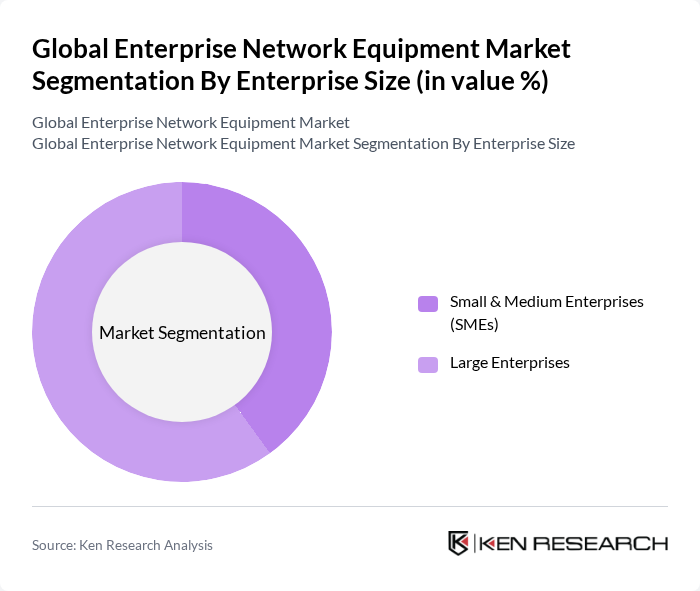
By Enterprise Size:The market is categorized based on enterprise size into Small & Medium Enterprises (SMEs) and Large Enterprises. SMEs are increasingly investing in scalable, cloud-based, and wireless networking solutions to support business growth and remote work, while large enterprises prioritize robust, integrated, and secure network architectures to manage complex operations and compliance requirements .
The Global Enterprise Network Equipment Market is characterized by a dynamic mix of regional and international players. Leading participants such as Cisco Systems, Inc., Juniper Networks, Inc., Arista Networks, Inc., Hewlett Packard Enterprise, Dell Technologies Inc., Extreme Networks, Inc., Netgear, Inc., Huawei Technologies Co., Ltd., TP-Link Technologies Co., Ltd., Broadcom Inc., VMware, Inc., Ciena Corporation, Ubiquiti Inc., Accton Technology Corporation, Tejas Networks Limited, Sterlite Technologies Limited, Fortinet, Inc., Palo Alto Networks, Inc., ZTE Corporation, Nokia Corporation contribute to innovation, geographic expansion, and service delivery in this space .
The future of the enterprise network equipment market is poised for significant transformation, driven by advancements in technology and evolving consumer demands. As organizations increasingly prioritize digital transformation, the integration of AI and machine learning into network management will enhance operational efficiency. Additionally, the expansion of 5G infrastructure will facilitate faster and more reliable connectivity, enabling new applications and services. These trends will shape the competitive landscape, compelling companies to innovate and adapt to remain relevant in a dynamic market environment.
| Segment | Sub-Segments |
|---|---|
| By Type | Routers Switches WLAN Equipment Firewalls Access Points Network Management Tools Network Security Equipment Others |
| By Enterprise Size | Small & Medium Enterprises (SMEs) Large Enterprises |
| By Deployment Model | On-Premise Cloud-Based Hybrid |
| By End-Use Industry | IT & Telecom BFSI (Banking, Financial Services, and Insurance) Retail & E-Commerce Healthcare Manufacturing Government & Public Sector Education Energy & Utilities Transportation & Logistics |
| By Region | North America Latin America Western Europe Eastern Europe East Asia South Asia & Pacific Middle East & Africa |
| Scope Item/Segment | Sample Size | Target Respondent Profiles |
|---|---|---|
| Enterprise Network Infrastructure | 100 | IT Managers, Network Architects |
| Cloud Networking Solutions | 80 | Cloud Operations Managers, IT Directors |
| Wireless Networking Equipment | 60 | Network Engineers, Wireless Specialists |
| Network Security Solutions | 50 | Security Analysts, Compliance Officers |
| Telecom Infrastructure | 70 | Telecom Engineers, Project Managers |
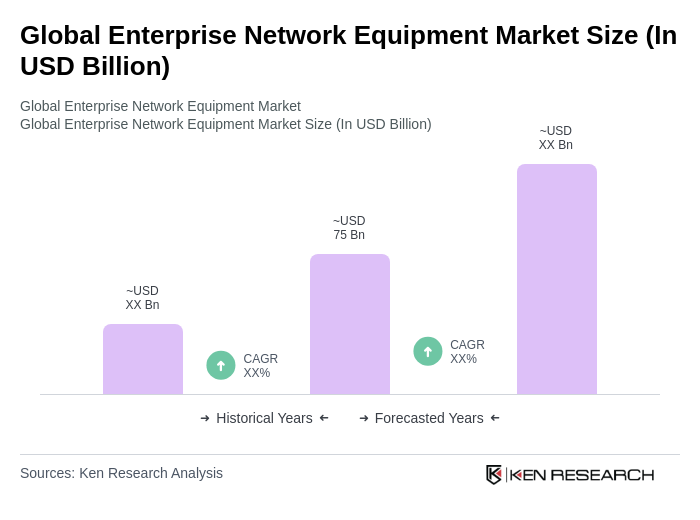
The Global Enterprise Network Equipment Market is valued at approximately USD 75 billion, driven by the increasing demand for high-speed connectivity, cloud computing, IoT device expansion, and cybersecurity needs.

What makes us stand out is that our consultants follow Robust, Refine and Result (RRR) methodology. Robust for clear definitions, approaches and sanity checking, Refine for differentiating respondents' facts and opinions, and Result for presenting data with story.

We have set a benchmark in the industry by offering our clients with syndicated and customized market research reports featuring coverage of entire market as well as meticulous research and analyst insights.

While we don't replace traditional research, we flip the method upside down. Our dual approach of Top Bottom & Bottom Top ensures quality deliverable by not just verifying company fundamentals but also looking at the sector and macroeconomic factors.

With one step in the future, our research team constantly tries to show you the bigger picture. We help with some of the tough questions you may encounter along the way: How is the industry positioned? Best marketing channel? KPI's of competitors? By aligning every element, we help maximize success.

Our report gives you instant access to the answers and sources that other companies might choose to hide. We elaborate each steps of research methodology we have used and showcase you the sample size to earn your trust.

If you need any support, we are here! We pride ourselves on universe strength, data quality, and quick, friendly, and professional service.













