About the Report
Base Year 2024Global Esg Rating Services Market Overview
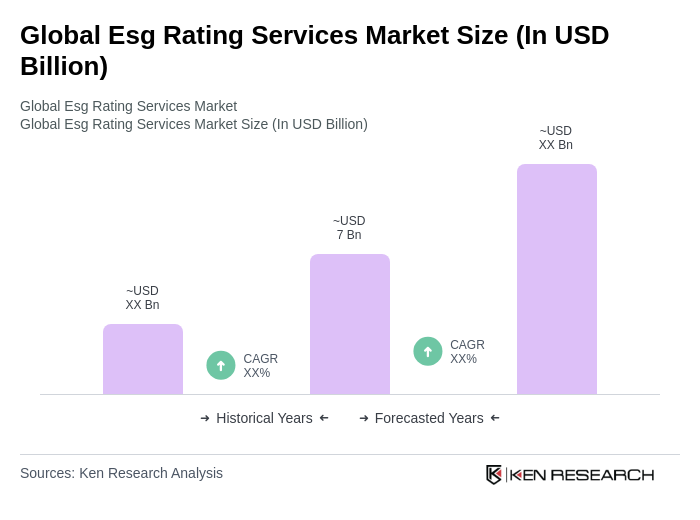
- The Global ESG Rating Services Market is valued at USD 7 billion, based on a five?year historical analysis. This level reflects broad-based adoption of ESG assessments by issuers and investors and aligns with multiple industry trackers placing the market in the multi?billion range in the early to mid?2020s .
- Growth is primarily driven by increasing regulatory pressures (notably in the European Union and the United States), heightened investor demand for decision?useful sustainability data, and expanding corporate disclosure aligned to recognized frameworks and taxonomies, which collectively raise transparency and governance standards and spur demand for independent ratings .
- Key markets include the United States, the United Kingdom, and Germany, underpinned by deep capital markets, active stewardship and proxy ecosystems, and advanced regulatory initiatives that encourage standardized sustainability reporting and data assurance—factors that attract investment and innovation in ESG analytics and ratings .
- The European Union’s Corporate Sustainability Reporting Directive (CSRD) requires large and listed companies (with limited exemptions) to disclose sustainability information using European Sustainability Reporting Standards, which is increasing the volume and comparability of ESG data and reinforcing demand for ratings and related services across sectors .
Global Esg Rating Services Market Segmentation
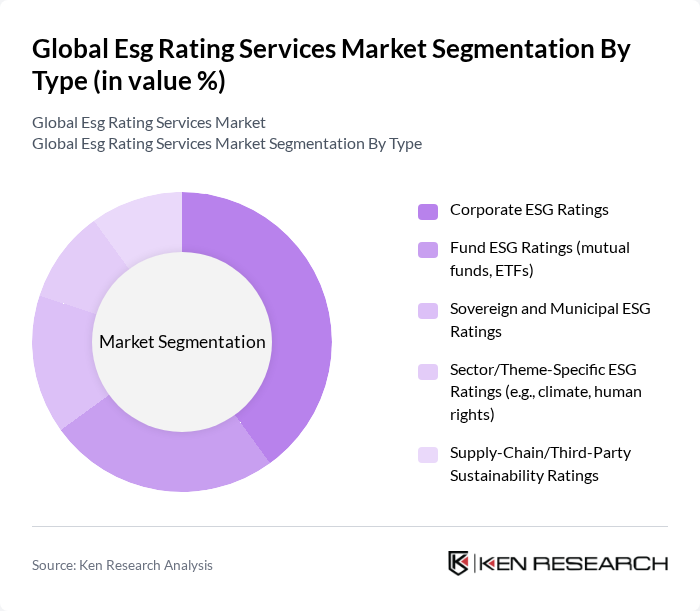
By Type:The market is segmented into various types of ESG ratings, including Corporate ESG Ratings, Fund ESG Ratings, Sovereign and Municipal ESG Ratings, Sector/Theme-Specific ESG Ratings, and Supply-Chain/Third-Party Sustainability Ratings. Among these, Corporate ESG Ratings dominate the market due to the increasing focus of companies on sustainability practices and the need for transparent reporting to attract investors. Fund ESG Ratings are also gaining traction as investors seek to align their portfolios with sustainable practices. Continuing regulatory alignment (e.g., EU CSRD and fund disclosure regimes) and demand from asset managers for decision?useful, comparable data support these segments’ growth .
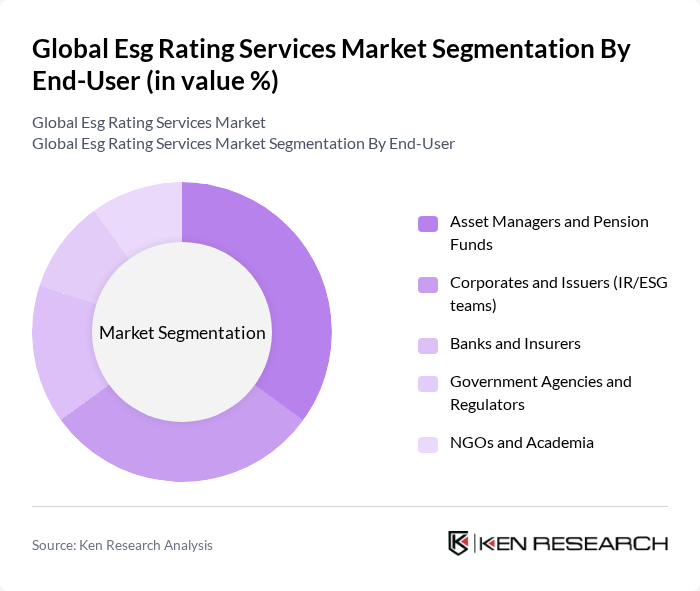
By End-User:The end-users of ESG rating services include Asset Managers and Pension Funds, Corporates and Issuers, Banks and Insurers, Government Agencies and Regulators, and NGOs and Academia. Asset Managers and Pension Funds are the leading end-users, driven by the need to integrate ESG factors into investment decisions and risk assessments. Corporates and Issuers are also significant users as they seek to improve their sustainability profiles and attract responsible investment. Increased supervisory expectations and disclosure rules in key markets continue to anchor demand among financial institutions and corporates .
Global Esg Rating Services Market Competitive Landscape
The Global Esg Rating Services Market is characterized by a dynamic mix of regional and international players. Leading participants such as MSCI Inc. (MSCI ESG Research), Sustainalytics (a Morningstar company), S&P Global Sustainable1, Moody’s ESG Solutions, LSEG (Refinitiv) — LSEG Data & Analytics, V.E (formerly Vigeo Eiris, part of Moody’s), ISS ESG (Institutional Shareholder Services), Bloomberg L.P., EcoVadis, Arabesque S-Ray (Arabesque ESG Book), CDP (Carbon Disclosure Project), FTSE Russell (FTSE4Good), S&P Global Trucost, GRESB, and RepRisk contribute to innovation, geographic expansion, and service delivery in this space. Independent industry coverage identifies MSCI, Sustainalytics, and S&P Global among the largest providers by market presence and client penetration within ESG data and ratings .
Additional validated insights to enhance growth drivers and context
- Asset?management demand:Buy?side integration of ESG into research, portfolio construction, and risk management remains a core driver for ratings coverage and controversy monitoring services, with North America and Europe representing the largest client bases for ESG data and ratings .
- Regulatory momentum:Expanding disclosure rules (e.g., EU CSRD and related standards) are increasing the granularity and auditability of sustainability data, raising demand for external ratings, data feeds, and assurance?adjacent analytics .
- Competitive dynamics:The market remains fragmented with leading providers and multiple specialized players; consolidation and partnerships continue as providers broaden coverage and methodology depth .
Global Esg Rating Services Market Industry Analysis
Growth Drivers
- Increasing Demand for Sustainable Investments:The global sustainable investment market reached approximately $35.3 trillion, reflecting a significant increase from $30 trillion. This trend is driven by institutional investors, with 75% of them considering ESG factors in their investment decisions. The demand for ESG-compliant assets is projected to grow as more investors seek to align their portfolios with sustainable practices, indicating a robust growth trajectory for ESG rating services in future.
- Regulatory Pressure for Transparency:In future, over 50 countries are expected to implement stricter ESG disclosure regulations, impacting thousands of companies globally. The European Union's Sustainable Finance Disclosure Regulation (SFDR) mandates that financial market participants disclose how they integrate ESG risks. This regulatory landscape compels companies to seek reliable ESG ratings, thereby driving demand for rating services in future, as firms strive to comply with evolving standards and enhance transparency.
- Rising Consumer Awareness on ESG Issues:A recent survey indicated that 70% of consumers in future are willing to pay a premium for products from companies with strong ESG practices. This heightened awareness is influencing corporate behavior, as businesses recognize the need to improve their ESG profiles to attract and retain customers. Consequently, the demand for ESG ratings is expected to surge, as companies seek to validate their sustainability claims and enhance their market appeal.
Market Challenges
- Lack of Standardization in ESG Ratings:The absence of universally accepted ESG rating standards poses a significant challenge, with over 100 different rating agencies providing varying assessments. This inconsistency leads to confusion among investors and companies, as evidenced by a recent report highlighting that 40% of investors find it difficult to compare ESG ratings. The lack of standardization undermines the credibility of ESG ratings, hindering market growth in future.
- Data Quality and Availability Issues:A recent analysis revealed that approximately 60% of companies in future struggle to provide reliable ESG data due to inadequate reporting frameworks. This data deficiency hampers the ability of rating agencies to deliver accurate assessments, leading to skepticism among investors. The challenge of ensuring high-quality, accessible data remains a critical barrier to the effective functioning of the ESG rating services market in future.
Global Esg Rating Services Market Future Outlook
The future of ESG rating services in future is poised for significant transformation, driven by technological advancements and increasing regulatory scrutiny. As companies adopt integrated reporting frameworks, the demand for comprehensive ESG assessments will rise. Furthermore, the focus on climate risk assessment will intensify, compelling organizations to enhance their sustainability practices. This evolving landscape presents opportunities for innovative rating methodologies and strategic partnerships, positioning ESG rating services as essential tools for investors and companies alike.
Market Opportunities
- Expansion into Emerging Markets:Emerging markets in future are witnessing a surge in sustainable investment interest, with an estimated $5 trillion expected to flow into these regions. This growth presents a lucrative opportunity for ESG rating agencies to establish a foothold and cater to the increasing demand for reliable ratings, thereby enhancing their market presence and influence.
- Development of Innovative Rating Methodologies:The need for more nuanced ESG assessments is driving the development of innovative rating methodologies. Agencies that leverage advanced analytics and artificial intelligence can provide more accurate and actionable insights. This innovation is expected to attract a broader client base, as companies seek tailored solutions to meet their specific ESG challenges and enhance their sustainability profiles.
Scope of the Report
| Segment | Sub-Segments |
|---|---|
| By Type | Corporate ESG Ratings Fund ESG Ratings (mutual funds, ETFs) Sovereign and Municipal ESG Ratings Sector/Theme-Specific ESG Ratings (e.g., climate, human rights) Supply-Chain/Third-Party Sustainability Ratings |
| By End-User | Asset Managers and Pension Funds Corporates and Issuers (IR/ESG teams) Banks and Insurers Government Agencies and Regulators NGOs and Academia |
| By Application | Investment and Asset Allocation Credit and Risk Management Regulatory Reporting and Disclosure (e.g., SFDR, CSRD) Corporate Sustainability/Integrated Reporting Supply Chain Due Diligence and Vendor Risk |
| By Service Type | ESG Assessment and Ratings ESG Data Provision and Analytics ESG Reporting and Disclosure Support Verification, Assurance, and Compliance Services ESG Strategy and Advisory/Consulting |
| By Distribution Channel | Direct Enterprise Sales Data Platforms and Marketplaces (APIs, terminals) Partnerships with Index/Benchmark Providers Channel Partners and System Integrators |
| By Pricing Model | Subscription (seat-based or enterprise license) Usage-Based/API Consumption Per-Report/Project-Based Custom/Managed Service Contracts |
| By Geographic Focus | North America Europe Asia-Pacific Latin America Middle East & Africa |
Key Target Audience
Investors and Venture Capitalist Firms
Government and Regulatory Bodies (e.g., Securities and Exchange Commission, Environmental Protection Agency)
Corporations and Enterprises seeking ESG ratings
Asset Management Firms
Insurance Companies
Non-Governmental Organizations (NGOs) focused on sustainability
Financial Institutions
Stock Exchanges and Trading Platforms
Players Mentioned in the Report:
MSCI Inc. (MSCI ESG Research)
Sustainalytics (a Morningstar company)
S&P Global Sustainable1
Moodys ESG Solutions
LSEG (Refinitiv) LSEG Data & Analytics
V.E (formerly Vigeo Eiris, part of Moodys)
ISS ESG (Institutional Shareholder Services)
Bloomberg L.P.
EcoVadis
Arabesque S-Ray (Arabesque ESG Book)
CDP (Carbon Disclosure Project)
FTSE Russell (FTSE4Good)
S&P Global Trucost
GRESB
RepRisk
Table of Contents
Market Assessment Phase
1. Executive Summary and Approach
2. Global Esg Rating Services Market Overview
2.1 Key Insights and Strategic Recommendations
2.2 Global Esg Rating Services Market Overview
2.3 Definition and Scope
2.4 Evolution of Market Ecosystem
2.5 Timeline of Key Regulatory Milestones
2.6 Value Chain & Stakeholder Mapping
2.7 Business Cycle Analysis
2.8 Policy & Incentive Landscape
3. Global Esg Rating Services Market Analysis
3.1 Growth Drivers
3.1.1 Increasing Demand for Sustainable Investments
3.1.2 Regulatory Pressure for Transparency
3.1.3 Rising Consumer Awareness on ESG Issues
3.1.4 Integration of ESG Factors in Financial Analysis
3.2 Market Challenges
3.2.1 Lack of Standardization in ESG Ratings
3.2.2 Data Quality and Availability Issues
3.2.3 High Competition Among Rating Agencies
3.2.4 Resistance from Traditional Investors
3.3 Market Opportunities
3.3.1 Expansion into Emerging Markets
3.3.2 Development of Innovative Rating Methodologies
3.3.3 Partnerships with Financial Institutions
3.3.4 Growing Interest in Impact Investing
3.4 Market Trends
3.4.1 Increased Focus on Climate Risk Assessment
3.4.2 Adoption of Technology in ESG Data Collection
3.4.3 Shift Towards Integrated Reporting
3.4.4 Rise of ESG-focused Investment Funds
3.5 Government Regulation
3.5.1 Implementation of ESG Disclosure Requirements
3.5.2 Introduction of Tax Incentives for Sustainable Practices
3.5.3 Establishment of ESG Reporting Standards
3.5.4 Regulatory Scrutiny on Greenwashing
4. SWOT Analysis
5. Stakeholder Analysis
6. Porter's Five Forces Analysis
7. Global Esg Rating Services Market Market Size, 2019-2024
7.1 By Value
7.2 By Volume
7.3 By Average Selling Price
8. Global Esg Rating Services Market Segmentation
8.1 By Type
8.1.1 Corporate ESG Ratings
8.1.2 Fund ESG Ratings (mutual funds, ETFs)
8.1.3 Sovereign and Municipal ESG Ratings
8.1.4 Sector/Theme-Specific ESG Ratings (e.g., climate, human rights)
8.1.5 Supply-Chain/Third-Party Sustainability Ratings
8.2 By End-User
8.2.1 Asset Managers and Pension Funds
8.2.2 Corporates and Issuers (IR/ESG teams)
8.2.3 Banks and Insurers
8.2.4 Government Agencies and Regulators
8.2.5 NGOs and Academia
8.3 By Application
8.3.1 Investment and Asset Allocation
8.3.2 Credit and Risk Management
8.3.3 Regulatory Reporting and Disclosure (e.g., SFDR, CSRD)
8.3.4 Corporate Sustainability/Integrated Reporting
8.3.5 Supply Chain Due Diligence and Vendor Risk
8.4 By Service Type
8.4.1 ESG Assessment and Ratings
8.4.2 ESG Data Provision and Analytics
8.4.3 ESG Reporting and Disclosure Support
8.4.4 Verification, Assurance, and Compliance Services
8.4.5 ESG Strategy and Advisory/Consulting
8.5 By Distribution Channel
8.5.1 Direct Enterprise Sales
8.5.2 Data Platforms and Marketplaces (APIs, terminals)
8.5.3 Partnerships with Index/Benchmark Providers
8.5.4 Channel Partners and System Integrators
8.6 By Pricing Model
8.6.1 Subscription (seat-based or enterprise license)
8.6.2 Usage-Based/API Consumption
8.6.3 Per-Report/Project-Based
8.6.4 Custom/Managed Service Contracts
8.7 By Geographic Focus
8.7.1 North America
8.7.2 Europe
8.7.3 Asia-Pacific
8.7.4 Latin America
8.7.5 Middle East & Africa
9. Global Esg Rating Services Market Competitive Analysis
9.1 Market Share of Key Players
9.2 Cross Comparison of Key Players
9.2.1 Company Name
9.2.2 Scale Tier (Global, Regional, Niche)
9.2.3 ESG Ratings Coverage (number of issuers/funds covered)
9.2.4 Data Sources Breadth (disclosed, alternative, controversies)
9.2.5 Methodology Transparency Score
9.2.6 Revenue Mix (ratings vs. data vs. advisory)
9.2.7 Client Segments Penetration (AMs, banks, corporates)
9.2.8 Regulatory Alignment (SFDR/CSRD/SEC suitability)
9.2.9 Index/Benchmark Partnerships Count
9.2.10 Controversy Detection Latency (update frequency)
9.2.11 Geographic Footprint (regions served, offices)
9.2.12 Pricing Bands (enterprise, API, per-report)
9.2.13 Client Retention/Net Revenue Retention
9.2.14 Product Innovation Velocity (new features/releases)
9.2.15 Assurance/Verification Capabilities
9.3 SWOT Analysis of Top Players
9.4 Pricing Analysis
9.5 Detailed Profile of Major Companies
9.5.1 MSCI Inc. (MSCI ESG Research)
9.5.2 Sustainalytics (a Morningstar company)
9.5.3 S&P Global Sustainable1
9.5.4 Moody’s ESG Solutions
9.5.5 LSEG (Refinitiv) — LSEG Data & Analytics
9.5.6 V.E (formerly Vigeo Eiris, part of Moody’s)
9.5.7 ISS ESG (Institutional Shareholder Services)
9.5.8 Bloomberg L.P.
9.5.9 EcoVadis
9.5.10 Arabesque S-Ray (Arabesque ESG Book)
9.5.11 CDP (Carbon Disclosure Project)
9.5.12 FTSE Russell (FTSE4Good)
9.5.13 S&P Global Trucost
9.5.14 GRESB
9.5.15 RepRisk
10. Global Esg Rating Services Market End-User Analysis
10.1 Procurement Behavior of Key Ministries
10.1.1 Government ESG Policy Frameworks
10.1.2 Budget Allocations for ESG Initiatives
10.1.3 Collaboration with Rating Agencies
10.2 Corporate Spend on Infrastructure & Energy
10.2.1 Investment in Sustainable Projects
10.2.2 Budgeting for ESG Compliance
10.2.3 Funding for ESG Reporting Tools
10.3 Pain Point Analysis by End-User Category
10.3.1 Data Collection Challenges
10.3.2 Understanding ESG Metrics
10.3.3 Balancing Cost and Compliance
10.4 User Readiness for Adoption
10.4.1 Awareness of ESG Benefits
10.4.2 Training and Resources Availability
10.4.3 Integration with Existing Systems
10.5 Post-Deployment ROI and Use Case Expansion
10.5.1 Measuring ESG Impact on Financial Performance
10.5.2 Expanding ESG Initiatives
10.5.3 Long-term Sustainability Goals
11. Global Esg Rating Services Market Future Size, 2025-2030
11.1 By Value
11.2 By Volume
11.3 By Average Selling Price
Go-To-Market Strategy Phase
1. Whitespace Analysis + Business Model Canvas
1.1 Market Gaps Identification
1.2 Business Model Development
2. Marketing and Positioning Recommendations
2.1 Branding Strategies
2.2 Product USPs
3. Distribution Plan
3.1 Urban Retail Strategies
3.2 Rural NGO Tie-ups
4. Channel & Pricing Gaps
4.1 Underserved Routes
4.2 Pricing Bands Analysis
5. Unmet Demand & Latent Needs
5.1 Category Gaps
5.2 Consumer Segments
6. Customer Relationship
6.1 Loyalty Programs
6.2 After-sales Service
7. Value Proposition
7.1 Sustainability Initiatives
7.2 Integrated Supply Chains
8. Key Activities
8.1 Regulatory Compliance
8.2 Branding Efforts
8.3 Distribution Setup
9. Entry Strategy Evaluation
9.1 Domestic Market Entry Strategy
9.1.1 Product Mix Considerations
9.1.2 Pricing Band Strategy
9.1.3 Packaging Options
9.2 Export Entry Strategy
9.2.1 Target Countries
9.2.2 Compliance Roadmap
10. Entry Mode Assessment
10.1 Joint Ventures
10.2 Greenfield Investments
10.3 Mergers & Acquisitions
10.4 Distributor Model
11. Capital and Timeline Estimation
11.1 Capital Requirements
11.2 Timelines for Implementation
12. Control vs Risk Trade-Off
12.1 Ownership Considerations
12.2 Partnerships Evaluation
13. Profitability Outlook
13.1 Breakeven Analysis
13.2 Long-term Sustainability Strategies
14. Potential Partner List
14.1 Distributors
14.2 Joint Ventures
14.3 Acquisition Targets
15. Execution Roadmap
15.1 Phased Plan for Market Entry
15.1.1 Market Setup
15.1.2 Market Entry
15.1.3 Growth Acceleration
15.1.4 Scale & Stabilize
15.2 Key Activities and Milestones
15.2.1 Milestone Planning
15.2.2 Activity Tracking
Research Methodology
Phase 1: Approach1
Desk Research
- Analysis of industry reports from global ESG rating agencies and market research firms
- Review of academic journals and publications on ESG metrics and frameworks
- Examination of regulatory documents and guidelines from international bodies like the UN and OECD
Primary Research
- Interviews with ESG analysts and rating agency executives to gather insights on methodologies
- Surveys with corporate sustainability officers to understand ESG implementation challenges
- Focus groups with investors and stakeholders to assess the impact of ESG ratings on investment decisions
Validation & Triangulation
- Cross-validation of findings through multiple data sources, including financial reports and ESG disclosures
- Triangulation of qualitative insights from interviews with quantitative data from surveys
- Sanity checks through expert panel reviews comprising industry veterans and academic scholars
Phase 2: Market Size Estimation1
Top-down Assessment
- Estimation of the global ESG rating services market size based on total investment in sustainable assets
- Segmentation by geographic regions and industry sectors to identify growth hotspots
- Incorporation of trends in regulatory compliance and corporate governance affecting ESG ratings
Bottom-up Modeling
- Analysis of revenue streams from leading ESG rating firms and their market share
- Estimation of service pricing based on the complexity and depth of ESG assessments
- Volume of rated entities and frequency of assessments to derive total market value
Forecasting & Scenario Analysis
- Multi-factor regression analysis incorporating economic indicators and sustainability trends
- Scenario modeling based on varying levels of regulatory pressure and market demand for ESG compliance
- Development of baseline, optimistic, and pessimistic forecasts through 2030
Phase 3: CATI Sample Composition1
| Scope Item/Segment | Sample Size | Target Respondent Profiles |
|---|---|---|
| Corporate ESG Strategy Implementation | 130 | Sustainability Officers, ESG Analysts |
| Investment Decision-Making Processes | 100 | Portfolio Managers, Investment Analysts |
| Regulatory Compliance and Reporting | 80 | Compliance Officers, Legal Advisors |
| Stakeholder Engagement Practices | 70 | Corporate Communication Heads, Investor Relations Managers |
| ESG Rating Methodology Insights | 90 | Rating Agency Executives, Research Analysts |
Frequently Asked Questions
What is the current value of the Global ESG Rating Services Market?
The Global ESG Rating Services Market is valued at approximately USD 7 billion, reflecting significant adoption of ESG assessments by issuers and investors, particularly in the early to mid-2020s.
What factors are driving the growth of the ESG Rating Services Market?
Which regions are key markets for ESG rating services?
What is the Corporate Sustainability Reporting Directive (CSRD)?
Other Regional/Country Reports
Indonesia ESG Rating Services Market
Malaysia ESG Rating Services Market
APAC ESG Rating Services Market
SEA ESG Rating Services Market
Why Buy From Us?

What makes us stand out is that our consultants follow Robust, Refine and Result (RRR) methodology. Robust for clear definitions, approaches and sanity checking, Refine for differentiating respondents' facts and opinions, and Result for presenting data with story.

We have set a benchmark in the industry by offering our clients with syndicated and customized market research reports featuring coverage of entire market as well as meticulous research and analyst insights.

While we don't replace traditional research, we flip the method upside down. Our dual approach of Top Bottom & Bottom Top ensures quality deliverable by not just verifying company fundamentals but also looking at the sector and macroeconomic factors.

With one step in the future, our research team constantly tries to show you the bigger picture. We help with some of the tough questions you may encounter along the way: How is the industry positioned? Best marketing channel? KPI's of competitors? By aligning every element, we help maximize success.

Our report gives you instant access to the answers and sources that other companies might choose to hide. We elaborate each steps of research methodology we have used and showcase you the sample size to earn your trust.

If you need any support, we are here! We pride ourselves on universe strength, data quality, and quick, friendly, and professional service.