About the Report
Base Year 2024Listen to the audio summary
Global Esomeprazole Market Overview
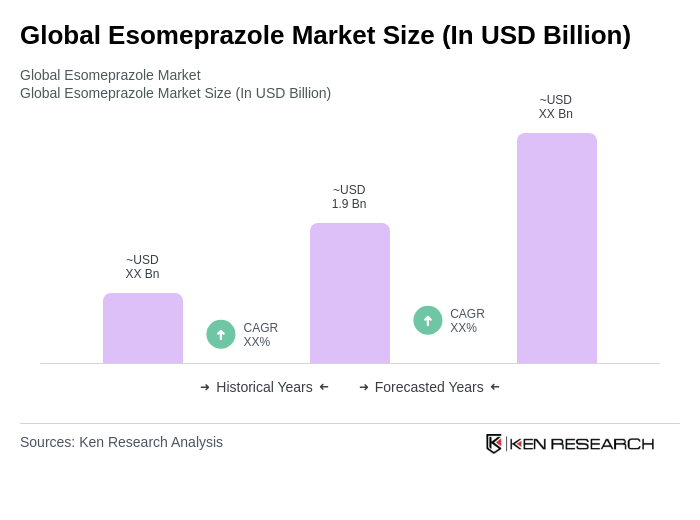
- The Global Esomeprazole Market is valued at USD 1.9 billion, based on a five-year historical analysis. This growth is primarily driven by the increasing prevalence of gastroesophageal reflux disease (GERD) and other acid-related disorders, alongside a rising geriatric population that requires long-term medication for chronic conditions. The market is also supported by advancements in drug formulations and delivery methods, enhancing patient compliance and treatment outcomes, including broader adoption of pediatric-approved and dual-release/delayed-release formulations.
- Key players in this market are predominantly located in North America and Europe, with the United States and Germany being the most significant contributors. The dominance of these regions can be attributed to their advanced healthcare infrastructure, high healthcare expenditure, and strong regulatory frameworks that support pharmaceutical innovation and market access.
- In 2023, the U.S. Food and Drug Administration (FDA) implemented new guidelines for the approval of generic esomeprazole formulations, aimed at enhancing the quality and efficacy of these products. This regulation mandates rigorous bioequivalence studies to ensure that generic versions meet the same standards as their branded counterparts, thereby promoting patient safety and therapeutic effectiveness.
Global Esomeprazole Market Segmentation
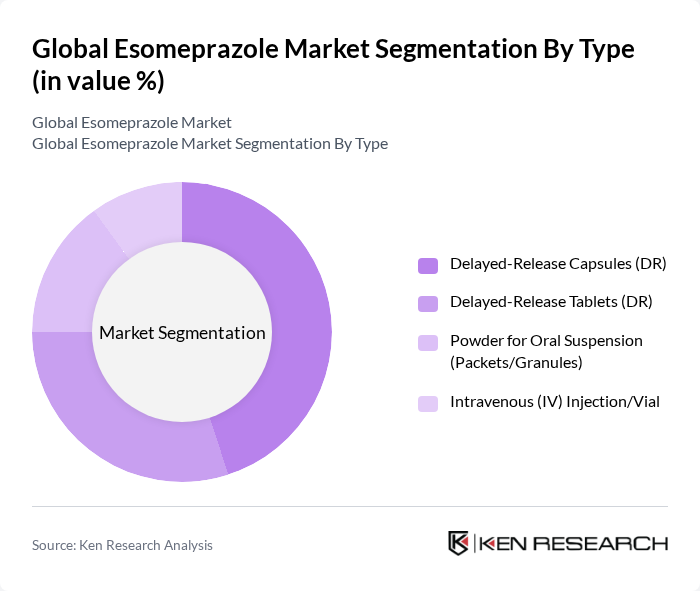
By Type:The market is segmented into various types, including Delayed-Release Capsules (DR), Delayed-Release Tablets (DR), Powder for Oral Suspension (Packets/Granules), and Intravenous (IV) Injection/Vial. Among these, Delayed-Release Capsules (DR) dominate the market due to their convenience and effectiveness in delivering the drug over an extended period, which aligns with patient preferences for ease of use and adherence to treatment regimens.
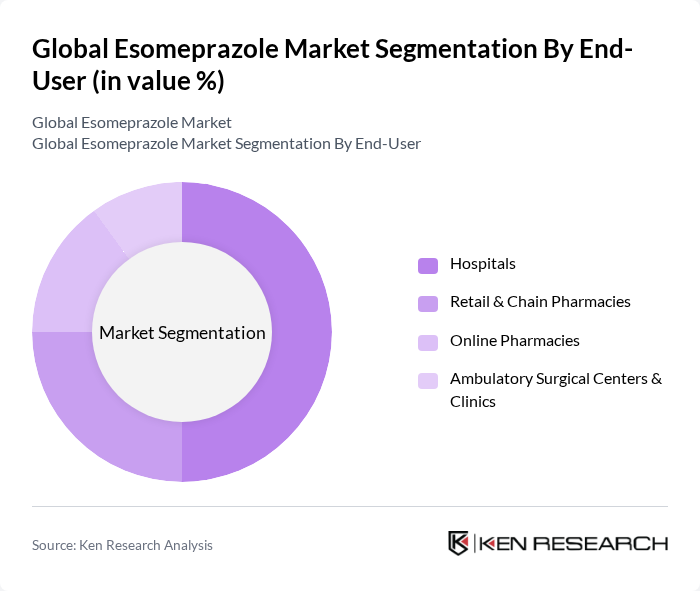
By End-User:The end-user segmentation includes Hospitals, Retail & Chain Pharmacies, Online Pharmacies, and Ambulatory Surgical Centers & Clinics. Hospitals are the leading end-user segment, primarily due to the high volume of patients requiring treatment for severe acid-related disorders, which necessitates the use of esomeprazole in clinical settings for effective management. Growing e-pharmacy penetration is expanding access for maintenance therapy and OTC purchases in certain markets.
Global Esomeprazole Market Competitive Landscape
The Global Esomeprazole Market is characterized by a dynamic mix of regional and international players. Leading participants such as AstraZeneca PLC, Viatris Inc. (includes legacy Mylan), Teva Pharmaceutical Industries Ltd., Sandoz Group AG, Sun Pharmaceutical Industries Ltd., Dr. Reddy's Laboratories Ltd., Hikma Pharmaceuticals PLC, Aurobindo Pharma Ltd., Cipla Ltd., Zydus Lifesciences Ltd., Amneal Pharmaceuticals, Inc., Lupin Limited, Glenmark Pharmaceuticals Ltd., Pfizer Inc., GSK plc contribute to innovation, geographic expansion, and service delivery in this space.
Global Esomeprazole Market Industry Analysis
Growth Drivers
- Increasing Prevalence of Gastrointestinal Disorders:The rise in gastrointestinal disorders, such as gastroesophageal reflux disease (GERD), is a significant growth driver for the esomeprazole market. In future, it is estimated that over 20% of the global population will experience GERD symptoms, translating to approximately 1.6 billion individuals. This increasing prevalence necessitates effective treatment options, propelling the demand for esomeprazole, a leading proton pump inhibitor, to manage these conditions effectively.
- Rising Demand for Proton Pump Inhibitors:The global demand for proton pump inhibitors (PPIs) is projected to reach 55 million units in future, driven by their effectiveness in treating acid-related disorders. Esomeprazole, as a widely prescribed PPI, benefits from this trend. The increasing awareness among healthcare providers and patients regarding the benefits of PPIs in managing chronic conditions further fuels this demand, positioning esomeprazole as a preferred choice in therapeutic regimens.
- Growing Geriatric Population:The global geriatric population is expected to surpass 1.6 billion in future, with individuals aged 65 and older being more susceptible to gastrointestinal disorders. This demographic shift is a crucial driver for the esomeprazole market, as older adults often require long-term management of acid-related conditions. The increasing healthcare expenditure on this age group, projected to reach $13 trillion globally, further supports the demand for effective treatments like esomeprazole.
Market Challenges
- Patent Expirations and Generic Competition:The expiration of patents for esomeprazole has led to a surge in generic alternatives, significantly impacting market share. In future, it is anticipated that generic versions will account for over 65% of the total esomeprazole market. This increased competition pressures pricing and profit margins for branded products, challenging manufacturers to innovate and differentiate their offerings to maintain market presence.
- Regulatory Hurdles and Compliance Issues:The pharmaceutical industry faces stringent regulatory requirements that can delay the approval of new formulations and therapies. In future, the average time for drug approval is projected to be around 13-16 months, which can hinder the timely introduction of innovative esomeprazole formulations. Compliance with evolving regulations also increases operational costs, posing a significant challenge for companies in the esomeprazole market.
Global Esomeprazole Market Future Outlook
The future of the esomeprazole market appears promising, driven by ongoing advancements in drug formulation and delivery methods. As healthcare systems increasingly adopt patient-centric approaches, the demand for personalized medicine is expected to rise. Additionally, the integration of digital health technologies into treatment plans will enhance patient engagement and adherence, further supporting the growth of esomeprazole. Companies that leverage these trends will likely gain a competitive edge in the evolving market landscape.
Market Opportunities
- Expansion into Emerging Markets:Emerging markets present significant growth opportunities for esomeprazole, with an expected increase in healthcare access and spending. In future, countries in Asia and Africa are projected to see a 20% rise in healthcare expenditure, creating a favorable environment for the introduction of esomeprazole and other proton pump inhibitors.
- Development of Combination Therapies:The trend towards combination therapies is gaining traction, offering a unique opportunity for esomeprazole. In future, the market for combination therapies is expected to grow by 25%, as healthcare providers seek to enhance treatment efficacy for patients with complex gastrointestinal conditions, positioning esomeprazole as a key component in these innovative treatment regimens.
Scope of the Report
| Segment | Sub-Segments |
|---|---|
| By Type | Delayed-Release Capsules (DR) Delayed-Release Tablets (DR) Powder for Oral Suspension (Packets/Granules) Intravenous (IV) Injection/Vial |
| By End-User | Hospitals Retail & Chain Pharmacies Online Pharmacies Ambulatory Surgical Centers & Clinics |
| By Distribution Channel | Hospital Pharmacies Retail Pharmacies Online/Direct-to-Consumer |
| By Region | North America Europe Asia-Pacific Latin America Middle East & Africa |
| By Dosage Form | Oral Parenteral |
| By Patient Demographics | Adults Pediatrics |
| By Pricing Strategy | Branded (Rx/OTC) Pricing Generic Competitive Pricing Discount & Tender-Based Pricing |
| By Prescription Status | Prescription (Rx) Over-the-Counter (OTC) |
Key Target Audience
Investors and Venture Capitalist Firms
Government and Regulatory Bodies (e.g., U.S. Food and Drug Administration, European Medicines Agency)
Pharmaceutical Manufacturers and Producers
Wholesale Distributors and Retail Pharmacies
Health Insurance Companies
Clinical Research Organizations
Pharmaceutical Supply Chain Management Firms
Healthcare Providers and Hospitals
Players Mentioned in the Report:
AstraZeneca PLC
Viatris Inc. (includes legacy Mylan)
Teva Pharmaceutical Industries Ltd.
Sandoz Group AG
Sun Pharmaceutical Industries Ltd.
Dr. Reddy's Laboratories Ltd.
Hikma Pharmaceuticals PLC
Aurobindo Pharma Ltd.
Cipla Ltd.
Zydus Lifesciences Ltd.
Amneal Pharmaceuticals, Inc.
Lupin Limited
Glenmark Pharmaceuticals Ltd.
Pfizer Inc.
GSK plc
Table of Contents
Market Assessment Phase
1. Executive Summary and Approach
2. Global Esomeprazole Market Overview
2.1 Key Insights and Strategic Recommendations
2.2 Global Esomeprazole Market Overview
2.3 Definition and Scope
2.4 Evolution of Market Ecosystem
2.5 Timeline of Key Regulatory Milestones
2.6 Value Chain & Stakeholder Mapping
2.7 Business Cycle Analysis
2.8 Policy & Incentive Landscape
3. Global Esomeprazole Market Analysis
3.1 Growth Drivers
3.1.1 Increasing prevalence of gastrointestinal disorders
3.1.2 Rising demand for proton pump inhibitors
3.1.3 Growing geriatric population
3.1.4 Advancements in drug formulation and delivery
3.2 Market Challenges
3.2.1 Patent expirations and generic competition
3.2.2 Regulatory hurdles and compliance issues
3.2.3 High cost of research and development
3.2.4 Market saturation in developed regions
3.3 Market Opportunities
3.3.1 Expansion into emerging markets
3.3.2 Development of combination therapies
3.3.3 Increasing focus on personalized medicine
3.3.4 Collaborations and partnerships for innovation
3.4 Market Trends
3.4.1 Shift towards over-the-counter availability
3.4.2 Growing emphasis on patient-centric healthcare
3.4.3 Digital health integration in treatment plans
3.4.4 Rise in telemedicine and remote consultations
3.5 Government Regulation
3.5.1 Stricter approval processes for new drugs
3.5.2 Enhanced pharmacovigilance requirements
3.5.3 Price control measures in various regions
3.5.4 Guidelines for clinical trials and research
4. SWOT Analysis
5. Stakeholder Analysis
6. Porter's Five Forces Analysis
7. Global Esomeprazole Market Market Size, 2019-2024
7.1 By Value
7.2 By Volume
7.3 By Average Selling Price
8. Global Esomeprazole Market Segmentation
8.1 By Type
8.1.1 Delayed-Release Capsules (DR)
8.1.2 Delayed-Release Tablets (DR)
8.1.3 Powder for Oral Suspension (Packets/Granules)
8.1.4 Intravenous (IV) Injection/Vial
8.2 By End-User
8.2.1 Hospitals
8.2.2 Retail & Chain Pharmacies
8.2.3 Online Pharmacies
8.2.4 Ambulatory Surgical Centers & Clinics
8.3 By Distribution Channel
8.3.1 Hospital Pharmacies
8.3.2 Retail Pharmacies
8.3.3 Online/Direct-to-Consumer
8.4 By Region
8.4.1 North America
8.4.2 Europe
8.4.3 Asia-Pacific
8.4.4 Latin America
8.4.5 Middle East & Africa
8.5 By Dosage Form
8.5.1 Oral
8.5.2 Parenteral
8.6 By Patient Demographics
8.6.1 Adults
8.6.2 Pediatrics
8.7 By Pricing Strategy
8.7.1 Branded (Rx/OTC) Pricing
8.7.2 Generic Competitive Pricing
8.7.3 Discount & Tender-Based Pricing
8.8 By Prescription Status
8.8.1 Prescription (Rx)
8.8.2 Over-the-Counter (OTC)
9. Global Esomeprazole Market Competitive Analysis
9.1 Market Share of Key Players
9.2 Cross Comparison of Key Players
9.2.1 Company Name
9.2.2 Group Size (Global, Regional, Local)
9.2.3 Esomeprazole Revenue (USD) and Growth Rate (3-Year CAGR)
9.2.4 Geographic Footprint (No. of Markets with Marketing Authorization)
9.2.5 Portfolio Breadth (Rx vs OTC; Oral vs IV SKUs)
9.2.6 Market Access Strength (Formulary/Tender Wins)
9.2.7 Pricing Positioning (Brand vs Generic ASP Index)
9.2.8 R&D/Registration Investment (as % of Pharma Revenue)
9.2.9 Manufacturing Capacity & Compliance (cGMP sites; US/EU approvals)
9.2.10 Supply Reliability (Fill Rate, Backorder Incidence)
9.2.11 Brand Equity & Switch Rate (OTC brand awareness; Rx-to-OTC conversion)
9.2.12 Partnership/M&A Activity (past 3 years)
9.3 SWOT Analysis of Top Players
9.4 Pricing Analysis
9.5 Detailed Profile of Major Companies
9.5.1 AstraZeneca PLC
9.5.2 Viatris Inc. (includes legacy Mylan)
9.5.3 Teva Pharmaceutical Industries Ltd.
9.5.4 Sandoz Group AG
9.5.5 Sun Pharmaceutical Industries Ltd.
9.5.6 Dr. Reddy's Laboratories Ltd.
9.5.7 Hikma Pharmaceuticals PLC
9.5.8 Aurobindo Pharma Ltd.
9.5.9 Cipla Ltd.
9.5.10 Zydus Lifesciences Ltd.
9.5.11 Amneal Pharmaceuticals, Inc.
9.5.12 Lupin Limited
9.5.13 Glenmark Pharmaceuticals Ltd.
9.5.14 Pfizer Inc.
9.5.15 GSK plc
10. Global Esomeprazole Market End-User Analysis
10.1 Procurement Behavior of Key Ministries
10.1.1 Budget Allocation Trends
10.1.2 Decision-Making Processes
10.1.3 Supplier Selection Criteria
10.2 Corporate Spend on Infrastructure & Energy
10.2.1 Investment in Healthcare Infrastructure
10.2.2 Spending on Pharmaceutical Supplies
10.2.3 Budgeting for R&D
10.3 Pain Point Analysis by End-User Category
10.3.1 Access to Medications
10.3.2 Affordability Issues
10.3.3 Quality of Care
10.4 User Readiness for Adoption
10.4.1 Awareness of Esomeprazole
10.4.2 Acceptance of New Treatment Protocols
10.4.3 Training Needs for Healthcare Providers
10.5 Post-Deployment ROI and Use Case Expansion
10.5.1 Measurement of Treatment Outcomes
10.5.2 Long-term Cost Savings
10.5.3 Expansion into New Indications
11. Global Esomeprazole Market Future Size, 2025-2030
11.1 By Value
11.2 By Volume
11.3 By Average Selling Price
Go-To-Market Strategy Phase
1. Whitespace Analysis + Business Model Canvas
1.1 Market Gaps Identification
1.2 Value Proposition Development
1.3 Revenue Streams Analysis
1.4 Key Partnerships Exploration
1.5 Customer Segmentation
1.6 Cost Structure Assessment
1.7 Channels of Distribution
2. Marketing and Positioning Recommendations
2.1 Branding Strategies
2.2 Product USPs
2.3 Target Audience Identification
2.4 Communication Strategies
2.5 Digital Marketing Approaches
3. Distribution Plan
3.1 Urban Retail Strategies
3.2 Rural NGO Tie-ups
3.3 E-commerce Integration
3.4 Direct-to-Consumer Models
4. Channel & Pricing Gaps
4.1 Underserved Routes
4.2 Pricing Bands Analysis
4.3 Competitor Pricing Strategies
5. Unmet Demand & Latent Needs
5.1 Category Gaps Identification
5.2 Consumer Segments Analysis
5.3 Emerging Trends Exploration
6. Customer Relationship
6.1 Loyalty Programs
6.2 After-sales Service
6.3 Customer Feedback Mechanisms
7. Value Proposition
7.1 Sustainability Initiatives
7.2 Integrated Supply Chains
7.3 Customer-Centric Innovations
8. Key Activities
8.1 Regulatory Compliance
8.2 Branding Efforts
8.3 Distribution Setup
9. Entry Strategy Evaluation
9.1 Domestic Market Entry Strategy
9.1.1 Product Mix Considerations
9.1.2 Pricing Band Strategy
9.1.3 Packaging Innovations
9.2 Export Entry Strategy
9.2.1 Target Countries Selection
9.2.2 Compliance Roadmap Development
10. Entry Mode Assessment
10.1 Joint Ventures
10.2 Greenfield Investments
10.3 Mergers & Acquisitions
10.4 Distributor Model Evaluation
11. Capital and Timeline Estimation
11.1 Capital Requirements
11.2 Timelines for Implementation
12. Control vs Risk Trade-Off
12.1 Ownership Considerations
12.2 Partnerships Evaluation
13. Profitability Outlook
13.1 Breakeven Analysis
13.2 Long-term Sustainability Strategies
14. Potential Partner List
14.1 Distributors
14.2 Joint Ventures
14.3 Acquisition Targets
15. Execution Roadmap
15.1 Phased Plan for Market Entry
15.1.1 Market Setup
15.1.2 Market Entry
15.1.3 Growth Acceleration
15.1.4 Scale & Stabilize
15.2 Key Activities and Milestones
15.2.1 Milestone Planning
15.2.2 Activity Tracking
Research Methodology
Phase 1: Approach1
Desk Research
- Analysis of global esomeprazole sales data from pharmaceutical industry reports
- Review of market trends and forecasts from health and wellness publications
- Examination of regulatory frameworks and patent information from health authorities
Primary Research
- Interviews with key opinion leaders in gastroenterology and pharmacy
- Surveys with healthcare professionals prescribing esomeprazole
- Focus groups with patients using esomeprazole for various conditions
Validation & Triangulation
- Cross-validation of findings with multiple data sources including sales and prescription data
- Triangulation of insights from primary interviews and secondary research findings
- Sanity checks through expert panel discussions and feedback sessions
Phase 2: Market Size Estimation1
Top-down Assessment
- Estimation of total market size based on global pharmaceutical expenditure trends
- Segmentation by region, therapeutic area, and patient demographics
- Incorporation of market share data from leading pharmaceutical companies
Bottom-up Modeling
- Volume estimates derived from prescription data and pharmacy sales
- Cost analysis based on average pricing of esomeprazole across different markets
- Calculation of market size using volume x price methodology
Forecasting & Scenario Analysis
- Multi-variable forecasting using factors such as aging population and prevalence of GERD
- Scenario analysis based on potential market disruptions and regulatory changes
- Development of baseline, optimistic, and pessimistic market projections through 2030
Phase 3: CATI Sample Composition1
| Scope Item/Segment | Sample Size | Target Respondent Profiles |
|---|---|---|
| Gastroenterology Clinics | 120 | Gastroenterologists, Nurse Practitioners |
| Pharmacy Chains | 90 | Pharmacists, Pharmacy Managers |
| Patient Advocacy Groups | 60 | Patient Representatives, Health Educators |
| Healthcare Providers | 100 | General Practitioners, Internal Medicine Specialists |
| Market Analysts | 50 | Healthcare Market Analysts, Industry Consultants |
Frequently Asked Questions
What is the current value of the Global Esomeprazole Market?
The Global Esomeprazole Market is valued at approximately USD 1.9 billion, based on a five-year historical analysis. This valuation reflects the increasing demand for esomeprazole driven by the prevalence of gastroesophageal reflux disease (GERD) and other acid-related disorders.
What factors are driving the growth of the Esomeprazole Market?
Which regions are the largest contributors to the Esomeprazole Market?
What are the main types of esomeprazole formulations available?
Other Regional/Country Reports
Indonesia Esomeprazole Market
Malaysia Esomeprazole Market
APAC Esomeprazole Market
Why Buy From Us?

What makes us stand out is that our consultants follow Robust, Refine and Result (RRR) methodology. Robust for clear definitions, approaches and sanity checking, Refine for differentiating respondents' facts and opinions, and Result for presenting data with story.

We have set a benchmark in the industry by offering our clients with syndicated and customized market research reports featuring coverage of entire market as well as meticulous research and analyst insights.

While we don't replace traditional research, we flip the method upside down. Our dual approach of Top Bottom & Bottom Top ensures quality deliverable by not just verifying company fundamentals but also looking at the sector and macroeconomic factors.

With one step in the future, our research team constantly tries to show you the bigger picture. We help with some of the tough questions you may encounter along the way: How is the industry positioned? Best marketing channel? KPI's of competitors? By aligning every element, we help maximize success.

Our report gives you instant access to the answers and sources that other companies might choose to hide. We elaborate each steps of research methodology we have used and showcase you the sample size to earn your trust.

If you need any support, we are here! We pride ourselves on universe strength, data quality, and quick, friendly, and professional service.