About the Report
Base Year 2024Global Exercise Weight Loss Apps Market Overview
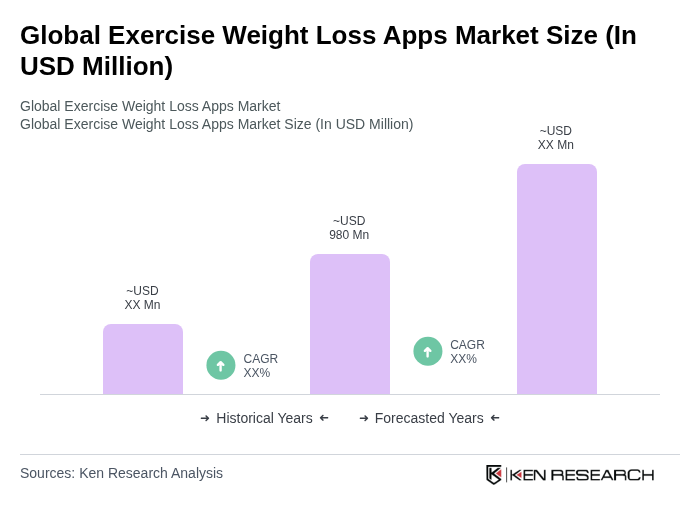
- The Global Exercise Weight Loss Apps Market is valued at USD 980 million, based on a five-year historical analysis. This growth is primarily driven by the increasing prevalence of obesity and lifestyle-related diseases, coupled with a growing awareness of health and fitness among consumers. The rise in smartphone penetration and the availability of advanced technologies, including artificial intelligence-powered personalization and real-time tracking features, have also contributed significantly to the market's expansion.
- The United States, China, and India dominate the Global Exercise Weight Loss Apps Market due to their large populations and increasing health consciousness. The U.S. leads in technological advancements and app development, with North America commanding approximately 32.3% of the global market share, while China and India have seen a surge in fitness app usage driven by urbanization and rising disposable incomes. Asia Pacific exhibits the fastest growth with an estimated share of 25.5%, fueled by rising health consciousness among the young, tech-savvy population. These countries are also witnessing a growing trend of fitness influencers and online coaching, further propelling market growth.
- The Health Insurance Portability and Accountability Act (HIPAA), issued by the U.S. Department of Health and Human Services, establishes comprehensive privacy and security standards for protected health information. This regulatory framework requires exercise and weight loss app developers to implement safeguards for user data, maintain audit controls, and ensure secure transmission of health information. Compliance with HIPAA standards is mandatory for apps handling personal health data, ensuring user safety and enhancing the credibility of health-related applications while fostering innovation in the digital health landscape.
Global Exercise Weight Loss Apps Market Segmentation
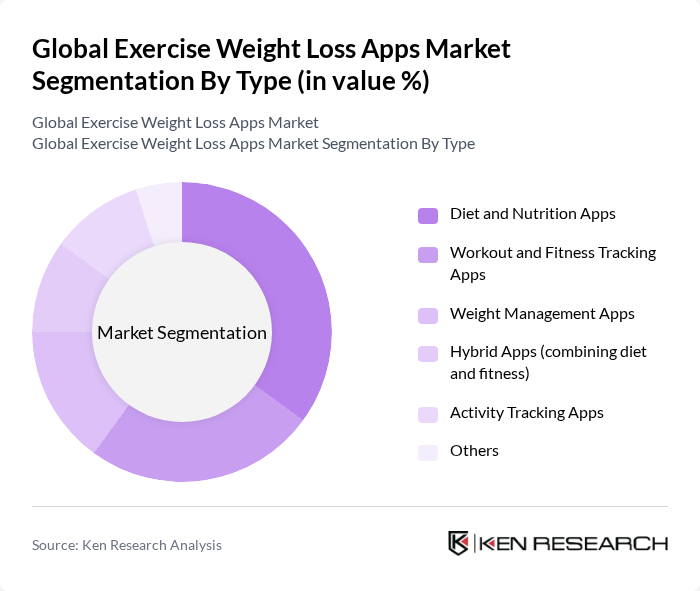
By Type:The market is segmented into various types of applications that cater to different aspects of weight loss and fitness. The primary subsegments include Diet and Nutrition Apps, Workout and Fitness Tracking Apps, Weight Management Apps, Hybrid Apps (combining diet and fitness), Activity Tracking Apps, and Others. Among these, Exercise and Weight Loss apps represent the dominant segment, accounting for approximately 44.8% of the broader fitness apps market, as they provide users with meal planning, calorie tracking, nutritional information, and comprehensive fitness solutions essential for effective weight loss.
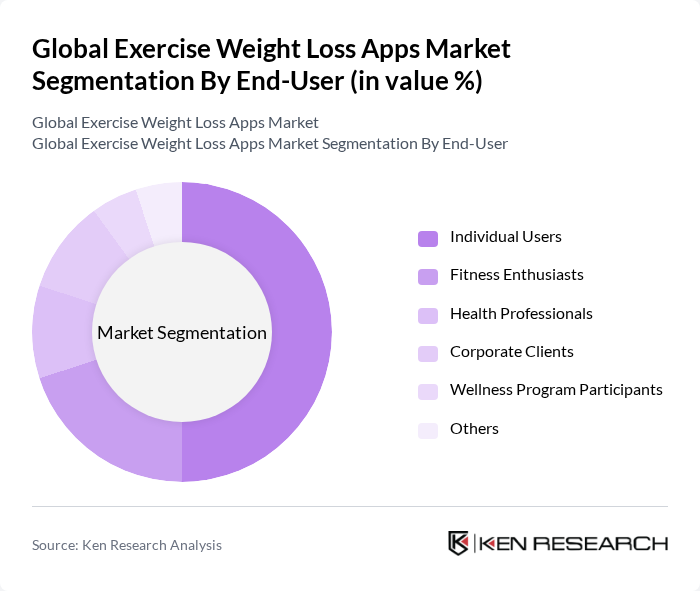
By End-User:The end-user segmentation includes Individual Users, Fitness Enthusiasts, Health Professionals, Corporate Clients, Wellness Program Participants, and Others. Individual Users represent the largest segment, as many people are increasingly taking charge of their health and fitness journeys through personal apps. This trend is driven by the desire for personalized fitness solutions and the convenience of tracking progress on mobile devices.
Global Exercise Weight Loss Apps Market Competitive Landscape
The Global Exercise Weight Loss Apps Market is characterized by a dynamic mix of regional and international players. Leading participants such as MyFitnessPal, Noom, Lose It!, Fitbit, Weight Watchers (WW), Cronometer, SparkPeople, MapMyFitness, JEFIT, Strava, Sworkit, 8fit, Fitbod, Freeletics, Aaptiv, Adidas Running (formerly Runtastic), YAZIO, Nike Training Club, Apple Fitness+, Google Fit, Samsung Health, HealthifyMe, Lifesum, Calorie Counter by FatSecret, Simple Diet & Fitness Tracker, Azumio contribute to innovation, geographic expansion, and service delivery in this space.
Global Exercise Weight Loss Apps Market Industry Analysis
Growth Drivers
- Increasing Health Consciousness Among Consumers:The global health and wellness market is projected to reach $4.5 trillion by future, driven by a surge in health awareness. In future, 70% of adults reported prioritizing their health, leading to a significant increase in the adoption of exercise weight loss apps. This trend is particularly evident in urban areas, where access to technology and fitness resources is more prevalent, fostering a culture of health and fitness among consumers.
- Rising Prevalence of Obesity and Related Health Issues:According to the World Health Organization, over 1.9 billion adults are classified as overweight, with 650 million considered obese. This alarming trend has prompted individuals to seek effective weight loss solutions, including mobile applications. The increasing incidence of obesity-related diseases, such as diabetes and heart disease, further drives the demand for exercise weight loss apps as consumers look for accessible and effective ways to manage their health.
- Technological Advancements in Mobile Applications:The global mobile application market is expected to reach $475 billion by future, fueled by innovations in technology. Features such as real-time tracking, personalized workout plans, and integration with wearable devices enhance user experience. In future, it is estimated that 75% of fitness app users will utilize apps with AI-driven features, indicating a strong preference for technology that personalizes fitness journeys and improves user engagement.
Market Challenges
- High Competition Among Existing Apps:The exercise weight loss app market is saturated, with over 50,000 fitness apps available globally. This intense competition makes it challenging for new entrants to gain market share. In future, the top five apps accounted for 40% of the market, leaving limited opportunities for differentiation. As a result, many apps struggle to attract and retain users, leading to high customer acquisition costs and reduced profitability.
- User Retention and Engagement Issues:Research indicates that 80% of fitness app users stop using the app within the first three months. This high churn rate poses a significant challenge for app developers, as maintaining user engagement is crucial for long-term success. Factors contributing to this issue include lack of personalized content, insufficient motivation, and the overwhelming number of available options, which can lead to user fatigue and disengagement.
Global Exercise Weight Loss Apps Market Future Outlook
The future of exercise weight loss apps is promising, driven by technological advancements and a growing focus on holistic wellness. As consumers increasingly prioritize mental health alongside physical fitness, apps that integrate mindfulness and stress management features are likely to gain traction. Additionally, the rise of community-driven platforms will foster social engagement, encouraging users to participate in challenges and share their progress, ultimately enhancing user retention and satisfaction in the market.
Market Opportunities
- Expansion into Emerging Markets:With a projected growth rate of 10% in smartphone penetration in regions like Southeast Asia, there is a significant opportunity for exercise weight loss apps to tap into these emerging markets. As more individuals gain access to smartphones, the demand for fitness solutions will likely increase, providing a fertile ground for app developers to expand their user base.
- Integration of AI and Machine Learning:The integration of AI and machine learning technologies can enhance user experience by providing personalized fitness recommendations. In future, it is estimated that 60% of fitness apps will incorporate AI features, allowing for tailored workout plans and nutrition advice. This technological advancement can significantly improve user engagement and retention, positioning apps as essential tools for weight loss and fitness.
Scope of the Report
| Segment | Sub-Segments |
|---|---|
| By Type | Diet and Nutrition Apps Workout and Fitness Tracking Apps Weight Management Apps Hybrid Apps (combining diet and fitness) Activity Tracking Apps Others |
| By End-User | Individual Users Fitness Enthusiasts Health Professionals Corporate Clients Wellness Program Participants Others |
| By Subscription Model | Free Apps Freemium Apps Paid Subscription Apps One-time Purchase Apps Others |
| By Demographics | Age Group (18-24, 25-34, 35-44, 45+) Gender (Male, Female, Non-binary) Income Level (Low, Middle, High) Fitness Level (Beginner, Intermediate, Advanced) Others |
| By Device Type | Smartphones Tablets Wearable Devices (e.g., smartwatches, fitness bands) Desktop/Web Applications Others |
| By Geographic Focus | North America Europe Asia-Pacific Latin America Middle East & Africa Others |
| By User Engagement Level | High Engagement Users Moderate Engagement Users Low Engagement Users New Users Others |
Key Target Audience
Investors and Venture Capitalist Firms
Government and Regulatory Bodies (e.g., Food and Drug Administration, Federal Trade Commission)
Health and Fitness App Developers
Mobile Technology Companies
Healthcare Providers and Organizations
Insurance Companies and Health Plans
Fitness Equipment Manufacturers
Marketing and Advertising Agencies
Players Mentioned in the Report:
MyFitnessPal
Noom
Lose It!
Fitbit
Weight Watchers (WW)
Cronometer
SparkPeople
MapMyFitness
JEFIT
Strava
Sworkit
8fit
Fitbod
Freeletics
Aaptiv
Adidas Running (formerly Runtastic)
YAZIO
Nike Training Club
Apple Fitness+
Google Fit
Samsung Health
HealthifyMe
Lifesum
Calorie Counter by FatSecret
Simple Diet & Fitness Tracker
Azumio
Table of Contents
Market Assessment Phase
1. Executive Summary and Approach
2. Global Exercise Weight Loss Apps Market Overview
2.1 Key Insights and Strategic Recommendations
2.2 Global Exercise Weight Loss Apps Market Overview
2.3 Definition and Scope
2.4 Evolution of Market Ecosystem
2.5 Timeline of Key Regulatory Milestones
2.6 Value Chain & Stakeholder Mapping
2.7 Business Cycle Analysis
2.8 Policy & Incentive Landscape
3. Global Exercise Weight Loss Apps Market Analysis
3.1 Growth Drivers
3.1.1 Increasing health consciousness among consumers
3.1.2 Rising prevalence of obesity and related health issues
3.1.3 Technological advancements in mobile applications
3.1.4 Growing demand for personalized fitness solutions
3.2 Market Challenges
3.2.1 High competition among existing apps
3.2.2 User retention and engagement issues
3.2.3 Data privacy and security concerns
3.2.4 Limited awareness in emerging markets
3.3 Market Opportunities
3.3.1 Expansion into emerging markets
3.3.2 Integration of AI and machine learning for personalized experiences
3.3.3 Partnerships with fitness centers and health professionals
3.3.4 Development of corporate wellness programs
3.4 Market Trends
3.4.1 Increasing use of wearable technology
3.4.2 Shift towards subscription-based models
3.4.3 Rise of community-driven fitness challenges
3.4.4 Focus on mental health and holistic wellness
3.5 Government Regulation
3.5.1 Data protection regulations (e.g., GDPR)
3.5.2 Health and safety standards for fitness apps
3.5.3 Advertising regulations for health-related products
3.5.4 Incentives for promoting healthy lifestyles
4. SWOT Analysis
5. Stakeholder Analysis
6. Porter's Five Forces Analysis
7. Global Exercise Weight Loss Apps Market Market Size, 2019-2024
7.1 By Value
7.2 By Volume
7.3 By Average Selling Price
8. Global Exercise Weight Loss Apps Market Segmentation
8.1 By Type
8.1.1 Diet and Nutrition Apps
8.1.2 Workout and Fitness Tracking Apps
8.1.3 Weight Management Apps
8.1.4 Hybrid Apps (combining diet and fitness)
8.1.5 Activity Tracking Apps
8.1.6 Others
8.2 By End-User
8.2.1 Individual Users
8.2.2 Fitness Enthusiasts
8.2.3 Health Professionals
8.2.4 Corporate Clients
8.2.5 Wellness Program Participants
8.2.6 Others
8.3 By Subscription Model
8.3.1 Free Apps
8.3.2 Freemium Apps
8.3.3 Paid Subscription Apps
8.3.4 One-time Purchase Apps
8.3.5 Others
8.4 By Demographics
8.4.1 Age Group (18-24, 25-34, 35-44, 45+)
8.4.2 Gender (Male, Female, Non-binary)
8.4.3 Income Level (Low, Middle, High)
8.4.4 Fitness Level (Beginner, Intermediate, Advanced)
8.4.5 Others
8.5 By Device Type
8.5.1 Smartphones
8.5.2 Tablets
8.5.3 Wearable Devices (e.g., smartwatches, fitness bands)
8.5.4 Desktop/Web Applications
8.5.5 Others
8.6 By Geographic Focus
8.6.1 North America
8.6.2 Europe
8.6.3 Asia-Pacific
8.6.4 Latin America
8.6.5 Middle East & Africa
8.6.6 Others
8.7 By User Engagement Level
8.7.1 High Engagement Users
8.7.2 Moderate Engagement Users
8.7.3 Low Engagement Users
8.7.4 New Users
8.7.5 Others
9. Global Exercise Weight Loss Apps Market Competitive Analysis
9.1 Market Share of Key Players
9.2 Cross Comparison of Key Players
9.2.1 Company Name
9.2.2 Group Size (Large, Medium, Small as per industry convention)
9.2.3 User Acquisition Cost (UAC)
9.2.4 Monthly Active Users (MAU)
9.2.5 Customer Lifetime Value (CLV)
9.2.6 Churn Rate
9.2.7 Pricing Strategy (Free, Freemium, Subscription, One-time Purchase)
9.2.8 Average Revenue Per User (ARPU)
9.2.9 Engagement Rate (e.g., daily active users/MAU)
9.2.10 Conversion Rate (free to paid)
9.2.11 Retention Rate (30/90/180 days)
9.2.12 Geographic Penetration (key regions/countries)
9.2.13 App Store Ratings & Reviews
9.2.14 Integration with Wearables/Devices
9.3 SWOT Analysis of Top Players
9.4 Pricing Analysis
9.5 Detailed Profile of Major Companies
9.5.1 MyFitnessPal
9.5.2 Noom
9.5.3 Lose It!
9.5.4 Fitbit
9.5.5 Weight Watchers (WW)
9.5.6 Cronometer
9.5.7 SparkPeople
9.5.8 MapMyFitness
9.5.9 JEFIT
9.5.10 Strava
9.5.11 Sworkit
9.5.12 8fit
9.5.13 Fitbod
9.5.14 Freeletics
9.5.15 Aaptiv
9.5.16 Adidas Running (formerly Runtastic)
9.5.17 YAZIO
9.5.18 Nike Training Club
9.5.19 Apple Fitness+
9.5.20 Google Fit
9.5.21 Samsung Health
9.5.22 HealthifyMe
9.5.23 Lifesum
9.5.24 Calorie Counter by FatSecret
9.5.25 Simple Diet & Fitness Tracker
9.5.26 Azumio
10. Global Exercise Weight Loss Apps Market End-User Analysis
10.1 Procurement Behavior of Key Ministries
10.1.1 Government health initiatives
10.1.2 Funding for public health programs
10.1.3 Collaboration with tech companies
10.1.4 Promotion of fitness and wellness
10.2 Corporate Spend on Infrastructure & Energy
10.2.1 Investment in employee wellness programs
10.2.2 Budget allocation for health apps
10.2.3 Partnerships with fitness app developers
10.2.4 Corporate fitness challenges
10.3 Pain Point Analysis by End-User Category
10.3.1 Lack of personalized fitness plans
10.3.2 Difficulty in tracking progress
10.3.3 Limited access to professional guidance
10.3.4 Motivation and accountability issues
10.4 User Readiness for Adoption
10.4.1 Awareness of fitness apps
10.4.2 Technological literacy
10.4.3 Willingness to invest in health
10.4.4 Availability of internet access
10.5 Post-Deployment ROI and Use Case Expansion
10.5.1 Measurement of user satisfaction
10.5.2 Analysis of health outcomes
10.5.3 Expansion of features based on feedback
10.5.4 Long-term user engagement strategies
11. Global Exercise Weight Loss Apps Market Future Size, 2025-2030
11.1 By Value
11.2 By Volume
11.3 By Average Selling Price
Go-To-Market Strategy Phase
1. Whitespace Analysis + Business Model Canvas
1.1
2. Marketing and Positioning Recommendations
2.1
3. Distribution Plan
3.1
4. Channel & Pricing Gaps
4.1
5. Unmet Demand & Latent Needs
5.1
6. Customer Relationship
7.1
7. Value Proposition
8.1
8. Key Activities
9.1
9. Entry Strategy Evaluation
9.1 Domestic Market Entry Strategy
10.1.1
9.2 Export Entry Strategy
10.2.1
10. Entry Mode Assessment
11.1
11. Capital and Timeline Estimation
12.1
12. Control vs Risk Trade-Off
13.1
13. Profitability Outlook
14.1
14. Potential Partner List
15.1
15. Execution Roadmap
15.1 Phased Plan for Market Entry
16.1.1
15.2 Key Activities and Milestones
16.2.1
Research Methodology
Phase 1: Approach1
Desk Research
- Analysis of market reports from fitness and health organizations
- Review of app store data and user reviews for popular exercise weight loss apps
- Examination of industry publications and white papers on digital health trends
Primary Research
- Interviews with app developers and product managers in the fitness tech sector
- Surveys targeting users of exercise weight loss apps to gather usage patterns
- Focus groups with fitness trainers and nutritionists to understand app effectiveness
Validation & Triangulation
- Cross-validation of user data with industry growth statistics and trends
- Triangulation of findings from user surveys, expert interviews, and market reports
- Sanity checks through feedback from a panel of fitness industry experts
Phase 2: Market Size Estimation1
Top-down Assessment
- Estimation of total addressable market based on global fitness app revenue
- Segmentation by geographic regions and demographic profiles of users
- Incorporation of trends in health consciousness and digital fitness adoption
Bottom-up Modeling
- Analysis of subscription models and pricing strategies of leading apps
- Estimation of user acquisition costs and retention rates for fitness apps
- Volume of downloads and active users to project revenue streams
Forecasting & Scenario Analysis
- Multi-variable regression analysis incorporating fitness trends and technology adoption
- Scenario modeling based on potential market disruptions and regulatory changes
- Baseline, optimistic, and pessimistic forecasts through 2030
Phase 3: CATI Sample Composition1
| Scope Item/Segment | Sample Size | Target Respondent Profiles |
|---|---|---|
| General Users of Weight Loss Apps | 120 | Fitness Enthusiasts, Casual Users |
| Health and Fitness Professionals | 60 | Personal Trainers, Nutritionists |
| App Developers and Marketers | 40 | Product Managers, Marketing Directors |
| Healthcare Providers | 50 | Physicians, Health Coaches |
| Technology Adoption Analysts | 40 | Market Researchers, Industry Analysts |
Frequently Asked Questions
What is the current value of the Global Exercise Weight Loss Apps Market?
The Global Exercise Weight Loss Apps Market is valued at approximately USD 980 million, reflecting a significant growth trend driven by increasing health consciousness and the prevalence of obesity and lifestyle-related diseases among consumers.
Which regions dominate the Global Exercise Weight Loss Apps Market?
What are the main types of exercise weight loss apps available?
Who are the primary users of exercise weight loss apps?
Other Regional/Country Reports
Indonesia Exercise Weight Loss Apps Market
Malaysia Exercise Weight Loss Apps Market
KSA Exercise Weight Loss Apps Market
APAC Exercise Weight Loss Apps Market
SEA Exercise Weight Loss Apps Market
Vietnam Exercise Weight Loss Apps Market
Other Adjacent Reports
Mexico Fitness Wearables Market
Thailand Nutrition Tracking Apps Market
Vietnam Virtual Fitness Training Market
Brazil Health Monitoring Devices Market
Germany Personalized Wellness Programs Market
New Zealand Digital Therapeutics Market Size Share Growth Drivers Trends Opportunities & Forecast 2025–2030Malaysia Sports Nutrition Supplements Market
Belgium Online Health Coaching Market
Indonesia Wellness and Mindfulness Apps Market
Ksa Telehealth Services Market Report Size, Share, Growth Drivers, Trends, Opportunities & Forecast 2025–2030Why Buy From Us?

What makes us stand out is that our consultants follow Robust, Refine and Result (RRR) methodology. Robust for clear definitions, approaches and sanity checking, Refine for differentiating respondents' facts and opinions, and Result for presenting data with story.

We have set a benchmark in the industry by offering our clients with syndicated and customized market research reports featuring coverage of entire market as well as meticulous research and analyst insights.

While we don't replace traditional research, we flip the method upside down. Our dual approach of Top Bottom & Bottom Top ensures quality deliverable by not just verifying company fundamentals but also looking at the sector and macroeconomic factors.

With one step in the future, our research team constantly tries to show you the bigger picture. We help with some of the tough questions you may encounter along the way: How is the industry positioned? Best marketing channel? KPI's of competitors? By aligning every element, we help maximize success.

Our report gives you instant access to the answers and sources that other companies might choose to hide. We elaborate each steps of research methodology we have used and showcase you the sample size to earn your trust.

If you need any support, we are here! We pride ourselves on universe strength, data quality, and quick, friendly, and professional service.