About the Report
Base Year 2024Global Eye Tracking Solutions Market Overview
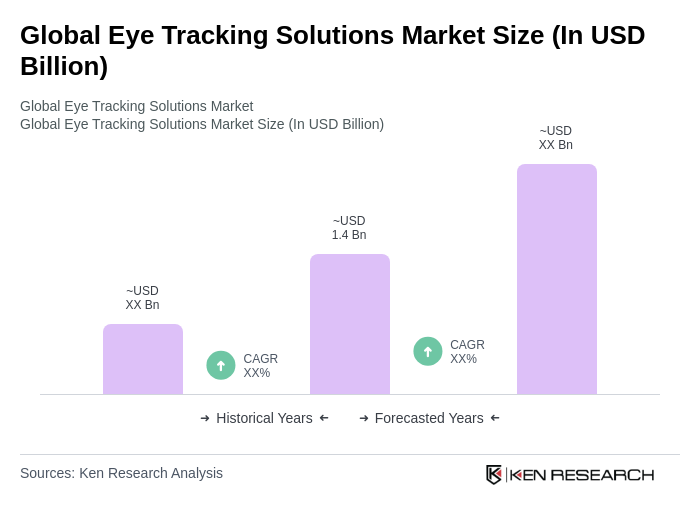
- The Global Eye Tracking Solutions Market is valued at USD 1.4 billion, based on a five-year historical analysis. This growth is primarily driven by the increasing demand for eye tracking technology in sectors such as healthcare, automotive, consumer electronics, and research, as well as advancements in sensor technology, deep learning, and image processing that enhance the accuracy and usability of eye tracking devices .
- Key players in this market are concentrated in regions such as North America and Europe, where technological innovation and high investment in research and development are prevalent. Countries like the United States and Germany dominate due to their strong industrial base and the presence of leading technology firms that drive market growth .
- In 2023, the European Union strengthened regulations to ensure the ethical use of eye tracking technologies, particularly in consumer research and advertising. These regulations mandate transparency in data collection and usage, requiring companies to obtain explicit consent from users before tracking their eye movements, thereby enhancing consumer trust and data protection .
Global Eye Tracking Solutions Market Segmentation
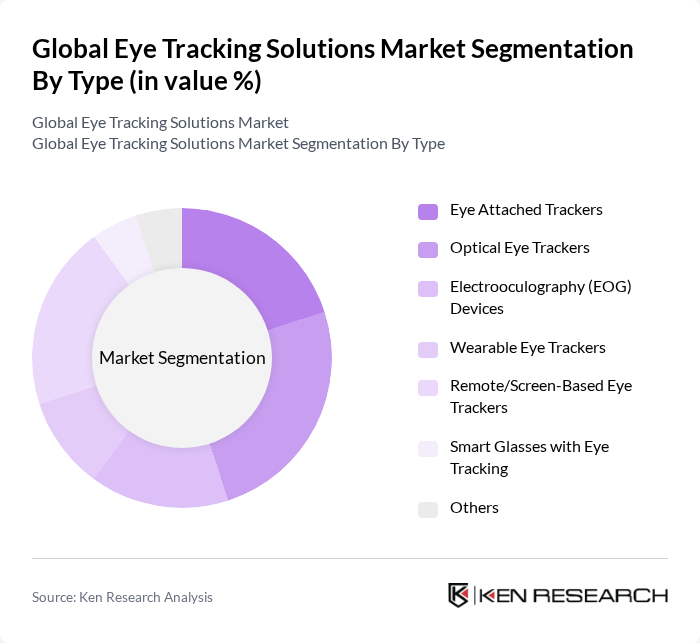
By Type:The eye tracking solutions market can be segmented into various types, including Eye Attached Trackers, Optical Eye Trackers, Electrooculography (EOG) Devices, Wearable Eye Trackers, Remote/Screen-Based Eye Trackers, Smart Glasses with Eye Tracking, and Others. Each of these subsegments caters to different applications and user needs, contributing to the overall market dynamics. Optical eye trackers and remote/screen-based eye trackers are widely adopted for usability testing, research, and consumer electronics, while wearable and smart glasses solutions are increasingly used in healthcare, automotive, and field research applications .
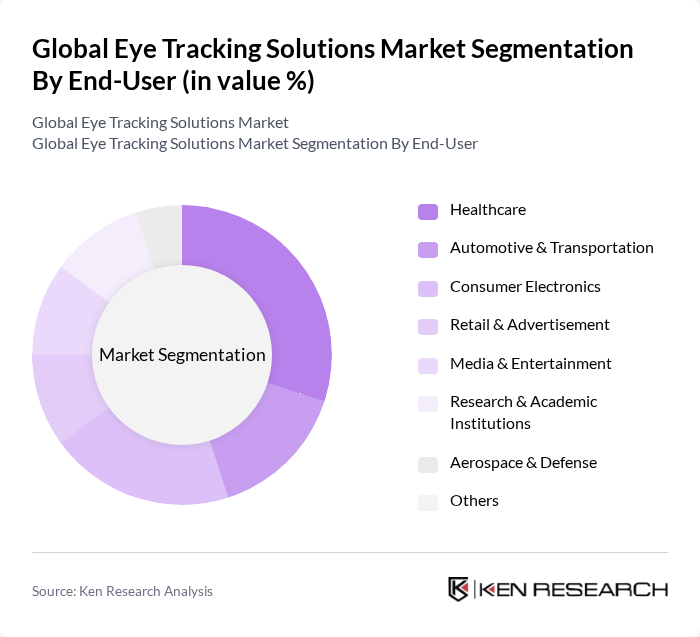
By End-User:The end-user segmentation includes Healthcare, Automotive & Transportation, Consumer Electronics, Retail & Advertisement, Media & Entertainment, Research & Academic Institutions, Aerospace & Defense, and Others. Each sector utilizes eye tracking technology for various applications, influencing the market's growth trajectory. Healthcare leads due to the adoption of eye tracking for diagnostics and patient monitoring, while consumer electronics and automotive sectors are rapidly increasing their usage for user experience enhancement and driver monitoring systems .
Global Eye Tracking Solutions Market Competitive Landscape
The Global Eye Tracking Solutions Market is characterized by a dynamic mix of regional and international players. Leading participants such as Tobii AB, EyeTech Digital Systems, Inc., SensoMotoric Instruments (SMI), Pupil Labs GmbH, Gazepoint Research Inc., Smart Eye AB, Seeing Machines Limited, iMotions A/S, NeuroSky, Inc., EyeTracking, Inc., FOVE, Inc., Optalert Pty Ltd, GazeRecorder Sp. z o.o., Visage Technologies AB, Aware Technologies, Inc. contribute to innovation, geographic expansion, and service delivery in this space.
Global Eye Tracking Solutions Market Industry Analysis
Growth Drivers
- Increasing Demand for User Experience Research:The global user experience research market is projected to reach $1.2 billion by in future, driven by the need for businesses to enhance customer satisfaction. Companies are investing heavily in eye tracking solutions to gather insights on user behavior, with a reported 60% increase in demand for such technologies in the last two years. This trend is supported by the growing recognition of the importance of user-centric design in product development.
- Advancements in Eye Tracking Technology:The eye tracking technology sector has seen significant advancements, with the introduction of devices that offer precision tracking at 120 Hz and beyond. This has led to a 40% increase in the accuracy of data collection, making eye tracking more appealing for various applications. The integration of machine learning algorithms has further enhanced the capabilities of these systems, allowing for real-time data analysis and improved user insights.
- Growing Applications in Healthcare and Education:The healthcare sector is increasingly utilizing eye tracking for patient monitoring and rehabilitation, with an estimated 30% growth in its application over the past year. In education, eye tracking is being used to assess student engagement, with studies showing a 25% improvement in learning outcomes when eye tracking data is utilized. This expansion into critical sectors is driving the demand for innovative eye tracking solutions.
Market Challenges
- High Cost of Advanced Eye Tracking Systems:The average cost of advanced eye tracking systems can exceed $10,000, which poses a significant barrier for small to medium-sized enterprises. This high investment requirement limits accessibility and adoption rates, particularly in emerging markets where budget constraints are prevalent. As a result, many potential users are deterred from integrating these technologies into their operations.
- Data Privacy Concerns:With increasing scrutiny on data privacy, particularly in regions like the EU, companies face challenges in ensuring compliance with regulations such as GDPR. The potential for misuse of eye tracking data raises ethical concerns, leading to hesitance among organizations to adopt these technologies. A survey indicated that 70% of businesses are wary of implementing eye tracking due to privacy issues, impacting market growth.
Global Eye Tracking Solutions Market Future Outlook
The future of eye tracking solutions appears promising, with a notable shift towards remote and portable technologies. As businesses adapt to hybrid work environments, the demand for remote eye tracking solutions is expected to rise significantly. Additionally, the integration of artificial intelligence with eye tracking technology will enhance data analysis capabilities, providing deeper insights into user behavior. This evolution will likely lead to broader adoption across various sectors, including marketing, healthcare, and education, fostering innovation and growth.
Market Opportunities
- Expansion in Emerging Markets:Emerging markets, particularly in Asia-Pacific, are witnessing a surge in technology adoption. With a projected increase in technology spending by 15% in future, eye tracking solutions can capitalize on this growth. Companies that tailor their offerings to meet local needs will find significant opportunities for expansion and market penetration.
- Development of Portable Eye Tracking Devices:The demand for portable eye tracking devices is on the rise, with a projected market growth of 20% in the next year. These devices are becoming essential for field studies and remote research, allowing for greater flexibility and accessibility. Companies that innovate in this space can tap into a growing customer base seeking efficient and effective solutions.
Scope of the Report
| Segment | Sub-Segments |
|---|---|
| By Type | Eye Attached Trackers Optical Eye Trackers Electrooculography (EOG) Devices Wearable Eye Trackers Remote/Screen-Based Eye Trackers Smart Glasses with Eye Tracking Others |
| By End-User | Healthcare Automotive & Transportation Consumer Electronics Retail & Advertisement Media & Entertainment Research & Academic Institutions Aerospace & Defense Others |
| By Application | User Experience & Usability Testing Behavioral & Cognitive Research Clinical Diagnostics & Research Driver Monitoring Systems Marketing Analytics Human-Computer Interaction Gaming & Virtual/Augmented Reality Others |
| By Distribution Channel | Direct Sales Online Retail Distributors Resellers Others |
| By Region | North America Europe Asia-Pacific Latin America Middle East & Africa |
| By Price Range | Low-End Mid-Range High-End |
| By Technology | Optical Tracking Electrooculography (EOG) Video-Based Eye Tracking Fixed Electrode Systems Mobile/Portable Electrode Systems Others |
Key Target Audience
Investors and Venture Capitalist Firms
Government and Regulatory Bodies (e.g., Federal Trade Commission, National Institute of Standards and Technology)
Manufacturers and Producers of Eye Tracking Devices
Healthcare Providers and Medical Institutions
Advertising and Marketing Agencies
Technology Providers and Software Developers
Market Research and Analytics Firms
Financial Institutions and Investment Banks
Players Mentioned in the Report:
Tobii AB
EyeTech Digital Systems, Inc.
SensoMotoric Instruments (SMI)
Pupil Labs GmbH
Gazepoint Research Inc.
Smart Eye AB
Seeing Machines Limited
iMotions A/S
NeuroSky, Inc.
EyeTracking, Inc.
FOVE, Inc.
Optalert Pty Ltd
GazeRecorder Sp. z o.o.
Visage Technologies AB
Aware Technologies, Inc.
Table of Contents
Market Assessment Phase
1. Executive Summary and Approach
2. Global Eye Tracking Solutions Market Overview
2.1 Key Insights and Strategic Recommendations
2.2 Global Eye Tracking Solutions Market Overview
2.3 Definition and Scope
2.4 Evolution of Market Ecosystem
2.5 Timeline of Key Regulatory Milestones
2.6 Value Chain & Stakeholder Mapping
2.7 Business Cycle Analysis
2.8 Policy & Incentive Landscape
3. Global Eye Tracking Solutions Market Analysis
3.1 Growth Drivers
3.1.1 Increasing demand for user experience research
3.1.2 Advancements in eye tracking technology
3.1.3 Growing applications in healthcare and education
3.1.4 Rising adoption in marketing and advertising
3.2 Market Challenges
3.2.1 High cost of advanced eye tracking systems
3.2.2 Limited awareness among potential users
3.2.3 Data privacy concerns
3.2.4 Integration issues with existing systems
3.3 Market Opportunities
3.3.1 Expansion in emerging markets
3.3.2 Development of portable eye tracking devices
3.3.3 Increasing use in virtual and augmented reality
3.3.4 Collaborations with tech companies for innovation
3.4 Market Trends
3.4.1 Growth of remote eye tracking solutions
3.4.2 Integration of AI with eye tracking technology
3.4.3 Focus on user-centric design in product development
3.4.4 Rise of eye tracking in gaming and entertainment
3.5 Government Regulation
3.5.1 Compliance with data protection regulations
3.5.2 Standards for eye tracking device safety
3.5.3 Guidelines for ethical use in research
3.5.4 Incentives for technology development
4. SWOT Analysis
5. Stakeholder Analysis
6. Porter's Five Forces Analysis
7. Global Eye Tracking Solutions Market Market Size, 2019-2024
7.1 By Value
7.2 By Volume
7.3 By Average Selling Price
8. Global Eye Tracking Solutions Market Segmentation
8.1 By Type
8.1.1 Eye Attached Trackers
8.1.2 Optical Eye Trackers
8.1.3 Electrooculography (EOG) Devices
8.1.4 Wearable Eye Trackers
8.1.5 Remote/Screen-Based Eye Trackers
8.1.6 Smart Glasses with Eye Tracking
8.1.7 Others
8.2 By End-User
8.2.1 Healthcare
8.2.2 Automotive & Transportation
8.2.3 Consumer Electronics
8.2.4 Retail & Advertisement
8.2.5 Media & Entertainment
8.2.6 Research & Academic Institutions
8.2.7 Aerospace & Defense
8.2.8 Others
8.3 By Application
8.3.1 User Experience & Usability Testing
8.3.2 Behavioral & Cognitive Research
8.3.3 Clinical Diagnostics & Research
8.3.4 Driver Monitoring Systems
8.3.5 Marketing Analytics
8.3.6 Human-Computer Interaction
8.3.7 Gaming & Virtual/Augmented Reality
8.3.8 Others
8.4 By Distribution Channel
8.4.1 Direct Sales
8.4.2 Online Retail
8.4.3 Distributors
8.4.4 Resellers
8.4.5 Others
8.5 By Region
8.5.1 North America
8.5.2 Europe
8.5.3 Asia-Pacific
8.5.4 Latin America
8.5.5 Middle East & Africa
8.6 By Price Range
8.6.1 Low-End
8.6.2 Mid-Range
8.6.3 High-End
8.7 By Technology
8.7.1 Optical Tracking
8.7.2 Electrooculography (EOG)
8.7.3 Video-Based Eye Tracking
8.7.4 Fixed Electrode Systems
8.7.5 Mobile/Portable Electrode Systems
8.7.6 Others
9. Global Eye Tracking Solutions Market Competitive Analysis
9.1 Market Share of Key Players
9.2 Cross Comparison of Key Players
9.2.1 Company Name
9.2.2 Company Size (Large, Medium, Small)
9.2.3 Global Revenue (USD Millions)
9.2.4 Revenue Growth Rate (%)
9.2.5 Market Share (%)
9.2.6 Geographic Presence (Number of Countries/Regions)
9.2.7 R&D Investment (% of Revenue)
9.2.8 Number of Patents/Intellectual Property Assets
9.2.9 Product Portfolio Breadth (Number of Product Lines)
9.2.10 Key End-User Segments Served
9.2.11 Strategic Partnerships/Collaborations
9.2.12 Customer Retention Rate (%)
9.2.13 Customer Satisfaction Score (NPS or Equivalent)
9.2.14 Average Deal Size (USD)
9.2.15 Sales Conversion Rate (%)
9.2.16 Pricing Strategy (Premium, Value, Volume, etc.)
9.2.17 Product Development Cycle Time (Months)
9.3 SWOT Analysis of Top Players
9.4 Pricing Analysis
9.5 Detailed Profile of Major Companies
9.5.1 Tobii AB
9.5.2 EyeTech Digital Systems, Inc.
9.5.3 SensoMotoric Instruments (SMI)
9.5.4 Pupil Labs GmbH
9.5.5 Gazepoint Research Inc.
9.5.6 Smart Eye AB
9.5.7 Seeing Machines Limited
9.5.8 iMotions A/S
9.5.9 NeuroSky, Inc.
9.5.10 EyeTracking, Inc.
9.5.11 FOVE, Inc.
9.5.12 Optalert Pty Ltd
9.5.13 GazeRecorder Sp. z o.o.
9.5.14 Visage Technologies AB
9.5.15 Aware Technologies, Inc.
10. Global Eye Tracking Solutions Market End-User Analysis
10.1 Procurement Behavior of Key Ministries
10.1.1 Government funding for research projects
10.1.2 Collaboration with educational institutions
10.1.3 Adoption of technology in public health
10.2 Corporate Spend on Infrastructure & Energy
10.2.1 Investment in user experience research
10.2.2 Budget allocation for technology upgrades
10.3 Pain Point Analysis by End-User Category
10.3.1 Challenges in integrating eye tracking in research
10.3.2 Need for training and support
10.4 User Readiness for Adoption
10.4.1 Awareness of eye tracking benefits
10.4.2 Technical readiness of organizations
10.5 Post-Deployment ROI and Use Case Expansion
10.5.1 Measurement of effectiveness in research
10.5.2 Expansion into new applications
11. Global Eye Tracking Solutions Market Future Size, 2025-2030
11.1 By Value
11.2 By Volume
11.3 By Average Selling Price
Go-To-Market Strategy Phase
1. Whitespace Analysis + Business Model Canvas
1.1
2. Marketing and Positioning Recommendations
2.1
3. Distribution Plan
3.1
4. Channel & Pricing Gaps
4.1
5. Unmet Demand & Latent Needs
5.1
6. Customer Relationship
7.1
7. Value Proposition
8.1
8. Key Activities
9.1
9. Entry Strategy Evaluation
9.1 Domestic Market Entry Strategy
10.1.1
9.2 Export Entry Strategy
10.2.1
10. Entry Mode Assessment
11.1
11. Capital and Timeline Estimation
12.1
12. Control vs Risk Trade-Off
13.1
13. Profitability Outlook
14.1
14. Potential Partner List
15.1
15. Execution Roadmap
15.1 Phased Plan for Market Entry
16.1.1
15.2 Key Activities and Milestones
16.2.1
Research Methodology
Phase 1: Approach1
Desk Research
- Industry reports from market research firms focusing on eye tracking technology
- Published articles and white papers from academic journals on eye tracking applications
- Market data from trade associations and industry bodies related to consumer behavior analytics
Primary Research
- Interviews with product managers at leading eye tracking solution providers
- Surveys with end-users in sectors such as retail, healthcare, and automotive
- Focus groups with researchers and practitioners utilizing eye tracking technology
Validation & Triangulation
- Cross-validation of findings through multiple data sources including sales data and user feedback
- Triangulation of insights from primary interviews and secondary data analysis
- Sanity checks conducted through expert panel reviews and industry roundtables
Phase 2: Market Size Estimation1
Top-down Assessment
- Analysis of global market trends in eye tracking technology adoption across various industries
- Estimation of market size based on revenue generated from key application areas
- Incorporation of macroeconomic factors influencing technology investment and adoption
Bottom-up Modeling
- Collection of sales data from key players in the eye tracking solutions market
- Estimation of market share based on product offerings and regional presence
- Volume and pricing analysis to derive revenue projections for different segments
Forecasting & Scenario Analysis
- Multi-variable forecasting models incorporating technological advancements and market dynamics
- Scenario analysis based on varying levels of market penetration and adoption rates
- Development of baseline, optimistic, and pessimistic forecasts through 2030
Phase 3: CATI Sample Composition1
| Scope Item/Segment | Sample Size | Target Respondent Profiles |
|---|---|---|
| Retail Eye Tracking Applications | 100 | Marketing Managers, Store Operations Directors |
| Healthcare Usability Studies | 60 | Clinical Researchers, UX Designers |
| Automotive User Experience Testing | 50 | Product Development Engineers, User Experience Researchers |
| Academic Research in Eye Tracking | 40 | University Professors, Graduate Students |
| Advertising and Marketing Insights | 70 | Brand Managers, Advertising Executives |
Frequently Asked Questions
What is the current value of the Global Eye Tracking Solutions Market?
The Global Eye Tracking Solutions Market is valued at approximately USD 1.4 billion, reflecting significant growth driven by advancements in technology and increasing demand across various sectors such as healthcare, automotive, and consumer electronics.
What are the key drivers of growth in the eye tracking solutions market?
Which regions dominate the Global Eye Tracking Solutions Market?
What are the main types of eye tracking solutions available?
Other Regional/Country Reports
Indonesia Eye Tracking Solutions Market
Malaysia Eye Tracking Solutions Market
APAC Eye Tracking Solutions Market
SEA Eye Tracking Solutions Market
Why Buy From Us?

What makes us stand out is that our consultants follow Robust, Refine and Result (RRR) methodology. Robust for clear definitions, approaches and sanity checking, Refine for differentiating respondents' facts and opinions, and Result for presenting data with story.

We have set a benchmark in the industry by offering our clients with syndicated and customized market research reports featuring coverage of entire market as well as meticulous research and analyst insights.

While we don't replace traditional research, we flip the method upside down. Our dual approach of Top Bottom & Bottom Top ensures quality deliverable by not just verifying company fundamentals but also looking at the sector and macroeconomic factors.

With one step in the future, our research team constantly tries to show you the bigger picture. We help with some of the tough questions you may encounter along the way: How is the industry positioned? Best marketing channel? KPI's of competitors? By aligning every element, we help maximize success.

Our report gives you instant access to the answers and sources that other companies might choose to hide. We elaborate each steps of research methodology we have used and showcase you the sample size to earn your trust.

If you need any support, we are here! We pride ourselves on universe strength, data quality, and quick, friendly, and professional service.