About the Report
Base Year 2024Global Feed Yeast Market Overview
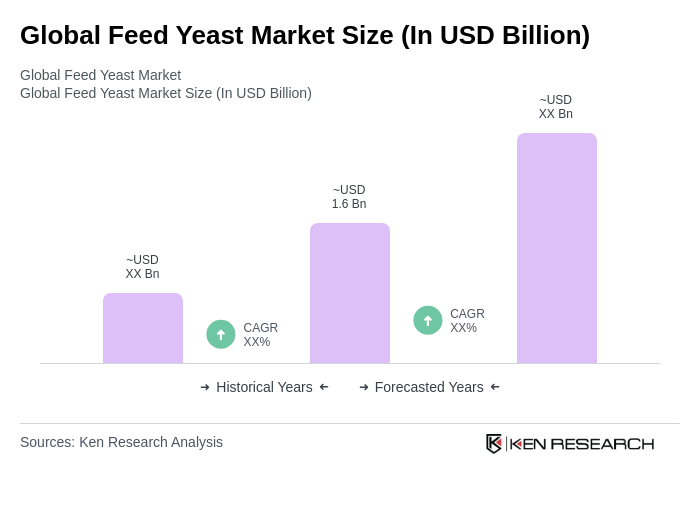
- The Global Feed Yeast Market is valued at USD 1.6 billion, based on a five-year historical analysis. This growth is primarily driven by the increasing demand for high-quality animal feed, which enhances livestock health and productivity, and the proven role of yeast and yeast derivatives in improving gut function, immune modulation, and feed efficiency in livestock .
- Key markets include the United States, Germany, and China. The U.S. is a leading producer and consumer of compound feed and specialty additives; China’s large livestock sector and rising feed output support high yeast adoption; Germany’s focus on animal nutrition and stringent quality standards underpins advanced additive use . Asia Pacific (notably China) is frequently identified as holding the highest share or fastest growth due to animal population, feed mill capacity, and meat demand .
- The European Union has tightened the framework to reduce antibiotic use and promote alternative feed additives such as yeast through measures linked to the veterinary medicines regulation (antibiotics ban for prophylactic use) and continued EFSA authorization pathways for zootechnical additives, which encourage adoption of yeast-based solutions to support animal health and food safety .
Global Feed Yeast Market Segmentation
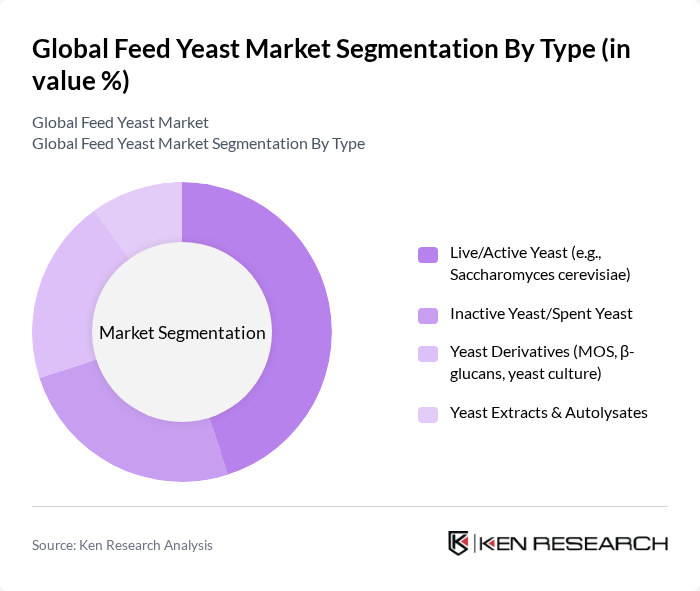
By Type:The feed yeast market is segmented into four main types: Live/Active Yeast, Inactive Yeast/Spent Yeast, Yeast Derivatives, and Yeast Extracts & Autolysates. Among these, Live/Active Yeast is the leading subsegment due to its effectiveness in stabilizing rumen and gut microbiota, improving fiber digestion, and enhancing feed efficiency across species; yeast derivatives such as mannan-oligosaccharides (MOS), ?-glucans, and yeast cultures are also gaining traction for immune support and pathogen binding, aligning with the shift to natural, antibiotic-free nutrition .
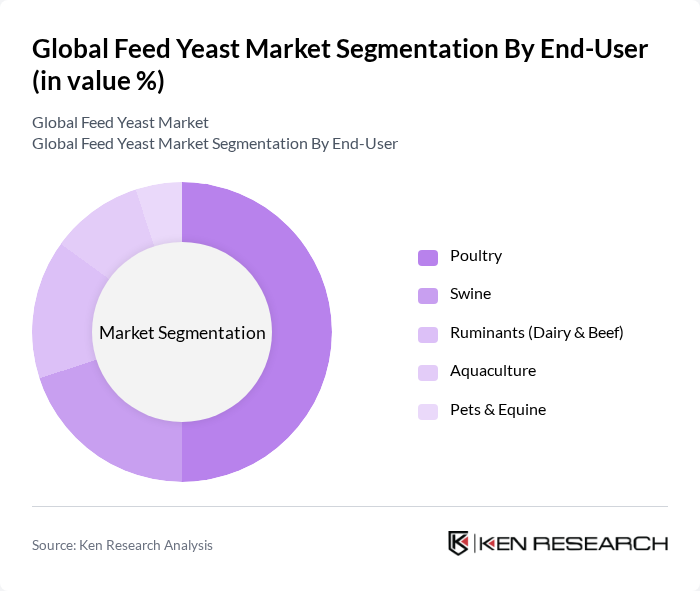
By End-User:The end-user segmentation includes Poultry, Swine, Ruminants (Dairy & Beef), Aquaculture, and Pets & Equine. The Poultry segment typically holds the largest share, supported by strong global demand for poultry protein and the role of yeast in improving feed conversion ratio, gut health, and resilience; ruminants, swine, and aquaculture also show growing adoption as producers target antibiotic reduction and performance consistency .
Global Feed Yeast Market Competitive Landscape
The Global Feed Yeast Market is characterized by a dynamic mix of regional and international players. Leading participants such as Alltech, Inc., Archer Daniels Midland Company (ADM), Lesaffre Group (including Phileo by Lesaffre), Lallemand Inc. (Lallemand Animal Nutrition), Associated British Foods plc (AB Agri), dsm-firmenich, Kemin Industries, Inc., Nutreco N.V. (Trouw Nutrition), Cargill, Incorporated, Angel Yeast Co., Ltd., Novus International, Inc., Biorigin (Zilor), ICC Brazil (ICC Indústria e Comércio de Castanhas S.A.), Evonik Industries AG, OHLY GmbH (a subsidiary of ABF) contribute to innovation, geographic expansion, and service delivery as they expand fermentation capacity, develop new yeast strains and derivatives, and partner with premix/feed mill networks to reach producers globally .
Global Feed Yeast Market Industry Analysis
Growth Drivers
- Increasing Demand for Animal Nutrition:The global livestock population is projected to reach 1.5 billion by in future, driving the demand for high-quality animal nutrition. The feed yeast market benefits from this trend, as feed yeast enhances nutrient absorption and overall animal health. According to the Food and Agriculture Organization (FAO), the global demand for animal protein is expected to increase by 15% by in future, further propelling the feed yeast market's growth in None.
- Rising Awareness of Health Benefits:The awareness of health benefits associated with feed yeast is growing, particularly in None, where livestock producers are increasingly adopting yeast-based supplements. Research indicates that feed yeast can improve gut health and enhance immune responses in animals. The World Health Organization (WHO) reports that livestock health directly impacts food safety and quality, leading to a projected increase in feed yeast consumption by 20% in the region by in future.
- Expansion of Livestock Production:The livestock sector in None is experiencing significant expansion, with an estimated increase in production by 10% by in future. This growth is driven by rising consumer demand for meat and dairy products. The International Livestock Research Institute (ILRI) highlights that increased livestock production necessitates the use of efficient feed additives like yeast, which can enhance feed efficiency and reduce production costs, thereby supporting the feed yeast market's growth.
Market Challenges
- Fluctuating Raw Material Prices:The feed yeast industry faces challenges due to fluctuating raw material prices, particularly for sugar and molasses, which are essential for yeast production. In future, the price of molasses is projected to rise by 15% due to supply chain disruptions and increased demand from the biofuel sector. This volatility can impact production costs and profit margins for feed yeast manufacturers in None, posing a significant challenge to market stability.
- Stringent Regulatory Frameworks:The feed yeast market in None is subject to stringent regulatory frameworks that govern feed safety and quality. Compliance with these regulations can be costly and time-consuming for manufacturers. In future, the implementation of new EU regulations is expected to increase compliance costs by approximately 10%, which may deter smaller producers from entering the market and limit overall growth potential in the region.
Global Feed Yeast Market Future Outlook
The future of the feed yeast market in None appears promising, driven by increasing consumer demand for sustainable and nutritious animal feed. Innovations in feed yeast formulations, particularly those enhancing gut health and feed efficiency, are expected to gain traction. Additionally, the growing trend towards organic farming will likely boost the demand for organic feed yeast products. As livestock production continues to expand, the integration of advanced technologies in yeast production will further enhance market growth and sustainability.
Market Opportunities
- Innovations in Feed Yeast Products:There is a significant opportunity for innovation in feed yeast products, particularly in developing specialized strains that cater to specific livestock needs. Research and development investments are projected to increase by 12% in future, enabling manufacturers to create more effective and targeted feed solutions, thus enhancing market competitiveness in None.
- Expansion into Developing Regions:The feed yeast market has substantial growth potential in developing regions, where livestock production is on the rise. By in future, investments in infrastructure and distribution channels are expected to increase by 15%, facilitating market entry and expansion. This growth will allow companies to tap into new customer bases and increase their market share in None.
Scope of the Report
| Segment | Sub-Segments |
|---|---|
| By Type | Live/Active Yeast (e.g., Saccharomyces cerevisiae) Inactive Yeast/Spent Yeast Yeast Derivatives (MOS, ?-glucans, yeast culture) Yeast Extracts & Autolysates |
| By End-User | Poultry Swine Ruminants (Dairy & Beef) Aquaculture Pets & Equine |
| By Application | Probiotic/Functional Feed Additives Performance & Health (immunity, gut health, mycotoxin management) Palatability & Protein Source Others |
| By Distribution Channel | Direct Sales (to integrators/premix & feed mills) Distributors/Dealers Online/Indirect Sales Others |
| By Region | North America Europe Asia-Pacific Latin America Middle East & Africa |
| By Price Range | Economy Standard Premium |
| By Packaging Type | Bulk (500 kg–1,000 kg bags, totes) Industrial Sacks (20–25 kg) Customized/Premix-ready Packs Others |
Key Target Audience
Investors and Venture Capitalist Firms
Government and Regulatory Bodies (e.g., Food and Drug Administration, European Food Safety Authority)
Manufacturers and Producers
Distributors and Retailers
Animal Nutrition Companies
Feed Additive Suppliers
Industry Associations (e.g., American Feed Industry Association)
Financial Institutions
Players Mentioned in the Report:
Alltech, Inc.
Archer Daniels Midland Company (ADM)
Lesaffre Group (including Phileo by Lesaffre)
Lallemand Inc. (Lallemand Animal Nutrition)
Associated British Foods plc (AB Agri)
dsm-firmenich
Kemin Industries, Inc.
Nutreco N.V. (Trouw Nutrition)
Cargill, Incorporated
Angel Yeast Co., Ltd.
Novus International, Inc.
Biorigin (Zilor)
ICC Brazil (ICC Industria e Comercio de Castanhas S.A.)
Evonik Industries AG
OHLY GmbH (a subsidiary of ABF)
Table of Contents
Market Assessment Phase
1. Executive Summary and Approach
2. Global Feed Yeast Market Overview
2.1 Key Insights and Strategic Recommendations
2.2 Global Feed Yeast Market Overview
2.3 Definition and Scope
2.4 Evolution of Market Ecosystem
2.5 Timeline of Key Regulatory Milestones
2.6 Value Chain & Stakeholder Mapping
2.7 Business Cycle Analysis
2.8 Policy & Incentive Landscape
3. Global Feed Yeast Market Analysis
3.1 Growth Drivers
3.1.1 Increasing Demand for Animal Nutrition
3.1.2 Rising Awareness of Health Benefits
3.1.3 Expansion of Livestock Production
3.1.4 Growth in Aquaculture Industry
3.2 Market Challenges
3.2.1 Fluctuating Raw Material Prices
3.2.2 Stringent Regulatory Frameworks
3.2.3 Competition from Alternative Feed Additives
3.2.4 Limited Awareness in Emerging Markets
3.3 Market Opportunities
3.3.1 Innovations in Feed Yeast Products
3.3.2 Expansion into Developing Regions
3.3.3 Increasing Demand for Organic Feed
3.3.4 Collaborations and Partnerships
3.4 Market Trends
3.4.1 Shift Towards Sustainable Practices
3.4.2 Growing Use of Probiotics in Animal Feed
3.4.3 Technological Advancements in Production
3.4.4 Rising Popularity of Plant-Based Feed Ingredients
3.5 Government Regulation
3.5.1 Feed Safety Regulations
3.5.2 Labeling Requirements for Feed Products
3.5.3 Environmental Regulations on Production
3.5.4 Import/Export Regulations for Feed Ingredients
4. SWOT Analysis
5. Stakeholder Analysis
6. Porter's Five Forces Analysis
7. Global Feed Yeast Market Market Size, 2019-2024
7.1 By Value
7.2 By Volume
7.3 By Average Selling Price
8. Global Feed Yeast Market Segmentation
8.1 By Type
8.1.1 Live/Active Yeast (e.g., Saccharomyces cerevisiae)
8.1.2 Inactive Yeast/Spent Yeast
8.1.3 Yeast Derivatives (MOS, ?-glucans, yeast culture)
8.1.4 Yeast Extracts & Autolysates
8.2 By End-User
8.2.1 Poultry
8.2.2 Swine
8.2.3 Ruminants (Dairy & Beef)
8.2.4 Aquaculture
8.2.5 Pets & Equine
8.3 By Application
8.3.1 Probiotic/Functional Feed Additives
8.3.2 Performance & Health (immunity, gut health, mycotoxin management)
8.3.3 Palatability & Protein Source
8.3.4 Others
8.4 By Distribution Channel
8.4.1 Direct Sales (to integrators/premix & feed mills)
8.4.2 Distributors/Dealers
8.4.3 Online/Indirect Sales
8.4.4 Others
8.5 By Region
8.5.1 North America
8.5.2 Europe
8.5.3 Asia-Pacific
8.5.4 Latin America
8.5.5 Middle East & Africa
8.6 By Price Range
8.6.1 Economy
8.6.2 Standard
8.6.3 Premium
8.7 By Packaging Type
8.7.1 Bulk (500 kg–1,000 kg bags, totes)
8.7.2 Industrial Sacks (20–25 kg)
8.7.3 Customized/Premix-ready Packs
8.7.4 Others
9. Global Feed Yeast Market Competitive Analysis
9.1 Market Share of Key Players
9.2 KPIs for Cross Comparison of Key Players
9.2.1 Feed yeast revenue (USD) and % of company animal nutrition revenue
9.2.2 Production capacity (tons/year) and utilization rate
9.2.3 Geographic footprint (manufacturing sites and countries served)
9.2.4 Portfolio breadth (live yeast, derivatives, extracts, species coverage)
9.2.5 R&D intensity (% of revenue; number of strains/patents)
9.2.6 Regulatory approvals & certifications (EFSA dossiers, GRAS, FAMI-QS, GMP+)
9.2.7 Strategic partnerships and distribution reach (premix/feed mill tie-ups)
9.2.8 Pricing position vs. peers (economy/standard/premium)
9.2.9 Innovation and new launches (strain upgrades, functional claims)
9.2.10 Customer mix and retention (integrators vs. dealers; key accounts)
9.3 SWOT Analysis of Top Players
9.4 Pricing Analysis
9.5 Detailed Profile of Major Companies
9.5.1 Alltech, Inc.
9.5.2 Archer Daniels Midland Company (ADM)
9.5.3 Lesaffre Group (including Phileo by Lesaffre)
9.5.4 Lallemand Inc. (Lallemand Animal Nutrition)
9.5.5 Associated British Foods plc (AB Agri)
9.5.6 dsm-firmenich
9.5.7 Kemin Industries, Inc.
9.5.8 Nutreco N.V. (Trouw Nutrition)
9.5.9 Cargill, Incorporated
9.5.10 Angel Yeast Co., Ltd.
9.5.11 Novus International, Inc.
9.5.12 Biorigin (Zilor)
9.5.13 ICC Brazil (ICC Indústria e Comércio de Castanhas S.A.)
9.5.14 Evonik Industries AG
9.5.15 OHLY GmbH (a subsidiary of ABF)
10. Global Feed Yeast Market End-User Analysis
10.1 Procurement Behavior of Key Ministries
10.1.1 Government Procurement Policies
10.1.2 Budget Allocations for Feed Products
10.1.3 Supplier Selection Criteria
10.1.4 Contract Management Practices
10.2 Corporate Spend on Infrastructure & Energy
10.2.1 Investment in Feed Production Facilities
10.2.2 Expenditure on Research and Development
10.2.3 Budget for Sustainability Initiatives
10.3 Pain Point Analysis by End-User Category
10.3.1 Quality Assurance Issues
10.3.2 Supply Chain Disruptions
10.3.3 Cost Management Challenges
10.4 User Readiness for Adoption
10.4.1 Awareness of Feed Yeast Benefits
10.4.2 Training and Support Needs
10.4.3 Infrastructure Readiness
10.5 Post-Deployment ROI and Use Case Expansion
10.5.1 Measurement of Feed Efficiency
10.5.2 Long-term Cost Savings
10.5.3 Expansion into New Markets
11. Global Feed Yeast Market Future Size, 2025-2030
11.1 By Value
11.2 By Volume
11.3 By Average Selling Price
Go-To-Market Strategy Phase
1. Whitespace Analysis + Business Model Canvas
1.1 Market Gaps Identification
1.2 Value Proposition Development
1.3 Revenue Streams Analysis
1.4 Cost Structure Evaluation
1.5 Key Partnerships Exploration
1.6 Customer Segmentation
1.7 Channels of Distribution
2. Marketing and Positioning Recommendations
2.1 Branding Strategies
2.2 Product USPs
2.3 Target Market Identification
2.4 Communication Strategies
2.5 Digital Marketing Approaches
3. Distribution Plan
3.1 Urban Retail Strategies
3.2 Rural NGO Tie-ups
3.3 E-commerce Integration
3.4 Logistics and Supply Chain Management
4. Channel & Pricing Gaps
4.1 Underserved Routes
4.2 Pricing Bands Analysis
4.3 Competitor Pricing Strategies
5. Unmet Demand & Latent Needs
5.1 Category Gaps Identification
5.2 Consumer Segments Analysis
5.3 Product Development Opportunities
6. Customer Relationship
6.1 Loyalty Programs
6.2 After-sales Service
6.3 Customer Feedback Mechanisms
7. Value Proposition
7.1 Sustainability Initiatives
7.2 Integrated Supply Chains
7.3 Competitive Advantages
8. Key Activities
8.1 Regulatory Compliance
8.2 Branding Efforts
8.3 Distribution Setup
9. Entry Strategy Evaluation
9.1 Domestic Market Entry Strategy
9.1.1 Product Mix Considerations
9.1.2 Pricing Band Strategy
9.1.3 Packaging Innovations
9.2 Export Entry Strategy
9.2.1 Target Countries Identification
9.2.2 Compliance Roadmap Development
10. Entry Mode Assessment
10.1 Joint Ventures
10.2 Greenfield Investments
10.3 Mergers & Acquisitions
10.4 Distributor Model Evaluation
11. Capital and Timeline Estimation
11.1 Capital Requirements
11.2 Timelines for Implementation
12. Control vs Risk Trade-Off
12.1 Ownership Considerations
12.2 Partnerships Evaluation
13. Profitability Outlook
13.1 Breakeven Analysis
13.2 Long-term Sustainability Strategies
14. Potential Partner List
14.1 Distributors
14.2 Joint Ventures
14.3 Acquisition Targets
15. Execution Roadmap
15.1 Phased Plan for Market Entry
15.1.1 Market Setup
15.1.2 Market Entry
15.1.3 Growth Acceleration
15.1.4 Scale & Stabilize
15.2 Key Activities and Milestones
15.2.1 Milestone Planning
15.2.2 Activity Tracking
Research Methodology
Phase 1: Approach1
Desk Research
- Industry reports from agricultural and animal nutrition associations
- Market analysis publications from leading agricultural research firms
- Statistical data from FAO and other global agricultural databases
Primary Research
- Interviews with feed manufacturers and nutritionists specializing in yeast products
- Surveys with livestock producers to understand feed preferences and usage
- Field interviews with distributors and retailers of animal feed products
Validation & Triangulation
- Cross-validation of findings through multiple industry sources and reports
- Triangulation of data from primary interviews and secondary research findings
- Sanity checks conducted with a panel of industry experts and analysts
Phase 2: Market Size Estimation1
Top-down Assessment
- Analysis of global feed production volumes and market share of yeast products
- Segmentation by livestock type (poultry, swine, ruminants) and geographical region
- Incorporation of trends in animal nutrition and health regulations
Bottom-up Modeling
- Volume estimates based on production capacities of leading yeast manufacturers
- Cost analysis of feed formulations incorporating yeast as an ingredient
- Estimation of market size based on sales data from key distributors
Forecasting & Scenario Analysis
- Multi-variable forecasting using growth rates in livestock production and feed consumption
- Scenario analysis based on potential shifts in consumer preferences and regulatory changes
- Development of baseline, optimistic, and pessimistic market projections through 2030
Phase 3: CATI Sample Composition1
| Scope Item/Segment | Sample Size | Target Respondent Profiles |
|---|---|---|
| Poultry Feed Manufacturers | 120 | Production Managers, Nutritionists |
| Swine Nutrition Experts | 90 | Feed Formulators, Veterinarians |
| Ruminant Feed Suppliers | 80 | Sales Managers, Product Development Specialists |
| Livestock Producers | 110 | Farm Owners, Feed Buyers |
| Animal Health Consultants | 60 | Veterinary Nutritionists, Industry Analysts |
Frequently Asked Questions
What is the current value of the Global Feed Yeast Market?
The Global Feed Yeast Market is valued at approximately USD 1.6 billion, driven by the increasing demand for high-quality animal feed that enhances livestock health and productivity, as well as the benefits of yeast in improving gut function and feed efficiency.
Which regions are key markets for feed yeast?
What are the main types of feed yeast available in the market?
Who are the major players in the Global Feed Yeast Market?
Other Regional/Country Reports
Indonesia Feed Yeast Market
Malaysia Feed Yeast Market
APAC Feed Yeast Market
SEA Feed Yeast Market
Why Buy From Us?

What makes us stand out is that our consultants follow Robust, Refine and Result (RRR) methodology. Robust for clear definitions, approaches and sanity checking, Refine for differentiating respondents' facts and opinions, and Result for presenting data with story.

We have set a benchmark in the industry by offering our clients with syndicated and customized market research reports featuring coverage of entire market as well as meticulous research and analyst insights.

While we don't replace traditional research, we flip the method upside down. Our dual approach of Top Bottom & Bottom Top ensures quality deliverable by not just verifying company fundamentals but also looking at the sector and macroeconomic factors.

With one step in the future, our research team constantly tries to show you the bigger picture. We help with some of the tough questions you may encounter along the way: How is the industry positioned? Best marketing channel? KPI's of competitors? By aligning every element, we help maximize success.

Our report gives you instant access to the answers and sources that other companies might choose to hide. We elaborate each steps of research methodology we have used and showcase you the sample size to earn your trust.

If you need any support, we are here! We pride ourselves on universe strength, data quality, and quick, friendly, and professional service.