Global Fire Fighting Aircraft Market

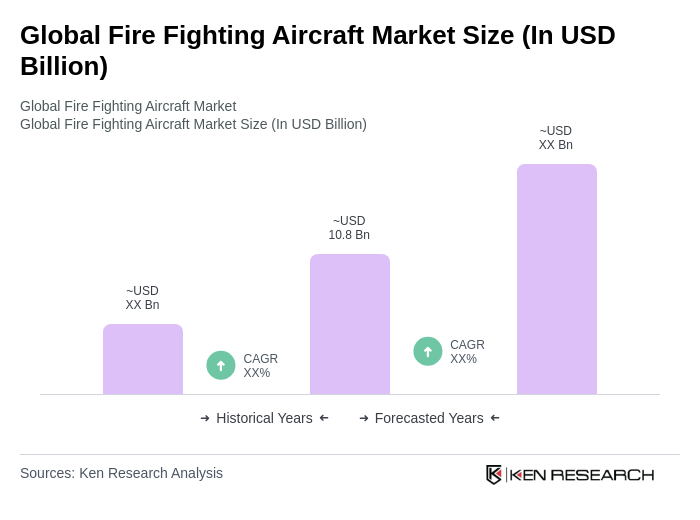
Global firefighting aircraft market, valued at USD 10.8 billion, is growing due to increasing wildfire frequency, technological advancements, and government investments in rapid response solutions.

Region:Global

Author(s):Shubham

Product Code:KRAA3165

Pages:80

Published On:August 2025
About the Report

Base Year 2024

Global Fire Fighting Aircraft Market Overview

  • The Global Fire Fighting Aircraft Market is valued at USD 10.8 billion, based on a five-year historical analysis. This growth is primarily driven by the increasing frequency and severity of wildfires globally, accelerated by climate change, urban expansion into wildland areas, and the critical need for rapid, effective disaster management solutions. The adoption of advanced aerial firefighting technologies, including improved water/retardant delivery systems and enhanced aircraft maneuverability, is further propelling demand for specialized aircraft in firefighting operations. Additionally, heightened awareness of environmental sustainability and the necessity for swift emergency response have reinforced the market’s expansion .
  • Key players in this market include the United States, Canada, Australia, and Brazil. These countries dominate the market due to their extensive forested territories, frequent wildfire incidents, and robust firefighting infrastructure. Government support and significant investments in advanced firefighting aircraft and technologies further consolidate their leadership in the global market .
  • The U.S. government, through the "National Interagency Mobilization Guide" (issued by the National Interagency Fire Center, 2023), mandates the integration of aerial firefighting resources in federal wildfire response operations. This regulatory framework establishes operational standards, resource mobilization protocols, and minimum requirements for aerial support, ensuring federal agencies are equipped to address increasingly severe wildfire seasons with coordinated aerial assets .
Global Fire Fighting Aircraft Market Size

Global Fire Fighting Aircraft Market Segmentation

By Type:The market is segmented into Fixed-Wing Aircraft, Rotary-Wing Aircraft (Helicopters), Amphibious Aircraft, Multi-Role Aircraft, Unmanned Aerial Vehicles (UAVs)/Drones, and Others. Fixed-Wing Aircraft remain the most dominant segment, favored for their ability to cover extensive areas rapidly and deliver large payloads, making them essential for wide-scale wildfire suppression. Rotary-Wing Aircraft are critical for precision drops, rapid deployment, and access to challenging terrains, especially in urban-wildland interface zones. Amphibious Aircraft, capable of scooping water from nearby sources, are increasingly utilized in regions with abundant lakes and rivers. UAVs and drones are gaining traction for real-time surveillance, hotspot detection, and situational awareness, complementing manned aircraft in integrated firefighting strategies .
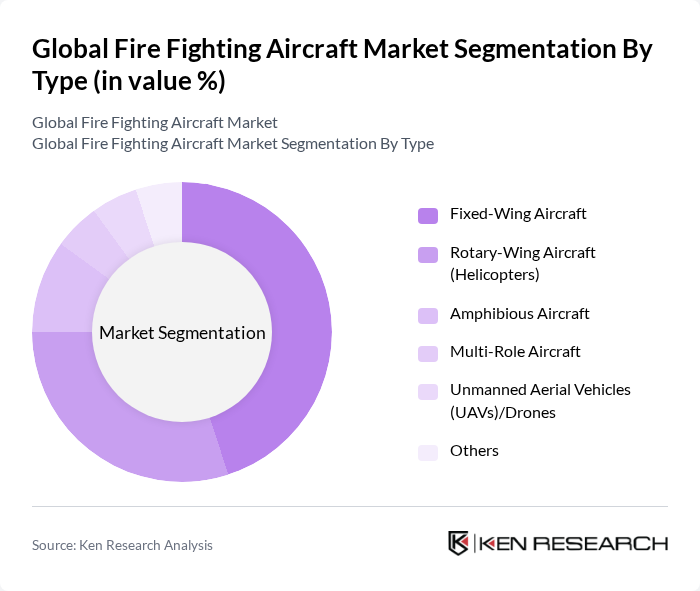
Global Fire Fighting Aircraft Market segmentation by Type.

By End-User:The end-user segmentation comprises Government Agencies (Forestry, Civil Protection, Defense), Private Firefighting Operators, Non-Governmental Organizations (NGOs), and the Industrial & Commercial Sector. Government Agencies are the predominant end-users, reflecting their central role in public safety, environmental stewardship, and wildfire management. The trend toward public-private partnerships and increased outsourcing to specialized operators is enhancing operational flexibility and resource availability. NGOs and industrial/commercial stakeholders are also expanding their roles, particularly in high-risk regions and for asset protection .

Global Fire Fighting Aircraft Market segmentation by End-User.

Global Fire Fighting Aircraft Market Competitive Landscape

The Global Fire Fighting Aircraft Market is characterized by a dynamic mix of regional and international players. Leading participants such as Air Tractor, Inc., De Havilland Aircraft of Canada Limited, Lockheed Martin Corporation, Textron Aviation Inc., Conair Group Inc., BAE Systems plc, Airbus S.A.S., Northrop Grumman Corporation, Leonardo S.p.A., Erickson Incorporated, SAAB AB, ShinMaywa Industries, Ltd., Coulson Group, Kaman Corporation, and Conair Aerial Firefighting contribute to innovation, geographic expansion, and service delivery in this space .

Air Tractor, Inc.

1972

Olney, Texas, USA

De Havilland Aircraft of Canada Limited

1928

Toronto, Ontario, Canada

Lockheed Martin Corporation

1995

Bethesda, Maryland, USA

Textron Aviation Inc.

1923

Wichita, Kansas, USA

Conair Group Inc.

1969

Abbotsford, British Columbia, Canada

Company

Establishment Year

Headquarters

Group Size (Large, Medium, or Small as per industry convention)

Revenue (USD, most recent fiscal year)

Revenue Growth Rate (CAGR %)

Market Share (%)

Number of Aircraft Delivered (Annual/Total)

Geographic Presence (Regions/Countries Served)

Global Fire Fighting Aircraft Market Industry Analysis

Growth Drivers

  • Increasing Frequency of Wildfires:The global incidence of wildfires has surged, with over 10 million hectares burned annually in recent years, according to the Global Forest Watch. This alarming trend is driven by climate change, leading to longer fire seasons and more intense fires. In future, the U.S. alone is projected to allocate approximately $3.5 billion for wildfire management, significantly boosting demand for firefighting aircraft. This increased funding directly correlates with the need for advanced aerial firefighting solutions.
  • Advancements in Aircraft Technology:Technological innovations in firefighting aircraft have enhanced operational efficiency and effectiveness. For instance, the introduction of next-generation water-scooping aircraft has improved water retention capabilities, allowing for up to 35% more water to be carried. Additionally, the integration of GPS and real-time data analytics has optimized flight paths, reducing response times. In future, investments in R&D for firefighting technologies are expected to exceed $600 million, further driving market growth.
  • Government Funding for Firefighting Resources:Governments worldwide are increasingly recognizing the importance of investing in firefighting resources. In future, the U.S. federal budget allocates $3 billion specifically for aerial firefighting initiatives. This funding supports the acquisition of new aircraft and upgrades to existing fleets, ensuring that firefighting agencies are better equipped to handle escalating wildfire threats. Such financial commitments are crucial for sustaining the growth of the firefighting aircraft market.

Market Challenges

  • High Operational Costs:Operating firefighting aircraft incurs significant costs, including maintenance, fuel, and crew salaries. For instance, the average operational cost of a large firefighting aircraft can exceed $12,000 per flight hour. This financial burden can limit the number of missions conducted during critical wildfire events. As budgets tighten, many firefighting agencies may struggle to justify these expenses, posing a challenge to the market's growth potential.
  • Regulatory Compliance Issues:The firefighting aircraft industry faces stringent regulatory requirements, particularly concerning safety and environmental standards. Compliance with these regulations can be costly and time-consuming, often requiring significant modifications to existing aircraft. For example, the FAA mandates that all firefighting aircraft meet specific safety standards, which can lead to delays in deployment. In future, compliance-related costs are expected to rise by 20%, further complicating market dynamics.

Global Fire Fighting Aircraft Market Future Outlook

The future of the firefighting aircraft market appears promising, driven by technological advancements and increasing government support. As climate change continues to exacerbate wildfire conditions, the demand for efficient aerial firefighting solutions will likely rise. Innovations such as drone technology and AI integration are expected to enhance operational capabilities. Furthermore, partnerships between private companies and government agencies will facilitate the development of more effective firefighting strategies, ensuring that resources are allocated efficiently to combat wildfires.

Market Opportunities

  • Expansion into Emerging Markets:Emerging markets, particularly in regions prone to wildfires, present significant growth opportunities. Countries like Brazil and Australia are increasing their investments in firefighting infrastructure, with Brazil allocating $1.2 billion for wildfire management in future. This trend opens avenues for manufacturers to introduce advanced firefighting aircraft tailored to local needs, enhancing market penetration.
  • Development of Hybrid Firefighting Aircraft:The development of hybrid firefighting aircraft represents a significant opportunity for innovation. These aircraft can operate with reduced emissions and lower operational costs, appealing to environmentally conscious agencies. In future, investments in hybrid technology are projected to reach $250 million, fostering advancements that could revolutionize aerial firefighting capabilities and attract new customers.

Scope of the Report

SegmentSub-Segments
By Type

Fixed-Wing Aircraft

Rotary-Wing Aircraft (Helicopters)

Amphibious Aircraft

Multi-Role Aircraft

Unmanned Aerial Vehicles (UAVs)/Drones

Others

By End-User

Government Agencies (Forestry, Civil Protection, Defense)

Private Firefighting Operators

Non-Governmental Organizations (NGOs)

Industrial & Commercial Sector

By Application

Wildfire Control

Urban Firefighting

Agricultural & Grassland Fire Management

Disaster Relief & Emergency Response

By Payload Capacity

Less than 1,000 Liters

,000 to 5,000 Liters

,001 to 10,000 Liters

More than 10,000 Liters

By Sales Channel

Direct Sales

Distributors/Dealers

Leasing/Charter Services

By Region

North America

Europe

Asia-Pacific

Latin America

Middle East & Africa

By Investment Source

Public Sector Funding

Private Investments

International Aid & Grants

Key Target Audience

Investors and Venture Capitalist Firms

Government and Regulatory Bodies (e.g., Federal Aviation Administration, National Interagency Fire Center)

Manufacturers and Producers

Distributors and Retailers

Aerospace and Defense Contractors

Firefighting Agencies and Departments

Insurance Companies

Environmental Protection Agencies

Players Mentioned in the Report:

Air Tractor, Inc.

De Havilland Aircraft of Canada Limited

Lockheed Martin Corporation

Textron Aviation Inc.

Conair Group Inc.

BAE Systems plc

Airbus S.A.S.

Northrop Grumman Corporation

Leonardo S.p.A.

Erickson Incorporated

SAAB AB

ShinMaywa Industries, Ltd.

Coulson Group

Kaman Corporation

Conair Aerial Firefighting

Table of Contents

Market Assessment Phase

1. Executive Summary and Approach


2. Global Fire Fighting Aircraft Market Overview

2.1 Key Insights and Strategic Recommendations

2.2 Global Fire Fighting Aircraft Market Overview

2.3 Definition and Scope

2.4 Evolution of Market Ecosystem

2.5 Timeline of Key Regulatory Milestones

2.6 Value Chain & Stakeholder Mapping

2.7 Business Cycle Analysis

2.8 Policy & Incentive Landscape


3. Global Fire Fighting Aircraft Market Analysis

3.1 Growth Drivers

3.1.1 Increasing frequency of wildfires
3.1.2 Advancements in aircraft technology
3.1.3 Government funding for firefighting resources
3.1.4 Rising awareness of environmental protection

3.2 Market Challenges

3.2.1 High operational costs
3.2.2 Limited availability of specialized aircraft
3.2.3 Regulatory compliance issues
3.2.4 Competition from ground-based firefighting methods

3.3 Market Opportunities

3.3.1 Expansion into emerging markets
3.3.2 Development of hybrid firefighting aircraft
3.3.3 Partnerships with government agencies
3.3.4 Technological innovations in firefighting systems

3.4 Market Trends

3.4.1 Increasing use of drones for firefighting
3.4.2 Integration of AI in firefighting operations
3.4.3 Focus on sustainable firefighting practices
3.4.4 Growth in private sector involvement

3.5 Government Regulation

3.5.1 Safety standards for firefighting aircraft
3.5.2 Environmental regulations on emissions
3.5.3 Funding programs for firefighting resources
3.5.4 Licensing requirements for operators

4. SWOT Analysis


5. Stakeholder Analysis


6. Porter's Five Forces Analysis


7. Global Fire Fighting Aircraft Market Market Size, 2019-2024

7.1 By Value

7.2 By Volume

7.3 By Average Selling Price


8. Global Fire Fighting Aircraft Market Segmentation

8.1 By Type

8.1.1 Fixed-Wing Aircraft
8.1.2 Rotary-Wing Aircraft (Helicopters)
8.1.3 Amphibious Aircraft
8.1.4 Multi-Role Aircraft
8.1.5 Unmanned Aerial Vehicles (UAVs)/Drones
8.1.6 Others

8.2 By End-User

8.2.1 Government Agencies (Forestry, Civil Protection, Defense)
8.2.2 Private Firefighting Operators
8.2.3 Non-Governmental Organizations (NGOs)
8.2.4 Industrial & Commercial Sector

8.3 By Application

8.3.1 Wildfire Control
8.3.2 Urban Firefighting
8.3.3 Agricultural & Grassland Fire Management
8.3.4 Disaster Relief & Emergency Response

8.4 By Payload Capacity

8.4.1 Less than 1,000 Liters
8.4.2 1,000 to 5,000 Liters
8.4.3 5,001 to 10,000 Liters
8.4.4 More than 10,000 Liters

8.5 By Sales Channel

8.5.1 Direct Sales
8.5.2 Distributors/Dealers
8.5.3 Leasing/Charter Services

8.6 By Region

8.6.1 North America
8.6.2 Europe
8.6.3 Asia-Pacific
8.6.4 Latin America
8.6.5 Middle East & Africa

8.7 By Investment Source

8.7.1 Public Sector Funding
8.7.2 Private Investments
8.7.3 International Aid & Grants

9. Global Fire Fighting Aircraft Market Competitive Analysis

9.1 Market Share of Key Players

9.2 Cross Comparison of Key Players

9.2.1 Company Name
9.2.2 Group Size (Large, Medium, or Small as per industry convention)
9.2.3 Revenue (USD, most recent fiscal year)
9.2.4 Revenue Growth Rate (CAGR %)
9.2.5 Market Share (%)
9.2.6 Number of Aircraft Delivered (Annual/Total)
9.2.7 Geographic Presence (Regions/Countries Served)
9.2.8 Product Portfolio Breadth (Types/Models Offered)
9.2.9 R&D Expenditure (% of Revenue)
9.2.10 Major Contracts/Awards (Recent)
9.2.11 Fleet Operational Availability (%)
9.2.12 Customer Base (Key Clients/Segments)

9.3 SWOT Analysis of Top Players

9.4 Pricing Analysis

9.5 Detailed Profile of Major Companies

9.5.1 Air Tractor, Inc.
9.5.2 De Havilland Aircraft of Canada Limited
9.5.3 Lockheed Martin Corporation
9.5.4 Textron Aviation Inc.
9.5.5 Conair Group Inc.
9.5.6 BAE Systems plc
9.5.7 Airbus S.A.S.
9.5.8 Northrop Grumman Corporation
9.5.9 Leonardo S.p.A.
9.5.10 Erickson Incorporated
9.5.11 SAAB AB
9.5.12 ShinMaywa Industries, Ltd.
9.5.13 Coulson Group
9.5.14 Kaman Corporation
9.5.15 Conair Aerial Firefighting

10. Global Fire Fighting Aircraft Market End-User Analysis

10.1 Procurement Behavior of Key Ministries

10.1.1 Budget Allocation Trends
10.1.2 Decision-Making Processes
10.1.3 Contracting Procedures

10.2 Corporate Spend on Infrastructure & Energy

10.2.1 Investment in Firefighting Infrastructure
10.2.2 Spending on Aircraft Maintenance
10.2.3 Budget for Training and Development

10.3 Pain Point Analysis by End-User Category

10.3.1 Budget Constraints
10.3.2 Equipment Availability
10.3.3 Training Gaps

10.4 User Readiness for Adoption

10.4.1 Awareness of New Technologies
10.4.2 Training Needs Assessment
10.4.3 Financial Readiness

10.5 Post-Deployment ROI and Use Case Expansion

10.5.1 Performance Metrics Evaluation
10.5.2 Long-term Cost Savings
10.5.3 Expansion into New Applications

11. Global Fire Fighting Aircraft Market Future Size, 2025-2030

11.1 By Value

11.2 By Volume

11.3 By Average Selling Price


Go-To-Market Strategy Phase

1. Whitespace Analysis + Business Model Canvas

1.1 Market Gaps Identification

1.2 Value Proposition Development

1.3 Revenue Streams Analysis

1.4 Cost Structure Assessment

1.5 Key Partnerships Exploration

1.6 Customer Segmentation

1.7 Channels of Distribution


2. Marketing and Positioning Recommendations

2.1 Branding Strategies

2.2 Product USPs

2.3 Target Market Identification

2.4 Communication Strategies

2.5 Digital Marketing Approaches


3. Distribution Plan

3.1 Urban Retail Strategies

3.2 Rural NGO Tie-Ups

3.3 Direct Sales Approaches

3.4 Online Distribution Channels


4. Channel & Pricing Gaps

4.1 Underserved Routes

4.2 Pricing Bands Analysis

4.3 Competitor Pricing Strategies


5. Unmet Demand & Latent Needs

5.1 Category Gaps

5.2 Consumer Segments Analysis

5.3 Emerging Trends Identification


6. Customer Relationship

6.1 Loyalty Programs

6.2 After-Sales Service

6.3 Customer Feedback Mechanisms


7. Value Proposition

7.1 Sustainability Initiatives

7.2 Integrated Supply Chains

7.3 Competitive Advantages


8. Key Activities

8.1 Regulatory Compliance

8.2 Branding Efforts

8.3 Distribution Setup


9. Entry Strategy Evaluation

9.1 Domestic Market Entry Strategy

9.1.1 Product Mix Considerations
9.1.2 Pricing Band Strategy
9.1.3 Packaging Options

9.2 Export Entry Strategy

9.2.1 Target Countries
9.2.2 Compliance Roadmap

10. Entry Mode Assessment

10.1 Joint Ventures

10.2 Greenfield Investments

10.3 Mergers & Acquisitions

10.4 Distributor Model


11. Capital and Timeline Estimation

11.1 Capital Requirements

11.2 Timelines for Implementation


12. Control vs Risk Trade-Off

12.1 Ownership Considerations

12.2 Partnerships Evaluation


13. Profitability Outlook

13.1 Breakeven Analysis

13.2 Long-term Sustainability


14. Potential Partner List

14.1 Distributors

14.2 Joint Ventures

14.3 Acquisition Targets


15. Execution Roadmap

15.1 Phased Plan for Market Entry

15.1.1 Market Setup
15.1.2 Market Entry
15.1.3 Growth Acceleration
15.1.4 Scale & Stabilize

15.2 Key Activities and Milestones

15.2.1 Milestone Planning
15.2.2 Activity Tracking

Research Methodology

ApproachModellingSample

Phase 1: Approach1

Desk Research

  • Industry reports from aviation and firefighting organizations
  • Market analysis from government publications and aviation authorities
  • Academic journals and white papers on firefighting technologies and aircraft

Primary Research

  • Interviews with fleet managers of firefighting aircraft operators
  • Surveys with manufacturers of firefighting aircraft and equipment
  • Field interviews with fire department officials and emergency response coordinators

Validation & Triangulation

  • Cross-validation of data from multiple industry sources and reports
  • Triangulation of market trends with expert insights and historical data
  • Sanity checks through feedback from industry panels and focus groups

Phase 2: Market Size Estimation1

Top-down Assessment

  • Analysis of global firefighting budgets and expenditure trends
  • Segmentation by aircraft type, including fixed-wing and rotary-wing
  • Incorporation of regional demand variations and climate impact assessments

Bottom-up Modeling

  • Volume estimates based on aircraft production and sales data
  • Operational cost analysis derived from maintenance and operational efficiency
  • Revenue projections based on pricing models and service contracts

Forecasting & Scenario Analysis

  • Multi-factor regression analysis incorporating climate change and fire incidence rates
  • Scenario modeling based on regulatory changes and technological advancements
  • Baseline, optimistic, and pessimistic forecasts through 2035

Phase 3: CATI Sample Composition1

Scope Item/SegmentSample SizeTarget Respondent Profiles
Commercial Firefighting Aircraft60Fleet Managers, Operations Directors
Government Firefighting Agencies50Fire Chiefs, Emergency Response Coordinators
Private Sector Firefighting Services40Business Owners, Service Managers
Aircraft Manufacturers40Product Development Managers, Sales Executives
Regulatory Bodies40Policy Makers, Compliance Officers

Frequently Asked Questions

What is the current value of the Global Fire Fighting Aircraft Market?

The Global Fire Fighting Aircraft Market is valued at approximately USD 10.8 billion, driven by the increasing frequency and severity of wildfires, advancements in aerial firefighting technologies, and the need for effective disaster management solutions.

What factors are driving the growth of the Global Fire Fighting Aircraft Market?

Which countries are the leading players in the Global Fire Fighting Aircraft Market?

What types of aircraft are used in firefighting operations?

Other Adjacent Reports

Bahrain Wildfire Detection Systems Market

Japan Fire Retardant Chemicals Market

Philippines Emergency Response Drones Market

KSA Forestry Management Software Market

Brazil Aviation Maintenance Services Market

South Africa Disaster Insurance Services Market

Bahrain Climate Monitoring Technologies Market

Egypt Ground Firefighting Equipment Market

UAE Aerial Surveillance Systems Market

Mexico Public Safety Communications Market

Why Buy From Us?

Refine Robust Result (RRR) Framework

What makes us stand out is that our consultants follow Robust, Refine and Result (RRR) methodology. Robust for clear definitions, approaches and sanity checking, Refine for differentiating respondents' facts and opinions, and Result for presenting data with story.

Our Reach Is Unmatched

We have set a benchmark in the industry by offering our clients with syndicated and customized market research reports featuring coverage of entire market as well as meticulous research and analyst insights.

Shifting the Research Paradigm

While we don't replace traditional research, we flip the method upside down. Our dual approach of Top Bottom & Bottom Top ensures quality deliverable by not just verifying company fundamentals but also looking at the sector and macroeconomic factors.

More Insights-Better Decisions

With one step in the future, our research team constantly tries to show you the bigger picture. We help with some of the tough questions you may encounter along the way: How is the industry positioned? Best marketing channel? KPI's of competitors? By aligning every element, we help maximize success.

Transparency and Trust

Our report gives you instant access to the answers and sources that other companies might choose to hide. We elaborate each steps of research methodology we have used and showcase you the sample size to earn your trust.

Round the Clock Support

If you need any support, we are here! We pride ourselves on universe strength, data quality, and quick, friendly, and professional service.

Why Clients Choose Us?

400000+
Reports in repository
150+
Consulting projects a year
100+
Analysts
8000+
Client Queries in 2022








