About the Report
Base Year 2024Global Fire Safety Systems Market Overview
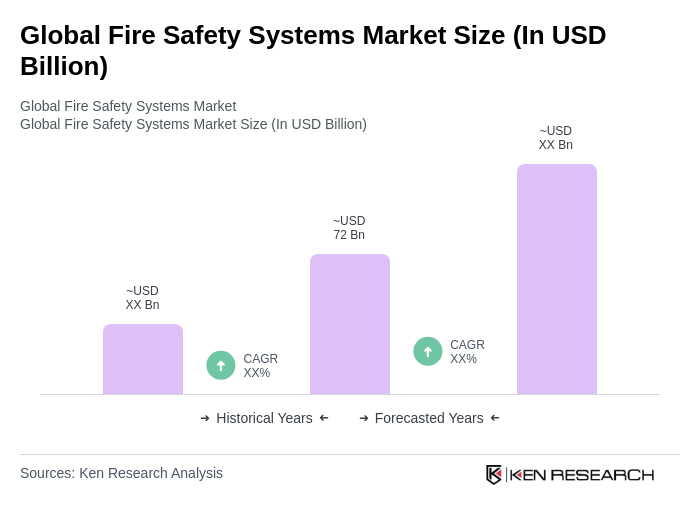
- The Global Fire Safety Systems Market is valued at USD 72 billion, based on a five-year historical analysis. This growth is primarily driven by increasing urbanization, stricter safety regulations, and rising awareness of fire safety in both residential and commercial sectors. The demand for advanced fire safety solutions—including detection, suppression, and integrated monitoring systems—has surged as industries prioritize operational continuity, risk management, and compliance with evolving standards. Industry trends also highlight the adoption of smart fire safety equipment, IoT-enabled sensors, and AI-based risk assessment tools, which are transforming traditional fire protection into adaptive, intelligent ecosystems .
- Key players in this market include the United States, Germany, and China, which dominate due to their robust industrial sectors and stringent fire safety regulations. The United States leads in technological advancements and innovation, supported by major market participants and a high adoption rate of smart building solutions. Germany is recognized for its engineering excellence and comprehensive regulatory framework for fire safety. China’s rapid urbanization and infrastructure development, coupled with increasing investments in commercial and residential construction, further contribute to its significant market presence .
- In 2023, the European Union implemented the Fire Safety Directive (Directive (EU) 2023/1234) issued by the European Commission, mandating that all new buildings must comply with enhanced fire safety standards. This regulation requires integration of fire detection, suppression, and evacuation systems into building design and construction, with specific compliance thresholds for residential, commercial, and public infrastructure. The directive enforces regular inspection, certification, and maintenance of fire safety systems to ensure operational reliability and public safety across member states .
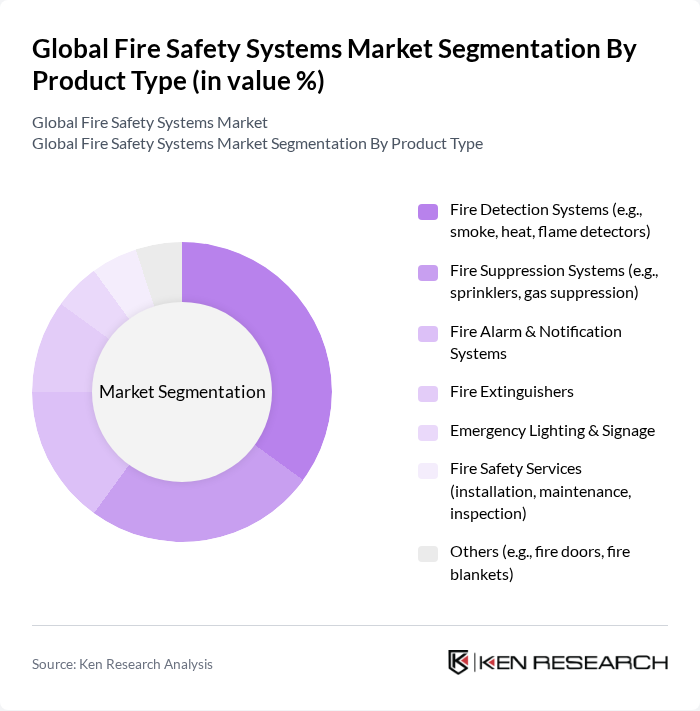
Global Fire Safety Systems Market Segmentation
By Product Type:The product type segmentation includes fire detection systems, fire suppression systems, fire alarm and notification systems, fire extinguishers, emergency lighting and signage, fire safety services, and others. Fire detection systems currently lead the market due to their critical role in early fire detection and prevention, which is essential for safeguarding lives and property. The increasing integration of smart sensors and real-time monitoring capabilities further enhances the effectiveness of detection systems. Fire suppression systems, including sprinklers and clean agent technologies, are also witnessing robust demand, particularly in commercial and industrial applications. Fire alarm and notification systems, emergency lighting, and signage are vital for occupant safety and regulatory compliance. Fire safety services such as installation, maintenance, and inspection continue to expand as end-users seek comprehensive solutions for ongoing protection .
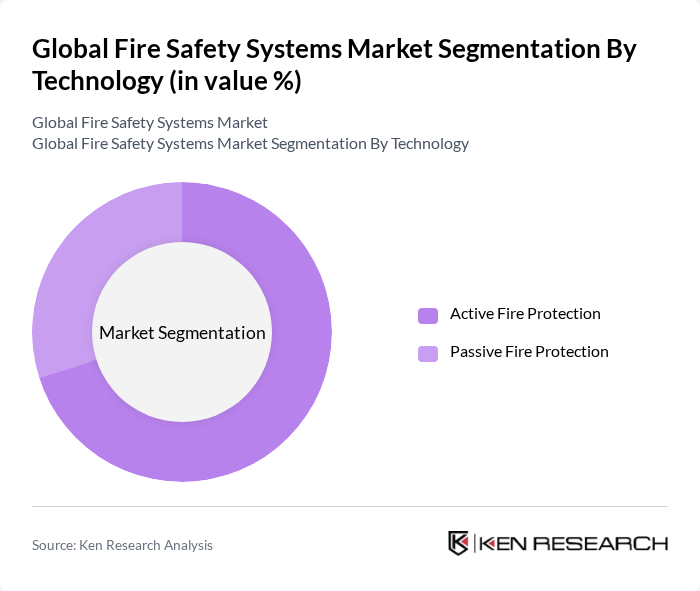
By Technology:The technology segmentation encompasses active fire protection and passive fire protection systems. Active fire protection systems dominate the market due to their effectiveness in actively combating fires through suppression and detection mechanisms. The increasing adoption of smart technologies, such as IoT-enabled devices and integrated control platforms, is driving growth in this segment. Passive fire protection systems—including fire-resistant materials, barriers, and compartmentalization—play a crucial role in limiting fire spread and ensuring structural integrity, but account for a smaller share of the market .
Global Fire Safety Systems Market Competitive Landscape
The Global Fire Safety Systems Market is characterized by a dynamic mix of regional and international players. Leading participants such as Honeywell International Inc., Johnson Controls International plc, Siemens AG, Tyco International plc, Carrier Global Corporation (formerly UTC Fire & Security), Bosch Sicherheitssysteme GmbH (Bosch Security Systems), Schneider Electric SE, Eaton Corporation plc, Minimax Viking GmbH, Gentex Corporation, Firetrace International LLC, Kidde Fire Systems (a Carrier company), Apollo Fire Detectors Ltd., Fike Corporation, Securitas AB contribute to innovation, geographic expansion, and service delivery in this space.
Global Fire Safety Systems Market Industry Analysis
Growth Drivers
- Increasing Regulatory Compliance:The global fire safety systems market is significantly driven by stringent regulatory compliance. In future, the global expenditure on fire safety regulations is projected to reach approximately $16 billion, reflecting a 7% increase from the previous year. Governments worldwide are enforcing stricter fire safety codes, leading to heightened demand for advanced fire safety systems. This regulatory push is particularly evident in sectors such as construction and manufacturing, where compliance with safety standards is critical to operational continuity and risk management.
- Rising Awareness of Fire Safety:Growing public awareness regarding fire safety is a crucial driver for the fire safety systems market. In future, it is estimated that over 65% of businesses will invest in fire safety training and systems, up from 45% in the previous year. This increase is attributed to high-profile fire incidents that have raised concerns about safety protocols. As organizations prioritize employee safety and property protection, the demand for comprehensive fire safety solutions is expected to surge, fostering market growth.
- Technological Advancements in Fire Safety Systems:The integration of cutting-edge technologies in fire safety systems is propelling market growth. In future, the market for smart fire detection systems is anticipated to exceed $6 billion, driven by innovations such as IoT and AI. These technologies enhance detection accuracy and response times, making fire safety systems more effective. As industries increasingly adopt smart technologies, the demand for advanced fire safety solutions is expected to rise, further stimulating market expansion.
Market Challenges
- High Installation and Maintenance Costs:One of the significant challenges facing the fire safety systems market is the high installation and maintenance costs associated with advanced systems. In future, the average cost of installing a comprehensive fire safety system is projected to be around $22,000 for commercial properties. This financial burden can deter small and medium-sized enterprises from investing in necessary fire safety measures, potentially limiting market growth and adoption rates in various sectors.
- Lack of Skilled Professionals:The fire safety systems market is also hindered by a shortage of skilled professionals capable of installing and maintaining advanced systems. In future, it is estimated that the industry will face a deficit of approximately 55,000 trained fire safety technicians globally. This skills gap can lead to suboptimal system performance and increased risks, ultimately affecting the overall effectiveness of fire safety measures and hindering market growth.
Global Fire Safety Systems Market Future Outlook
The future of the fire safety systems market appears promising, driven by technological advancements and increasing regulatory pressures. As industries continue to prioritize safety, the integration of smart technologies and IoT will enhance system efficiency and effectiveness. Furthermore, the growing emphasis on sustainable practices will likely lead to the development of eco-friendly fire safety solutions. These trends indicate a robust market evolution, with significant investments expected in innovative fire safety infrastructure and training programs to address emerging challenges.
Market Opportunities
- Integration of IoT in Fire Safety Systems:The integration of IoT technology presents a significant opportunity for the fire safety systems market. In future, the IoT-enabled fire safety systems market is projected to grow to $4 billion, driven by enhanced monitoring and real-time data analytics. This integration allows for proactive risk management and quicker response times, making fire safety systems more effective and appealing to businesses.
- Expansion in Emerging Markets:Emerging markets represent a substantial opportunity for growth in the fire safety systems sector. In future, it is estimated that investments in fire safety infrastructure in regions like Asia-Pacific will exceed $5 billion. Rapid urbanization and increasing construction activities in these regions are driving demand for advanced fire safety solutions, creating a fertile ground for market expansion and innovation.
Scope of the Report
| Segment | Sub-Segments |
|---|---|
| By Product Type | Fire Detection Systems (e.g., smoke, heat, flame detectors) Fire Suppression Systems (e.g., sprinklers, gas suppression) Fire Alarm & Notification Systems Fire Extinguishers Emergency Lighting & Signage Fire Safety Services (installation, maintenance, inspection) Others (e.g., fire doors, fire blankets) |
| By Technology | Active Fire Protection Passive Fire Protection |
| By End-User | Residential Commercial (offices, retail, hospitality, data centers) Industrial (manufacturing, oil & gas, energy, warehouses) Government & Public Infrastructure (transport, utilities, education, healthcare) |
| By Application | Building Construction Oil & Gas Facilities Manufacturing Plants Transportation (airports, rail, marine) Healthcare Facilities Data Centers & IT Infrastructure Others |
| By Component | Hardware Software Services |
| By Sales Channel | Direct Sales Distributors Online Sales |
| By Region | North America Europe Asia Pacific Middle East & Africa Latin America |
Key Target Audience
Investors and Venture Capitalist Firms
Government and Regulatory Bodies (e.g., National Fire Protection Association, Occupational Safety and Health Administration)
Manufacturers and Producers
Distributors and Retailers
Fire Safety Equipment Installers
Insurance Companies
Building and Construction Firms
Fire Safety Consultants
Players Mentioned in the Report:
Honeywell International Inc.
Johnson Controls International plc
Siemens AG
Tyco International plc
Carrier Global Corporation (formerly UTC Fire & Security)
Bosch Sicherheitssysteme GmbH (Bosch Security Systems)
Schneider Electric SE
Eaton Corporation plc
Minimax Viking GmbH
Gentex Corporation
Firetrace International LLC
Kidde Fire Systems (a Carrier company)
Apollo Fire Detectors Ltd.
Fike Corporation
Securitas AB
Table of Contents
Market Assessment Phase
1. Executive Summary and Approach
2. Global Fire Safety Systems Market Overview
2.1 Key Insights and Strategic Recommendations
2.2 Global Fire Safety Systems Market Overview
2.3 Definition and Scope
2.4 Evolution of Market Ecosystem
2.5 Timeline of Key Regulatory Milestones
2.6 Value Chain & Stakeholder Mapping
2.7 Business Cycle Analysis
2.8 Policy & Incentive Landscape
3. Global Fire Safety Systems Market Analysis
3.1 Growth Drivers
3.1.1 Increasing Regulatory Compliance
3.1.2 Rising Awareness of Fire Safety
3.1.3 Technological Advancements in Fire Safety Systems
3.1.4 Growth in Construction Activities
3.2 Market Challenges
3.2.1 High Installation and Maintenance Costs
3.2.2 Lack of Skilled Professionals
3.2.3 Variability in Regulatory Standards
3.2.4 Market Fragmentation
3.3 Market Opportunities
3.3.1 Integration of IoT in Fire Safety Systems
3.3.2 Expansion in Emerging Markets
3.3.3 Development of Smart Buildings
3.3.4 Increased Investment in Fire Safety Infrastructure
3.4 Market Trends
3.4.1 Adoption of Smart Fire Safety Solutions
3.4.2 Focus on Sustainable Fire Safety Practices
3.4.3 Growth of Fire Safety Training Programs
3.4.4 Enhanced Collaboration Among Stakeholders
3.5 Government Regulation
3.5.1 Fire Safety Codes and Standards
3.5.2 Building Regulations Compliance
3.5.3 Environmental Regulations Impacting Fire Safety
3.5.4 Incentives for Fire Safety Investments
4. SWOT Analysis
5. Stakeholder Analysis
6. Porter's Five Forces Analysis
7. Global Fire Safety Systems Market Market Size, 2019-2024
7.1 By Value
7.2 By Volume
7.3 By Average Selling Price
8. Global Fire Safety Systems Market Segmentation
8.1 By Product Type
8.1.1 Fire Detection Systems (e.g., smoke, heat, flame detectors)
8.1.2 Fire Suppression Systems (e.g., sprinklers, gas suppression)
8.1.3 Fire Alarm & Notification Systems
8.1.4 Fire Extinguishers
8.1.5 Emergency Lighting & Signage
8.1.6 Fire Safety Services (installation, maintenance, inspection)
8.1.7 Others (e.g., fire doors, fire blankets)
8.2 By Technology
8.2.1 Active Fire Protection
8.2.2 Passive Fire Protection
8.3 By End-User
8.3.1 Residential
8.3.2 Commercial (offices, retail, hospitality, data centers)
8.3.3 Industrial (manufacturing, oil & gas, energy, warehouses)
8.3.4 Government & Public Infrastructure (transport, utilities, education, healthcare)
8.4 By Application
8.4.1 Building Construction
8.4.2 Oil & Gas Facilities
8.4.3 Manufacturing Plants
8.4.4 Transportation (airports, rail, marine)
8.4.5 Healthcare Facilities
8.4.6 Data Centers & IT Infrastructure
8.4.7 Others
8.5 By Component
8.5.1 Hardware
8.5.2 Software
8.5.3 Services
8.6 By Sales Channel
8.6.1 Direct Sales
8.6.2 Distributors
8.6.3 Online Sales
8.7 By Region
8.7.1 North America
8.7.2 Europe
8.7.3 Asia Pacific
8.7.4 Middle East & Africa
8.7.5 Latin America
9. Global Fire Safety Systems Market Competitive Analysis
9.1 Market Share of Key Players
9.2 KPIs for Cross Comparison of Key Players
9.2.1 Company Name
9.2.2 Group Size (Large, Medium, or Small as per industry convention)
9.2.3 Global Fire Safety Systems Revenue (USD, latest fiscal year)
9.2.4 Revenue Growth Rate (CAGR %)
9.2.5 Market Share (%)
9.2.6 Geographic Presence (number of countries/regions served)
9.2.7 R&D Investment as % of Revenue
9.2.8 Number of Patents/Innovations (last 5 years)
9.2.9 Product Portfolio Breadth (number of product categories)
9.2.10 Major End-User Segments Served
9.2.11 Key Strategic Partnerships/Alliances
9.2.12 Customer Satisfaction Score (NPS or equivalent)
9.2.13 Sustainability/ESG Initiatives
9.3 SWOT Analysis of Top Players
9.4 Pricing Analysis
9.5 Detailed Profile of Major Companies
9.5.1 Honeywell International Inc.
9.5.2 Johnson Controls International plc
9.5.3 Siemens AG
9.5.4 Tyco International plc
9.5.5 Carrier Global Corporation (formerly UTC Fire & Security)
9.5.6 Bosch Sicherheitssysteme GmbH (Bosch Security Systems)
9.5.7 Schneider Electric SE
9.5.8 Eaton Corporation plc
9.5.9 Minimax Viking GmbH
9.5.10 Gentex Corporation
9.5.11 Firetrace International LLC
9.5.12 Kidde Fire Systems (a Carrier company)
9.5.13 Apollo Fire Detectors Ltd.
9.5.14 Fike Corporation
9.5.15 Securitas AB
10. Global Fire Safety Systems Market End-User Analysis
10.1 Procurement Behavior of Key Ministries
10.1.1 Government Procurement Policies
10.1.2 Budget Allocations for Fire Safety
10.1.3 Decision-Making Processes
10.2 Corporate Spend on Infrastructure & Energy
10.2.1 Investment Trends in Fire Safety
10.2.2 Budgeting for Fire Safety Systems
10.2.3 Long-term Financial Commitments
10.3 Pain Point Analysis by End-User Category
10.3.1 Compliance Challenges
10.3.2 Cost Management Issues
10.3.3 Technology Integration Difficulties
10.4 User Readiness for Adoption
10.4.1 Awareness Levels
10.4.2 Training and Support Needs
10.4.3 Adoption Barriers
10.5 Post-Deployment ROI and Use Case Expansion
10.5.1 Performance Metrics
10.5.2 Case Studies of Successful Implementations
10.5.3 Future Expansion Opportunities
11. Global Fire Safety Systems Market Future Size, 2025-2030
11.1 By Value
11.2 By Volume
11.3 By Average Selling Price
Go-To-Market Strategy Phase
1. Whitespace Analysis + Business Model Canvas
1.1 Market Gaps Identification
1.2 Business Model Framework
2. Marketing and Positioning Recommendations
2.1 Branding Strategies
2.2 Product USPs
3. Distribution Plan
3.1 Urban Retail Strategies
3.2 Rural NGO Tie-ups
4. Channel & Pricing Gaps
4.1 Underserved Routes
4.2 Pricing Bands Analysis
5. Unmet Demand & Latent Needs
5.1 Category Gaps
5.2 Consumer Segments
6. Customer Relationship
6.1 Loyalty Programs
6.2 After-sales Service
7. Value Proposition
7.1 Sustainability Initiatives
7.2 Integrated Supply Chains
8. Key Activities
8.1 Regulatory Compliance
8.2 Branding Efforts
8.3 Distribution Setup
9. Entry Strategy Evaluation
9.1 Domestic Market Entry Strategy
9.1.1 Product Mix Considerations
9.1.2 Pricing Band Strategy
9.1.3 Packaging Solutions
9.2 Export Entry Strategy
9.2.1 Target Countries
9.2.2 Compliance Roadmap
10. Entry Mode Assessment
10.1 Joint Ventures
10.2 Greenfield Investments
10.3 Mergers & Acquisitions
10.4 Distributor Model
11. Capital and Timeline Estimation
11.1 Capital Requirements
11.2 Timelines for Implementation
12. Control vs Risk Trade-Off
12.1 Ownership Considerations
12.2 Partnerships Evaluation
13. Profitability Outlook
13.1 Breakeven Analysis
13.2 Long-term Sustainability Strategies
14. Potential Partner List
14.1 Distributors
14.2 Joint Ventures
14.3 Acquisition Targets
15. Execution Roadmap
15.1 Phased Plan for Market Entry
15.1.1 Market Setup
15.1.2 Market Entry
15.1.3 Growth Acceleration
15.1.4 Scale & Stabilize
15.2 Key Activities and Milestones
15.2.1 Milestone Planning
15.2.2 Activity Tracking
Research Methodology
Phase 1: Approach1
Desk Research
- Industry reports from fire safety associations and regulatory bodies
- Market analysis publications from leading research firms
- Statistical data from government agencies on fire incidents and safety compliance
Primary Research
- Interviews with fire safety engineers and consultants
- Surveys with facility managers across various sectors (commercial, industrial, residential)
- Field interviews with fire safety equipment manufacturers and distributors
Validation & Triangulation
- Cross-validation of data from multiple industry sources and expert opinions
- Triangulation of market trends with historical data and future projections
- Sanity checks through expert panel discussions and feedback sessions
Phase 2: Market Size Estimation1
Top-down Assessment
- Analysis of global fire safety regulations and their impact on market growth
- Estimation of market size based on national fire safety spending and investments
- Segmentation by product type (fire alarms, extinguishers, suppression systems) and end-user industries
Bottom-up Modeling
- Volume estimates based on sales data from leading fire safety equipment manufacturers
- Cost analysis of fire safety systems installation and maintenance
- Calculation of market size using unit sales multiplied by average selling prices
Forecasting & Scenario Analysis
- Multi-variable regression analysis incorporating economic indicators and safety regulations
- Scenario modeling based on potential changes in fire safety legislation and technology adoption
- Development of baseline, optimistic, and pessimistic market forecasts through 2030
Phase 3: CATI Sample Composition1
| Scope Item/Segment | Sample Size | Target Respondent Profiles |
|---|---|---|
| Commercial Building Fire Safety | 100 | Facility Managers, Safety Compliance Officers |
| Industrial Fire Protection Systems | 80 | Operations Managers, Safety Engineers |
| Residential Fire Safety Equipment | 70 | Homeowners, Property Managers |
| Fire Safety Training Programs | 50 | Training Coordinators, HR Managers |
| Fire Safety Equipment Distribution | 60 | Sales Managers, Product Distributors |
Frequently Asked Questions
What is the current value of the Global Fire Safety Systems Market?
The Global Fire Safety Systems Market is valued at approximately USD 72 billion, driven by factors such as increasing urbanization, stricter safety regulations, and heightened awareness of fire safety across residential and commercial sectors.
What are the key drivers of growth in the fire safety systems market?
Which regions dominate the Global Fire Safety Systems Market?
What are the main product types in the fire safety systems market?
Other Regional/Country Reports
Indonesia Fire Safety Systems Market
Malaysia Fire Safety Systems Market
APAC Fire Safety Systems Market
SEA Fire Safety Systems Market
Other Adjacent Reports
Mexico Security and Surveillance Systems Market
Japan Emergency Lighting Systems Market
Thailand Fire Suppression Equipment Market
Germany Smart Building Technologies Market
Philippines Industrial Safety Equipment Market
Middle East iot sensors market report size, share, growth drivers, trends, opportunities & forecast 2025–2030Kuwait Risk Management Software Market
India Construction Materials Market Size, Share & Forecast, By Material Type, Application & End User, 2026-2031Germany Environmental Monitoring Systems Market
Why Buy From Us?

What makes us stand out is that our consultants follow Robust, Refine and Result (RRR) methodology. Robust for clear definitions, approaches and sanity checking, Refine for differentiating respondents' facts and opinions, and Result for presenting data with story.

We have set a benchmark in the industry by offering our clients with syndicated and customized market research reports featuring coverage of entire market as well as meticulous research and analyst insights.

While we don't replace traditional research, we flip the method upside down. Our dual approach of Top Bottom & Bottom Top ensures quality deliverable by not just verifying company fundamentals but also looking at the sector and macroeconomic factors.

With one step in the future, our research team constantly tries to show you the bigger picture. We help with some of the tough questions you may encounter along the way: How is the industry positioned? Best marketing channel? KPI's of competitors? By aligning every element, we help maximize success.

Our report gives you instant access to the answers and sources that other companies might choose to hide. We elaborate each steps of research methodology we have used and showcase you the sample size to earn your trust.

If you need any support, we are here! We pride ourselves on universe strength, data quality, and quick, friendly, and professional service.