About the Report
Base Year 2024Global Food 3D Printing Market Overview
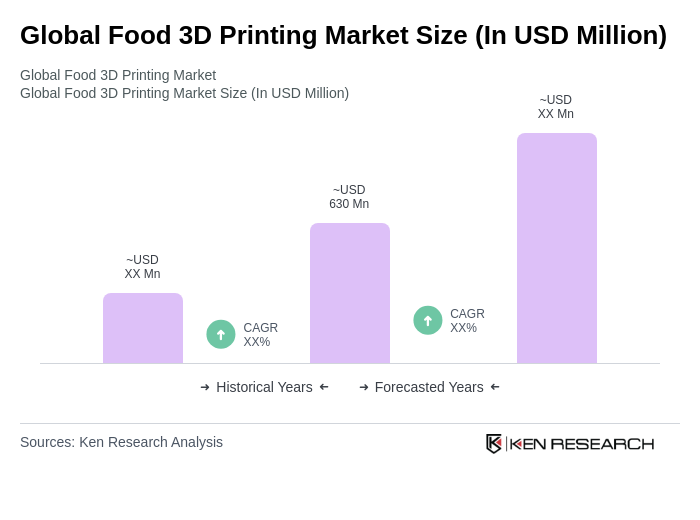
- The Global Food 3D Printing Market is valued at USD 630 million, based on a five-year historical analysis. This growth is primarily driven by advancements in 3D printing technology, increasing consumer demand for personalized nutrition, and the rising trend of sustainable food production methods. The integration of 3D printing technology in food manufacturing is revolutionizing the industry, enabling innovative designs, customized nutritional profiles, and reduced food waste through precise ingredient use .
- Key players in this market include the United States, Germany, and China, which dominate due to their robust technological infrastructure, significant investments in research and development, and a growing consumer base interested in novel food experiences. The presence of leading food manufacturers and technology companies in these regions further strengthens their market position .
- The European Union’s Regulation (EU) 2017/625 on official controls, issued by the European Parliament and the Council, establishes binding requirements for food business operators, including those using 3D printing technology. This regulation mandates compliance with hygiene standards, traceability, and food safety protocols for all food production processes, including innovative manufacturing such as 3D printing, ensuring consumer protection and high product quality .
Global Food 3D Printing Market Segmentation
By Technology:The technology segment includes various methods used in food 3D printing, such as extrusion-based printing, binder jetting, selective laser sintering (SLS), inkjet printing, and others. Among these, extrusion-based printing is the most widely adopted due to its versatility and ability to process a broad range of food materials. The demand for customized food products and the technology’s suitability for commercial kitchens and bakeries have led to increased investments in extrusion-based systems, making it the leading technology in the market .

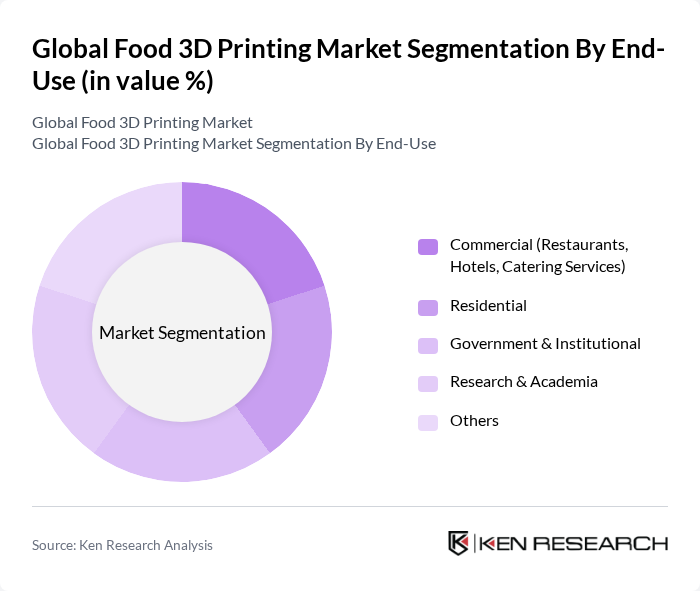
By End-Use:The end-use segment covers commercial (restaurants, hotels, catering services), residential, government & institutional, research & academia, and others. The commercial segment is the largest, driven by the hospitality industry’s adoption of 3D printing for personalized dining experiences, innovative food presentation, and menu differentiation. Restaurants and catering services are increasingly utilizing 3D food printers to create intricate, customized dishes that enhance customer engagement and brand identity .
Global Food 3D Printing Market Competitive Landscape
The Global Food 3D Printing Market is characterized by a dynamic mix of regional and international players. Leading participants such as 3D Systems Corporation, Natural Machines (Foodini), BeeHex, Print2Taste (mycusini), Redefine Meat, TNO (Netherlands Organisation for Applied Scientific Research), ByFlow, Barilla Group, SavorEat, Novameat, Choc Edge, Brill Inc. (a CSM Bakery Solutions company), Nestlé, Unilever, Cargill contribute to innovation, geographic expansion, and service delivery in this space.
Global Food 3D Printing Market Industry Analysis
Growth Drivers
- Increasing Demand for Customization:The food industry is witnessing a significant shift towards personalized dining experiences, with 70% of consumers expressing interest in customized food options. This trend is driven by the growing consumer preference for unique flavors and dietary needs, leading to an increase in demand for 3D printed food solutions. The customization trend is expected to contribute to a projected increase in the food 3D printing market, with an estimated value of $2.5 billion in future, according to industry reports.
- Advancements in 3D Printing Technology:Technological innovations in 3D printing are enhancing the capabilities of food production. In future, the global investment in 3D printing technology is expected to reach $15 billion, facilitating the development of more efficient and versatile food printers. These advancements allow for the creation of complex food structures and textures, appealing to both consumers and chefs. As a result, the market is likely to expand, driven by improved product offerings and operational efficiencies.
- Rising Interest in Sustainable Food Production:Sustainability is becoming a critical focus in food production, with 80% of consumers willing to pay more for sustainably produced food. The food 3D printing market is positioned to capitalize on this trend by reducing food waste and utilizing alternative ingredients. In future, the global market for sustainable food is projected to reach $1.5 trillion, creating a favorable environment for 3D printing technologies that align with eco-friendly practices and consumer preferences.
Market Challenges
- High Initial Investment Costs:The adoption of food 3D printing technology requires substantial upfront investments, often exceeding $150,000 for advanced printers. This financial barrier limits access for small and medium-sized enterprises (SMEs) in the food sector. As a result, many potential users are hesitant to invest, slowing the overall market growth. In future, it is estimated that only 25% of food businesses will have adopted 3D printing technology due to these cost constraints.
- Regulatory Compliance Issues:Navigating the complex landscape of food safety regulations poses a significant challenge for the food 3D printing market. In future, it is anticipated that compliance costs could reach $7 billion globally, as companies must adhere to stringent food safety standards. This regulatory burden can deter innovation and slow market entry for new players, impacting the overall growth of the food 3D printing sector.
Global Food 3D Printing Market Future Outlook
The future of the food 3D printing market appears promising, driven by technological advancements and evolving consumer preferences. As the market matures, we can expect increased collaboration between food technologists and culinary experts, leading to innovative product offerings. Additionally, the integration of artificial intelligence in food design and production processes will enhance customization and efficiency. These trends will likely foster a more dynamic market environment, encouraging further investment and development in the sector.
Market Opportunities
- Expansion into Emerging Markets:Emerging markets present significant growth opportunities for food 3D printing, with a projected increase in food demand by 60% in future. Countries like India and Brazil are investing heavily in food technology, creating a favorable environment for 3D printing solutions that cater to local tastes and preferences, thus enhancing market penetration.
- Development of New Food Materials:The exploration of novel food materials, such as plant-based and alternative proteins, is a key opportunity for the food 3D printing market. With the global plant-based food market expected to reach $100 billion in future, companies can leverage 3D printing technology to create innovative products that meet the rising consumer demand for healthier and sustainable food options.
Scope of the Report
| Segment | Sub-Segments |
|---|---|
| By Technology | Extrusion-Based Printing Binder Jetting Selective Laser Sintering (SLS) Inkjet Printing Others |
| By End-Use | Commercial (Restaurants, Hotels, Catering Services) Residential Government & Institutional Research & Academia Others |
| By Application | Customized Food Products Prototyping and R&D Food Decoration Nutritional Customization Others |
| By Ingredient/Material Type | Chocolate & Confectionery Dough & Bakery Dairy Products Fruits & Vegetables Meat & Alternative Proteins Others |
| By Component | Hardware Software Services |
| By Distribution Channel | Direct Sales Online Retail Distributors Trade Shows Others |
| By Region | North America Europe Asia-Pacific Latin America Middle East & Africa |
Key Target Audience
Investors and Venture Capitalist Firms
Government and Regulatory Bodies (e.g., Food and Drug Administration, European Food Safety Authority)
Manufacturers and Producers of 3D Food Printers
Food Technology Startups
Food Processing Companies
Ingredient Suppliers
Food Safety and Quality Assurance Organizations
Logistics and Supply Chain Management Firms
Players Mentioned in the Report:
3D Systems Corporation
Natural Machines (Foodini)
BeeHex
Print2Taste (mycusini)
Redefine Meat
TNO (Netherlands Organisation for Applied Scientific Research)
ByFlow
Barilla Group
SavorEat
Novameat
Choc Edge
Brill Inc. (a CSM Bakery Solutions company)
Nestle
Unilever
Cargill
Table of Contents
Market Assessment Phase
1. Executive Summary and Approach
2. Global Food 3D Printing Market Overview
2.1 Key Insights and Strategic Recommendations
2.2 Global Food 3D Printing Market Overview
2.3 Definition and Scope
2.4 Evolution of Market Ecosystem
2.5 Timeline of Key Regulatory Milestones
2.6 Value Chain & Stakeholder Mapping
2.7 Business Cycle Analysis
2.8 Policy & Incentive Landscape
3. Global Food 3D Printing Market Analysis
3.1 Growth Drivers
3.1.1 Increasing Demand for Customization
3.1.2 Advancements in 3D Printing Technology
3.1.3 Rising Interest in Sustainable Food Production
3.1.4 Growth in the Food Industry's R&D Investments
3.2 Market Challenges
3.2.1 High Initial Investment Costs
3.2.2 Regulatory Compliance Issues
3.2.3 Limited Consumer Awareness
3.2.4 Technical Limitations of Current Technologies
3.3 Market Opportunities
3.3.1 Expansion into Emerging Markets
3.3.2 Development of New Food Materials
3.3.3 Collaborations with Culinary Experts
3.3.4 Integration with Smart Kitchen Technologies
3.4 Market Trends
3.4.1 Increasing Use of Plant-Based Ingredients
3.4.2 Growth of On-Demand Food Printing Services
3.4.3 Rise of Personalized Nutrition
3.4.4 Adoption of AI in Food 3D Printing
3.5 Government Regulation
3.5.1 Food Safety Standards Compliance
3.5.2 Intellectual Property Regulations
3.5.3 Environmental Impact Assessments
3.5.4 Labeling and Transparency Requirements
4. SWOT Analysis
5. Stakeholder Analysis
6. Porter's Five Forces Analysis
7. Global Food 3D Printing Market Market Size, 2019-2024
7.1 By Value
7.2 By Volume
7.3 By Average Selling Price
8. Global Food 3D Printing Market Segmentation
8.1 By Technology
8.1.1 Extrusion-Based Printing
8.1.2 Binder Jetting
8.1.3 Selective Laser Sintering (SLS)
8.1.4 Inkjet Printing
8.1.5 Others
8.2 By End-Use
8.2.1 Commercial (Restaurants, Hotels, Catering Services)
8.2.2 Residential
8.2.3 Government & Institutional
8.2.4 Research & Academia
8.2.5 Others
8.3 By Application
8.3.1 Customized Food Products
8.3.2 Prototyping and R&D
8.3.3 Food Decoration
8.3.4 Nutritional Customization
8.3.5 Others
8.4 By Ingredient/Material Type
8.4.1 Chocolate & Confectionery
8.4.2 Dough & Bakery
8.4.3 Dairy Products
8.4.4 Fruits & Vegetables
8.4.5 Meat & Alternative Proteins
8.4.6 Others
8.5 By Component
8.5.1 Hardware
8.5.2 Software
8.5.3 Services
8.6 By Distribution Channel
8.6.1 Direct Sales
8.6.2 Online Retail
8.6.3 Distributors
8.6.4 Trade Shows
8.6.5 Others
8.7 By Region
8.7.1 North America
8.7.2 Europe
8.7.3 Asia-Pacific
8.7.4 Latin America
8.7.5 Middle East & Africa
9. Global Food 3D Printing Market Competitive Analysis
9.1 Market Share of Key Players
9.2 KPIs for Cross Comparison of Key Players
9.2.1 Company Name
9.2.2 Technology Portfolio Breadth
9.2.3 Revenue from Food 3D Printing Segment
9.2.4 Installed Base of Food 3D Printers
9.2.5 Geographic Presence
9.2.6 R&D Intensity (% of Revenue)
9.2.7 Number of Patents/Intellectual Property
9.2.8 Product Launch Frequency
9.2.9 Strategic Partnerships/Collaborations
9.2.10 Customer Segments Served
9.2.11 Sustainability Initiatives
9.3 SWOT Analysis of Top Players
9.4 Pricing Analysis
9.5 Detailed Profile of Major Companies
9.5.1 3D Systems Corporation
9.5.2 Natural Machines (Foodini)
9.5.3 BeeHex
9.5.4 Print2Taste (mycusini)
9.5.5 Redefine Meat
9.5.6 TNO (Netherlands Organisation for Applied Scientific Research)
9.5.7 ByFlow
9.5.8 Barilla Group
9.5.9 SavorEat
9.5.10 Novameat
9.5.11 Choc Edge
9.5.12 Brill Inc. (a CSM Bakery Solutions company)
9.5.13 Nestlé
9.5.14 Unilever
9.5.15 Cargill
10. Global Food 3D Printing Market End-User Analysis
10.1 Procurement Behavior of Key Ministries
10.1.1 Government Food Programs
10.1.2 Research Grants for Food Technology
10.1.3 Public Health Initiatives
10.2 Corporate Spend on Infrastructure & Energy
10.2.1 Investment in 3D Printing Facilities
10.2.2 Energy Efficiency Programs
10.2.3 Sustainability Initiatives
10.3 Pain Point Analysis by End-User Category
10.3.1 Cost of Implementation
10.3.2 Technical Support Needs
10.3.3 Training and Skill Development
10.4 User Readiness for Adoption
10.4.1 Awareness of 3D Printing Benefits
10.4.2 Availability of Resources
10.4.3 Willingness to Experiment with New Technologies
10.5 Post-Deployment ROI and Use Case Expansion
10.5.1 Measurement of Cost Savings
10.5.2 Customer Feedback and Adaptation
10.5.3 Potential for New Product Lines
11. Global Food 3D Printing Market Future Size, 2025-2030
11.1 By Value
11.2 By Volume
11.3 By Average Selling Price
Go-To-Market Strategy Phase
1. Whitespace Analysis + Business Model Canvas
1.1 Market Gaps Identification
1.2 Value Proposition Development
1.3 Revenue Streams Analysis
1.4 Key Partnerships Exploration
1.5 Cost Structure Assessment
1.6 Customer Segmentation
1.7 Channels of Distribution
2. Marketing and Positioning Recommendations
2.1 Branding Strategies
2.2 Product USPs
3. Distribution Plan
3.1 Urban Retail vs Rural NGO Tie-ups
4. Channel & Pricing Gaps
4.1 Underserved Routes
4.2 Pricing Bands
5. Unmet Demand & Latent Needs
5.1 Category Gaps
5.2 Consumer Segments
6. Customer Relationship
6.1 Loyalty Programs
6.2 After-sales Service
7. Value Proposition
7.1 Sustainability
7.2 Integrated Supply Chains
8. Key Activities
8.1 Regulatory Compliance
8.2 Branding
8.3 Distribution Setup
9. Entry Strategy Evaluation
9.1 Domestic Market Entry Strategy
9.1.1 Product Mix
9.1.2 Pricing Band
9.1.3 Packaging
9.2 Export Entry Strategy
9.2.1 Target Countries
9.2.2 Compliance Roadmap
10. Entry Mode Assessment
10.1 JV
10.2 Greenfield
10.3 M&A
10.4 Distributor Model
11. Capital and Timeline Estimation
11.1 Capital Requirements
11.2 Timelines
12. Control vs Risk Trade-Off
12.1 Ownership vs Partnerships
13. Profitability Outlook
13.1 Breakeven Analysis
13.2 Long-term Sustainability
14. Potential Partner List
14.1 Distributors
14.2 JVs
14.3 Acquisition Targets
15. Execution Roadmap
15.1 Phased Plan for Market Entry
15.1.1 Market Setup
15.1.2 Market Entry
15.1.3 Growth Acceleration
15.1.4 Scale & Stabilize
15.2 Key Activities and Milestones
15.2.1 Activity Planning
15.2.2 Milestone Tracking
Research Methodology
Phase 1: Approach1
Desk Research
- Industry reports from food technology journals and market research publications
- Analysis of patents related to 3D food printing technologies
- Government publications on food safety regulations and standards
Primary Research
- Interviews with food technologists and 3D printing experts
- Surveys with chefs and culinary innovators using 3D printing
- Focus groups with consumers to gauge acceptance of 3D printed food
Validation & Triangulation
- Cross-validation of findings with industry expert panels
- Triangulation of data from academic studies and market trends
- Sanity checks through comparison with historical market data
Phase 2: Market Size Estimation1
Top-down Assessment
- Estimation of market size based on global food industry revenue
- Segmentation by application areas such as restaurants, home kitchens, and food manufacturing
- Incorporation of trends in personalized nutrition and sustainable food production
Bottom-up Modeling
- Volume estimates from leading 3D food printing companies
- Cost analysis based on material usage and operational expenses
- Market penetration rates derived from consumer adoption studies
Forecasting & Scenario Analysis
- Multi-variable forecasting using technological advancements and consumer behavior shifts
- Scenario analysis based on regulatory changes and market entry of new players
- Projections for market growth through 2030 under various economic conditions
Phase 3: CATI Sample Composition1
| Scope Item/Segment | Sample Size | Target Respondent Profiles |
|---|---|---|
| Restaurant Industry Adoption | 100 | Restaurant Owners, Executive Chefs |
| Home Kitchen Users | 60 | Home Cooks, Culinary Enthusiasts |
| Food Manufacturing Sector | 50 | Production Managers, R&D Specialists |
| Consumer Acceptance Studies | 90 | General Consumers, Health-Conscious Individuals |
| Food Technology Experts | 40 | Food Scientists, Technology Innovators |
Frequently Asked Questions
What is the current value of the Global Food 3D Printing Market?
The Global Food 3D Printing Market is valued at approximately USD 630 million, driven by advancements in technology, consumer demand for personalized nutrition, and sustainable food production methods.
What are the key drivers of growth in the Food 3D Printing Market?
Which regions dominate the Global Food 3D Printing Market?
What technologies are used in food 3D printing?
Other Regional/Country Reports
Indonesia Food 3D Printing Market
Malaysia Food 3D Printing Market
APAC Food 3D Printing Market
SEA Food 3D Printing Market
Why Buy From Us?

What makes us stand out is that our consultants follow Robust, Refine and Result (RRR) methodology. Robust for clear definitions, approaches and sanity checking, Refine for differentiating respondents' facts and opinions, and Result for presenting data with story.

We have set a benchmark in the industry by offering our clients with syndicated and customized market research reports featuring coverage of entire market as well as meticulous research and analyst insights.

While we don't replace traditional research, we flip the method upside down. Our dual approach of Top Bottom & Bottom Top ensures quality deliverable by not just verifying company fundamentals but also looking at the sector and macroeconomic factors.

With one step in the future, our research team constantly tries to show you the bigger picture. We help with some of the tough questions you may encounter along the way: How is the industry positioned? Best marketing channel? KPI's of competitors? By aligning every element, we help maximize success.

Our report gives you instant access to the answers and sources that other companies might choose to hide. We elaborate each steps of research methodology we have used and showcase you the sample size to earn your trust.

If you need any support, we are here! We pride ourselves on universe strength, data quality, and quick, friendly, and professional service.