About the Report
Base Year 2024Global Fuel Cell UAV Market Overview
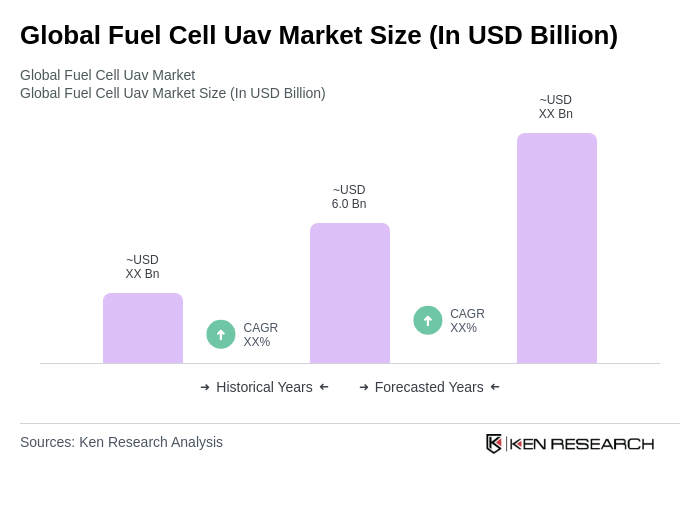
- The Global Fuel Cell UAV Market is valued at USD 6.0 billion, based on a five-year historical analysis. This growth is primarily driven by advancements in hydrogen fuel cell stacks enabling multi-hour endurance, rising demand for low-emission UAV operations, and expanding long-endurance use cases across defense ISR, industrial inspection, logistics, and public safety.
- Key players in this market include the United States, Germany, and Japan, supported by strong aerospace ecosystems, active hydrogen funding programs, and UAV regulatory testbeds; North America currently leads the market by share, with meaningful contributions from Europe (notably Germany) and Asia (including Japan) in fuel cell innovation and deployment.
- In 2023, the U.S. government did not mandate federal agencies to prioritize procurement of hydrogen fuel cell–powered UAVs. U.S. policy activity has broadly promoted hydrogen and clean energy across sectors (e.g., IRA/H2Hubs), but there is no federal requirement specific to fuel cell UAV procurement.
Global Fuel Cell UAV Market Segmentation
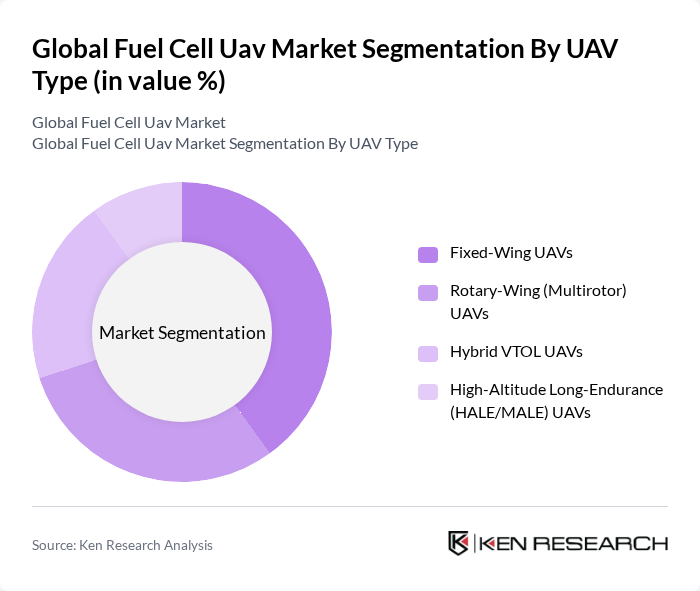
By UAV Type:The UAV type segmentation includes Fixed-Wing UAVs, Rotary-Wing (Multirotor) UAVs, Hybrid VTOL UAVs, and High-Altitude Long-Endurance (HALE/MALE) UAVs. Each type serves distinct operational needs, with Fixed-Wing UAVs being favored for long-range missions due to superior lift-to-drag and endurance; Rotary-Wing UAVs are preferred for maneuverability and vertical takeoff/landing in confined sites; Hybrid VTOL UAVs combine runway-free VTOL with efficient wing-borne cruise for versatile missions; HALE/MALE platforms are used for persistent ISR where long endurance is critical. Market analyses for fuel cell UAVs commonly segment by fixed-wing, rotary-wing, and hybrid VTOL; HALE/MALE fuel cell adoption is emergent and generally concentrated in long-endurance ISR and demonstration programs.
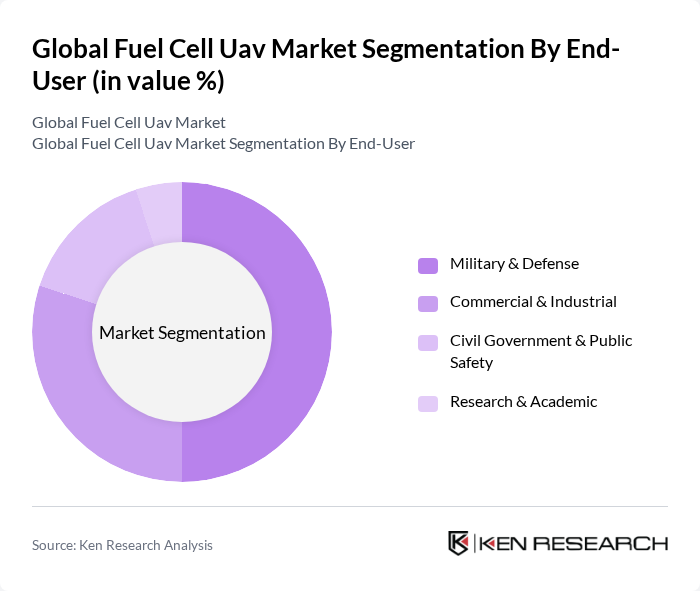
By End-User:The end-user segmentation encompasses Military & Defense, Commercial & Industrial, Civil Government & Public Safety, and Research & Academic sectors. The Military & Defense segment is the largest, reflecting adoption for long-endurance ISR and communications relay; Commercial & Industrial demand is growing in energy, utilities, and infrastructure inspection where multi-hour flights cut downtime; Civil Government & Public Safety employ fuel cell UAVs for disaster response and wide-area monitoring; Research & Academic users focus on hydrogen system integration and endurance testing. Published market structures consistently cite Military & Defense, Commercial & Industrial, and Civil/Government as primary end uses for fuel cell UAVs.
Global Fuel Cell UAV Market Competitive Landscape
The Global Fuel Cell UAV Market is characterized by a dynamic mix of regional and international players. Leading participants such as Doosan Mobility Innovation (DMI), Ballard Power Systems Inc., Intelligent Energy Ltd., H3 Dynamics, Protonex LLC (a Ballard company), Plug Power Inc. (Energy Vault/ProGen for UAV), Elbit Systems Ltd., AeroVironment Inc., Aurora Flight Sciences (a Boeing Company), JOUAV (Chengdu JOUAV Automation Tech Co., Ltd.), MMC UAV (MicroMultiCopter Aero Technology), HyPoint, Inc., Horizon Fuel Cell Technologies, Hylium Industries Inc., Honeywell Aerospace contribute to innovation, geographic expansion, and service delivery in this space.
Global Fuel Cell Uav Market Industry Analysis
Growth Drivers
- Increasing Demand for Sustainable Aviation:The global push for sustainable aviation is driving the fuel cell UAV market. In the future, the aviation sector is projected to contribute approximately $1.5 trillion to the global economy, with a significant portion allocated to green technologies. The International Air Transport Association (IATA) anticipates that by the future, 30% of all aviation fuel will be sustainable, creating a robust demand for fuel cell UAVs that align with these environmental goals.
- Advancements in Fuel Cell Technology:Technological innovations in fuel cell systems are enhancing performance and efficiency. In the future, the global fuel cell market is expected to reach $50 billion, with significant investments in research and development. Companies like Ballard Power Systems are developing fuel cells that can operate at higher efficiencies, with power outputs exceeding 200 kW, making them suitable for various UAV applications, thus driving market growth.
- Government Support and Funding:Governments worldwide are increasingly investing in clean technology initiatives. In the future, the U.S. government plans to allocate $3 billion for clean energy projects, including fuel cell technologies. This funding is expected to stimulate research and development, leading to enhanced fuel cell UAV capabilities. Additionally, countries like Germany and Japan are implementing policies that promote the adoption of fuel cell technologies, further supporting market expansion.
Market Challenges
- High Initial Investment Costs:The high upfront costs associated with fuel cell UAVs pose a significant barrier to market entry. In the future, the average cost of a fuel cell UAV is estimated to be around $300,000, compared to $120,000 for conventional UAVs. This price disparity can deter potential buyers, particularly in cost-sensitive sectors such as agriculture and logistics, limiting market penetration and growth.
- Limited Infrastructure for Fuel Cell Refueling:The lack of refueling infrastructure for fuel cell UAVs is a critical challenge. As of the future, there are only 500 hydrogen refueling stations globally, primarily concentrated in Europe and North America. This limited availability restricts operational capabilities and increases logistical complexities for operators, hindering the widespread adoption of fuel cell UAV technologies in various industries.
Global Fuel Cell Uav Market Future Outlook
The future of the fuel cell UAV market appears promising, driven by technological advancements and increasing environmental awareness. As governments implement stricter emission regulations, the demand for cleaner aviation solutions will rise. Additionally, the integration of AI and machine learning into UAV operations is expected to enhance efficiency and operational capabilities. These trends indicate a shift towards more sustainable and technologically advanced UAV solutions, positioning the market for significant growth in the coming years.
Market Opportunities
- Growth in Defense and Military Applications:The defense sector is increasingly adopting fuel cell UAVs for surveillance and reconnaissance missions. In the future, military spending is projected to reach $3 trillion globally, with a portion dedicated to advanced UAV technologies. This trend presents a significant opportunity for fuel cell UAV manufacturers to capture a share of the defense market, enhancing operational capabilities and mission effectiveness.
- Expansion into Emerging Markets:Emerging markets in Asia-Pacific and Africa present substantial growth opportunities for fuel cell UAVs. With a combined population of over 5 billion, these regions are witnessing rapid urbanization and infrastructure development. In the future, investments in UAV technology in these markets are expected to exceed $1 billion, driven by applications in agriculture, logistics, and disaster management, creating a fertile ground for fuel cell UAV adoption.
Scope of the Report
| Segment | Sub-Segments |
|---|---|
| By UAV Type | Fixed-Wing UAVs Rotary-Wing (Multirotor) UAVs Hybrid VTOL UAVs High-Altitude Long-Endurance (HALE/MALE) UAVs |
| By End-User | Military & Defense Commercial & Industrial Civil Government & Public Safety Research & Academic |
| By Application | Intelligence, Surveillance, and Reconnaissance (ISR) Cargo and Last-Mile Delivery Environmental and Infrastructure Monitoring Mapping, Inspection, and Surveying |
| By Powertrain/Component | Fuel Cell Stack (PEM, SOFC) Hydrogen Storage & Refueling Systems Balance of Plant (Compressors, Humidifiers, Controllers) Hybridization Components (Battery Buffer, Power Electronics) |
| By Range | Short Range (?50 km) Medium Range (50–200 km) Long Range (>200 km) |
| By Region | North America Europe Asia-Pacific Latin America Middle East & Africa |
| By Policy Support | Hydrogen Strategies and Subsidies Tax Incentives & Carbon Credits R&D Grants and Pilot Programs Dual-Use/Defense Procurement Programs |
Key Target Audience
Investors and Venture Capitalist Firms
Government and Regulatory Bodies (e.g., Federal Aviation Administration, European Union Aviation Safety Agency)
Manufacturers and Producers of Fuel Cell Technologies
Defense and Military Organizations
Aerospace and UAV Manufacturers
Energy and Power Generation Companies
Environmental Agencies
Logistics and Delivery Service Providers
Players Mentioned in the Report:
Doosan Mobility Innovation (DMI)
Ballard Power Systems Inc.
Intelligent Energy Ltd.
H3 Dynamics
Protonex LLC (a Ballard company)
Plug Power Inc. (Energy Vault/ProGen for UAV)
Elbit Systems Ltd.
AeroVironment Inc.
Aurora Flight Sciences (a Boeing Company)
JOUAV (Chengdu JOUAV Automation Tech Co., Ltd.)
MMC UAV (MicroMultiCopter Aero Technology)
HyPoint, Inc.
Horizon Fuel Cell Technologies
Hylium Industries Inc.
Honeywell Aerospace
Table of Contents
Market Assessment Phase
1. Executive Summary and Approach
2. Global Fuel Cell Uav Market Overview
2.1 Key Insights and Strategic Recommendations
2.2 Global Fuel Cell Uav Market Overview
2.3 Definition and Scope
2.4 Evolution of Market Ecosystem
2.5 Timeline of Key Regulatory Milestones
2.6 Value Chain & Stakeholder Mapping
2.7 Business Cycle Analysis
2.8 Policy & Incentive Landscape
3. Global Fuel Cell Uav Market Analysis
3.1 Growth Drivers
3.1.1 Increasing Demand for Sustainable Aviation
3.1.2 Advancements in Fuel Cell Technology
3.1.3 Government Support and Funding
3.1.4 Expanding Applications in Various Industries
3.2 Market Challenges
3.2.1 High Initial Investment Costs
3.2.2 Limited Infrastructure for Fuel Cell Refueling
3.2.3 Regulatory Hurdles and Compliance Issues
3.2.4 Competition from Conventional UAV Technologies
3.3 Market Opportunities
3.3.1 Growth in Defense and Military Applications
3.3.2 Expansion into Emerging Markets
3.3.3 Development of Hybrid Fuel Cell Systems
3.3.4 Collaborations with Research Institutions
3.4 Market Trends
3.4.1 Increasing Focus on Environmental Regulations
3.4.2 Rise of Autonomous UAVs
3.4.3 Integration of AI and Machine Learning
3.4.4 Growing Interest in Urban Air Mobility
3.5 Government Regulation
3.5.1 Emission Standards for UAVs
3.5.2 Safety Regulations for UAV Operations
3.5.3 Funding Programs for Clean Technology
3.5.4 International Collaboration on UAV Standards
4. SWOT Analysis
5. Stakeholder Analysis
6. Porter's Five Forces Analysis
7. Global Fuel Cell Uav Market Market Size, 2019-2024
7.1 By Value
7.2 By Volume
7.3 By Average Selling Price
8. Global Fuel Cell Uav Market Segmentation
8.1 By UAV Type
8.1.1 Fixed-Wing UAVs
8.1.2 Rotary-Wing (Multirotor) UAVs
8.1.3 Hybrid VTOL UAVs
8.1.4 High-Altitude Long-Endurance (HALE/MALE) UAVs
8.2 By End-User
8.2.1 Military & Defense
8.2.2 Commercial & Industrial
8.2.3 Civil Government & Public Safety
8.2.4 Research & Academic
8.3 By Application
8.3.1 Intelligence, Surveillance, and Reconnaissance (ISR)
8.3.2 Cargo and Last-Mile Delivery
8.3.3 Environmental and Infrastructure Monitoring
8.3.4 Mapping, Inspection, and Surveying
8.4 By Powertrain/Component
8.4.1 Fuel Cell Stack (PEM, SOFC)
8.4.2 Hydrogen Storage & Refueling Systems
8.4.3 Balance of Plant (Compressors, Humidifiers, Controllers)
8.4.4 Hybridization Components (Battery Buffer, Power Electronics)
8.5 By Range
8.5.1 Short Range (?50 km)
8.5.2 Medium Range (50–200 km)
8.5.3 Long Range (>200 km)
8.6 By Region
8.6.1 North America
8.6.2 Europe
8.6.3 Asia-Pacific
8.6.4 Latin America
8.6.5 Middle East & Africa
8.7 By Policy Support
8.7.1 Hydrogen Strategies and Subsidies
8.7.2 Tax Incentives & Carbon Credits
8.7.3 R&D Grants and Pilot Programs
8.7.4 Dual-Use/Defense Procurement Programs
9. Global Fuel Cell Uav Market Competitive Analysis
9.1 Market Share of Key Players
9.2 Cross Comparison of Key Players
9.2.1 Company Name
9.2.2 Group Size (Large, Medium, or Small as per industry convention)
9.2.3 Fuel-Cell UAV Revenue and YoY Growth (%)
9.2.4 Installed Base / Operating Fleet (Units)
9.2.5 Average Endurance (Hours) at Standard Payload
9.2.6 Maximum Payload Capacity (kg)
9.2.7 Hydrogen Storage Capacity & Refuel Time
9.2.8 Geographic Footprint (Regions Served)
9.2.9 R&D Intensity (% of Revenue) and Patents Filed
9.2.10 Key Partnerships (Fuel Cell, Airframe, Refueling)
9.2.11 Certification/Compliance (FAA, EASA, MIL-STD)
9.2.12 Unit Economics: ASP and Gross Margin (%)
9.3 SWOT Analysis of Top Players
9.4 Pricing Analysis
9.5 Detailed Profile of Major Companies
9.5.1 Doosan Mobility Innovation (DMI)
9.5.2 Ballard Power Systems Inc.
9.5.3 Intelligent Energy Ltd.
9.5.4 H3 Dynamics
9.5.5 Protonex LLC (a Ballard company)
9.5.6 Plug Power Inc. (Energy Vault/ProGen for UAV)
9.5.7 Elbit Systems Ltd.
9.5.8 AeroVironment Inc.
9.5.9 Aurora Flight Sciences (a Boeing Company)
9.5.10 JOUAV (Chengdu JOUAV Automation Tech Co., Ltd.)
9.5.11 MMC UAV (MicroMultiCopter Aero Technology)
9.5.12 HyPoint, Inc.
9.5.13 Horizon Fuel Cell Technologies
9.5.14 Hylium Industries Inc.
9.5.15 Honeywell Aerospace
10. Global Fuel Cell Uav Market End-User Analysis
10.1 Procurement Behavior of Key Ministries
10.1.1 Defense Procurement Trends
10.1.2 Environmental Agency Initiatives
10.1.3 Research Funding Allocations
10.1.4 Others
10.2 Corporate Spend on Infrastructure & Energy
10.2.1 Investment in UAV Technology
10.2.2 Budget Allocations for R&D
10.2.3 Partnerships with Tech Firms
10.2.4 Others
10.3 Pain Point Analysis by End-User Category
10.3.1 Cost of Ownership
10.3.2 Operational Limitations
10.3.3 Regulatory Compliance Challenges
10.3.4 Others
10.4 User Readiness for Adoption
10.4.1 Awareness of Fuel Cell Benefits
10.4.2 Training and Skill Development Needs
10.4.3 Infrastructure Readiness
10.4.4 Others
10.5 Post-Deployment ROI and Use Case Expansion
10.5.1 Performance Metrics Evaluation
10.5.2 Scalability of Applications
10.5.3 Long-term Cost Savings
10.5.4 Others
11. Global Fuel Cell Uav Market Future Size, 2025-2030
11.1 By Value
11.2 By Volume
11.3 By Average Selling Price
Go-To-Market Strategy Phase
1. Whitespace Analysis + Business Model Canvas
1.1 Market Gaps Identification
1.2 Value Proposition Development
1.3 Revenue Streams Analysis
1.4 Cost Structure Evaluation
1.5 Key Partnerships Exploration
1.6 Customer Segmentation
1.7 Channels of Distribution
2. Marketing and Positioning Recommendations
2.1 Branding Strategies
2.2 Product USPs
2.3 Target Market Identification
2.4 Communication Strategies
2.5 Digital Marketing Approaches
3. Distribution Plan
3.1 Urban Retail Strategies
3.2 Rural NGO Tie-ups
3.3 E-commerce Platforms
3.4 Direct Sales Approaches
4. Channel & Pricing Gaps
4.1 Underserved Routes
4.2 Pricing Bands Analysis
4.3 Competitor Pricing Strategies
4.4 Customer Willingness to Pay
5. Unmet Demand & Latent Needs
5.1 Category Gaps Identification
5.2 Consumer Segments Analysis
5.3 Emerging Trends Exploration
5.4 Future Needs Assessment
6. Customer Relationship
6.1 Loyalty Programs
6.2 After-sales Service
6.3 Customer Feedback Mechanisms
6.4 Community Engagement Strategies
7. Value Proposition
7.1 Sustainability Initiatives
7.2 Integrated Supply Chains
7.3 Customer-Centric Innovations
7.4 Competitive Differentiation
8. Key Activities
8.1 Regulatory Compliance
8.2 Branding Initiatives
8.3 Distribution Setup
8.4 Training and Development
9. Entry Strategy Evaluation
9.1 Domestic Market Entry Strategy
9.1.1 Product Mix Considerations
9.1.2 Pricing Band Strategy
9.1.3 Packaging Innovations
9.2 Export Entry Strategy
9.2.1 Target Countries Identification
9.2.2 Compliance Roadmap Development
10. Entry Mode Assessment
10.1 Joint Ventures
10.2 Greenfield Investments
10.3 Mergers & Acquisitions
10.4 Distributor Model Evaluation
11. Capital and Timeline Estimation
11.1 Capital Requirements Analysis
11.2 Timelines for Market Entry
12. Control vs Risk Trade-Off
12.1 Ownership Considerations
12.2 Partnerships Evaluation
13. Profitability Outlook
13.1 Breakeven Analysis
13.2 Long-term Sustainability Strategies
14. Potential Partner List
14.1 Distributors Identification
14.2 Joint Ventures Opportunities
14.3 Acquisition Targets
15. Execution Roadmap
15.1 Phased Plan for Market Entry
15.1.1 Market Setup
15.1.2 Market Entry
15.1.3 Growth Acceleration
15.1.4 Scale & Stabilize
15.2 Key Activities and Milestones
15.2.1 Milestone Planning
15.2.2 Activity Tracking
Research Methodology
Phase 1: Approach1
Desk Research
- Industry reports from leading market research firms focusing on fuel cell technology and UAV applications
- Government publications and white papers on renewable energy initiatives and UAV regulations
- Academic journals and conference proceedings detailing advancements in fuel cell technology
Primary Research
- Interviews with R&D heads at UAV manufacturers specializing in fuel cell integration
- Surveys with regulatory bodies overseeing UAV operations and fuel cell technologies
- Field interviews with end-users in sectors such as agriculture, surveillance, and logistics
Validation & Triangulation
- Cross-validation of data through multiple industry sources and expert opinions
- Triangulation of market trends from sales data, technological advancements, and policy changes
- Sanity checks conducted through expert panel reviews and feedback loops
Phase 2: Market Size Estimation1
Top-down Assessment
- Analysis of global UAV market size and growth rates, focusing on fuel cell applications
- Segmentation by application areas such as military, commercial, and recreational UAVs
- Incorporation of government incentives and funding for fuel cell technology in UAVs
Bottom-up Modeling
- Estimation of fuel cell UAV units sold based on production data from leading manufacturers
- Cost analysis of fuel cell systems integrated into UAVs, including materials and technology
- Volume x cost calculations to derive revenue estimates for the fuel cell UAV segment
Forecasting & Scenario Analysis
- Multi-factor regression analysis incorporating technological advancements and market adoption rates
- Scenario modeling based on regulatory changes and environmental sustainability trends
- Development of baseline, optimistic, and pessimistic forecasts through 2030
Phase 3: CATI Sample Composition1
| Scope Item/Segment | Sample Size | Target Respondent Profiles |
|---|---|---|
| Military UAV Applications | 120 | Defense Procurement Officers, Military Technology Analysts |
| Agricultural UAV Usage | 85 | Agronomists, Farm Equipment Managers |
| Commercial Delivery Drones | 95 | Logistics Managers, E-commerce Operations Heads |
| Environmental Monitoring UAVs | 75 | Environmental Scientists, Policy Makers |
| Research and Development in UAVs | 65 | R&D Directors, Innovation Managers |
Frequently Asked Questions
What is the current value of the Global Fuel Cell UAV Market?
The Global Fuel Cell UAV Market is valued at approximately USD 6.0 billion, driven by advancements in hydrogen fuel cell technology and increasing demand for low-emission UAV operations across various sectors, including defense, industrial inspection, and public safety.
Which regions are leading in the Fuel Cell UAV Market?
What are the main types of UAVs in the Fuel Cell UAV Market?
What are the primary end-user segments for Fuel Cell UAVs?
Other Regional/Country Reports
Indonesia Fuel Cell Uav Market
Malaysia Fuel Cell Uav Market
APAC Fuel Cell Uav Market
SEA Fuel Cell Uav Market
Why Buy From Us?

What makes us stand out is that our consultants follow Robust, Refine and Result (RRR) methodology. Robust for clear definitions, approaches and sanity checking, Refine for differentiating respondents' facts and opinions, and Result for presenting data with story.

We have set a benchmark in the industry by offering our clients with syndicated and customized market research reports featuring coverage of entire market as well as meticulous research and analyst insights.

While we don't replace traditional research, we flip the method upside down. Our dual approach of Top Bottom & Bottom Top ensures quality deliverable by not just verifying company fundamentals but also looking at the sector and macroeconomic factors.

With one step in the future, our research team constantly tries to show you the bigger picture. We help with some of the tough questions you may encounter along the way: How is the industry positioned? Best marketing channel? KPI's of competitors? By aligning every element, we help maximize success.

Our report gives you instant access to the answers and sources that other companies might choose to hide. We elaborate each steps of research methodology we have used and showcase you the sample size to earn your trust.

If you need any support, we are here! We pride ourselves on universe strength, data quality, and quick, friendly, and professional service.