About the Report
Base Year 2024Listen to the audio summary
Global Full Service Restaurants Market Overview
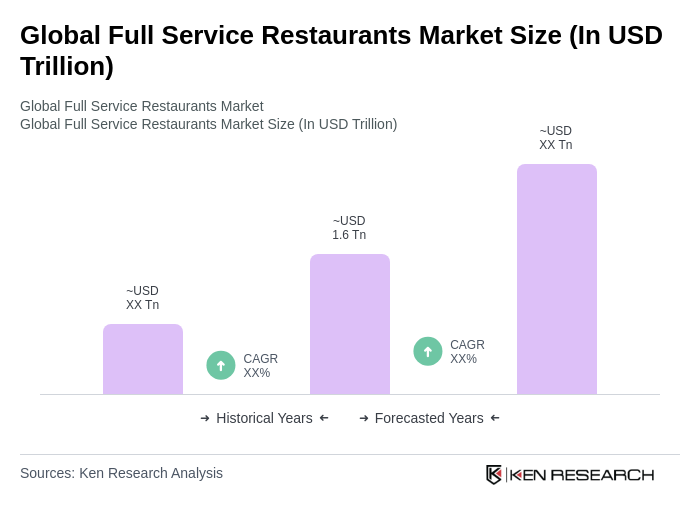
- The Global Full Service Restaurants Market is valued at USD 1.6 trillion, based on a five-year historical analysis. This value aligns with multiple industry sources that place the market in the mid–trillion range and reflect ongoing recovery and expansion in sit-down dining globally . The market’s growth is primarily driven by increasing consumer spending on dining experiences, the rise of technology-enabled ordering/reservations and delivery integration across full-service formats, and a growing trend towards experiential dining combining ambiance, chef-led concepts, and personalization . The market has also seen a sustained shift towards health-conscious, transparent, and sustainable dining options, including cleaner labels, local sourcing, and waste reduction initiatives .
- Key players in this market include the United States, China, and India, which dominate due to their large populations, diverse culinary cultures, and robust consumer spending trajectories. The U.S. is particularly influential, with a well-established restaurant industry and high per capita spending on dining out; the U.S. full-service segment alone is measured in the hundreds of billions within the broader national restaurant sales base . China and India continue to expand their full-service restaurant sectors, supported by urbanization and a growing middle class that is increasing out-of-home food consumption .
- In 2023, the U.S. government advanced food safety and traceability requirements affecting restaurants via the FDA’s Food Safety Modernization Act framework, including the Food Traceability Rule compliance timelines, alongside updated guidance and state-level adoptions of the FDA Model Food Code. These actions aim to strengthen controls around handling, preparation, and storage to reduce foodborne illnesses and bolster consumer confidence in dining out .
Global Full Service Restaurants Market Segmentation
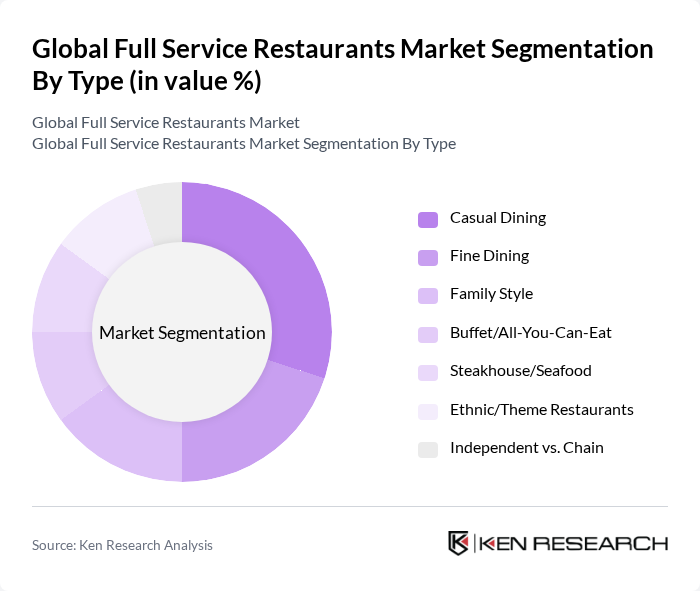
By Type:The full-service restaurant market can be segmented into various types, including Casual Dining, Fine Dining, Family Style, Buffet/All-You-Can-Eat, Steakhouse/Seafood, Ethnic/Theme Restaurants, and Independent vs. Chain. Each of these segments caters to different consumer preferences and dining occasions, influencing their market performance. Operators are emphasizing technology-enabled reservations and waitlist management, menu personalization, and immersive concepts across these formats to drive traffic and check growth .
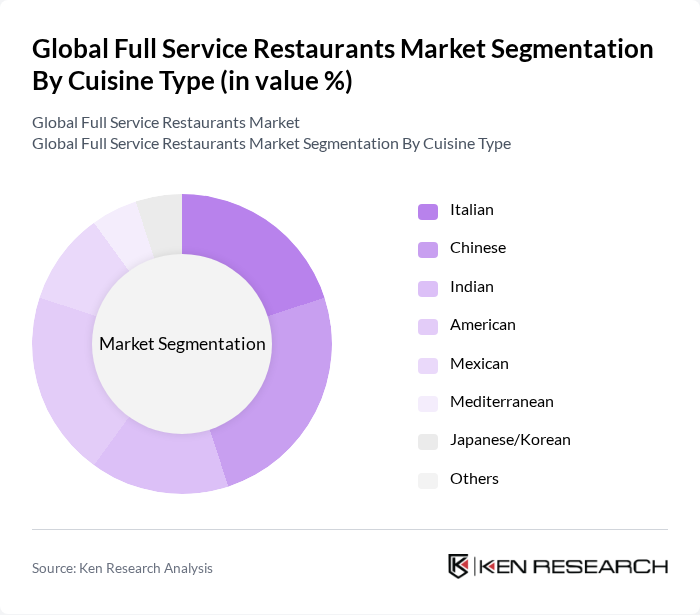
By Cuisine Type:The market can also be segmented by cuisine type, which includes Italian, Chinese, Indian, American, Mexican, Mediterranean, Japanese/Korean, and Others. Each cuisine type attracts different demographics and is influenced by cultural trends and consumer preferences. Growth is supported by rising demand for authentic regional flavors, healthier preparations (e.g., Mediterranean), and premiumization in Asian cuisines within full-service formats .
Global Full Service Restaurants Market Competitive Landscape
The Global Full Service Restaurants Market is characterized by a dynamic mix of regional and international players. Leading participants such as Darden Restaurants, Inc. (Olive Garden, LongHorn Steakhouse), Brinker International, Inc. (Chili’s Grill & Bar, Maggiano’s Little Italy), Bloomin’ Brands, Inc. (Outback Steakhouse, Carrabba’s Italian Grill), The Cheesecake Factory Incorporated, Texas Roadhouse, Inc. (Texas Roadhouse, Bubba’s 33), Cracker Barrel Old Country Store, Inc., The Wendy’s Company – note: QSR, excluded from FSR scope, P.F. Chang’s China Bistro, Inc., Red Robin Gourmet Burgers, Inc., First Watch Restaurant Group, Inc., Mitchells & Butlers plc (Harvester, Miller & Carter), Haidilao International Holding Ltd., The Oetker Collection (Fine Dining Concepts), D.Ream (Do?u? Restaurant Entertainment and Management), Dine Brands Global, Inc. (Applebee’s, IHOP) contribute to innovation, geographic expansion, and service delivery in this space.
Global Full Service Restaurants Market Industry Analysis
Growth Drivers
- Increasing Consumer Spending on Dining Out:In future, consumer spending on dining out in None is projected to reach approximately $160 billion, reflecting a 6% increase from the previous year. This growth is driven by rising disposable incomes, with the average household income in None estimated at $80,000. As more consumers prioritize dining experiences, restaurants are benefiting from increased foot traffic and higher average ticket sizes, contributing significantly to overall market growth.
- Rising Demand for Diverse Culinary Experiences:The demand for diverse culinary experiences in None is on the rise, with over 65% of consumers expressing interest in trying international cuisines. This trend is supported by a growing multicultural population, which has increased by 10% since 2020. Restaurants that offer unique and authentic dining experiences are likely to attract a broader customer base, enhancing their competitive edge and driving revenue growth in the full-service restaurant sector.
- Growth of Food Delivery Services:The food delivery market in None is expected to surpass $25 billion in future, driven by the increasing popularity of convenience among consumers. With 45% of consumers opting for delivery services at least once a week, full-service restaurants are adapting by partnering with delivery platforms. This shift not only expands their reach but also caters to the growing demand for on-demand dining options, significantly impacting overall market dynamics.
Market Challenges
- High Operational Costs:Full-service restaurants in None face operational costs averaging $275,000 annually, which includes rent, labor, and utilities. These high costs can significantly impact profitability, especially for smaller establishments. With labor costs projected to rise by 5% in future due to minimum wage increases, many restaurants are struggling to maintain margins while providing quality service and competitive pricing.
- Intense Competition:The full-service restaurant sector in None is characterized by intense competition, with over 18,000 establishments vying for market share. This saturation leads to price wars and increased marketing expenditures, which can erode profit margins. As consumer preferences shift rapidly, restaurants must continuously innovate and differentiate themselves to remain relevant, adding pressure to already strained resources.
Global Full Service Restaurants Market Future Outlook
The future of the full-service restaurant market in None appears promising, driven by evolving consumer preferences and technological advancements. As sustainability becomes a priority, restaurants are likely to adopt eco-friendly practices, enhancing their appeal. Additionally, the integration of digital solutions for ordering and payment is expected to streamline operations and improve customer experiences. These trends indicate a dynamic market landscape, where adaptability and innovation will be crucial for success in the coming years.
Market Opportunities
- Expansion into Emerging Markets:With emerging markets in None showing a 12% annual growth rate in dining out, full-service restaurants have a significant opportunity to expand their footprint. By targeting these regions, restaurants can tap into new customer bases and increase their revenue streams, capitalizing on the growing middle class and their increasing disposable income.
- Adoption of Technology for Enhanced Customer Experience:The integration of technology, such as mobile apps and AI-driven customer service, presents a lucrative opportunity for full-service restaurants. By investing in these technologies, restaurants can enhance customer engagement and streamline operations, potentially increasing customer retention rates by up to 25%, thereby boosting overall profitability.
Scope of the Report
| Segment | Sub-Segments |
|---|---|
| By Type | Casual Dining Fine Dining Family Style Buffet/All-You-Can-Eat Steakhouse/Seafood Ethnic/Theme Restaurants Independent vs. Chain |
| By Cuisine Type | Italian Chinese Indian American Mexican Mediterranean Japanese/Korean Others |
| By Service Style | Full Table Service Counter + Table Hybrid Reservations-Only/Prepaid Delivery/Off-Premise from FSR Catering/Private Dining Others |
| By Target Market | Families Young Professionals Tourists Business Diners/Corporate Events Special Occasion Diners Others |
| By Location | Standalone/High Street Shopping Centers/Retail Travel Hubs (Airports/Stations) Leisure & Entertainment Districts Hotels/Resorts Others |
| By Price Range | Budget Mid-Range Premium Luxury Others |
| By Dining Experience | Dine-In Takeaway Delivery (First-Party/Third-Party) Outdoor/Patio Dining Chef’s Table/Tasting Menu Others |
Key Target Audience
Investors and Venture Capitalist Firms
Government and Regulatory Bodies (e.g., Food and Drug Administration, Department of Health and Human Services)
Manufacturers and Producers
Distributors and Retailers
Franchise Owners and Operators
Food and Beverage Suppliers
Hospitality Management Companies
Insurance Providers
Players Mentioned in the Report:
Darden Restaurants, Inc. (Olive Garden, LongHorn Steakhouse)
Brinker International, Inc. (Chilis Grill & Bar, Maggianos Little Italy)
Bloomin Brands, Inc. (Outback Steakhouse, Carrabbas Italian Grill)
The Cheesecake Factory Incorporated
Texas Roadhouse, Inc. (Texas Roadhouse, Bubbas 33)
Cracker Barrel Old Country Store, Inc.
The Wendys Company note: QSR, excluded from FSR scope
P.F. Changs China Bistro, Inc.
Red Robin Gourmet Burgers, Inc.
First Watch Restaurant Group, Inc.
Mitchells & Butlers plc (Harvester, Miller & Carter)
Haidilao International Holding Ltd.
The Oetker Collection (Fine Dining Concepts)
D.Ream (Dogus Restaurant Entertainment and Management)
Dine Brands Global, Inc. (Applebees, IHOP)
Table of Contents
Market Assessment Phase
1. Executive Summary and Approach
2. Global Full Service Restaurants Market Overview
2.1 Key Insights and Strategic Recommendations
2.2 Global Full Service Restaurants Market Overview
2.3 Definition and Scope
2.4 Evolution of Market Ecosystem
2.5 Timeline of Key Regulatory Milestones
2.6 Value Chain & Stakeholder Mapping
2.7 Business Cycle Analysis
2.8 Policy & Incentive Landscape
3. Global Full Service Restaurants Market Analysis
3.1 Growth Drivers
3.1.1 Increasing consumer spending on dining out
3.1.2 Rising demand for diverse culinary experiences
3.1.3 Growth of food delivery services
3.1.4 Expansion of international cuisine offerings
3.2 Market Challenges
3.2.1 High operational costs
3.2.2 Intense competition
3.2.3 Fluctuating food prices
3.2.4 Regulatory compliance issues
3.3 Market Opportunities
3.3.1 Expansion into emerging markets
3.3.2 Adoption of technology for enhanced customer experience
3.3.3 Growth in health-conscious dining options
3.3.4 Collaboration with local suppliers for fresh ingredients
3.4 Market Trends
3.4.1 Increasing focus on sustainability
3.4.2 Rise of plant-based menu options
3.4.3 Integration of digital payment solutions
3.4.4 Popularity of experiential dining
3.5 Government Regulation
3.5.1 Food safety regulations
3.5.2 Labor laws and minimum wage policies
3.5.3 Health and sanitation standards
3.5.4 Alcohol licensing regulations
4. SWOT Analysis
5. Stakeholder Analysis
6. Porter's Five Forces Analysis
7. Global Full Service Restaurants Market Market Size, 2019-2024
7.1 By Value
7.2 By Volume
7.3 By Average Selling Price
8. Global Full Service Restaurants Market Segmentation
8.1 By Type
8.1.1 Casual Dining
8.1.2 Fine Dining
8.1.3 Family Style
8.1.4 Buffet/All-You-Can-Eat
8.1.5 Steakhouse/Seafood
8.1.6 Ethnic/Theme Restaurants
8.1.7 Independent vs. Chain
8.2 By Cuisine Type
8.2.1 Italian
8.2.2 Chinese
8.2.3 Indian
8.2.4 American
8.2.5 Mexican
8.2.6 Mediterranean
8.2.7 Japanese/Korean
8.2.8 Others
8.3 By Service Style
8.3.1 Full Table Service
8.3.2 Counter + Table Hybrid
8.3.3 Reservations-Only/Prepaid
8.3.4 Delivery/Off-Premise from FSR
8.3.5 Catering/Private Dining
8.3.6 Others
8.4 By Target Market
8.4.1 Families
8.4.2 Young Professionals
8.4.3 Tourists
8.4.4 Business Diners/Corporate Events
8.4.5 Special Occasion Diners
8.4.6 Others
8.5 By Location
8.5.1 Standalone/High Street
8.5.2 Shopping Centers/Retail
8.5.3 Travel Hubs (Airports/Stations)
8.5.4 Leisure & Entertainment Districts
8.5.5 Hotels/Resorts
8.5.6 Others
8.6 By Price Range
8.6.1 Budget
8.6.2 Mid-Range
8.6.3 Premium
8.6.4 Luxury
8.6.5 Others
8.7 By Dining Experience
8.7.1 Dine-In
8.7.2 Takeaway
8.7.3 Delivery (First-Party/Third-Party)
8.7.4 Outdoor/Patio Dining
8.7.5 Chef’s Table/Tasting Menu
8.7.6 Others
9. Global Full Service Restaurants Market Competitive Analysis
9.1 Market Share of Key Players
9.2 Cross Comparison of Key Players
9.2.1 Company Name
9.2.2 Scale (Global, Regional, or Domestic)
9.2.3 Systemwide Sales (Latest Fiscal Year)
9.2.4 Same-Store Sales Growth (Comparable Sales %)
9.2.5 Average Check/Per-Guest Spend
9.2.6 Table Turnover (Covers per Seat per Hour)
9.2.7 Unit Count and Net Openings/Closures
9.2.8 Revenue Mix (Dine-in vs Off-premise)
9.2.9 Labor Cost as % of Sales
9.2.10 Food & Beverage Cost as % of Sales
9.2.11 Digital Penetration (Online Reservations/Orders %)
9.2.12 Loyalty Members/Guest Frequency
9.2.13 EBITDA Margin/Operating Margin
9.2.14 Geographic Footprint (No. of Countries/Regions)
9.3 SWOT Analysis of Top Players
9.4 Pricing Analysis
9.5 Detailed Profile of Major Companies
9.5.1 Darden Restaurants, Inc. (Olive Garden, LongHorn Steakhouse)
9.5.2 Brinker International, Inc. (Chili’s Grill & Bar, Maggiano’s Little Italy)
9.5.3 Bloomin’ Brands, Inc. (Outback Steakhouse, Carrabba’s Italian Grill)
9.5.4 The Cheesecake Factory Incorporated
9.5.5 Texas Roadhouse, Inc. (Texas Roadhouse, Bubba’s 33)
9.5.6 Cracker Barrel Old Country Store, Inc.
9.5.7 The Wendy’s Company – note: QSR, excluded from FSR scope
9.5.8 P.F. Chang’s China Bistro, Inc.
9.5.9 Red Robin Gourmet Burgers, Inc.
9.5.10 First Watch Restaurant Group, Inc.
9.5.11 Mitchells & Butlers plc (Harvester, Miller & Carter)
9.5.12 Haidilao International Holding Ltd.
9.5.13 The Oetker Collection (Fine Dining Concepts)
9.5.14 D.Ream (Do?u? Restaurant Entertainment and Management)
9.5.15 Dine Brands Global, Inc. (Applebee’s, IHOP)
10. Global Full Service Restaurants Market End-User Analysis
10.1 Procurement Behavior of Key Ministries
10.1.1 Government contracts for catering services
10.1.2 Compliance with health regulations
10.1.3 Budget allocation for public events
10.2 Corporate Spend on Infrastructure & Energy
10.2.1 Investment in energy-efficient appliances
10.2.2 Budget for restaurant renovations
10.2.3 Expenditure on technology upgrades
10.3 Pain Point Analysis by End-User Category
10.3.1 High operational costs
10.3.2 Difficulty in sourcing quality ingredients
10.3.3 Challenges in maintaining customer loyalty
10.4 User Readiness for Adoption
10.4.1 Acceptance of digital ordering systems
10.4.2 Willingness to adopt sustainable practices
10.4.3 Readiness for menu diversification
10.5 Post-Deployment ROI and Use Case Expansion
10.5.1 Evaluation of customer feedback
10.5.2 Analysis of sales growth post-implementation
10.5.3 Opportunities for menu expansion
11. Global Full Service Restaurants Market Future Size, 2025-2030
11.1 By Value
11.2 By Volume
11.3 By Average Selling Price
Go-To-Market Strategy Phase
1. Whitespace Analysis + Business Model Canvas
1.1 Market Gaps Identification
1.2 Value Proposition Development
1.3 Revenue Streams Analysis
1.4 Customer Segmentation
1.5 Key Partnerships
1.6 Cost Structure
1.7 Channels of Distribution
2. Marketing and Positioning Recommendations
2.1 Branding strategies
2.2 Product USPs
3. Distribution Plan
3.1 Urban retail vs rural NGO tie-ups
4. Channel & Pricing Gaps
4.1 Underserved routes
4.2 Pricing bands
5. Unmet Demand & Latent Needs
5.1 Category gaps
5.2 Consumer segments
6. Customer Relationship
6.1 Loyalty programs
6.2 After-sales service
7. Value Proposition
7.1 Sustainability
7.2 Integrated supply chains
8. Key Activities
8.1 Regulatory compliance
8.2 Branding
8.3 Distribution setup
9. Entry Strategy Evaluation
9.1 Domestic Market Entry Strategy
9.1.1 Product mix
9.1.2 Pricing band
9.1.3 Packaging
9.2 Export Entry Strategy
9.2.1 Target countries
9.2.2 Compliance roadmap
10. Entry Mode Assessment
10.1 JV
10.2 Greenfield
10.3 M&A
10.4 Distributor Model
11. Capital and Timeline Estimation
11.1 Capital requirements
11.2 Timelines
12. Control vs Risk Trade-Off
12.1 Ownership vs Partnerships
13. Profitability Outlook
13.1 Breakeven analysis
13.2 Long-term sustainability
14. Potential Partner List
14.1 Distributors
14.2 JVs
14.3 Acquisition targets
15. Execution Roadmap
15.1 Phased Plan for Market Entry
15.1.1 Market Setup
15.1.2 Market Entry
15.1.3 Growth Acceleration
15.1.4 Scale & Stabilize
15.2 Key Activities and Milestones
15.2.1 Milestone Planning
15.2.2 Activity Scheduling
Research Methodology
Phase 1: Approach1
Desk Research
- Analysis of industry reports from global food service associations and market research firms
- Review of financial statements and annual reports from leading full-service restaurant chains
- Examination of consumer behavior studies and dining trends published by culinary institutes
Primary Research
- Interviews with restaurant owners and managers to gather insights on operational challenges
- Surveys targeting customers to understand dining preferences and spending habits
- Focus groups with food industry experts to discuss emerging trends and innovations
Validation & Triangulation
- Cross-validation of findings through multiple data sources, including sales data and consumer surveys
- Triangulation of qualitative insights from interviews with quantitative data from surveys
- Sanity checks conducted through expert panel reviews to ensure data accuracy
Phase 2: Market Size Estimation1
Top-down Assessment
- Estimation of market size based on national restaurant industry revenue and growth rates
- Segmentation of the market by cuisine type, service style, and geographic region
- Incorporation of macroeconomic factors such as GDP growth and consumer spending trends
Bottom-up Modeling
- Collection of data on average ticket sizes and customer footfall from various restaurant types
- Estimation of market share for key players based on sales volume and location density
- Calculation of revenue projections based on historical growth rates and market dynamics
Forecasting & Scenario Analysis
- Multi-variable regression analysis incorporating factors like demographic shifts and urbanization
- Scenario planning based on potential impacts of economic downturns and health crises
- Development of baseline, optimistic, and pessimistic forecasts through 2030
Phase 3: CATI Sample Composition1
| Scope Item/Segment | Sample Size | Target Respondent Profiles |
|---|---|---|
| Casual Dining Restaurants | 140 | Restaurant Owners, General Managers |
| Fine Dining Establishments | 80 | Head Chefs, Operations Directors |
| Fast Casual Chains | 120 | Marketing Managers, Franchise Owners |
| Food Trucks and Pop-ups | 70 | Entrepreneurs, Event Coordinators |
| Family-style Restaurants | 90 | Customer Experience Managers, Service Staff |
Frequently Asked Questions
What is the current value of the Global Full Service Restaurants Market?
The Global Full Service Restaurants Market is valued at approximately USD 1.6 trillion, reflecting a significant recovery and expansion in sit-down dining globally, driven by increased consumer spending and evolving dining preferences.
What factors are driving the growth of the full-service restaurant market?
Which countries dominate the Global Full Service Restaurants Market?
What are the main types of full-service restaurants?
Other Regional/Country Reports
Indonesia Full Service Restaurants Market
Malaysia Full Service Restaurants Market
APAC Full Service Restaurants Market
SEA Full Service Restaurants Market
Why Buy From Us?

What makes us stand out is that our consultants follow Robust, Refine and Result (RRR) methodology. Robust for clear definitions, approaches and sanity checking, Refine for differentiating respondents' facts and opinions, and Result for presenting data with story.

We have set a benchmark in the industry by offering our clients with syndicated and customized market research reports featuring coverage of entire market as well as meticulous research and analyst insights.

While we don't replace traditional research, we flip the method upside down. Our dual approach of Top Bottom & Bottom Top ensures quality deliverable by not just verifying company fundamentals but also looking at the sector and macroeconomic factors.

With one step in the future, our research team constantly tries to show you the bigger picture. We help with some of the tough questions you may encounter along the way: How is the industry positioned? Best marketing channel? KPI's of competitors? By aligning every element, we help maximize success.

Our report gives you instant access to the answers and sources that other companies might choose to hide. We elaborate each steps of research methodology we have used and showcase you the sample size to earn your trust.

If you need any support, we are here! We pride ourselves on universe strength, data quality, and quick, friendly, and professional service.