About the Report
Base Year 2024Global Gamification Market Overview
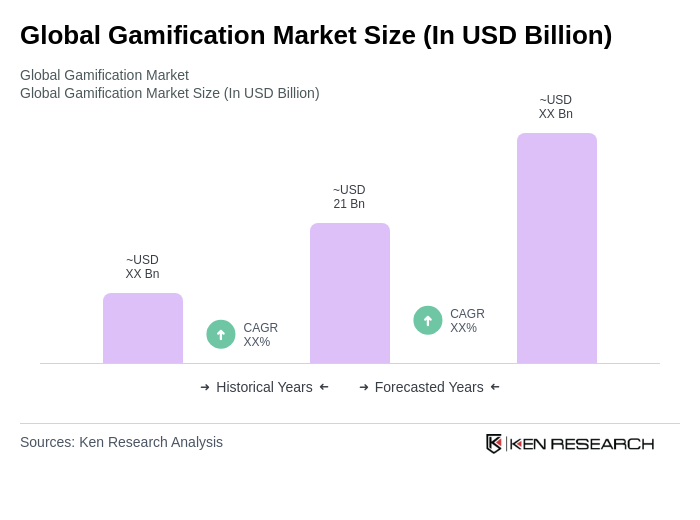
- The Global Gamification Market is valued at USD 21 billion, based on a five-year historical analysis. This growth is primarily driven by the increasing adoption of gamification strategies across various sectors, including education, healthcare, and retail, as organizations seek to enhance user engagement and improve learning outcomes. The rise of mobile technology and social media has further accelerated the demand for gamified solutions, making them integral to modern business strategies.
- Key players in this market are predominantly located in North America and Europe, with the United States and Germany leading the charge. North America currently holds the largest share, supported by mature enterprise software adoption and R&D intensity; Europe is growing on robust digital transformation investment and enterprise e?learning uptake.
- In 2023, the European Union implemented the Digital Services Act, which imposes duties on online platforms around transparency, recommender systems, advertising, and user protection; while it does not mandate “enhancing user engagement,” its transparency and fairness requirements are prompting product and UX changes that can include gamification for compliant engagement and better user experiences.
Global Gamification Market Segmentation
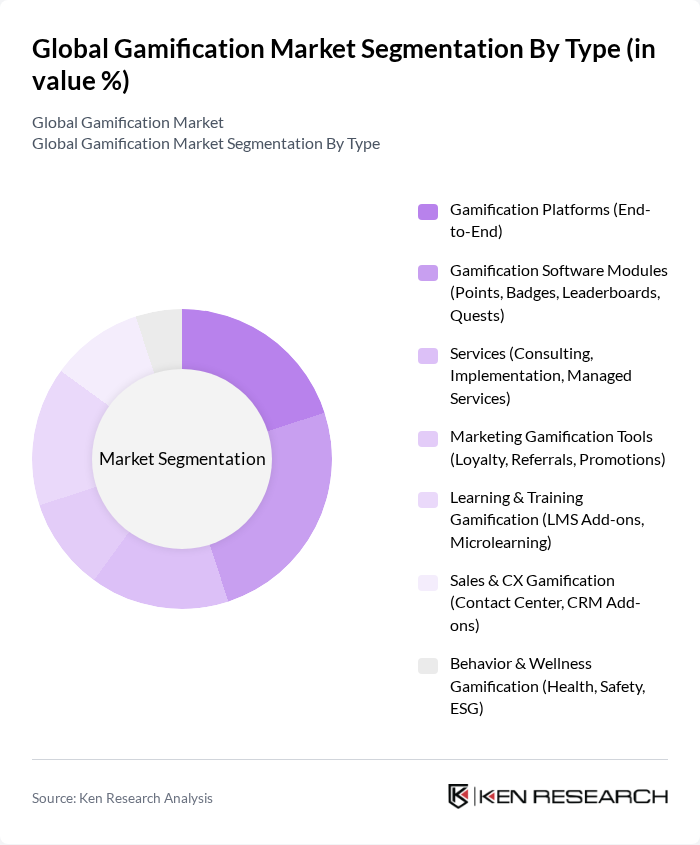
By Type:The market can be segmented into various types, including Gamification Platforms (End-to-End), Gamification Software Modules (Points, Badges, Leaderboards, Quests), Services (Consulting, Implementation, Managed Services), Marketing Gamification Tools (Loyalty, Referrals, Promotions), Learning & Training Gamification (LMS Add-ons, Microlearning), Sales & CX Gamification (Contact Center, CRM Add-ons), and Behavior & Wellness Gamification (Health, Safety, ESG). Each of these subsegments plays a crucial role in enhancing user engagement and driving business outcomes.
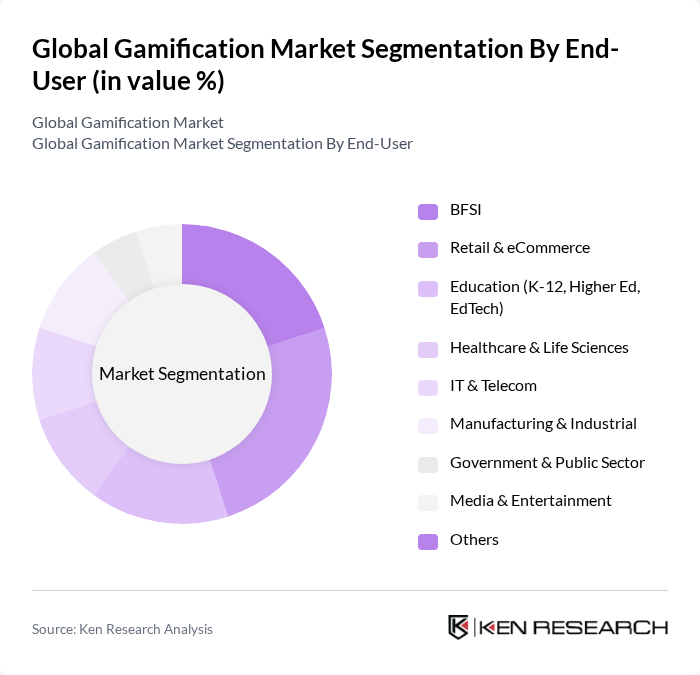
By End-User:The end-user segmentation includes various sectors such as BFSI, Retail & eCommerce, Education (K-12, Higher Ed, EdTech), Healthcare & Life Sciences, IT & Telecom, Manufacturing & Industrial, Government & Public Sector, Media & Entertainment, and Others. Each sector utilizes gamification to enhance engagement, improve customer loyalty, and drive operational efficiency. Retail/finance, education, healthcare, and telecom are consistently cited as leading adopters.
Global Gamification Market Competitive Landscape
The Global Gamification Market is characterized by a dynamic mix of regional and international players. Leading participants such as Bunchball (Nitro by Bunchball, now part of BI WORLDWIDE), Badgeville (acquired; legacy assets transitioned out of market), Gamify, SAP SE, Microsoft Corporation, IBM Corporation, Playvox, Inc., Centrical, TalentLMS (by Epignosis), Funifier, Axonify Inc., EVERFI, Inc., Kahoot! ASA, Classcraft Studios Inc., Zunos (acquired by CallidusCloud; integrated into SAP Litmos), Salesforce (Trailhead gamified learning), Pendo (Product adoption and in-app guides), Pointagram, Spinify, Growth Engineering contribute to innovation, geographic expansion, and service delivery in this space.
Global Gamification Market Industry Analysis
Growth Drivers
- Increasing Adoption of Gamification in Education:The education sector is increasingly integrating gamification, with over 70% of educators reporting its positive impact on student engagement. In future, the global education technology market is projected to reach $404 billion, driven by gamified learning solutions. This trend is supported by the World Bank's investment of $1.5 billion in educational technology initiatives, highlighting the growing recognition of gamification as a tool for enhancing learning outcomes and student retention.
- Rising Demand for Employee Engagement Solutions:Employee engagement solutions are critical for productivity, with studies indicating that engaged employees can lead to a 21% increase in profitability. In future, companies are expected to invest approximately $355 billion in employee training and development, with gamification playing a key role in these initiatives. The International Labour Organization reports that organizations utilizing gamified systems see a 30% improvement in employee retention rates, underscoring the importance of engagement strategies.
- Growth of Mobile Gaming and Applications:The mobile gaming industry is projected to generate $100 billion in revenue in future, driven by the increasing use of smartphones and tablets. This growth is complemented by a 50% rise in mobile app downloads, with gamified applications leading the charge. According to Statista, 80% of mobile users engage with gamified apps regularly, indicating a strong consumer preference for interactive and engaging content, which further fuels the gamification market.
Market Challenges
- High Initial Investment Costs:Implementing gamification solutions often requires significant upfront investment, with costs ranging from $10,000 to $500,000 depending on the complexity of the system. Many small to medium-sized enterprises (SMEs) struggle to allocate such budgets, leading to a slower adoption rate. The World Bank estimates that 60% of SMEs cite financial constraints as a barrier to adopting innovative technologies, including gamification, which hampers market growth.
- Lack of Awareness among Potential Users:Despite the benefits of gamification, a significant knowledge gap exists, with 65% of businesses unaware of its potential applications. This lack of awareness is particularly pronounced in industries such as healthcare and manufacturing, where traditional practices dominate. The International Data Corporation reports that companies that invest in education about gamification can see a 40% increase in adoption rates, highlighting the need for targeted awareness campaigns.
Global Gamification Market Future Outlook
The future of the gamification market appears promising, driven by technological advancements and changing consumer preferences. As organizations increasingly recognize the value of gamified solutions, particularly in education and employee engagement, the market is expected to expand significantly. The integration of artificial intelligence and machine learning will enhance personalization, making gamified experiences more effective. Additionally, the rise of remote work and learning will further accelerate the adoption of gamification, creating new avenues for growth and innovation in the sector.
Market Opportunities
- Expansion into Emerging Markets:Emerging markets present significant opportunities for gamification, with a projected increase in internet penetration rates to 70% in future. This growth will enable access to gamified solutions in regions previously underserved, creating a potential user base of over 1 billion new users. Companies that tailor their offerings to local cultures and preferences can capitalize on this expanding market.
- Development of Customizable Gamification Solutions:There is a growing demand for customizable gamification solutions, with 75% of businesses seeking tailored experiences. In future, the market for customizable platforms is expected to grow by $2 billion, as organizations look for solutions that align with their specific goals and branding. This trend presents an opportunity for developers to innovate and create flexible gamification tools that cater to diverse industries.
Scope of the Report
| Segment | Sub-Segments |
|---|---|
| By Type | Gamification Platforms (End-to-End) Gamification Software Modules (Points, Badges, Leaderboards, Quests) Services (Consulting, Implementation, Managed Services) Marketing Gamification Tools (Loyalty, Referrals, Promotions) Learning & Training Gamification (LMS Add?ons, Microlearning) Sales & CX Gamification (Contact Center, CRM Add?ons) Behavior & Wellness Gamification (Health, Safety, ESG) |
| By End-User | BFSI Retail & eCommerce Education (K?12, Higher Ed, EdTech) Healthcare & Life Sciences IT & Telecom Manufacturing & Industrial Government & Public Sector Media & Entertainment Others |
| By Application | Employee Training & Enablement Customer Engagement & Loyalty Sales Performance & Incentives Learning Management Systems Integration Health, Wellness & Safety Programs Product Adoption & Onboarding |
| By Distribution Channel | Direct (Vendor) Sales Cloud Marketplaces (SaaS) Value?Added Resellers (VARs) & System Integrators Strategic Partnerships & OEMs Others |
| By Pricing Model | Subscription (Per?User/Per?Month) Tiered Plans (SMB, Mid?Market, Enterprise) Freemium/Free Trial to Paid Usage?Based/Add?On Modules Perpetual License |
| By Region | North America Europe Asia-Pacific Latin America Middle East & Africa Others |
| By User Engagement Level | Low Engagement Moderate Engagement High Engagement Others |
Key Target Audience
Investors and Venture Capitalist Firms
Government and Regulatory Bodies (e.g., Federal Trade Commission, European Commission)
Manufacturers and Producers of Gamification Software
Distributors and Retailers of Gamification Solutions
Corporate Training and Development Departments
Marketing and Advertising Agencies
Game Developers and Designers
Technology Providers and Platform Developers
Players Mentioned in the Report:
Bunchball (Nitro by Bunchball, now part of BI WORLDWIDE)
Badgeville (acquired; legacy assets transitioned out of market)
Gamify
SAP SE
Microsoft Corporation
IBM Corporation
Playvox, Inc.
Centrical
TalentLMS (by Epignosis)
Funifier
Axonify Inc.
EVERFI, Inc.
Kahoot! ASA
Classcraft Studios Inc.
Zunos (acquired by CallidusCloud; integrated into SAP Litmos)
Salesforce (Trailhead gamified learning)
Pendo (Product adoption and inapp guides)
Pointagram
Spinify
Growth Engineering
Table of Contents
Market Assessment Phase
1. Executive Summary and Approach
2. Global Gamification Market Overview
2.1 Key Insights and Strategic Recommendations
2.2 Global Gamification Market Overview
2.3 Definition and Scope
2.4 Evolution of Market Ecosystem
2.5 Timeline of Key Regulatory Milestones
2.6 Value Chain & Stakeholder Mapping
2.7 Business Cycle Analysis
2.8 Policy & Incentive Landscape
3. Global Gamification Market Analysis
3.1 Growth Drivers
3.1.1 Increasing Adoption of Gamification in Education
3.1.2 Rising Demand for Employee Engagement Solutions
3.1.3 Growth of Mobile Gaming and Applications
3.1.4 Enhanced User Experience through Gamified Interfaces
3.2 Market Challenges
3.2.1 High Initial Investment Costs
3.2.2 Lack of Awareness among Potential Users
3.2.3 Data Privacy and Security Concerns
3.2.4 Integration with Existing Systems
3.3 Market Opportunities
3.3.1 Expansion into Emerging Markets
3.3.2 Development of Customizable Gamification Solutions
3.3.3 Partnerships with Educational Institutions
3.3.4 Utilization of AI and Machine Learning in Gamification
3.4 Market Trends
3.4.1 Increasing Use of AR and VR in Gamification
3.4.2 Shift Towards Remote Learning and Work
3.4.3 Focus on Health and Wellness Gamification
3.4.4 Rise of Social Gamification Platforms
3.5 Government Regulation
3.5.1 Data Protection Regulations
3.5.2 Educational Standards Compliance
3.5.3 Employment and Labor Laws
3.5.4 Consumer Protection Laws
4. SWOT Analysis
5. Stakeholder Analysis
6. Porter's Five Forces Analysis
7. Global Gamification Market Market Size, 2019-2024
7.1 By Value
7.2 By Volume
7.3 By Average Selling Price
8. Global Gamification Market Segmentation
8.1 By Type
8.1.1 Gamification Platforms (End-to-End)
8.1.2 Gamification Software Modules (Points, Badges, Leaderboards, Quests)
8.1.3 Services (Consulting, Implementation, Managed Services)
8.1.4 Marketing Gamification Tools (Loyalty, Referrals, Promotions)
8.1.5 Learning & Training Gamification (LMS Add?ons, Microlearning)
8.1.6 Sales & CX Gamification (Contact Center, CRM Add?ons)
8.1.7 Behavior & Wellness Gamification (Health, Safety, ESG)
8.2 By End-User
8.2.1 BFSI
8.2.2 Retail & eCommerce
8.2.3 Education (K?12, Higher Ed, EdTech)
8.2.4 Healthcare & Life Sciences
8.2.5 IT & Telecom
8.2.6 Manufacturing & Industrial
8.2.7 Government & Public Sector
8.2.8 Media & Entertainment
8.2.9 Others
8.3 By Application
8.3.1 Employee Training & Enablement
8.3.2 Customer Engagement & Loyalty
8.3.3 Sales Performance & Incentives
8.3.4 Learning Management Systems Integration
8.3.5 Health, Wellness & Safety Programs
8.3.6 Product Adoption & Onboarding
8.4 By Distribution Channel
8.4.1 Direct (Vendor) Sales
8.4.2 Cloud Marketplaces (SaaS)
8.4.3 Value?Added Resellers (VARs) & System Integrators
8.4.4 Strategic Partnerships & OEMs
8.4.5 Others
8.5 By Pricing Model
8.5.1 Subscription (Per?User/Per?Month)
8.5.2 Tiered Plans (SMB, Mid?Market, Enterprise)
8.5.3 Freemium/Free Trial to Paid
8.5.4 Usage?Based/Add?On Modules
8.5.5 Perpetual License
8.6 By Region
8.6.1 North America
8.6.2 Europe
8.6.3 Asia-Pacific
8.6.4 Latin America
8.6.5 Middle East & Africa
8.6.6 Others
8.7 By User Engagement Level
8.7.1 Low Engagement
8.7.2 Moderate Engagement
8.7.3 High Engagement
8.7.4 Others
9. Global Gamification Market Competitive Analysis
9.1 Market Share of Key Players
9.2 Cross Comparison of Key Players
9.2.1 Company Name
9.2.2 Company Scale (Employees/ARR Tier)
9.2.3 YoY Revenue Growth (%)
9.2.4 Net Revenue Retention (NRR, %)
9.2.5 Customer Count (Logos) and Enterprise Mix (%)
9.2.6 Average Contract Value (ACV, USD)
9.2.7 Pricing Model (Per?User, Tiered, Usage?Based)
9.2.8 Customer Satisfaction (G2/Capterra Rating)
9.2.9 Product Release Velocity (Major Releases/Year)
9.2.10 Geographic Footprint (Regions Served)
9.3 SWOT Analysis of Top Players
9.4 Pricing Analysis
9.5 Detailed Profile of Major Companies
9.5.1 Bunchball (Nitro by Bunchball, now part of BI WORLDWIDE)
9.5.2 Badgeville (acquired; legacy assets transitioned out of market)
9.5.3 Gamify
9.5.4 SAP SE
9.5.5 Microsoft Corporation
9.5.6 IBM Corporation
9.5.7 Playvox, Inc.
9.5.8 Centrical
9.5.9 TalentLMS (by Epignosis)
9.5.10 Funifier
9.5.11 Axonify Inc.
9.5.12 EVERFI, Inc.
9.5.13 Kahoot! ASA
9.5.14 Classcraft Studios Inc.
9.5.15 Zunos (acquired by CallidusCloud; integrated into SAP Litmos)
9.5.16 Salesforce (Trailhead gamified learning)
9.5.17 Pendo (Product adoption and in?app guides)
9.5.18 Pointagram
9.5.19 Spinify
9.5.20 Growth Engineering
10. Global Gamification Market End-User Analysis
10.1 Procurement Behavior of Key Ministries
10.1.1 Government Initiatives for Digital Learning
10.1.2 Budget Allocations for Employee Training
10.1.3 Partnerships with Educational Institutions
10.1.4 Adoption of Technology in Public Services
10.2 Corporate Spend on Infrastructure & Energy
10.2.1 Investment in Employee Engagement Tools
10.2.2 Budget for Gamification Solutions
10.2.3 Spending on Training and Development
10.3 Pain Point Analysis by End-User Category
10.3.1 Lack of Engagement in Training Programs
10.3.2 Difficulty in Measuring Training Effectiveness
10.3.3 High Turnover Rates in Organizations
10.4 User Readiness for Adoption
10.4.1 Awareness of Gamification Benefits
10.4.2 Training Needs for Implementation
10.4.3 Technological Infrastructure Readiness
10.5 Post-Deployment ROI and Use Case Expansion
10.5.1 Measurement of Engagement Metrics
10.5.2 Expansion into New Departments
10.5.3 Long-term Impact on Employee Performance
11. Global Gamification Market Future Size, 2025-2030
11.1 By Value
11.2 By Volume
11.3 By Average Selling Price
Go-To-Market Strategy Phase
1. Whitespace Analysis + Business Model Canvas
1.1 Identification of Market Gaps
1.2 Business Model Development
1.3 Value Proposition Analysis
2. Marketing and Positioning Recommendations
2.1 Branding Strategies
2.2 Product USPs
3. Distribution Plan
3.1 Urban Retail Strategies
3.2 Rural NGO Tie-Ups
4. Channel & Pricing Gaps
4.1 Underserved Routes
4.2 Pricing Bands Analysis
5. Unmet Demand & Latent Needs
5.1 Category Gaps
5.2 Consumer Segments
6. Customer Relationship
6.1 Loyalty Programs
6.2 After-Sales Service
7. Value Proposition
7.1 Sustainability Initiatives
7.2 Integrated Supply Chains
8. Key Activities
8.1 Regulatory Compliance
8.2 Branding Efforts
8.3 Distribution Setup
9. Entry Strategy Evaluation
9.1 Domestic Market Entry Strategy
9.1.1 Product Mix Considerations
9.1.2 Pricing Band Strategy
9.1.3 Packaging Options
9.2 Export Entry Strategy
9.2.1 Target Countries
9.2.2 Compliance Roadmap
10. Entry Mode Assessment
10.1 Joint Ventures
10.2 Greenfield Investments
10.3 Mergers & Acquisitions
10.4 Distributor Model
11. Capital and Timeline Estimation
11.1 Capital Requirements
11.2 Timelines for Implementation
12. Control vs Risk Trade-Off
12.1 Ownership Considerations
12.2 Partnerships Evaluation
13. Profitability Outlook
13.1 Breakeven Analysis
13.2 Long-Term Sustainability
14. Potential Partner List
14.1 Distributors
14.2 Joint Ventures
14.3 Acquisition Targets
15. Execution Roadmap
15.1 Phased Plan for Market Entry
15.1.1 Market Setup
15.1.2 Market Entry
15.1.3 Growth Acceleration
15.1.4 Scale & Stabilize
15.2 Key Activities and Milestones
15.2.1 Milestone Planning
15.2.2 Activity Tracking
Research Methodology
Phase 1: Approach1
Desk Research
- Analysis of industry reports from market research firms focusing on gamification trends
- Review of academic journals and publications on gamification applications across sectors
- Examination of white papers and case studies from leading gamification solution providers
Primary Research
- Interviews with product managers at companies implementing gamification strategies
- Surveys targeting HR professionals and training coordinators using gamified learning tools
- Focus groups with end-users to gather insights on user experience and engagement
Validation & Triangulation
- Cross-validation of findings through multiple industry reports and expert opinions
- Triangulation of data from primary interviews and secondary research sources
- Sanity checks conducted through expert panel discussions and feedback sessions
Phase 2: Market Size Estimation1
Top-down Assessment
- Estimation of market size based on global digital transformation spending trends
- Segmentation of the market by industry verticals such as education, healthcare, and retail
- Incorporation of growth rates from related sectors like e-learning and mobile applications
Bottom-up Modeling
- Data collection from leading gamification platforms regarding user adoption rates
- Estimation of revenue generated from gamification services across various sectors
- Analysis of pricing models and subscription rates for gamification software
Forecasting & Scenario Analysis
- Multi-variable forecasting using trends in user engagement and technology adoption
- Scenario analysis based on potential regulatory impacts and market disruptions
- Development of baseline, optimistic, and pessimistic growth projections through 2030
Phase 3: CATI Sample Composition1
| Scope Item/Segment | Sample Size | Target Respondent Profiles |
|---|---|---|
| Corporate Training Programs | 120 | Training Managers, Learning & Development Specialists |
| Healthcare Gamification Solutions | 100 | Healthcare Administrators, Patient Engagement Coordinators |
| Retail Customer Engagement | 80 | Marketing Managers, Customer Experience Directors |
| Education Sector Gamification | 110 | Educators, Curriculum Developers |
| Gamification in Mobile Apps | 90 | App Developers, Product Managers |
Frequently Asked Questions
What is the current value of the Global Gamification Market?
The Global Gamification Market is valued at approximately USD 21 billion, reflecting a significant growth trend driven by the adoption of gamification strategies across various sectors, including education, healthcare, and retail.
What factors are driving the growth of the Gamification Market?
Which regions are leading in the Gamification Market?
How does the Digital Services Act impact the Gamification Market?
Other Regional/Country Reports
Indonesia Gamification Market
APAC Gamification Market
SEA Gamification Market
Why Buy From Us?

What makes us stand out is that our consultants follow Robust, Refine and Result (RRR) methodology. Robust for clear definitions, approaches and sanity checking, Refine for differentiating respondents' facts and opinions, and Result for presenting data with story.

We have set a benchmark in the industry by offering our clients with syndicated and customized market research reports featuring coverage of entire market as well as meticulous research and analyst insights.

While we don't replace traditional research, we flip the method upside down. Our dual approach of Top Bottom & Bottom Top ensures quality deliverable by not just verifying company fundamentals but also looking at the sector and macroeconomic factors.

With one step in the future, our research team constantly tries to show you the bigger picture. We help with some of the tough questions you may encounter along the way: How is the industry positioned? Best marketing channel? KPI's of competitors? By aligning every element, we help maximize success.

Our report gives you instant access to the answers and sources that other companies might choose to hide. We elaborate each steps of research methodology we have used and showcase you the sample size to earn your trust.

If you need any support, we are here! We pride ourselves on universe strength, data quality, and quick, friendly, and professional service.