Global Gaming Gpu Market

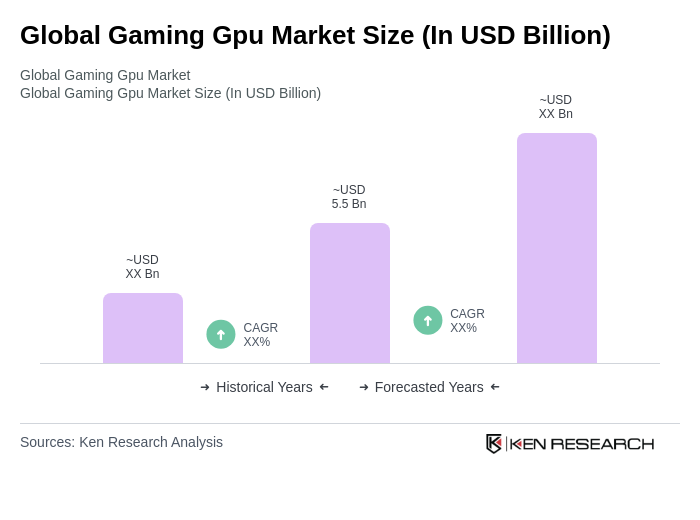
Global Gaming GPU Market, valued at USD 5.5 billion, grows with rising esports, AI-powered tech, and high-res gaming needs. Dominated by US, China, and Germany, with opportunities in emerging markets.

Region:Global

Author(s):Rebecca

Product Code:KRAD0201

Pages:84

Published On:August 2025
About the Report

Base Year 2024

Global Gaming GPU Market Overview

  • The Global Gaming GPU Market is valued at USD 5.5 billion, based on a five-year historical analysis. This growth is primarily driven by the increasing demand for high-performance graphics in gaming, rapid advancements in GPU technology such as ray tracing and AI-powered upscaling, and the rise of esports and online gaming platforms. The market has seen a surge in consumer interest, leading to robust demand for GPUs that support high-resolution graphics and real-time rendering.
  • Key players in this market include the United States, China, and Germany. The United States dominates due to its strong gaming culture, presence of major GPU manufacturers, and a large consumer base. China follows closely, driven by its massive gaming population and rapid technological advancements. Germany's prominence is attributed to its well-established gaming industry and a growing number of gaming events and conventions.
  • In 2023, the European Union implemented regulations aimed at enhancing energy efficiency in electronic devices, including GPUs. This regulation mandates that all new GPUs must meet specific energy consumption standards, promoting the development of more energy-efficient products. The initiative is part of a broader strategy to reduce carbon emissions and encourage sustainable practices within the tech industry.
Global Gaming Gpu Market Size

Global Gaming GPU Market Segmentation

By Type:The market is segmented into Dedicated GPUs, Integrated GPUs, Hybrid GPUs, and External GPUs. Dedicated GPUs are primarily used for high-performance gaming and professional applications, while Integrated GPUs are commonly found in laptops and budget PCs. Hybrid GPUs combine features of both dedicated and integrated GPUs, and External GPUs provide additional graphics power for laptops. The Integrated GPU segment currently holds the largest share of the overall GPU market, driven by widespread adoption in mobile devices and entry-level PCs.
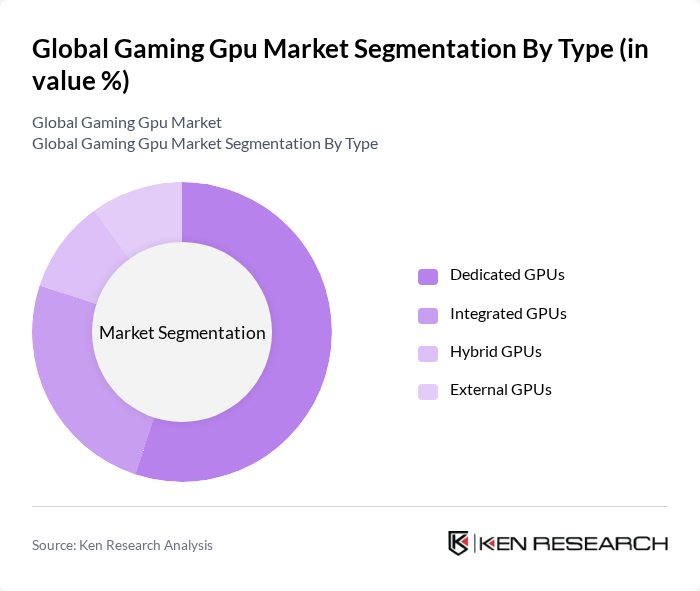
Global Gaming Gpu Market segmentation by Type.

By Device:The market is segmented into PCs and Workstations, Gaming Consoles, and Mobile Devices. PCs and Workstations dominate the market due to their versatility and performance capabilities, making them the preferred choice for serious gamers. Gaming Consoles are also significant, appealing to casual gamers, while Mobile Devices are gaining traction due to the increasing popularity of mobile gaming. The Mobile Devices segment has seen rapid growth and currently holds a substantial share of the global gaming GPU market, reflecting the shift toward portable and cloud-based gaming experiences.
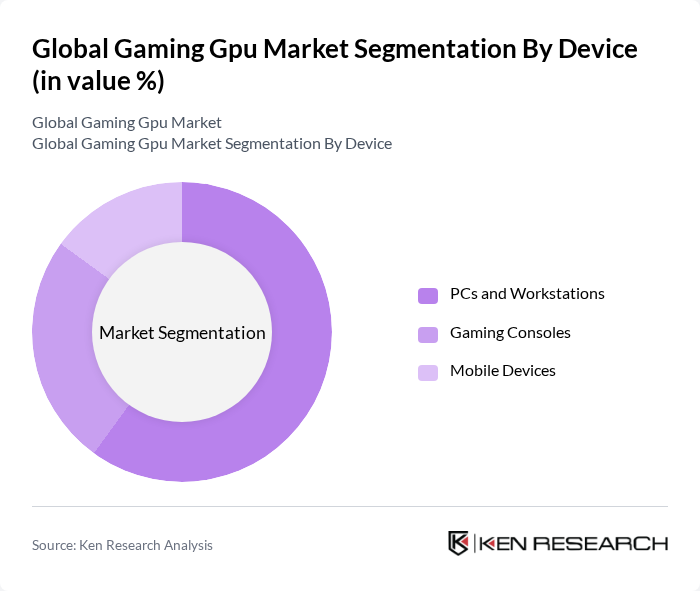
Global Gaming Gpu Market segmentation by Device.

Global Gaming GPU Market Competitive Landscape

The Global Gaming GPU Market is characterized by a dynamic mix of regional and international players. Leading participants such as NVIDIA Corporation, Advanced Micro Devices, Inc. (AMD), Intel Corporation, ASUS Computer International, Micro-Star International Co., Ltd. (MSI), Gigabyte Technology Co., Ltd., EVGA Corporation, Zotac International (MCO) Ltd., PNY Technologies, Inc., Sapphire Technology Limited, Palit Microsystems Ltd., XFX Technology Inc., Colorful Technology Company Limited, InnoVISION Multimedia Limited (Inno3D), PowerColor (TUL Corporation) contribute to innovation, geographic expansion, and service delivery in this space.

NVIDIA Corporation

1993

Santa Clara, California, USA

Advanced Micro Devices, Inc. (AMD)

1969

Santa Clara, California, USA

Intel Corporation

1968

Santa Clara, California, USA

ASUS Computer International

1989

Fremont, California, USA

Micro-Star International Co., Ltd. (MSI)

1986

New Taipei City, Taiwan

Company

Establishment Year

Headquarters

Company Size (Large, Medium, Small)

Revenue (USD, latest fiscal year)

Revenue Growth Rate (%)

Market Share (%)

Geographic Presence (Regions/Countries)

Product Portfolio Breadth

Global Gaming Gpu Market Industry Analysis

Growth Drivers

  • Increasing Demand for High-Performance Gaming:The global gaming industry is projected to reach $200 billion in revenue in future, driven by a surge in demand for high-performance gaming experiences. This demand is fueled by the increasing number of gamers, which reached approximately 3 billion globally. As gamers seek enhanced graphics and smoother gameplay, the need for advanced GPUs becomes critical, leading to a projected increase in GPU sales to 50 million units in future, according to industry reports.
  • Rise of Esports and Competitive Gaming:The esports market is expected to generate $1.8 billion in revenue in future, reflecting a growing audience and increased sponsorships. With over 500 million esports viewers globally, the demand for high-performance GPUs is essential for competitive gaming. This trend is further supported by the rise of tournaments, which attracted over 20 million participants globally, driving manufacturers to innovate and produce GPUs that meet the rigorous demands of esports.
  • Advancements in GPU Technology:Continuous advancements in GPU technology are propelling the market forward, with companies investing over $10 billion in R&D in future. Innovations such as ray tracing and AI-enhanced graphics are becoming standard features, enhancing user experiences. The introduction of next-generation GPUs is expected to increase performance by 30% in future, making them more appealing to gamers and developers alike, thus driving sales and market growth.

Market Challenges

  • Supply Chain Disruptions:The gaming GPU market faces significant challenges due to ongoing supply chain disruptions, which have led to a 20% decrease in production capacity in future. Factors such as semiconductor shortages and logistical issues have resulted in delayed product launches and increased lead times. These disruptions are expected to continue in future, impacting the availability of GPUs and hindering market growth as demand outpaces supply.
  • High Costs of Advanced GPUs:The average price of high-performance GPUs has surged to $1,200 in future, making them less accessible to a broader audience. This price increase is attributed to rising production costs and demand for cutting-edge technology. As a result, many potential customers are opting for lower-end models, which could limit the overall growth of the high-performance segment in future, as affordability becomes a significant barrier.

Global Gaming Gpu Market Future Outlook

The future of the gaming GPU market appears promising, driven by technological advancements and an expanding user base. As gaming continues to evolve, the integration of AI and machine learning into gaming experiences is expected to enhance user engagement. Additionally, the increasing popularity of cloud gaming platforms is likely to create new demand for GPUs that support high-quality streaming, further driving innovation and competition among manufacturers in the coming years.

Market Opportunities

  • Expansion into Emerging Markets:Emerging markets, particularly in Asia and Africa, are witnessing a rapid increase in gaming adoption, with over 500 million new gamers expected in future. This presents a significant opportunity for GPU manufacturers to tailor products to meet the needs of these markets, potentially increasing sales by 15% as local demand grows for affordable yet powerful gaming solutions.
  • Development of Energy-Efficient GPUs:With energy costs rising, the demand for energy-efficient GPUs is increasing. The global push for sustainability is prompting manufacturers to invest in eco-friendly technologies, which could lead to a 25% reduction in energy consumption in future. This shift not only meets regulatory requirements but also appeals to environmentally conscious consumers, creating a competitive edge in the market.

Scope of the Report

SegmentSub-Segments
By Type

Dedicated GPUs

Integrated GPUs

Hybrid GPUs

External GPUs

By Device

PCs and Workstations

Gaming Consoles

Mobile Devices

By Application

Gaming

Content Creation (Video Editing, 3D Rendering)

Machine Learning & AI

Cloud Gaming

By Graphics Interface

DirectX

OpenGL

Vulkan

Metal

By GPU Architecture

Ampere

RDNA 2

RDNA 3

Lovelace

By Memory Type

GDDR6

GDDR6X

HBM2

HBM3

By Price Range

Budget GPUs

Mid-range GPUs

High-end GPUs

By Brand

NVIDIA

AMD

Intel

Others

By Region

North America

Europe

Asia Pacific

Latin America

Middle East & Africa

Key Target Audience

Investors and Venture Capitalist Firms

Government and Regulatory Bodies (e.g., Federal Trade Commission, European Commission)

Manufacturers and Producers

Distributors and Retailers

Gaming Hardware Developers

Cloud Gaming Service Providers

Industry Associations (e.g., Entertainment Software Association)

Financial Institutions

Players Mentioned in the Report:

NVIDIA Corporation

Advanced Micro Devices, Inc. (AMD)

Intel Corporation

ASUS Computer International

Micro-Star International Co., Ltd. (MSI)

Gigabyte Technology Co., Ltd.

EVGA Corporation

Zotac International (MCO) Ltd.

PNY Technologies, Inc.

Sapphire Technology Limited

Palit Microsystems Ltd.

XFX Technology Inc.

Colorful Technology Company Limited

InnoVISION Multimedia Limited (Inno3D)

PowerColor (TUL Corporation)

Table of Contents

Market Assessment Phase

1. Executive Summary and Approach


2. Global Gaming Gpu Market Overview

2.1 Key Insights and Strategic Recommendations

2.2 Global Gaming Gpu Market Overview

2.3 Definition and Scope

2.4 Evolution of Market Ecosystem

2.5 Timeline of Key Regulatory Milestones

2.6 Value Chain & Stakeholder Mapping

2.7 Business Cycle Analysis

2.8 Policy & Incentive Landscape


3. Global Gaming Gpu Market Analysis

3.1 Growth Drivers

3.1.1 Increasing demand for high-performance gaming
3.1.2 Rise of esports and competitive gaming
3.1.3 Advancements in GPU technology
3.1.4 Growth in virtual reality and augmented reality applications

3.2 Market Challenges

3.2.1 Supply chain disruptions
3.2.2 High costs of advanced GPUs
3.2.3 Intense competition among manufacturers
3.2.4 Rapid technological changes

3.3 Market Opportunities

3.3.1 Expansion into emerging markets
3.3.2 Development of energy-efficient GPUs
3.3.3 Collaborations with gaming developers
3.3.4 Increasing adoption of cloud gaming

3.4 Market Trends

3.4.1 Shift towards integrated graphics solutions
3.4.2 Growing popularity of mobile gaming
3.4.3 Customization and personalization of GPUs
3.4.4 Rise of AI-driven gaming experiences

3.5 Government Regulation

3.5.1 Environmental regulations on manufacturing
3.5.2 Import/export tariffs on electronic components
3.5.3 Standards for energy efficiency
3.5.4 Data protection regulations affecting online gaming

4. SWOT Analysis


5. Stakeholder Analysis


6. Porter's Five Forces Analysis


7. Global Gaming Gpu Market Market Size, 2019-2024

7.1 By Value

7.2 By Volume

7.3 By Average Selling Price


8. Global Gaming Gpu Market Segmentation

8.1 By Type

8.1.1 Dedicated GPUs
8.1.2 Integrated GPUs
8.1.3 Hybrid GPUs
8.1.4 External GPUs

8.2 By Device

8.2.1 PCs and Workstations
8.2.2 Gaming Consoles
8.2.3 Mobile Devices

8.3 By Application

8.3.1 Gaming
8.3.2 Content Creation (Video Editing, 3D Rendering)
8.3.3 Machine Learning & AI
8.3.4 Cloud Gaming

8.4 By Graphics Interface

8.4.1 DirectX
8.4.2 OpenGL
8.4.3 Vulkan
8.4.4 Metal

8.5 By GPU Architecture

8.5.1 Ampere
8.5.2 RDNA 2
8.5.3 RDNA 3
8.5.4 Lovelace

8.6 By Memory Type

8.6.1 GDDR6
8.6.2 GDDR6X
8.6.3 HBM2
8.6.4 HBM3

8.7 By Price Range

8.7.1 Budget GPUs
8.7.2 Mid-range GPUs
8.7.3 High-end GPUs

8.8 By Brand

8.8.1 NVIDIA
8.8.2 AMD
8.8.3 Intel
8.8.4 Others

8.9 By Region

8.9.1 North America
8.9.2 Europe
8.9.3 Asia Pacific
8.9.4 Latin America
8.9.5 Middle East & Africa

9. Global Gaming Gpu Market Competitive Analysis

9.1 Market Share of Key Players

9.2 Cross Comparison of Key Players

9.2.1 Company Name
9.2.2 Company Size (Large, Medium, Small)
9.2.3 Revenue (USD, latest fiscal year)
9.2.4 Revenue Growth Rate (%)
9.2.5 Market Share (%)
9.2.6 Geographic Presence (Regions/Countries)
9.2.7 Product Portfolio Breadth
9.2.8 R&D Expenditure (% of Revenue)
9.2.9 Product Innovation Rate (New Launches/Year)
9.2.10 Distribution Network Strength
9.2.11 Brand Recognition Index
9.2.12 Customer Satisfaction Score
9.2.13 ESG/Sustainability Initiatives

9.3 SWOT Analysis of Top Players

9.4 Pricing Analysis

9.5 Detailed Profile of Major Companies

9.5.1 NVIDIA Corporation
9.5.2 Advanced Micro Devices, Inc. (AMD)
9.5.3 Intel Corporation
9.5.4 ASUS Computer International
9.5.5 Micro-Star International Co., Ltd. (MSI)
9.5.6 Gigabyte Technology Co., Ltd.
9.5.7 EVGA Corporation
9.5.8 Zotac International (MCO) Ltd.
9.5.9 PNY Technologies, Inc.
9.5.10 Sapphire Technology Limited
9.5.11 Palit Microsystems Ltd.
9.5.12 XFX Technology Inc.
9.5.13 Colorful Technology Company Limited
9.5.14 InnoVISION Multimedia Limited (Inno3D)
9.5.15 PowerColor (TUL Corporation)

10. Global Gaming Gpu Market End-User Analysis

10.1 Procurement Behavior of Key Ministries

10.1.1 Budget Allocation Trends
10.1.2 Procurement Processes
10.1.3 Supplier Selection Criteria

10.2 Corporate Spend on Infrastructure & Energy

10.2.1 Investment in Gaming Infrastructure
10.2.2 Energy Consumption Patterns
10.2.3 Budgeting for Upgrades

10.3 Pain Point Analysis by End-User Category

10.3.1 Performance Limitations
10.3.2 Cost Constraints
10.3.3 Availability of Latest Technology

10.4 User Readiness for Adoption

10.4.1 Awareness of New Technologies
10.4.2 Training and Support Needs
10.4.3 Adoption Barriers

10.5 Post-Deployment ROI and Use Case Expansion

10.5.1 Measurement of ROI
10.5.2 Expansion into New Use Cases
10.5.3 Long-term Value Assessment

11. Global Gaming Gpu Market Future Size, 2025-2030

11.1 By Value

11.2 By Volume

11.3 By Average Selling Price


Go-To-Market Strategy Phase

1. Whitespace Analysis + Business Model Canvas

1.1 Market Gaps Identification

1.2 Business Model Development


2. Marketing and Positioning Recommendations

2.1 Branding Strategies

2.2 Product USPs


3. Distribution Plan

3.1 Urban Retail Strategies

3.2 Rural NGO Tie-ups


4. Channel & Pricing Gaps

4.1 Underserved Routes

4.2 Pricing Bands Analysis


5. Unmet Demand & Latent Needs

5.1 Category Gaps

5.2 Consumer Segments


6. Customer Relationship

6.1 Loyalty Programs

6.2 After-sales Service


7. Value Proposition

7.1 Sustainability Initiatives

7.2 Integrated Supply Chains


8. Key Activities

8.1 Regulatory Compliance

8.2 Branding Efforts

8.3 Distribution Setup


9. Entry Strategy Evaluation

9.1 Domestic Market Entry Strategy

9.1.1 Product Mix Considerations
9.1.2 Pricing Band Strategy
9.1.3 Packaging Options

9.2 Export Entry Strategy

9.2.1 Target Countries
9.2.2 Compliance Roadmap

10. Entry Mode Assessment

10.1 Joint Ventures

10.2 Greenfield Investments

10.3 Mergers & Acquisitions

10.4 Distributor Model


11. Capital and Timeline Estimation

11.1 Capital Requirements

11.2 Timelines for Implementation


12. Control vs Risk Trade-Off

12.1 Ownership Considerations

12.2 Partnerships Evaluation


13. Profitability Outlook

13.1 Breakeven Analysis

13.2 Long-term Sustainability


14. Potential Partner List

14.1 Distributors

14.2 Joint Ventures

14.3 Acquisition Targets


15. Execution Roadmap

15.1 Phased Plan for Market Entry

15.1.1 Market Setup
15.1.2 Market Entry
15.1.3 Growth Acceleration
15.1.4 Scale & Stabilize

15.2 Key Activities and Milestones

15.2.1 Milestone Planning
15.2.2 Activity Tracking

Research Methodology

ApproachModellingSample

Phase 1: Approach1

Desk Research

  • Industry reports from gaming hardware associations and market research firms
  • Analysis of sales data from major GPU manufacturers and retailers
  • Review of technological advancements and trends in gaming graphics

Primary Research

  • Interviews with product managers at leading GPU manufacturers
  • Surveys with gaming industry analysts and market experts
  • Focus groups with gamers to understand preferences and usage patterns

Validation & Triangulation

  • Cross-validation of findings with multiple industry reports and publications
  • Triangulation of data from sales figures, consumer feedback, and expert opinions
  • Sanity checks through peer reviews and expert panel discussions

Phase 2: Market Size Estimation1

Top-down Assessment

  • Estimation of total addressable market based on global gaming revenue
  • Segmentation by GPU types (e.g., integrated, discrete) and gaming platforms
  • Incorporation of growth rates from emerging markets and gaming trends

Bottom-up Modeling

  • Volume estimates based on sales data from major GPU vendors
  • Cost analysis of GPU production and pricing strategies
  • Calculation of market share based on unit sales and revenue figures

Forecasting & Scenario Analysis

  • Multi-variable forecasting using gaming trends, technological advancements, and consumer behavior
  • Scenario analysis based on potential market disruptions and economic factors
  • Baseline, optimistic, and pessimistic projections through 2030

Phase 3: CATI Sample Composition1

Scope Item/SegmentSample SizeTarget Respondent Profiles
High-End Gaming GPUs100Product Managers, Technical Leads
Mid-Range Gaming GPUs90Market Analysts, Sales Directors
Integrated Graphics Solutions60Hardware Engineers, System Architects
Gaming Laptop GPUs50Product Development Managers, Retail Buyers
Cloud Gaming Solutions40Cloud Service Managers, IT Directors

Frequently Asked Questions

What is the current value of the Global Gaming GPU Market?

The Global Gaming GPU Market is valued at approximately USD 5.5 billion, driven by increasing demand for high-performance graphics in gaming, advancements in GPU technology, and the rise of esports and online gaming platforms.

Which countries are leading in the Global Gaming GPU Market?

What regulations has the European Union implemented regarding GPUs?

What are the main types of GPUs in the market?

Other Regional/Country Reports

UAE Gaming Gpu MarketKSA Gaming Gpu Market

Indonesia Gaming Gpu Market

Malaysia Gaming Gpu Market

APAC Gaming Gpu Market

SEA Gaming Gpu Market

Why Buy From Us?

Refine Robust Result (RRR) Framework

What makes us stand out is that our consultants follow Robust, Refine and Result (RRR) methodology. Robust for clear definitions, approaches and sanity checking, Refine for differentiating respondents' facts and opinions, and Result for presenting data with story.

Our Reach Is Unmatched

We have set a benchmark in the industry by offering our clients with syndicated and customized market research reports featuring coverage of entire market as well as meticulous research and analyst insights.

Shifting the Research Paradigm

While we don't replace traditional research, we flip the method upside down. Our dual approach of Top Bottom & Bottom Top ensures quality deliverable by not just verifying company fundamentals but also looking at the sector and macroeconomic factors.

More Insights-Better Decisions

With one step in the future, our research team constantly tries to show you the bigger picture. We help with some of the tough questions you may encounter along the way: How is the industry positioned? Best marketing channel? KPI's of competitors? By aligning every element, we help maximize success.

Transparency and Trust

Our report gives you instant access to the answers and sources that other companies might choose to hide. We elaborate each steps of research methodology we have used and showcase you the sample size to earn your trust.

Round the Clock Support

If you need any support, we are here! We pride ourselves on universe strength, data quality, and quick, friendly, and professional service.

Why Clients Choose Us?

400000+
Reports in repository
150+
Consulting projects a year
100+
Analysts
8000+
Client Queries in 2022








