About the Report
Base Year 2024Global Gas Separation Membrane Market Overview
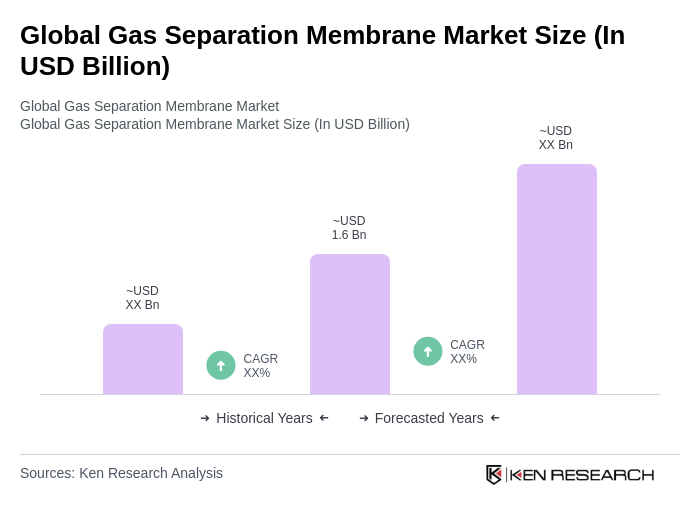
- The Global Gas Separation Membrane Market is valued at USD 1.6 billion, based on a five-year historical analysis. This growth is primarily driven by the increasing demand for efficient gas separation technologies across oil and gas, chemical processing, and environmental applications, where membranes offer energy-efficient and lower-footprint alternatives to cryogenic and absorption systems . The rising focus on reducing carbon emissions and enhancing energy efficiency has further propelled adoption, supported by stricter emissions regulations and decarbonization initiatives in major regions .
- Key players are predominantly located in North America, Europe, and Asia-Pacific. The United States leads with advanced industrial infrastructure and sustained R&D and deployment in natural gas processing, hydrogen recovery, and nitrogen generation, while Germany and Japan remain important due to strong manufacturing bases, specialty polymer capabilities, and emphasis on sustainable industrial processes .
- In 2023, the European Union advanced its Green Deal framework and “Fit for 55” package targeting at least a 55% reduction in net greenhouse gas emissions by 2030 versus 1990 levels, which is spurring adoption of gas separation for CO? removal, biogas upgrading, and low-carbon hydrogen value chains in Europe .
Global Gas Separation Membrane Market Segmentation
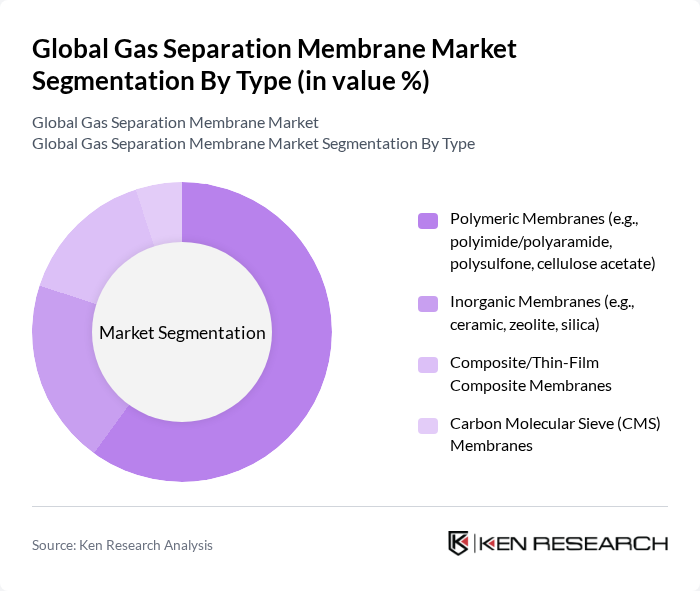
By Type:The gas separation membrane market is segmented into four main types: Polymeric Membranes, Inorganic Membranes, Composite/Thin-Film Composite Membranes, and Carbon Molecular Sieve (CMS) Membranes. Among these,Polymeric Membranesdominate due to cost-effectiveness, versatility, and scalable manufacturing (e.g., cellulose acetate, polysulfone/PES, PVDF, polyimide) and are widely used in natural gas sweetening, nitrogen generation, hydrogen recovery, and biogas upgrading .Inorganicandcomposite/TFCmembranes can offer higher selectivity/temperature resistance for niche separations but are generally higher cost and less prevalent commercially, whileCMS membranesare used where high selectivity for oxygen/nitrogen or hydrocarbon separations is needed .
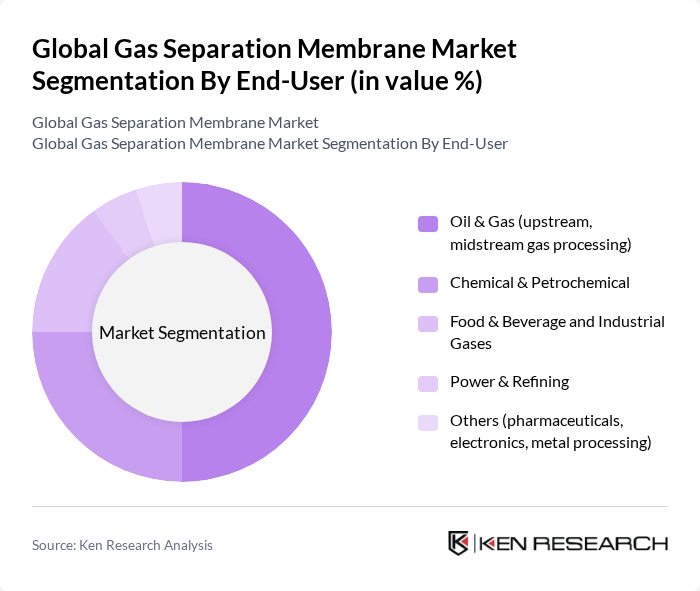
By End-User:The market is segmented by end-user industries, including Oil & Gas, Chemical & Petrochemical, Food & Beverage and Industrial Gases, Power & Refining, and Others.Oil & Gasis the largest consumer, driven by natural gas CO?/H?S removal, nitrogen rejection, and dehydration; theChemical & Petrochemicalsector follows for hydrogen recovery, CO? removal, and hydrocarbon separations;industrial gases and food & beverageuse membranes for nitrogen generation, CO? control, and carbonation;power & refiningdemand is tied to refinery hydrogen management and emerging CCS; other uses span electronics, metals, and pharmaceuticals .
Global Gas Separation Membrane Market Competitive Landscape
The Global Gas Separation Membrane Market features a mix of regional and international players. Leading participants such as Membrane Technology and Research, Inc. (MTR), Air Products and Chemicals, Inc., DIC Corporation, UBE Corporation, Parker Hannifin Corporation, Honeywell International Inc. (UOP), 3M Company, Mitsubishi Chemical Group Corporation, Membrane Solutions LLC, Air Liquide S.A. (Air Liquide Advanced Separations), SUEZ WTS (formerly GE Water) — for industrial gas-related membranes, Evonik Industries AG, The Linde Group (Linde plc), Air Products PRISM Membranes, BASF SE (BASF SE – OASE/SELEXOL related offerings) contribute through product development, installed base expansion, and application diversification across CO? removal, N? generation, and H? recovery .
Global Gas Separation Membrane Market Industry Analysis
Growth Drivers
- Increasing Demand for Natural Gas:The global demand for natural gas is projected to reach approximately 4,100–4,300 billion cubic meters in the near term, driven by its role as a cleaner energy source compared to coal. Countries like the United States and China are leading this surge, with the U.S. expected to produce over 1,100 billion cubic meters. This rising demand necessitates efficient gas separation technologies, propelling the market for gas separation membranes significantly.
- Technological Advancements in Membrane Materials:Innovations in membrane technology, such as the development of polymeric and ceramic membranes, are enhancing separation efficiency. For instance, new materials can achieve gas permeance rates exceeding 10,000 GPU (gas permeation units). These advancements are crucial as industries seek to optimize processes and reduce operational costs, thereby increasing the adoption of gas separation membranes across various sectors.
- Rising Environmental Regulations:Stricter environmental regulations are being implemented globally, with the European Union aiming for a 55% reduction in greenhouse gas emissions compared to baseline levels. This regulatory landscape is pushing industries to adopt cleaner technologies, including gas separation membranes, to comply with emission standards. As a result, the market is witnessing increased investments in membrane technologies that facilitate compliance with these regulations.
Market Challenges
- High Initial Investment Costs:The initial capital required for implementing gas separation membrane systems can be substantial, often exceeding $1.5 million for large-scale applications. This high upfront cost can deter potential adopters, particularly in emerging markets where budget constraints are prevalent. Consequently, this challenge limits the widespread adoption of gas separation technologies despite their long-term operational savings.
- Competition from Alternative Separation Technologies:The gas separation membrane market faces stiff competition from alternative technologies such as cryogenic distillation and adsorption processes. For example, cryogenic separation can achieve efficiencies of up to 99% for certain gases, making it a preferred choice in specific applications. This competition can hinder market growth as industries weigh the benefits of various separation methods against their costs and efficiencies.
Global Gas Separation Membrane Market Future Outlook
The future of the gas separation membrane market appears promising, driven by ongoing technological innovations and increasing environmental awareness. As industries prioritize sustainability, the demand for efficient gas separation solutions is expected to rise. Furthermore, the integration of smart technologies, such as IoT, will enhance operational efficiencies and monitoring capabilities, making gas separation processes more effective and reliable. This trend will likely attract new investments and partnerships, fostering market growth in the coming years.
Market Opportunities
- Expansion in Developing Regions:Developing regions, particularly in Asia-Pacific and Africa, present significant growth opportunities for gas separation membranes. With natural gas consumption in Asia projected to increase by 30% in future, companies can capitalize on this demand by establishing local production facilities and partnerships, enhancing market penetration and accessibility.
- Innovations in Membrane Technology:Continuous innovations in membrane technology, such as the development of mixed-matrix membranes, are creating new market opportunities. These advanced membranes can achieve higher selectivity and permeability, making them suitable for a broader range of applications. Companies investing in R&D can leverage these innovations to differentiate their offerings and capture a larger market share.
Scope of the Report
| Segment | Sub-Segments |
|---|---|
| By Type | Polymeric Membranes (e.g., polyimide/polyaramide, polysulfone, cellulose acetate) Inorganic Membranes (e.g., ceramic, zeolite, silica) Composite/Thin-Film Composite Membranes Carbon Molecular Sieve (CMS) Membranes |
| By End-User | Oil & Gas (upstream, midstream gas processing) Chemical & Petrochemical Food & Beverage and Industrial Gases Power & Refining Others (pharmaceuticals, electronics, metal processing) |
| By Application | Carbon Dioxide Removal (natural gas sweetening, biogas upgrading) Nitrogen Generation/Air Separation Hydrogen Recovery/Purification Oxygen Enrichment and Air Dehydration Vapor/Gas and Hydrocarbon Separation |
| By Material | Polyimide/Polyaramide Polysulfone/Polyethersulfone (PSU/PES) Cellulose Acetate Polyvinylidene Fluoride (PVDF) and Other Fluoropolymers Others (Pebax, PIMs, PDMS) |
| By Module/Configuration | Hollow Fiber Spiral Wound Plate & Frame Others (tubular, capillary) |
| By Region | North America Europe Asia-Pacific Middle East & Africa South America |
| By Price/Performance Tier | Entry Mid Premium Custom/Engineered Systems |
Key Target Audience
Investors and Venture Capitalist Firms
Government and Regulatory Bodies (e.g., U.S. Department of Energy, European Commission)
Manufacturers and Producers
Distributors and Retailers
Technology Providers
Industry Associations (e.g., Gas Processors Association, American Membrane Technology Association)
Financial Institutions
Energy and Environmental Agencies (e.g., International Energy Agency, Environmental Protection Agency)
Players Mentioned in the Report:
Membrane Technology and Research, Inc. (MTR)
Air Products and Chemicals, Inc.
DIC Corporation
UBE Corporation
Parker Hannifin Corporation
Honeywell International Inc. (UOP)
3M Company
Mitsubishi Chemical Group Corporation
Membrane Solutions LLC
Air Liquide S.A. (Air Liquide Advanced Separations)
SUEZ WTS (formerly GE Water) for industrial gas-related membranes
Evonik Industries AG
The Linde Group (Linde plc)
Air Products PRISM Membranes
BASF SE (BASF SE OASE/SELEXOL related offerings)
Table of Contents
Market Assessment Phase
1. Executive Summary and Approach
2. Global Gas Separation Membrane Market Overview
2.1 Key Insights and Strategic Recommendations
2.2 Global Gas Separation Membrane Market Overview
2.3 Definition and Scope
2.4 Evolution of Market Ecosystem
2.5 Timeline of Key Regulatory Milestones
2.6 Value Chain & Stakeholder Mapping
2.7 Business Cycle Analysis
2.8 Policy & Incentive Landscape
3. Global Gas Separation Membrane Market Analysis
3.1 Growth Drivers
3.1.1 Increasing demand for natural gas
3.1.2 Technological advancements in membrane materials
3.1.3 Rising environmental regulations
3.1.4 Growth in industrial applications
3.2 Market Challenges
3.2.1 High initial investment costs
3.2.2 Competition from alternative separation technologies
3.2.3 Limited awareness in emerging markets
3.2.4 Regulatory compliance complexities
3.3 Market Opportunities
3.3.1 Expansion in developing regions
3.3.2 Innovations in membrane technology
3.3.3 Strategic partnerships and collaborations
3.3.4 Increasing focus on renewable energy sources
3.4 Market Trends
3.4.1 Shift towards sustainable gas separation solutions
3.4.2 Integration of IoT in gas separation processes
3.4.3 Customization of membrane solutions
3.4.4 Growth in demand for high-purity gases
3.5 Government Regulation
3.5.1 Emission reduction targets
3.5.2 Safety and quality standards
3.5.3 Incentives for clean technology adoption
3.5.4 Trade regulations affecting imports and exports
4. SWOT Analysis
5. Stakeholder Analysis
6. Porter's Five Forces Analysis
7. Global Gas Separation Membrane Market Market Size, 2019-2024
7.1 By Value
7.2 By Volume
7.3 By Average Selling Price
8. Global Gas Separation Membrane Market Segmentation
8.1 By Type
8.1.1 Polymeric Membranes (e.g., polyimide/polyaramide, polysulfone, cellulose acetate)
8.1.2 Inorganic Membranes (e.g., ceramic, zeolite, silica)
8.1.3 Composite/Thin-Film Composite Membranes
8.1.4 Carbon Molecular Sieve (CMS) Membranes
8.2 By End-User
8.2.1 Oil & Gas (upstream, midstream gas processing)
8.2.2 Chemical & Petrochemical
8.2.3 Food & Beverage and Industrial Gases
8.2.4 Power & Refining
8.2.5 Others (pharmaceuticals, electronics, metal processing)
8.3 By Application
8.3.1 Carbon Dioxide Removal (natural gas sweetening, biogas upgrading)
8.3.2 Nitrogen Generation/Air Separation
8.3.3 Hydrogen Recovery/Purification
8.3.4 Oxygen Enrichment and Air Dehydration
8.3.5 Vapor/Gas and Hydrocarbon Separation
8.4 By Material
8.4.1 Polyimide/Polyaramide
8.4.2 Polysulfone/Polyethersulfone (PSU/PES)
8.4.3 Cellulose Acetate
8.4.4 Polyvinylidene Fluoride (PVDF) and Other Fluoropolymers
8.4.5 Others (Pebax, PIMs, PDMS)
8.5 By Module/Configuration
8.5.1 Hollow Fiber
8.5.2 Spiral Wound
8.5.3 Plate & Frame
8.5.4 Others (tubular, capillary)
8.6 By Region
8.6.1 North America
8.6.2 Europe
8.6.3 Asia-Pacific
8.6.4 Middle East & Africa
8.6.5 South America
8.7 By Price/Performance Tier
8.7.1 Entry
8.7.2 Mid
8.7.3 Premium
8.7.4 Custom/Engineered Systems
9. Global Gas Separation Membrane Market Competitive Analysis
9.1 Market Share of Key Players
9.2 Cross Comparison of Key Players
9.2.1 Company Name
9.2.2 Group Size (Large, Medium, Small)
9.2.3 Revenue from Gas Separation Membranes (USD, latest FY)
9.2.4 Installed Membrane Capacity/Throughput (kNm³/h or MMSCFD equivalent)
9.2.5 Project Backlog and New Orders (number/value)
9.2.6 Geographic Footprint (regions served, export share %)
9.2.7 Application Mix (% of CO? removal, N? generation, H? recovery, others)
9.2.8 Module Portfolio Breadth (hollow fiber, spiral wound, plate & frame)
9.2.9 R&D Intensity (% of revenue; active patents/patent families)
9.2.10 Certification & Compliance (ATEX, ISO 9001/14001, PED/ASME)
9.2.11 Average Lead Time (weeks) and On-time Delivery (%)
9.2.12 Field Performance KPIs (recovery %, selectivity, uptime %)
9.2.13 Service Network Depth (install base, service centers, O&M contracts)
9.2.14 Strategic Moves (M&A, capacity expansions, partnerships in last 24 months)
9.3 SWOT Analysis of Top Players
9.4 Pricing Analysis
9.5 Detailed Profile of Major Companies
9.5.1 Membrane Technology and Research, Inc. (MTR)
9.5.2 Air Products and Chemicals, Inc.
9.5.3 DIC Corporation
9.5.4 UBE Corporation
9.5.5 Parker Hannifin Corporation
9.5.6 Honeywell International Inc. (UOP)
9.5.7 3M Company
9.5.8 Mitsubishi Chemical Group Corporation
9.5.9 Membrane Solutions LLC
9.5.10 Air Liquide S.A. (Air Liquide Advanced Separations)
9.5.11 SUEZ WTS (formerly GE Water) — for industrial gas-related membranes
9.5.12 Evonik Industries AG
9.5.13 The Linde Group (Linde plc)
9.5.14 Air Products PRISM Membranes
9.5.15 BASF SE (BASF SE – OASE/SELEXOL related offerings)
10. Global Gas Separation Membrane Market End-User Analysis
10.1 Procurement Behavior of Key Ministries
10.1.1 Government procurement policies
10.1.2 Budget allocation trends
10.1.3 Decision-making processes
10.2 Corporate Spend on Infrastructure & Energy
10.2.1 Investment trends in gas separation technologies
10.2.2 Budget priorities for energy efficiency
10.2.3 Corporate sustainability initiatives
10.3 Pain Point Analysis by End-User Category
10.3.1 Cost management challenges
10.3.2 Technology integration issues
10.3.3 Regulatory compliance difficulties
10.4 User Readiness for Adoption
10.4.1 Awareness of gas separation technologies
10.4.2 Training and skill development needs
10.4.3 Financial readiness for investment
10.5 Post-Deployment ROI and Use Case Expansion
10.5.1 Performance metrics tracking
10.5.2 Case studies of successful implementations
10.5.3 Future expansion opportunities
11. Global Gas Separation Membrane Market Future Size, 2025-2030
11.1 By Value
11.2 By Volume
11.3 By Average Selling Price
Go-To-Market Strategy Phase
1. Whitespace Analysis + Business Model Canvas
1.1 Market gaps identification
1.2 Business model evaluation
2. Marketing and Positioning Recommendations
2.1 Branding strategies
2.2 Product USPs
3. Distribution Plan
3.1 Urban retail vs rural NGO tie-ups
4. Channel & Pricing Gaps
4.1 Underserved routes
4.2 Pricing bands
5. Unmet Demand & Latent Needs
5.1 Category gaps
5.2 Consumer segments
6. Customer Relationship
6.1 Loyalty programs
6.2 After-sales service
7. Value Proposition
7.1 Sustainability
7.2 Integrated supply chains
8. Key Activities
8.1 Regulatory compliance
8.2 Branding
8.3 Distribution setup
9. Entry Strategy Evaluation
9.1 Domestic Market Entry Strategy
9.1.1 Product mix
9.1.2 Pricing band
9.1.3 Packaging
9.2 Export Entry Strategy
9.2.1 Target countries
9.2.2 Compliance roadmap
10. Entry Mode Assessment
10.1 JV
10.2 Greenfield
10.3 M&A
10.4 Distributor Model
11. Capital and Timeline Estimation
11.1 Capital requirements
11.2 Timelines
12. Control vs Risk Trade-Off
12.1 Ownership vs Partnerships
13. Profitability Outlook
13.1 Breakeven analysis
13.2 Long-term sustainability
14. Potential Partner List
14.1 Distributors
14.2 JVs
14.3 Acquisition targets
15. Execution Roadmap
15.1 Phased Plan for Market Entry
15.1.1 Market Setup
15.1.2 Market Entry
15.1.3 Growth Acceleration
15.1.4 Scale & Stabilize
15.2 Key Activities and Milestones
15.2.1 Milestone tracking
15.2.2 Activity scheduling
Research Methodology
Phase 1: Approach1
Desk Research
- Industry reports from global gas separation membrane associations and organizations
- Market analysis publications from leading research firms focusing on membrane technology
- Technical papers and patents related to gas separation membrane innovations
Primary Research
- Interviews with R&D heads at membrane manufacturing companies
- Surveys with end-users in industries such as natural gas processing and petrochemicals
- Field interviews with engineers and project managers involved in membrane installations
Validation & Triangulation
- Cross-validation of market data through multiple industry sources and expert opinions
- Triangulation of findings from primary interviews and secondary data sources
- Sanity checks through expert panel discussions and feedback loops
Phase 2: Market Size Estimation1
Top-down Assessment
- Global market size derived from macroeconomic indicators and energy sector growth
- Segmentation by application areas such as hydrogen recovery, CO2 removal, and nitrogen generation
- Incorporation of regional market dynamics and regulatory impacts on membrane adoption
Bottom-up Modeling
- Volume estimates based on production capacities of leading membrane manufacturers
- Cost analysis derived from material and operational expenses associated with membrane technology
- Market share calculations based on sales data from key players in the gas separation sector
Forecasting & Scenario Analysis
- Multi-variable forecasting using trends in energy transition and carbon capture initiatives
- Scenario modeling based on potential regulatory changes and technological advancements
- Baseline, optimistic, and pessimistic forecasts through 2035, considering market volatility
Phase 3: CATI Sample Composition1
| Scope Item/Segment | Sample Size | Target Respondent Profiles |
|---|---|---|
| Natural Gas Processing | 100 | Process Engineers, Operations Managers |
| Petrochemical Applications | 80 | Product Development Managers, Technical Directors |
| Hydrogen Production | 70 | R&D Scientists, Project Engineers |
| CO2 Capture Technologies | 60 | Environmental Engineers, Compliance Officers |
| Industrial Gas Separation | 90 | Supply Chain Managers, Procurement Specialists |
Frequently Asked Questions
What is the current value of the Global Gas Separation Membrane Market?
The Global Gas Separation Membrane Market is valued at approximately USD 1.6 billion, driven by the increasing demand for efficient gas separation technologies across various industries, including oil and gas, chemical processing, and environmental applications.
What are the main types of gas separation membranes?
Which industries are the largest consumers of gas separation membranes?
What are the growth drivers for the gas separation membrane market?
Other Regional/Country Reports
Indonesia Gas Separation Membrane Market
Malaysia Gas Separation Membrane Market
APAC Gas Separation Membrane Market
SEA Gas Separation Membrane Market
Why Buy From Us?

What makes us stand out is that our consultants follow Robust, Refine and Result (RRR) methodology. Robust for clear definitions, approaches and sanity checking, Refine for differentiating respondents' facts and opinions, and Result for presenting data with story.

We have set a benchmark in the industry by offering our clients with syndicated and customized market research reports featuring coverage of entire market as well as meticulous research and analyst insights.

While we don't replace traditional research, we flip the method upside down. Our dual approach of Top Bottom & Bottom Top ensures quality deliverable by not just verifying company fundamentals but also looking at the sector and macroeconomic factors.

With one step in the future, our research team constantly tries to show you the bigger picture. We help with some of the tough questions you may encounter along the way: How is the industry positioned? Best marketing channel? KPI's of competitors? By aligning every element, we help maximize success.

Our report gives you instant access to the answers and sources that other companies might choose to hide. We elaborate each steps of research methodology we have used and showcase you the sample size to earn your trust.

If you need any support, we are here! We pride ourselves on universe strength, data quality, and quick, friendly, and professional service.