Global Gluten Free Prepared Foods Market

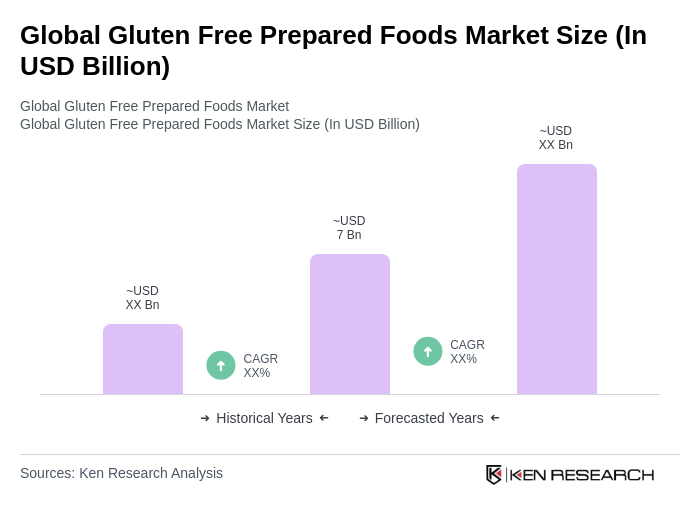
The global gluten free prepared foods market, valued at USD 7 billion, is driven by rising health consciousness and demand for convenient gluten-free options, with strong growth in North America and Europe.

Region:Global

Author(s):Dev

Product Code:KRAD0473

Pages:98

Published On:August 2025
About the Report

Base Year 2024

Global Gluten Free Prepared Foods Market Overview

  • The Global Gluten Free Prepared Foods Market is valued at USD 7 billion, based on a five-year historical analysis. Independent industry sources place the global gluten free prepared foods category around the lower-to-mid single-digit billions, with estimates aligning near USD 7 billion for the prepared foods subset within the broader gluten free foods market. Rising prevalence of celiac disease and non-celiac gluten sensitivity, along with health-oriented eating, continue to drive demand.
  • Key players in this market include the United States, Canada, and Germany, which dominate due to advanced food processing, high awareness, and well-developed retail ecosystems. North America is consistently identified as the largest regional market for gluten free foods, supported by mainstream retail penetration and strong consumer awareness; Europe (including Germany) also holds a major share supported by stringent standards and mature brands.
  • The U.S. Food and Drug Administration’s gluten-free labeling rule requires that foods labeled “gluten-free” contain less than 20 parts per million of gluten; this threshold has been the federal standard since 2013 and remains in force, with FDA updates and enforcement actions reinforcing compliance for foods and for fermented/hydrolyzed foods.
Global Gluten Free Prepared Foods Market Size

Global Gluten Free Prepared Foods Market Segmentation

By Type:The gluten-free prepared foods market is segmented into various types, including ready meals & frozen entrées, soups, sauces & gravies, pasta & noodles, pizza & savory breads, breakfast & cereals, snacks & savory bites, bakery & desserts, and others. Among these, ready meals & frozen entrées are leading the market due to convenience and rising demand for quick, health-oriented meal solutions. Increasing assortment and availability of gluten-free convenient foods via retail and e-commerce are key contributors to category leadership.
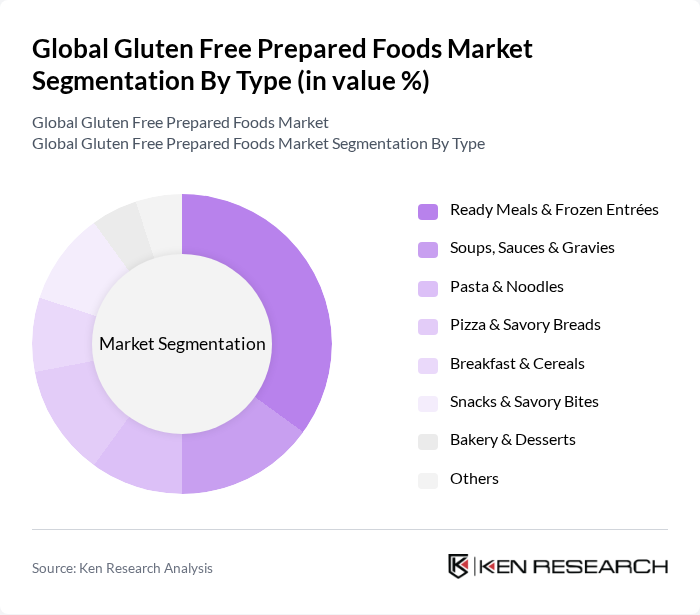
Global Gluten Free Prepared Foods Market segmentation by Type.

By End-User:The market is also segmented by end-user, which includes retail/at-home consumption, foodservice (QSRs, cafés, restaurants), and healthcare & institutional catering. Retail/at-home consumption is the dominant segment, supported by strong supermarket presence, private label expansion, and rapid growth of e-commerce making gluten-free prepared options widely accessible for home use.
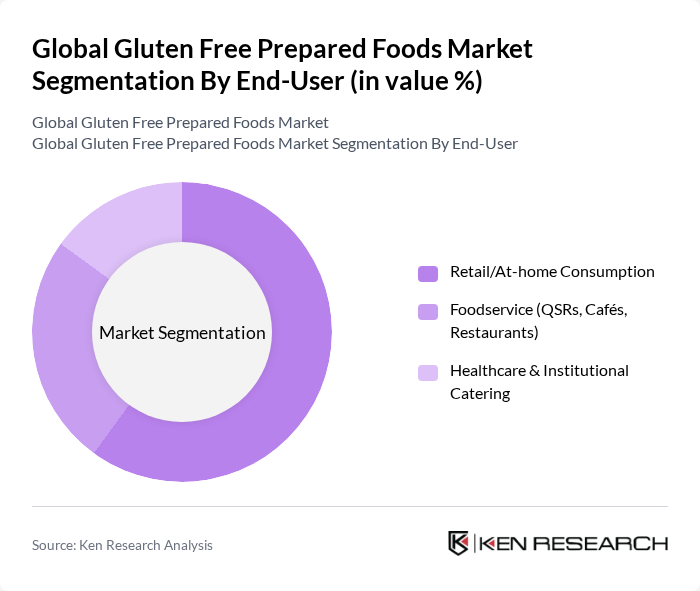
Global Gluten Free Prepared Foods Market segmentation by End-User.

Global Gluten Free Prepared Foods Market Competitive Landscape

The Global Gluten Free Prepared Foods Market is characterized by a dynamic mix of regional and international players. Leading participants such as General Mills, Inc. (Chex, Progresso, Old El Paso), The Kellogg Company (Kellogg’s, Kashi), Conagra Brands, Inc. (Birds Eye, Healthy Choice), Dr. Schär AG/SPA, B&G Foods, Inc. (Cream of Rice), Enjoy Life Foods, LLC, Glutino (a brand of Boulder Brands/Conagra), Udi’s Gluten Free (a brand of Conagra), Amy’s Kitchen, Inc., Schär USA, Inc., The Hain Celestial Group, Inc. (Terra, Celestial), Free2b Foods, Simply Good Foods Co. (Atkins, Quest), Against the Grain Gourmet, Barilla Group (Gluten Free Pasta & Ready Meals) contribute to innovation, geographic expansion, and service delivery in this space.

General Mills, Inc.

1928

Minneapolis, Minnesota, USA

The Kellogg Company

1906

Battle Creek, Michigan, USA

Conagra Brands, Inc.

1919

Chicago, Illinois, USA

Dr. Schär AG/SPA

1922

Burgstall (Postal), South Tyrol, Italy

B&G Foods, Inc.

1996

Parsippany, New Jersey, USA

Company

Establishment Year

Headquarters

Company Size (Large/Medium/Small by global revenue)

Gluten-Free Prepared Foods Revenue (latest FY, USD)

Revenue Growth Rate (CAGR in prepared foods)

Geographic Footprint (no. of countries/regions served)

Product Portfolio Breadth (no. of SKUs/categories)

Innovation Rate (new launches/patents/claims per year)

Global Gluten Free Prepared Foods Market Industry Analysis

Growth Drivers

  • Increasing Health Awareness:The global health consciousness is rising, with 70% of consumers actively seeking healthier food options. This trend is supported by the World Health Organization's report indicating that 39% of adults are overweight, prompting dietary changes. In future, the health food market is projected to reach $1.1 trillion, with gluten-free products gaining traction as consumers prioritize wellness and nutrition, driving demand for gluten-free prepared foods significantly.
  • Rising Demand for Gluten-Free Products:The gluten-free food sector is experiencing robust growth, with sales reaching $5.6 billion. This surge is driven by the increasing prevalence of celiac disease, affecting approximately 1 in 100 individuals globally. Additionally, the gluten-free lifestyle is being adopted by non-celiac consumers, with 30% of the population actively choosing gluten-free options, further propelling market expansion in future and beyond.
  • Expansion of Distribution Channels:The distribution landscape for gluten-free products is evolving, with e-commerce sales projected to grow by 20%, reaching $1.2 billion. Retailers are increasingly stocking gluten-free options, with 60% of grocery stores now offering dedicated gluten-free sections. This accessibility is crucial for meeting consumer demand, as 50% of gluten-free consumers report difficulty finding products, highlighting the importance of expanded distribution channels in driving market growth.

Market Challenges

  • High Production Costs:The production of gluten-free prepared foods often incurs higher costs, with raw materials priced 20-30% above their gluten-containing counterparts. This is due to the need for specialized ingredients and manufacturing processes to avoid cross-contamination. As a result, profit margins can be significantly impacted, making it challenging for manufacturers to maintain competitive pricing while ensuring product quality and safety in future.
  • Limited Consumer Awareness:Despite the growing market, consumer awareness remains a challenge, with 40% of potential customers unaware of gluten-free options. This lack of knowledge can hinder market penetration, as many consumers do not understand the benefits of gluten-free diets. Educational initiatives and marketing strategies are essential to bridge this gap, especially as the market aims to reach a broader audience in future and beyond.

Global Gluten Free Prepared Foods Market Future Outlook

The future of the gluten-free prepared foods market appears promising, driven by increasing health awareness and the expansion of distribution channels. Innovations in product offerings, such as clean label and plant-based options, are expected to attract a wider consumer base. Additionally, the rise of e-commerce will facilitate easier access to gluten-free products, enhancing market growth. As consumer preferences evolve, companies that adapt to these trends will likely thrive in the competitive landscape in future.

Market Opportunities

  • Growth in E-commerce:The e-commerce sector for gluten-free products is set to expand significantly, with online sales projected to reach $1.2 billion. This growth presents an opportunity for brands to enhance their online presence and cater to the increasing number of consumers preferring online shopping for convenience and variety.
  • Increasing Vegan and Plant-Based Options:The demand for vegan and plant-based gluten-free products is on the rise, with the market expected to grow by 15%. This trend aligns with the broader shift towards plant-based diets, providing manufacturers with the opportunity to innovate and diversify their product lines to meet consumer preferences.

Scope of the Report

SegmentSub-Segments
By Type

Ready Meals & Frozen Entrées

Soups, Sauces & Gravies

Pasta & Noodles

Pizza & Savory Breads

Breakfast & Cereals

Snacks & Savory Bites

Bakery & Desserts

Others

By End-User

Retail/At-home Consumption

Foodservice (QSRs, Cafés, Restaurants)

Healthcare & Institutional Catering

By Distribution Channel

Supermarkets/Hypermarkets

Online Retail/E-commerce

Specialty Health & Natural Food Stores

Convenience & Forecourt Stores

By Region

North America

Europe

Asia-Pacific

Latin America

Middle East & Africa

By Price Range

Premium

Mid-Range

Economy

By Packaging Type

Flexible Packaging (pouches, film, bags)

Rigid Packaging (trays, tubs, cans)

Bulk/Foodservice Packs

By Product Form

Frozen

Shelf-Stable/Ambient

Refrigerated/Chilled

Key Target Audience

Investors and Venture Capitalist Firms

Government and Regulatory Bodies (e.g., Food and Drug Administration, European Food Safety Authority)

Manufacturers and Producers

Distributors and Retailers

Food Service Operators

Health and Wellness Organizations

Importers and Exporters

Market Analysts and Industry Experts

Players Mentioned in the Report:

General Mills, Inc. (Chex, Progresso, Old El Paso)

The Kellogg Company (Kelloggs, Kashi)

Conagra Brands, Inc. (Birds Eye, Healthy Choice)

Dr. Schar AG/SPA

B&G Foods, Inc. (Cream of Rice)

Enjoy Life Foods, LLC

Glutino (a brand of Boulder Brands/Conagra)

Udis Gluten Free (a brand of Conagra)

Amys Kitchen, Inc.

Schar USA, Inc.

The Hain Celestial Group, Inc. (Terra, Celestial)

Free2b Foods

Simply Good Foods Co. (Atkins, Quest)

Against the Grain Gourmet

Barilla Group (Gluten Free Pasta & Ready Meals)

Table of Contents

Market Assessment Phase

1. Executive Summary and Approach


2. Global Gluten Free Prepared Foods Market Overview

2.1 Key Insights and Strategic Recommendations

2.2 Global Gluten Free Prepared Foods Market Overview

2.3 Definition and Scope

2.4 Evolution of Market Ecosystem

2.5 Timeline of Key Regulatory Milestones

2.6 Value Chain & Stakeholder Mapping

2.7 Business Cycle Analysis

2.8 Policy & Incentive Landscape


3. Global Gluten Free Prepared Foods Market Analysis

3.1 Growth Drivers

3.1.1 Increasing Health Awareness
3.1.2 Rising Demand for Gluten-Free Products
3.1.3 Expansion of Distribution Channels
3.1.4 Innovations in Product Offerings

3.2 Market Challenges

3.2.1 High Production Costs
3.2.2 Limited Consumer Awareness
3.2.3 Risk of Cross-Contamination
3.2.4 Regulatory Compliance Issues

3.3 Market Opportunities

3.3.1 Growth in E-commerce
3.3.2 Increasing Vegan and Plant-Based Options
3.3.3 Expansion into Emerging Markets
3.3.4 Collaborations with Health Institutions

3.4 Market Trends

3.4.1 Rise of Clean Label Products
3.4.2 Increased Focus on Sustainability
3.4.3 Customization of Gluten-Free Products
3.4.4 Growth of Online Communities and Support Groups

3.5 Government Regulation

3.5.1 Labeling Requirements for Gluten-Free Products
3.5.2 Food Safety Standards
3.5.3 Import Regulations for Gluten-Free Ingredients
3.5.4 Nutritional Guidelines for Gluten-Free Foods

4. SWOT Analysis


5. Stakeholder Analysis


6. Porter's Five Forces Analysis


7. Global Gluten Free Prepared Foods Market Market Size, 2019-2024

7.1 By Value

7.2 By Volume

7.3 By Average Selling Price


8. Global Gluten Free Prepared Foods Market Segmentation

8.1 By Type

8.1.1 Ready Meals & Frozen Entrées
8.1.2 Soups, Sauces & Gravies
8.1.3 Pasta & Noodles
8.1.4 Pizza & Savory Breads
8.1.5 Breakfast & Cereals
8.1.6 Snacks & Savory Bites
8.1.7 Bakery & Desserts
8.1.8 Others

8.2 By End-User

8.2.1 Retail/At-home Consumption
8.2.2 Foodservice (QSRs, Cafés, Restaurants)
8.2.3 Healthcare & Institutional Catering

8.3 By Distribution Channel

8.3.1 Supermarkets/Hypermarkets
8.3.2 Online Retail/E-commerce
8.3.3 Specialty Health & Natural Food Stores
8.3.4 Convenience & Forecourt Stores

8.4 By Region

8.4.1 North America
8.4.2 Europe
8.4.3 Asia-Pacific
8.4.4 Latin America
8.4.5 Middle East & Africa

8.5 By Price Range

8.5.1 Premium
8.5.2 Mid-Range
8.5.3 Economy

8.6 By Packaging Type

8.6.1 Flexible Packaging (pouches, film, bags)
8.6.2 Rigid Packaging (trays, tubs, cans)
8.6.3 Bulk/Foodservice Packs

8.7 By Product Form

8.7.1 Frozen
8.7.2 Shelf-Stable/Ambient
8.7.3 Refrigerated/Chilled

9. Global Gluten Free Prepared Foods Market Competitive Analysis

9.1 Market Share of Key Players

9.2 Cross Comparison of Key Players

9.2.1 Company Name
9.2.2 Company Size (Large/Medium/Small by global revenue)
9.2.3 Gluten-Free Prepared Foods Revenue (latest FY, USD)
9.2.4 Revenue Growth Rate (CAGR in prepared foods)
9.2.5 Geographic Footprint (no. of countries/regions served)
9.2.6 Product Portfolio Breadth (no. of SKUs/categories)
9.2.7 Innovation Rate (new launches/patents/claims per year)
9.2.8 Certification Coverage (GFCO/Coeliac UK/Non-GMO/Organic)
9.2.9 Distribution Reach (key channels: grocery, e-commerce, foodservice)
9.2.10 Brand Awareness/Share of Voice (social, search, retail media)
9.2.11 Average Price Positioning (premium/mid/economy index)
9.2.12 Private Label vs Branded Mix (%)

9.3 SWOT Analysis of Top Players

9.4 Pricing Analysis

9.5 Detailed Profile of Major Companies

9.5.1 General Mills, Inc. (Chex, Progresso, Old El Paso)
9.5.2 The Kellogg Company (Kellogg’s, Kashi)
9.5.3 Conagra Brands, Inc. (Birds Eye, Healthy Choice)
9.5.4 Dr. Schär AG/SPA
9.5.5 B&G Foods, Inc. (Cream of Rice)
9.5.6 Enjoy Life Foods, LLC
9.5.7 Glutino (a brand of Boulder Brands/Conagra)
9.5.8 Udi’s Gluten Free (a brand of Conagra)
9.5.9 Amy’s Kitchen, Inc.
9.5.10 Schär USA, Inc.
9.5.11 The Hain Celestial Group, Inc. (Terra, Celestial)
9.5.12 Free2b Foods
9.5.13 Simply Good Foods Co. (Atkins, Quest)
9.5.14 Against the Grain Gourmet
9.5.15 Barilla Group (Gluten Free Pasta & Ready Meals)

10. Global Gluten Free Prepared Foods Market End-User Analysis

10.1 Procurement Behavior of Key Ministries

10.1.1 Government Health Programs
10.1.2 School Nutrition Programs
10.1.3 Public Health Initiatives

10.2 Corporate Spend on Infrastructure & Energy

10.2.1 Investment in Gluten-Free Facilities
10.2.2 Funding for Research and Development
10.2.3 Budget Allocation for Marketing

10.3 Pain Point Analysis by End-User Category

10.3.1 Accessibility of Gluten-Free Products
10.3.2 Affordability Concerns
10.3.3 Quality and Taste Issues

10.4 User Readiness for Adoption

10.4.1 Awareness of Gluten-Free Options
10.4.2 Willingness to Pay a Premium
10.4.3 Availability of Information

10.5 Post-Deployment ROI and Use Case Expansion

10.5.1 Customer Satisfaction Metrics
10.5.2 Repeat Purchase Rates
10.5.3 Expansion into New Markets

11. Global Gluten Free Prepared Foods Market Future Size, 2025-2030

11.1 By Value

11.2 By Volume

11.3 By Average Selling Price


Go-To-Market Strategy Phase

1. Whitespace Analysis + Business Model Canvas

1.1 Market Gaps Identification

1.2 Business Model Framework


2. Marketing and Positioning Recommendations

2.1 Branding Strategies

2.2 Product USPs


3. Distribution Plan

3.1 Urban Retail Strategies

3.2 Rural NGO Tie-ups


4. Channel & Pricing Gaps

4.1 Underserved Routes

4.2 Pricing Bands


5. Unmet Demand & Latent Needs

5.1 Category Gaps

5.2 Consumer Segments


6. Customer Relationship

6.1 Loyalty Programs

6.2 After-sales Service


7. Value Proposition

7.1 Sustainability Initiatives

7.2 Integrated Supply Chains


8. Key Activities

8.1 Regulatory Compliance

8.2 Branding Efforts

8.3 Distribution Setup


9. Entry Strategy Evaluation

9.1 Domestic Market Entry Strategy

9.1.1 Product Mix Considerations
9.1.2 Pricing Band Strategy
9.1.3 Packaging Innovations

9.2 Export Entry Strategy

9.2.1 Target Countries
9.2.2 Compliance Roadmap

10. Entry Mode Assessment

10.1 Joint Ventures

10.2 Greenfield Investments

10.3 Mergers & Acquisitions

10.4 Distributor Model


11. Capital and Timeline Estimation

11.1 Capital Requirements

11.2 Timelines for Implementation


12. Control vs Risk Trade-Off

12.1 Ownership Considerations

12.2 Partnerships Evaluation


13. Profitability Outlook

13.1 Breakeven Analysis

13.2 Long-term Sustainability


14. Potential Partner List

14.1 Distributors

14.2 Joint Ventures

14.3 Acquisition Targets


15. Execution Roadmap

15.1 Phased Plan for Market Entry

15.1.1 Market Setup
15.1.2 Market Entry
15.1.3 Growth Acceleration
15.1.4 Scale & Stabilize

15.2 Key Activities and Milestones

15.2.1 Milestone Planning
15.2.2 Activity Tracking

Research Methodology

ApproachModellingSample

Phase 1: Approach1

Desk Research

  • Analysis of market reports from industry associations such as the Gluten Intolerance Group and the Celiac Disease Foundation
  • Review of published articles and white papers on gluten-free trends in food technology and consumer behavior
  • Examination of government publications and dietary guidelines related to gluten-free products

Primary Research

  • Interviews with product development managers at leading gluten-free food manufacturers
  • Surveys with nutritionists and dietitians specializing in gluten-free diets
  • Focus groups with consumers who follow gluten-free diets to understand preferences and purchasing behavior

Validation & Triangulation

  • Cross-validation of findings through multiple data sources, including sales data and consumer surveys
  • Triangulation of insights from industry experts, market analysts, and consumer feedback
  • Sanity checks through expert panel reviews to ensure data accuracy and relevance

Phase 2: Market Size Estimation1

Top-down Assessment

  • Estimation of the gluten-free market size based on overall food industry growth rates and gluten-free product penetration
  • Segmentation of the market by product type, including snacks, meals, and baked goods
  • Incorporation of demographic trends and health awareness impacting gluten-free consumption

Bottom-up Modeling

  • Collection of sales data from key gluten-free product manufacturers and retailers
  • Estimation of average selling prices and volume sold across various distribution channels
  • Analysis of consumer spending patterns on gluten-free products through retail audits

Forecasting & Scenario Analysis

  • Utilization of time-series analysis to project future market growth based on historical data
  • Scenario modeling based on potential changes in consumer health trends and regulatory impacts
  • Development of baseline, optimistic, and pessimistic forecasts through 2030

Phase 3: CATI Sample Composition1

Scope Item/SegmentSample SizeTarget Respondent Profiles
Gluten-Free Snack Products120Product Managers, Marketing Directors
Gluten-Free Meal Kits100Consumer Insights Analysts, Culinary Experts
Gluten-Free Baked Goods80Bakery Owners, Food Technologists
Health Food Retailers110Store Managers, Category Buyers
Online Gluten-Free Product Sales90E-commerce Managers, Digital Marketing Specialists

Frequently Asked Questions

What is the current value of the Global Gluten Free Prepared Foods Market?

The Global Gluten Free Prepared Foods Market is valued at approximately USD 7 billion, based on a five-year historical analysis. This figure represents a subset of the broader gluten-free foods market, which is experiencing significant growth due to rising health awareness and dietary preferences.

Which regions dominate the Gluten Free Prepared Foods Market?

What are the main types of gluten-free prepared foods?

What factors are driving the growth of the gluten-free prepared foods market?

Other Regional/Country Reports

UAE Gluten Free Prepared Foods MarketKSA Gluten Free Prepared Foods Market

Indonesia Gluten Free Prepared Foods Market

Malaysia Gluten Free Prepared Foods Market

APAC Gluten Free Prepared Foods Market

SEA Gluten Free Prepared Foods Market

Why Buy From Us?

Refine Robust Result (RRR) Framework

What makes us stand out is that our consultants follow Robust, Refine and Result (RRR) methodology. Robust for clear definitions, approaches and sanity checking, Refine for differentiating respondents' facts and opinions, and Result for presenting data with story.

Our Reach Is Unmatched

We have set a benchmark in the industry by offering our clients with syndicated and customized market research reports featuring coverage of entire market as well as meticulous research and analyst insights.

Shifting the Research Paradigm

While we don't replace traditional research, we flip the method upside down. Our dual approach of Top Bottom & Bottom Top ensures quality deliverable by not just verifying company fundamentals but also looking at the sector and macroeconomic factors.

More Insights-Better Decisions

With one step in the future, our research team constantly tries to show you the bigger picture. We help with some of the tough questions you may encounter along the way: How is the industry positioned? Best marketing channel? KPI's of competitors? By aligning every element, we help maximize success.

Transparency and Trust

Our report gives you instant access to the answers and sources that other companies might choose to hide. We elaborate each steps of research methodology we have used and showcase you the sample size to earn your trust.

Round the Clock Support

If you need any support, we are here! We pride ourselves on universe strength, data quality, and quick, friendly, and professional service.

Why Clients Choose Us?

400000+
Reports in repository
150+
Consulting projects a year
100+
Analysts
8000+
Client Queries in 2022








