About the Report
Base Year 2024Global Golf Trolley Market Overview
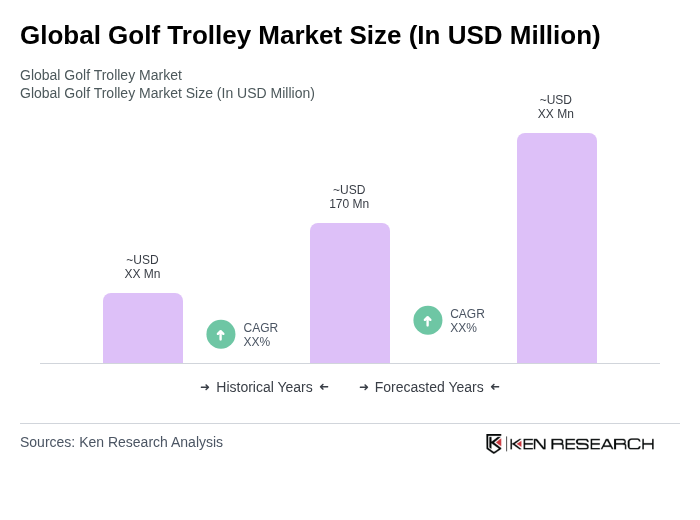
- The Global Golf Trolley Market is valued at USD 170 million, based on a five-year historical analysis of leading industry sources. This growth is primarily driven by the increasing popularity of golf as a leisure and competitive activity and the expanding global golfer base, especially among women, youth, and senior players. Advancements in technology such as lighter materials, lithium batteries, GPS integration, remote-control and follow-me features, as well as rising disposable income and the growth of golf tourism, have further enhanced the functionality, convenience, and demand for golf trolleys.
- Countries such as the United States, the United Kingdom, and Japan dominate the Global Golf Trolley Market due to their established golf cultures and extensive golf course infrastructure. North America and Europe together account for the largest share of golf trolley demand, supported by a high concentration of golf courses, strong club memberships, and a significant population of amateur and professional golfers. Additionally, these regions benefit from well-developed retail and online distribution channels for golf equipment, making it easier for consumers to access a wide range of trolley products.
- In recent years, several governments have advanced policies that indirectly promote the use of electric golf trolleys as part of broader environmental sustainability and clean mobility agendas. For example, in the United States, the Inflation Reduction Act, 2022, enacted by the U.S. Congress, provides federal tax credits for qualifying electric vehicles and certain electric equipment, encouraging manufacturers and consumers to adopt battery-powered, low-emission technologies, which supports the development of more energy-efficient electric golf trolleys. In the European Union, Regulation (EU) 2019/631 of the European Parliament and of the Council setting CO? emission performance standards for new passenger cars and light commercial vehicles drives OEMs and suppliers to innovate in lightweight, energy-efficient electric drive systems, which are increasingly applied in compact mobility products including electric golf trolleys. These measures aim to reduce carbon emissions and promote greener practices within the golfing community by accelerating the shift toward battery-powered and eco-friendly trolley designs.
Global Golf Trolley Market Segmentation
By Product Type:The product type segmentation includes Manual Golf Trolleys, Electric Golf Trolleys, Remote-Controlled Golf Trolleys, Push/Pull Golf Trolleys, and Others. This structure aligns with the established industry categorization of manual, electric, remote-controlled, and push/pull trolleys used by both amateurs and professionals. Among these, Electric Golf Trolleys are gaining significant traction due to their convenience, reduced physical strain, and suitability for older or mobility-conscious golfers, while remote-controlled and follow-me variants appeal to tech-oriented users. The trend towards automation, longer-lasting lithium batteries, smart control systems, and integration with GPS or mobile apps is driving demand for electric and remote-controlled models, which are increasingly preferred for their efficiency, ergonomic advantages, and user-friendly features.

By Application:The application segmentation consists of Commercial and Non-Commercial (Individual/Leisure Use). This split is consistent with industry practice, where golf clubs, resorts, and courses represent institutional or commercial demand, and individual golfers represent personal or leisure purchases. The Commercial segment is witnessing robust growth as golf clubs and facilities increasingly invest in high-quality electric and remote-controlled trolleys, often as rental fleets, to enhance the golfing experience and differentiate their services for members and guests. The demand for Non-Commercial applications is also significant, driven by amateur and leisure golfers seeking convenience, reduced fatigue, and improved course mobility, with many opting for lightweight push/pull or compact electric models for personal ownership.

Global Golf Trolley Market Competitive Landscape
The Global Golf Trolley Market is characterized by a dynamic mix of regional and international players. Leading participants such as Motocaddy, PowaKaddy, Sun Mountain Sports, Clicgear, Bag Boy Company, BIG MAX Golf, Stewart Golf, Hill Billy Trolleys, Bat-Caddy, Strong Caddy, Axglo, Ben Sayers, Golfstream, JuCad, MGI Golf contribute to innovation, geographic expansion, product customization, and premium service delivery in this space, with a strong focus on electric and remote-controlled trolley technologies.
Global Golf Trolley Market Industry Analysis
Growth Drivers
- Increasing Popularity of Golf as a Leisure Activity:The global golf participation rate has surged, with approximately 25 million people playing golf in the U.S. alone in future, according to the National Golf Foundation. This trend is supported by a growing interest in outdoor activities, particularly among millennials and Gen Z, who are increasingly seeking leisure activities that promote health and wellness. The rise in golf tourism, with the global golf tourism market valued at $22 billion in future, further fuels demand for golf trolleys.
- Technological Advancements in Golf Trolley Design:The golf trolley market is witnessing significant innovation, with electric trolleys equipped with advanced features such as remote control and GPS navigation. In future, the market for electric golf trolleys was estimated at $1.6 billion, driven by consumer demand for convenience and enhanced performance. The integration of smart technology, including mobile app connectivity, is expected to attract tech-savvy golfers, further propelling market growth as these features become standard in new models.
- Rising Disposable Income Among Consumers:As global economies recover post-pandemic, disposable income levels are projected to rise. In future, the World Bank anticipates a 3.5% increase in global GDP, which will enhance consumer spending power. This economic growth is particularly evident in emerging markets, where increased affluence is leading to higher participation in leisure activities like golf. Consequently, more consumers are likely to invest in premium golf trolleys, boosting overall market demand.
Market Challenges
- High Initial Cost of Advanced Golf Trolleys:The price of advanced electric golf trolleys can range from $500 to $2,200, which may deter potential buyers, especially in price-sensitive markets. According to industry reports, nearly 40% of consumers cite cost as a significant barrier to purchasing electric trolleys. This challenge is compounded by the availability of traditional golf bags, which are significantly cheaper, making it difficult for advanced trolley manufacturers to penetrate the market effectively.
- Limited Awareness Among Potential Users:Despite the benefits of golf trolleys, many golfers remain unaware of their advantages, particularly in regions where traditional golf bags dominate. A survey by the Golf Industry Association indicated that only 30% of golfers in the U.S. are familiar with electric trolleys. This lack of awareness can hinder market growth, as potential users may not recognize the convenience and efficiency that modern trolleys offer, limiting their adoption in the sport.
Global Golf Trolley Market Future Outlook
The future of the golf trolley market appears promising, driven by technological advancements and changing consumer preferences. As electric trolleys gain traction, manufacturers are likely to focus on enhancing features such as battery life and portability. Additionally, the trend towards eco-friendly products will encourage the development of sustainable materials in trolley manufacturing. With increasing participation in golf and a growing emphasis on convenience, the market is poised for significant growth in the coming years, particularly in emerging economies.
Market Opportunities
- Expansion into Emerging Markets:Emerging markets, particularly in Asia and Africa, present significant growth opportunities for golf trolley manufacturers. With rising disposable incomes and a growing interest in golf, these regions are expected to see increased demand for golf equipment, including trolleys. Targeting these markets can lead to substantial revenue growth for companies willing to adapt their products to local preferences and price points.
- Development of Smart Golf Trolleys:The integration of smart technology into golf trolleys represents a lucrative opportunity. Features such as GPS tracking, distance measurement, and smartphone connectivity can enhance user experience. As consumers increasingly seek tech-driven solutions, manufacturers that invest in developing smart trolleys are likely to capture a larger market share, appealing to younger, tech-savvy golfers looking for innovative products.
Scope of the Report
| Segment | Sub-Segments |
|---|---|
| By Product Type | Manual Golf Trolleys Electric Golf Trolleys Remote-Controlled Golf Trolleys Push/Pull Golf Trolleys Others |
| By Application | Commercial Non-Commercial (Individual/Leisure Use) |
| By End User | Amateur/Leisure Golfers Professional Golfers Golf Clubs/Facilities |
| By Distribution Channel | Offline Retail Stores Online Retail Platforms Specialty Sports/Golf Stores Direct Sales |
| By Price Range | Economy Mid-Range Premium |
| By Region | North America Europe Asia-Pacific Latin America Middle East & Africa |
Key Target Audience
Investors and Venture Capitalist Firms
Government and Regulatory Bodies (e.g., U.S. Consumer Product Safety Commission, European Commission)
Manufacturers and Producers
Distributors and Retailers
Golf Course Operators and Management Companies
Sports Equipment Wholesalers
Industry Associations (e.g., PGA, NGCOA)
Financial Institutions
Players Mentioned in the Report:
Motocaddy
PowaKaddy
Sun Mountain Sports
Clicgear
Bag Boy Company
BIG MAX Golf
Stewart Golf
Hill Billy Trolleys
Bat-Caddy
Strong Caddy
Axglo
Ben Sayers
Golfstream
JuCad
MGI Golf
Table of Contents
Market Assessment Phase
1. Executive Summary and Approach
2. Global Golf Trolley Market Overview
2.1 Key Insights and Strategic Recommendations
2.2 Global Golf Trolley Market Overview
2.3 Definition and Scope
2.4 Evolution of Market Ecosystem
2.5 Timeline of Key Regulatory Milestones
2.6 Value Chain & Stakeholder Mapping
2.7 Business Cycle Analysis
2.8 Policy & Incentive Landscape
3. Global Golf Trolley Market Analysis
3.1 Growth Drivers
3.1.1 Increasing popularity of golf as a leisure activity
3.1.2 Technological advancements in golf trolley design
3.1.3 Rising disposable income among consumers
3.1.4 Growing demand for eco-friendly golf equipment
3.2 Market Challenges
3.2.1 High initial cost of advanced golf trolleys
3.2.2 Limited awareness among potential users
3.2.3 Competition from traditional golf bags
3.2.4 Regulatory hurdles in different regions
3.3 Market Opportunities
3.3.1 Expansion into emerging markets
3.3.2 Development of smart golf trolleys
3.3.3 Collaborations with golf courses and clubs
3.3.4 Customization options for consumers
3.4 Market Trends
3.4.1 Increasing adoption of electric golf trolleys
3.4.2 Integration of GPS technology in trolleys
3.4.3 Focus on lightweight and portable designs
3.4.4 Rise of online sales channels
3.5 Government Regulation
3.5.1 Safety standards for electric golf trolleys
3.5.2 Environmental regulations on manufacturing
3.5.3 Import/export regulations affecting market entry
3.5.4 Tax incentives for eco-friendly products
4. SWOT Analysis
5. Stakeholder Analysis
6. Porter's Five Forces Analysis
7. Global Golf Trolley Market Market Size, 2019-2024
7.1 By Value
7.2 By Volume
7.3 By Average Selling Price
8. Global Golf Trolley Market Segmentation
8.1 By Product Type
8.1.1 Manual Golf Trolleys
8.1.2 Electric Golf Trolleys
8.1.3 Remote-Controlled Golf Trolleys
8.1.4 Push/Pull Golf Trolleys
8.1.5 Others
8.2 By Application
8.2.1 Commercial
8.2.2 Non-Commercial (Individual/Leisure Use)
8.3 By End User
8.3.1 Amateur/Leisure Golfers
8.3.2 Professional Golfers
8.3.3 Golf Clubs/Facilities
8.4 By Distribution Channel
8.4.1 Offline Retail Stores
8.4.2 Online Retail Platforms
8.4.3 Specialty Sports/Golf Stores
8.4.4 Direct Sales
8.5 By Price Range
8.5.1 Economy
8.5.2 Mid-Range
8.5.3 Premium
8.6 By Region
8.6.1 North America
8.6.2 Europe
8.6.3 Asia-Pacific
8.6.4 Latin America
8.6.5 Middle East & Africa
9. Global Golf Trolley Market Competitive Analysis
9.1 Market Share of Key Players
9.2 Cross Comparison of Key Players
9.2.1 Company Name
9.2.2 Group Size (Large, Medium, or Small as per industry convention)
9.2.3 Global Golf Trolley Revenue (USD Million)
9.2.4 Golf Trolley Revenue CAGR (Last 3–5 Years)
9.2.5 EBITDA Margin from Golf Trolley Business (%)
9.2.6 Market Share in Global Golf Trolley Market (%)
9.2.7 R&D Spend on Golf Trolley Segment (% of Sales)
9.2.8 New Product Launches (Last 3 Years)
9.2.9 Average Selling Price Positioning
9.2.10 Geographic Footprint (No. of Countries/Regions Served)
9.2.11 Distribution Channel Mix (Online vs Offline %)
9.2.12 Installed Base / Units in Operation (Approx.)
9.2.13 Warranty/Service Coverage (Years, Regions)
9.3 SWOT Analysis of Top Players
9.4 Pricing Analysis
9.5 Detailed Profile of Major Companies
9.5.1 Motocaddy
9.5.2 PowaKaddy
9.5.3 Sun Mountain Sports
9.5.4 Clicgear
9.5.5 Bag Boy Company
9.5.6 BIG MAX Golf
9.5.7 Stewart Golf
9.5.8 Hill Billy Trolleys
9.5.9 Bat-Caddy
9.5.10 Strong Caddy
9.5.11 Axglo
9.5.12 Ben Sayers
9.5.13 Golfstream
9.5.14 JuCad
9.5.15 MGI Golf
10. Global Golf Trolley Market End-User Analysis
10.1 Procurement Behavior of Key Ministries
10.1.1 Government Procurement Policies
10.1.2 Budget Allocations for Sports Equipment
10.1.3 Evaluation Criteria for Suppliers
10.1.4 Contracting Processes
10.2 Corporate Spend on Infrastructure & Energy
10.2.1 Investment in Golf Course Development
10.2.2 Sponsorship of Golf Events
10.2.3 Partnerships with Golf Equipment Suppliers
10.2.4 Budgeting for Maintenance and Upgrades
10.3 Pain Point Analysis by End-User Category
10.3.1 Individual Golfer Challenges
10.3.2 Golf Club Operational Issues
10.3.3 Course Management Concerns
10.3.4 Corporate Event Requirements
10.4 User Readiness for Adoption
10.4.1 Awareness of Golf Trolley Benefits
10.4.2 Willingness to Invest in Technology
10.4.3 Feedback from Early Adopters
10.4.4 Training and Support Needs
10.5 Post-Deployment ROI and Use Case Expansion
10.5.1 Measurement of Cost Savings
10.5.2 User Experience Improvements
10.5.3 Opportunities for Upselling
10.5.4 Long-term Value Assessment
11. Global Golf Trolley Market Future Size, 2025-2030
11.1 By Value
11.2 By Volume
11.3 By Average Selling Price
Go-To-Market Strategy Phase
1. Whitespace Analysis + Business Model Canvas
1.1 Market Gaps Identification
1.2 Value Proposition Development
1.3 Revenue Streams Analysis
1.4 Cost Structure Evaluation
1.5 Key Partnerships Exploration
1.6 Customer Segments Definition
1.7 Channels Strategy
2. Marketing and Positioning Recommendations
2.1 Branding Strategies
2.2 Product USPs
2.3 Target Audience Identification
2.4 Marketing Channels Selection
2.5 Promotional Activities Planning
3. Distribution Plan
3.1 Urban Retail Strategy
3.2 Rural NGO Tie-ups
3.3 Online Distribution Channels
3.4 Direct Sales Approach
3.5 Partnerships with Golf Courses
4. Channel & Pricing Gaps
4.1 Underserved Routes Analysis
4.2 Pricing Bands Evaluation
4.3 Competitor Pricing Comparison
4.4 Customer Willingness to Pay
4.5 Discount Strategies
5. Unmet Demand & Latent Needs
5.1 Category Gaps Identification
5.2 Consumer Segments Analysis
5.3 Product Development Opportunities
5.4 Service Gaps Exploration
5.5 Market Entry Barriers
6. Customer Relationship
6.1 Loyalty Programs Design
6.2 After-sales Service Strategies
6.3 Customer Feedback Mechanisms
6.4 Community Engagement Initiatives
6.5 Customer Education Programs
7. Value Proposition
7.1 Sustainability Initiatives
7.2 Integrated Supply Chains
7.3 Unique Selling Points Development
7.4 Customer-Centric Innovations
7.5 Competitive Advantage Strategies
8. Key Activities
8.1 Regulatory Compliance Measures
8.2 Branding Initiatives
8.3 Distribution Setup Plans
8.4 Marketing Campaigns Execution
8.5 Performance Monitoring Systems
9. Entry Strategy Evaluation
9.1 Domestic Market Entry Strategy
9.1.1 Product Mix Considerations
9.1.2 Pricing Band Analysis
9.1.3 Packaging Strategies
9.2 Export Entry Strategy
9.2.1 Target Countries Selection
9.2.2 Compliance Roadmap Development
10. Entry Mode Assessment
10.1 Joint Ventures Opportunities
10.2 Greenfield Investments Analysis
10.3 M&A Considerations
10.4 Distributor Model Evaluation
11. Capital and Timeline Estimation
11.1 Capital Requirements Assessment
11.2 Timelines for Market Entry
12. Control vs Risk Trade-Off
12.1 Ownership vs Partnerships Analysis
13. Profitability Outlook
13.1 Breakeven Analysis
13.2 Long-term Sustainability Strategies
14. Potential Partner List
14.1 Distributors Identification
14.2 Joint Ventures Opportunities
14.3 Acquisition Targets Analysis
15. Execution Roadmap
15.1 Phased Plan for Market Entry
15.1.1 Market Setup
15.1.2 Market Entry
15.1.3 Growth Acceleration
15.1.4 Scale & Stabilize
15.2 Key Activities and Milestones
15.2.1 Milestone Planning
15.2.2 Activity Tracking
Research Methodology
Phase 1: Approach1
Desk Research
- Industry reports from golf associations and market research firms
- Analysis of sales data from leading golf trolley manufacturers
- Review of consumer behavior studies and market trends in golf equipment
Primary Research
- Interviews with product managers at golf trolley manufacturers
- Surveys conducted with golf course operators and retailers
- Focus groups with avid golfers to understand preferences and usage
Validation & Triangulation
- Cross-validation of findings with historical sales data and market trends
- Triangulation of insights from primary interviews and secondary data sources
- Sanity checks through expert reviews from industry veterans
Phase 2: Market Size Estimation1
Top-down Assessment
- Analysis of global golf market size and growth rates
- Segmentation of the market by product type, including electric and manual trolleys
- Incorporation of regional market dynamics and consumer demographics
Bottom-up Modeling
- Estimation of sales volume based on unit sales from key manufacturers
- Cost analysis of production and pricing strategies across different segments
- Volume x price calculations to derive revenue estimates for each segment
Forecasting & Scenario Analysis
- Multi-variable regression analysis considering factors like golf participation rates and economic conditions
- Scenario planning based on potential shifts in consumer preferences and technological advancements
- Development of baseline, optimistic, and pessimistic forecasts through 2030
Phase 3: CATI Sample Composition1
| Scope Item/Segment | Sample Size | Target Respondent Profiles |
|---|---|---|
| Golf Retailers | 90 | Store Managers, Sales Representatives |
| Golf Course Operators | 80 | General Managers, Equipment Buyers |
| Golf Equipment Manufacturers | 70 | Product Development Managers, Marketing Directors |
| Avid Golfers | 120 | Regular Golf Players, Club Members |
| Golf Industry Experts | 40 | Consultants, Analysts, Industry Insiders |
Frequently Asked Questions
What is the current value of the Global Golf Trolley Market?
The Global Golf Trolley Market is valued at approximately USD 170 million, reflecting a five-year historical analysis of leading industry sources. This valuation highlights the market's growth driven by increasing golf participation and advancements in trolley technology.
What factors are driving the growth of the Global Golf Trolley Market?
Which regions dominate the Global Golf Trolley Market?
What types of golf trolleys are available in the market?
Other Regional/Country Reports
Indonesia Golf Trolley Market
Malaysia Golf Trolley Market
KSA Golf Trolley Market
APAC Golf Trolley Market
SEA Golf Trolley Market
Vietnam Golf Trolley Market
Other Adjacent Reports
Japan Golf Bag Market
South Africa Golf Club Market
KSA golf ball market size, share, growth drivers, trends, opportunities & forecast 2025–2030Apac Golf Apparel Market Report Size, Share, Growth Drivers, Trends, Opportunities & Forecast 2025–2030KSA Golf Tourism MarketAPAC Electric Golf Cart MarketQatar sports technology market Size, Share, Growth Drivers, Trends, Opportunities & Forecast 2025–2030Belgium Outdoor Recreation Equipment Market
Brazil Leisure Sports Accessories Market
Why Buy From Us?

What makes us stand out is that our consultants follow Robust, Refine and Result (RRR) methodology. Robust for clear definitions, approaches and sanity checking, Refine for differentiating respondents' facts and opinions, and Result for presenting data with story.

We have set a benchmark in the industry by offering our clients with syndicated and customized market research reports featuring coverage of entire market as well as meticulous research and analyst insights.

While we don't replace traditional research, we flip the method upside down. Our dual approach of Top Bottom & Bottom Top ensures quality deliverable by not just verifying company fundamentals but also looking at the sector and macroeconomic factors.

With one step in the future, our research team constantly tries to show you the bigger picture. We help with some of the tough questions you may encounter along the way: How is the industry positioned? Best marketing channel? KPI's of competitors? By aligning every element, we help maximize success.

Our report gives you instant access to the answers and sources that other companies might choose to hide. We elaborate each steps of research methodology we have used and showcase you the sample size to earn your trust.

If you need any support, we are here! We pride ourselves on universe strength, data quality, and quick, friendly, and professional service.