About the Report
Base Year 2024Global Green Datacenter Market Overview
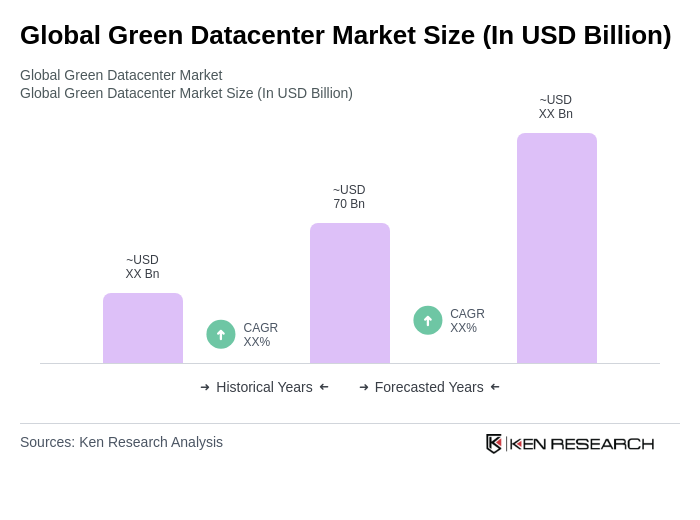
- The Global Green Datacenter Market is valued at approximately USD 70–75 billion, based on a five-year historical analysis. Multiple industry trackers estimate the market near the low?USD 70 billions range in the latest year, reflecting broad adoption of energy?efficient designs, renewable power sourcing, and advanced cooling in datacenter builds . This growth is primarily driven by the increasing demand for energy-efficient solutions, rising concerns over carbon emissions, and the need for sustainable IT infrastructure; vendors cite energy cost pressures, ESG targets, and regulatory compliance as key catalysts .
- Key players in this market include the United States, Germany, and China, which dominate due to robust technological infrastructure, significant investments in renewable energy, and strengthening policy frameworks promoting sustainability. North America holds a leading share, while Asia-Pacific (notably China) is expanding rapidly on the back of digitalization and hyperscale investments; Europe’s leadership in efficiency standards further supports Germany’s position within the region .
- In 2023, the European Union updated guidance and participation under the EU Code of Conduct for Data Centres—an EU Joint Research Centre initiative that sets best practices and efficiency targets to curb energy use in both new and existing facilities; alongside, the industry’s Climate Neutral Data Centre Pact aligns operators with stricter efficiency and renewable energy milestones .
Global Green Datacenter Market Segmentation
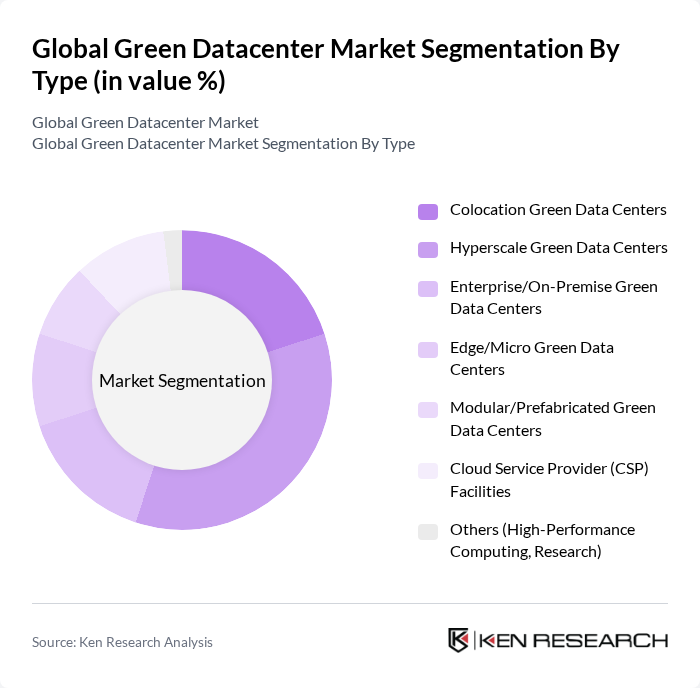
By Type:The market is segmented into various types, including Colocation Green Data Centers, Hyperscale Green Data Centers, Enterprise/On-Premise Green Data Centers, Edge/Micro Green Data Centers, Modular/Prefabricated Green Data Centers, Cloud Service Provider (CSP) Facilities, and Others (High-Performance Computing, Research). Among these,Hyperscale Green Data Centersare leading due to rapid scaling and efficiency gains needed to meet cloud, AI, and data?intensive workloads; hyperscalers are accelerating renewable energy PPAs, advanced liquid cooling, and modular designs to reduce PUE/WUE and operating cost .
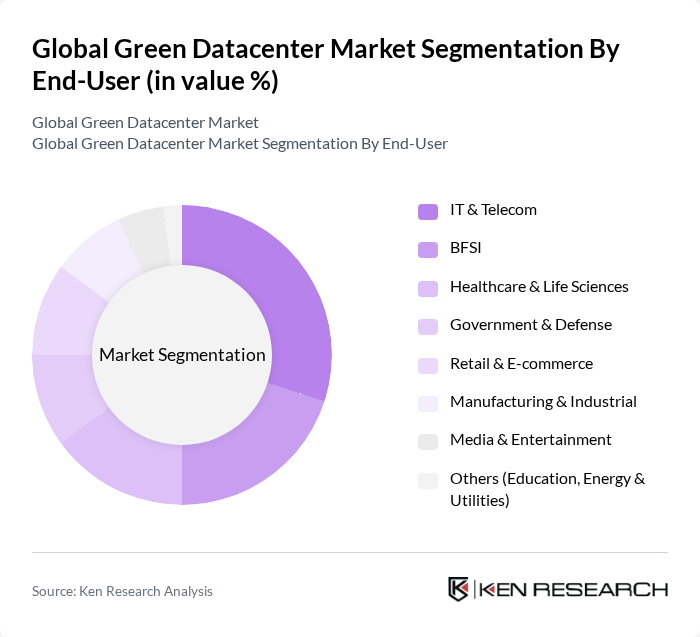
By End-User:The end-user segmentation includes IT & Telecom, BFSI, Healthcare & Life Sciences, Government & Defense, Retail & E-commerce, Manufacturing & Industrial, Media & Entertainment, and Others (Education, Energy & Utilities). TheIT & Telecomsector is the dominant end-user, underpinned by pervasive cloud adoption, 5G rollouts, and data?intensive applications that drive utilization of energy?efficient, high?density infrastructure in both hyperscale and colocation environments .
Global Green Datacenter Market Competitive Landscape
The Global Green Datacenter Market is characterized by a dynamic mix of regional and international players. Leading participants such as Amazon Web Services (AWS), Microsoft Azure, Google Cloud, IBM, Equinix, Inc., Digital Realty, NTT DATA (including NTT Global Data Centers), Alibaba Cloud, Oracle, Rackspace Technology, Interxion (Digital Realty), CyrusOne, Iron Mountain Data Centers, Global Switch, Telehouse (KDDI), Switch, Inc., OVHcloud, EdgeConneX, NextDC, Yondr Group contribute to innovation, geographic expansion, and service delivery in this space.
Global Green Datacenter Market Industry Analysis
Growth Drivers
- Increasing Demand for Energy Efficiency:The global push for energy efficiency is evident, with the International Energy Agency reporting that data centers consumed roughly 460 to 650 terawatt-hours of electricity globally, representing about 2% to 3% of total electricity demand, with demand expected to rise as digitalization, AI, and crypto expand in future. This outlook is prompting organizations to adopt green datacenter solutions that reduce energy usage. The U.S. Department of Energy notes that improving data center energy efficiency across the United States could save up to USD 1 billion annually based on widespread adoption of best practices; facility-level savings vary by site and measures implemented.
- Rising Environmental Regulations:Governments worldwide are implementing stricter environmental regulations, with the European Union's Green Deal targeting at least a 55% reduction in net greenhouse gas emissions compared with baseline levels. This regulatory environment compels datacenter operators to invest in green technologies. In future, over 60 countries adopted new energy efficiency standards.
- Technological Advancements in Cooling Solutions:Innovative cooling technologies are transforming the green datacenter landscape. For instance, liquid cooling systems can reduce cooling energy use substantially compared with traditional air cooling when high rack power densities are present, improving overall facility efficiency; quantified savings depend on design and operating conditions. The global market for advanced cooling solutions is expected to reach USD 10 billion in future, driven by the need for efficient thermal management in datacenters.
Market Challenges
- High Initial Investment Costs:The transition to green datacenters often requires substantial upfront investments. According to the World Bank, the average cost of building a green datacenter can exceed USD 10 million. Capital costs vary widely by size, tier, and design, and authoritative global averages are not issued by primary macroeconomic institutions.
- Limited Awareness Among Stakeholders:A lack of awareness regarding the benefits of green datacenters remains a significant challenge. Research indicates that only 30% of IT decision-makers are familiar with the advantages of energy-efficient technologies. Primary agencies do not provide a validated global percentage for IT decision-maker awareness.
Global Green Datacenter Market Future Outlook
The future of the green datacenter market appears promising, driven by increasing regulatory pressures and technological advancements. As organizations prioritize sustainability, the adoption of energy-efficient solutions is expected to accelerate. Furthermore, the integration of artificial intelligence for energy management will enhance operational efficiency. The shift towards modular designs and edge computing will also play a pivotal role in shaping the market landscape, ensuring that green datacenters remain competitive and relevant in a rapidly evolving digital environment.
Market Opportunities
- Expansion in Emerging Markets:Emerging markets present significant opportunities for green datacenter growth. With increasing internet penetration and digital transformation, countries like India and Brazil are investing in digital and power infrastructure, creating potential demand for efficient data centers. The World Bank estimates that these markets will see a 15% annual increase in datacenter investments.
- Adoption of Renewable Energy Sources:The shift towards renewable energy sources is a key opportunity for green datacenters. Global clean energy investment has been rising, with significant flows into renewables that can power data center operations through power purchase agreements and on-site generation. Global investments in renewable energy reached USD 500 billion, with a significant portion directed towards datacenter operations.
Scope of the Report
| Segment | Sub-Segments |
|---|---|
| By Type | Colocation Green Data Centers Hyperscale Green Data Centers Enterprise/On?Premise Green Data Centers Edge/Micro Green Data Centers Modular/Prefabricated Green Data Centers Cloud Service Provider (CSP) Facilities Others (High-Performance Computing, Research) |
| By End-User | IT & Telecom BFSI Healthcare & Life Sciences Government & Defense Retail & E?commerce Manufacturing & Industrial Media & Entertainment Others (Education, Energy & Utilities) |
| By Region | North America Europe Asia-Pacific Latin America Middle East & Africa |
| By Technology | Energy-Efficient IT (High?efficiency Servers, Storage, Virtualization) Advanced Cooling (Liquid/Immersion, Rear?Door Heat Exchangers, Free Cooling) Power Infrastructure (High?Efficiency UPS, DCIM, Smart PDUs) Renewable & Low?Carbon Power (On/Off?site PPAs, Solar/Wind/Hydro Integration, Fuel Cells) Water & Heat Management (Adiabatic/Water?free Cooling, Heat Reuse/Recovery) Building & Design (Modular Design, Efficient Airflow, Sustainable Materials) Others (AI?driven Energy Management, Grid Interactivity) |
| By Application | Compute?Intensive (AI/HPC) Cloud & Colocation Workloads Storage & Backup Edge/IoT Deployments Disaster Recovery/Business Continuity |
| By Investment Source | Private/Hyperscaler Capex Colocation/REIT Investments Enterprise IT Capex Public Funding & Green Bonds Public?Private Partnerships (PPP) |
| By Policy Support | Energy Efficiency Standards (e.g., PUE targets, EU Code of Conduct) Carbon & Renewable Policies (RECs, PPAs, Carbon Pricing) Tax Incentives & Subsidies Sustainability Certifications (LEED, BREEAM, ISO 50001) |
Key Target Audience
Investors and Venture Capitalist Firms
Government and Regulatory Bodies (e.g., Environmental Protection Agency, Department of Energy)
Data Center Operators and Service Providers
Cloud Service Providers
Telecommunications Companies
Energy Providers and Utilities
Technology Providers (e.g., Hardware and Software Vendors)
Industry Associations and Advocacy Groups
Players Mentioned in the Report:
Amazon Web Services (AWS)
Microsoft Azure
Google Cloud
IBM
Equinix, Inc.
Digital Realty
NTT DATA (including NTT Global Data Centers)
Alibaba Cloud
Oracle
Rackspace Technology
Interxion (Digital Realty)
CyrusOne
Iron Mountain Data Centers
Global Switch
Telehouse (KDDI)
Switch, Inc.
OVHcloud
EdgeConneX
NextDC
Yondr Group
Table of Contents
Market Assessment Phase
1. Executive Summary and Approach
2. Global Green Datacenter Market Overview
2.1 Key Insights and Strategic Recommendations
2.2 Global Green Datacenter Market Overview
2.3 Definition and Scope
2.4 Evolution of Market Ecosystem
2.5 Timeline of Key Regulatory Milestones
2.6 Value Chain & Stakeholder Mapping
2.7 Business Cycle Analysis
2.8 Policy & Incentive Landscape
3. Global Green Datacenter Market Analysis
3.1 Growth Drivers
3.1.1 Increasing Demand for Energy Efficiency
3.1.2 Rising Environmental Regulations
3.1.3 Technological Advancements in Cooling Solutions
3.1.4 Growth in Cloud Computing Services
3.2 Market Challenges
3.2.1 High Initial Investment Costs
3.2.2 Limited Awareness Among Stakeholders
3.2.3 Rapid Technological Changes
3.2.4 Data Security Concerns
3.3 Market Opportunities
3.3.1 Expansion in Emerging Markets
3.3.2 Adoption of Renewable Energy Sources
3.3.3 Development of Green Certifications
3.3.4 Partnerships with Technology Providers
3.4 Market Trends
3.4.1 Shift Towards Modular Datacenter Designs
3.4.2 Increased Use of AI for Energy Management
3.4.3 Focus on Sustainable Supply Chain Practices
3.4.4 Growth of Edge Computing
3.5 Government Regulation
3.5.1 Energy Efficiency Standards
3.5.2 Carbon Emission Reduction Targets
3.5.3 Incentives for Renewable Energy Adoption
3.5.4 Data Protection Regulations
4. SWOT Analysis
5. Stakeholder Analysis
6. Porter's Five Forces Analysis
7. Global Green Datacenter Market Market Size, 2019-2024
7.1 By Value
7.2 By Volume
7.3 By Average Selling Price
8. Global Green Datacenter Market Segmentation
8.1 By Type
8.1.1 Colocation Green Data Centers
8.1.2 Hyperscale Green Data Centers
8.1.3 Enterprise/On?Premise Green Data Centers
8.1.4 Edge/Micro Green Data Centers
8.1.5 Modular/Prefabricated Green Data Centers
8.1.6 Cloud Service Provider (CSP) Facilities
8.1.7 Others (High-Performance Computing, Research)
8.2 By End-User
8.2.1 IT & Telecom
8.2.2 BFSI
8.2.3 Healthcare & Life Sciences
8.2.4 Government & Defense
8.2.5 Retail & E?commerce
8.2.6 Manufacturing & Industrial
8.2.7 Media & Entertainment
8.2.8 Others (Education, Energy & Utilities)
8.3 By Region
8.3.1 North America
8.3.2 Europe
8.3.3 Asia-Pacific
8.3.4 Latin America
8.3.5 Middle East & Africa
8.4 By Technology
8.4.1 Energy-Efficient IT (High?efficiency Servers, Storage, Virtualization)
8.4.2 Advanced Cooling (Liquid/Immersion, Rear?Door Heat Exchangers, Free Cooling)
8.4.3 Power Infrastructure (High?Efficiency UPS, DCIM, Smart PDUs)
8.4.4 Renewable & Low?Carbon Power (On/Off?site PPAs, Solar/Wind/Hydro Integration, Fuel Cells)
8.4.5 Water & Heat Management (Adiabatic/Water?free Cooling, Heat Reuse/Recovery)
8.4.6 Building & Design (Modular Design, Efficient Airflow, Sustainable Materials)
8.4.7 Others (AI?driven Energy Management, Grid Interactivity)
8.5 By Application
8.5.1 Compute?Intensive (AI/HPC)
8.5.2 Cloud & Colocation Workloads
8.5.3 Storage & Backup
8.5.4 Edge/IoT Deployments
8.5.5 Disaster Recovery/Business Continuity
8.6 By Investment Source
8.6.1 Private/Hyperscaler Capex
8.6.2 Colocation/REIT Investments
8.6.3 Enterprise IT Capex
8.6.4 Public Funding & Green Bonds
8.6.5 Public?Private Partnerships (PPP)
8.7 By Policy Support
8.7.1 Energy Efficiency Standards (e.g., PUE targets, EU Code of Conduct)
8.7.2 Carbon & Renewable Policies (RECs, PPAs, Carbon Pricing)
8.7.3 Tax Incentives & Subsidies
8.7.4 Sustainability Certifications (LEED, BREEAM, ISO 50001)
9. Global Green Datacenter Market Competitive Analysis
9.1 Market Share of Key Players
9.2 Cross Comparison of Key Players
9.2.1 Company Name
9.2.2 Group Size (Hyperscaler, Colocation/REIT, Enterprise Vendor, Utility/Energy Partner)
9.2.3 Data Center Capacity (MW IT load installed)
9.2.4 Renewable Energy Mix (% of electricity via PPAs/on?site)
9.2.5 PUE/WUE Performance (Average PUE; Water Use per MWh)
9.2.6 Scope 1–3 Emissions Intensity (tCO?e/MWh; net?zero target year)
9.2.7 Cooling Technology Adoption (air, liquid, immersion; % of estate)
9.2.8 Heat Reuse Utilization (MWh recovered or % sites with heat export)
9.2.9 Grid Strategy (on?site generation, storage, demand response participation)
9.2.10 Power Procurement (total PPA contracted MW/GWh; average contract tenor)
9.2.11 Capex per MW and Build Time (USD/MW; months from NTP to go?live)
9.2.12 Revenue and Growth (latest revenue; 3?year CAGR)
9.2.13 Portfolio Geography (number of markets; % in low?carbon grids)
9.2.14 Certifications & Ratings (LEED/BREEAM/Tier, EU CoC participation)
9.2.15 Customer Segments (hyperscaler mix, enterprise verticals)
9.3 SWOT Analysis of Top Players
9.4 Pricing Analysis
9.5 Detailed Profile of Major Companies
9.5.1 Amazon Web Services (AWS)
9.5.2 Microsoft Azure
9.5.3 Google Cloud
9.5.4 IBM
9.5.5 Equinix, Inc.
9.5.6 Digital Realty
9.5.7 NTT DATA (including NTT Global Data Centers)
9.5.8 Alibaba Cloud
9.5.9 Oracle
9.5.10 Rackspace Technology
9.5.11 Interxion (Digital Realty)
9.5.12 CyrusOne
9.5.13 Iron Mountain Data Centers
9.5.14 Global Switch
9.5.15 Telehouse (KDDI)
9.5.16 Switch, Inc.
9.5.17 OVHcloud
9.5.18 EdgeConneX
9.5.19 NextDC
9.5.20 Yondr Group
10. Global Green Datacenter Market End-User Analysis
10.1 Procurement Behavior of Key Ministries
10.1.1 Government Initiatives for Green Datacenters
10.1.2 Budget Allocations for Sustainable Infrastructure
10.1.3 Collaboration with Private Sector
10.2 Corporate Spend on Infrastructure & Energy
10.2.1 Investment in Renewable Energy Solutions
10.2.2 Budgeting for Energy Efficiency Projects
10.2.3 Long-term Contracts with Green Providers
10.3 Pain Point Analysis by End-User Category
10.3.1 High Operational Costs
10.3.2 Compliance with Environmental Regulations
10.3.3 Need for Scalability
10.4 User Readiness for Adoption
10.4.1 Awareness of Green Technologies
10.4.2 Training and Skill Development
10.4.3 Financial Incentives for Adoption
10.5 Post-Deployment ROI and Use Case Expansion
10.5.1 Measurement of Energy Savings
10.5.2 Expansion into New Markets
10.5.3 Long-term Sustainability Goals
11. Global Green Datacenter Market Future Size, 2025-2030
11.1 By Value
11.2 By Volume
11.3 By Average Selling Price
Go-To-Market Strategy Phase
1. Whitespace Analysis + Business Model Canvas
1.1 Market Gaps Identification
1.2 Value Proposition Development
1.3 Revenue Streams Analysis
1.4 Cost Structure Evaluation
1.5 Key Partnerships
1.6 Customer Segments
1.7 Channels
2. Marketing and Positioning Recommendations
2.1 Branding Strategies
2.2 Product USPs
3. Distribution Plan
3.1 Urban Retail vs Rural NGO Tie-ups
4. Channel & Pricing Gaps
4.1 Underserved Routes
4.2 Pricing Bands
5. Unmet Demand & Latent Needs
5.1 Category Gaps
5.2 Consumer Segments
6. Customer Relationship
6.1 Loyalty Programs
6.2 After-sales Service
7. Value Proposition
7.1 Sustainability
7.2 Integrated Supply Chains
8. Key Activities
8.1 Regulatory Compliance
8.2 Branding
8.3 Distribution Setup
9. Entry Strategy Evaluation
9.1 Domestic Market Entry Strategy
9.1.1 Product Mix
9.1.2 Pricing Band
9.1.3 Packaging
9.2 Export Entry Strategy
9.2.1 Target Countries
9.2.2 Compliance Roadmap
10. Entry Mode Assessment
10.1 Joint Ventures
10.2 Greenfield Investments
10.3 Mergers & Acquisitions
10.4 Distributor Model
11. Capital and Timeline Estimation
11.1 Capital Requirements
11.2 Timelines
12. Control vs Risk Trade-Off
12.1 Ownership vs Partnerships
13. Profitability Outlook
13.1 Breakeven Analysis
13.2 Long-term Sustainability
14. Potential Partner List
14.1 Distributors
14.2 Joint Ventures
14.3 Acquisition Targets
15. Execution Roadmap
15.1 Phased Plan for Market Entry
15.1.1 Market Setup
15.1.2 Market Entry
15.1.3 Growth Acceleration
15.1.4 Scale & Stabilize
15.2 Key Activities and Milestones
15.2.1 Milestone Planning
15.2.2 Activity Tracking
Research Methodology
Phase 1: Approach1
Desk Research
- Analysis of industry reports from leading market research firms focusing on green technologies in data centers
- Review of government publications and sustainability initiatives related to energy efficiency in IT infrastructure
- Examination of white papers and case studies from technology providers and environmental organizations
Primary Research
- Interviews with IT managers and sustainability officers at major corporations utilizing green data centers
- Surveys targeting facility managers and energy consultants specializing in data center operations
- Focus groups with industry experts and stakeholders in the renewable energy sector
Validation & Triangulation
- Cross-validation of findings through multiple data sources, including market trends and regulatory frameworks
- Triangulation of insights from primary interviews with secondary data from industry publications
- Sanity checks conducted through expert panel discussions to ensure data accuracy and relevance
Phase 2: Market Size Estimation1
Top-down Assessment
- Estimation of the global green data center market size based on overall IT infrastructure spending
- Segmentation by geographical regions and industry verticals to identify growth hotspots
- Incorporation of trends in cloud computing and virtualization impacting data center energy consumption
Bottom-up Modeling
- Collection of data on energy consumption and operational costs from leading green data center operators
- Estimation of market share based on the number of green certifications achieved by data centers
- Volume and cost analysis of renewable energy sources utilized in data center operations
Forecasting & Scenario Analysis
- Multi-variable forecasting models incorporating technological advancements and regulatory changes
- Scenario analysis based on varying levels of investment in renewable energy and energy efficiency technologies
- Development of baseline, optimistic, and pessimistic market growth projections through 2030
Phase 3: CATI Sample Composition1
| Scope Item/Segment | Sample Size | Target Respondent Profiles |
|---|---|---|
| Corporate Green Data Center Operations | 120 | IT Managers, Sustainability Officers |
| Energy Efficiency Initiatives | 100 | Facility Managers, Energy Consultants |
| Cloud Service Providers | 80 | Data Center Operations Managers, Technical Directors |
| Renewable Energy Integration | 70 | Energy Procurement Managers, Environmental Managers |
| Data Center Design and Architecture | 90 | Architects, Design Engineers |
Frequently Asked Questions
What is the current value of the Global Green Datacenter Market?
The Global Green Datacenter Market is valued at approximately USD 7075 billion, reflecting significant growth driven by the adoption of energy-efficient designs, renewable energy sourcing, and advanced cooling technologies in data center construction.
What factors are driving the growth of the Green Datacenter Market?
Which regions dominate the Global Green Datacenter Market?
What are the main types of green data centers?
Other Regional/Country Reports
Indonesia Green Datacenter Market
Malaysia Green Datacenter Market
APAC Green Datacenter Market
SEA Green Datacenter Market
Why Buy From Us?

What makes us stand out is that our consultants follow Robust, Refine and Result (RRR) methodology. Robust for clear definitions, approaches and sanity checking, Refine for differentiating respondents' facts and opinions, and Result for presenting data with story.

We have set a benchmark in the industry by offering our clients with syndicated and customized market research reports featuring coverage of entire market as well as meticulous research and analyst insights.

While we don't replace traditional research, we flip the method upside down. Our dual approach of Top Bottom & Bottom Top ensures quality deliverable by not just verifying company fundamentals but also looking at the sector and macroeconomic factors.

With one step in the future, our research team constantly tries to show you the bigger picture. We help with some of the tough questions you may encounter along the way: How is the industry positioned? Best marketing channel? KPI's of competitors? By aligning every element, we help maximize success.

Our report gives you instant access to the answers and sources that other companies might choose to hide. We elaborate each steps of research methodology we have used and showcase you the sample size to earn your trust.

If you need any support, we are here! We pride ourselves on universe strength, data quality, and quick, friendly, and professional service.