About the Report
Base Year 2024Global Hand Protection Equipment Market Overview
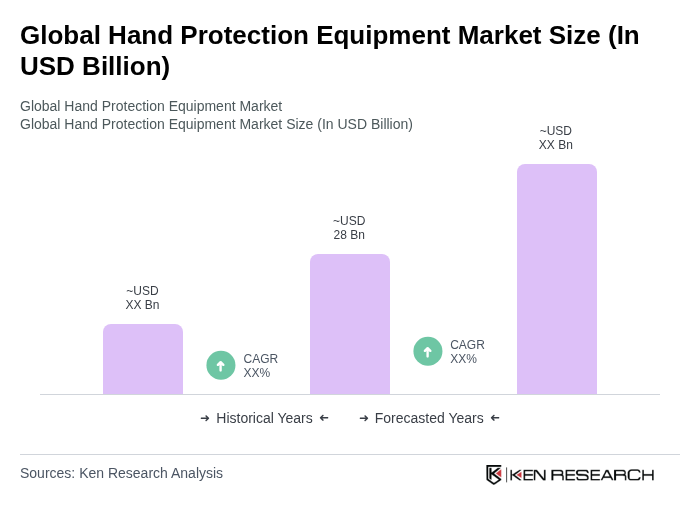
- The Global Hand Protection Equipment Market is valued at USD 28 billion, based on a five-year historical analysis. Growth is largely driven by heightened awareness of worker safety across critical sectors like healthcare, construction, manufacturing, and oil & gas, as well as stringent occupational health and hygiene standards. Regulatory enforcement and the need to limit workplace injuries and infection transmission have bolstered demand for both durable and disposable protective hand solutions.
- Key players in this market include Ansell, 3M, Honeywell, DuPont, MSA Safety, Lakeland Industries, Superior Glove, and SHOWA Group. These companies play a significant role in driving growth and maintaining high standards in hand protection equipment through innovation and product development.
- In 2024, the U.S. government imposed tariffs on imported chemical-resistant materials, such as butyl rubber formulations and puncture-resistant liners. This regulation is expected to elevate input costs and affect the availability of medical and industrial gloves, illustrating how trade policy directly influences the hand protection equipment sector.
Global Hand Protection Equipment Market Segmentation
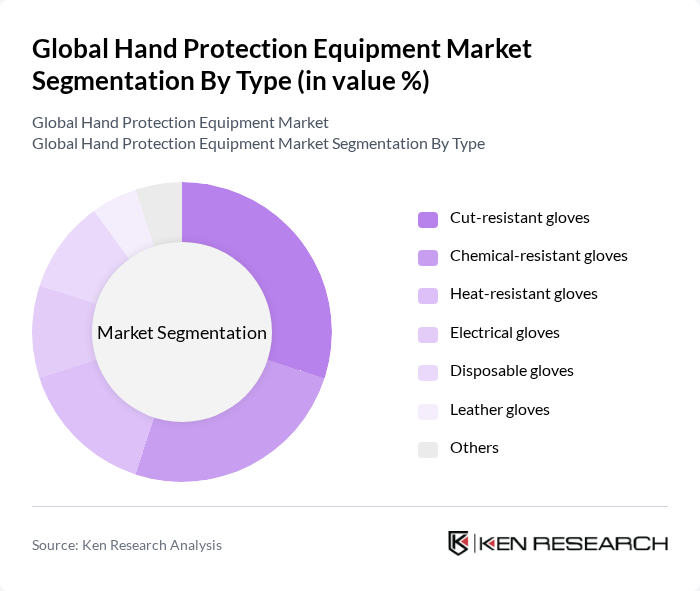
By Type:The hand protection equipment market is segmented into various types, including cut-resistant gloves, chemical-resistant gloves, heat-resistant gloves, electrical gloves, disposable gloves, leather gloves, and others. Among these, cut-resistant gloves are gaining significant traction due to the increasing need for safety in manufacturing and construction sectors. The demand for chemical-resistant gloves is also on the rise, driven by stringent regulations in industries handling hazardous materials.
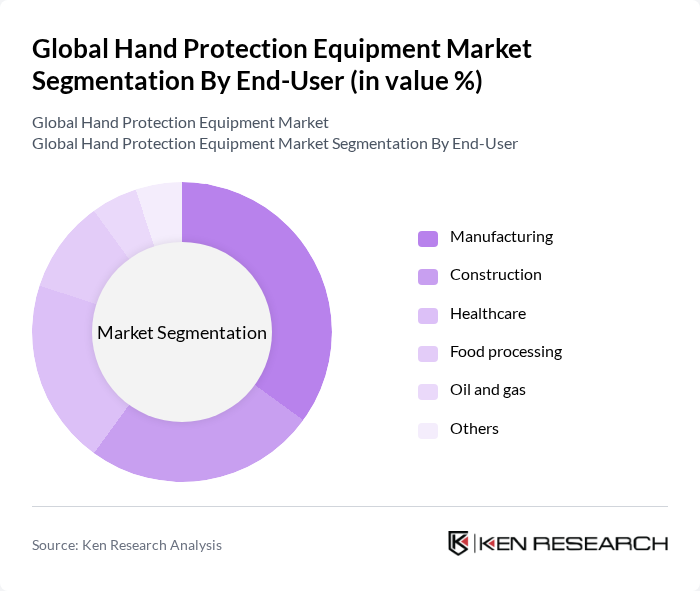
By End-User:The end-user segmentation includes manufacturing, construction, healthcare, food processing, oil and gas, and others. The manufacturing sector is the largest consumer of hand protection equipment, driven by the need for safety compliance and injury prevention. The healthcare sector is also a significant contributor, particularly due to the increased focus on hygiene and safety standards in medical environments.
Global Hand Protection Equipment Market Competitive Landscape
The Global Hand Protection Equipment Market is characterized by a dynamic mix of regional and international players. Leading participants such as Ansell Limited, Honeywell International Inc., 3M Company, DuPont de Nemours, Inc., MCR Safety, Kimberly-Clark Corporation, SHOWA Group, Magid Glove & Safety Manufacturing Company, Delta Plus Group, Radians, Inc., Superior Glove Works Ltd., Cestusline, Inc., PIP Global, Ergodyne, Towa Corporation contribute to innovation, geographic expansion, and service delivery in this space.
Global Hand Protection Equipment Market Industry Analysis
Growth Drivers
- High Market Size in Future:The global hand protection equipment market is projected to generate revenue of USD 25,911.7 million in future. This substantial market size reflects the increasing demand across various sectors, including healthcare, manufacturing, and construction. The growth is driven by heightened awareness of workplace safety and the need for protective gear to mitigate risks associated with hand injuries. This trend underscores the market's potential for expansion and innovation in product offerings.
- Durable Segment Leading Revenue:In future, the durable hand protection equipment segment is expected to reach USD 14,203.0 million. This growth is primarily fueled by the industrial and construction sectors, where robust gloves are essential for protection against cuts and chemical exposure. The demand for durable products is indicative of a broader trend towards investing in high-quality safety equipment, which enhances worker safety and productivity in hazardous environments.
- North America Market Dominance:North America is anticipated to account for 31.9% of the global hand protection equipment market revenue in future, with the U.S. contributing 84.6% of this share. The region's high healthcare expenditures and increasing awareness of safety protocols, particularly in response to workplace injuries, drive this dominance. This trend highlights the critical role of regulatory frameworks and consumer preferences in shaping market dynamics in North America.
Market Challenges
- Market Fragmentation Restraining Scale:The U.S. hand protection equipment market is estimated at USD 6.2 billion for future, characterized by significant fragmentation with numerous players. This competitive landscape can limit pricing power and scale efficiencies, making it challenging for companies to achieve sustainable growth. The presence of many small and medium-sized enterprises complicates market dynamics, often leading to price wars and reduced profit margins.
- Shift Toward Automation Reducing Labor Demand:The ongoing trend of automation in industries is expected to indirectly impact the demand for hand protection equipment. As automation reduces the workforce size, particularly in manufacturing and industrial sectors, the need for protective gear may decline. This shift poses a challenge for manufacturers, as fewer manual laborers translate to lower sales volumes for hand protection products, affecting overall market growth.
Global Hand Protection Equipment Market Future Outlook
The future of the hand protection equipment market is poised for significant transformation, driven by technological advancements and evolving consumer preferences. The integration of smart technology, such as sensor-enabled gloves, is expected to enhance safety monitoring and user experience. Additionally, the growing emphasis on sustainability will likely lead to increased demand for biodegradable materials, reflecting a shift towards environmentally friendly products. These trends indicate a dynamic market landscape with opportunities for innovation and growth.
Market Opportunities
- Asia-Pacific as Fastest-Growing Region:The Asia-Pacific region is projected to experience rapid growth, with India expected to reach USD 1,466.0 million and China USD 3,405.6 million in future. This growth is driven by the expansion of industrial and healthcare sectors in emerging economies, presenting significant untapped potential for hand protection equipment manufacturers looking to enter these markets.
- Smart Glove Innovation:The smart personal protective equipment market is anticipated to grow by USD 7.61 billion from future to future. This growth is fueled by the adoption of IoT and sensor technologies in hand protection, creating new product categories and opportunities for premium pricing. Companies that invest in smart glove innovations can capitalize on the increasing demand for advanced safety solutions in various industries.
Scope of the Report
| Segment | Sub-Segments |
|---|---|
| By Type | Cut-resistant gloves Chemical-resistant gloves Heat-resistant gloves Electrical gloves Disposable gloves Leather gloves Others |
| By End-User | Manufacturing Construction Healthcare Food processing Oil and gas Others |
| By Region | North America Europe Asia-Pacific Latin America Middle East & Africa |
| By Application | Industrial applications Medical applications Household applications Agricultural applications Others |
| By Material | Nitrile Latex PVC Leather Others |
| By Certification Standards | EN 388 EN 374 EN 407 ASTM standards Others |
| By Distribution Channel | Online retail Offline retail Direct sales Distributors Others |
Key Target Audience
Investors and Venture Capitalist Firms
Government and Regulatory Bodies (e.g., Occupational Safety and Health Administration, National Institute for Occupational Safety and Health)
Manufacturers and Producers
Distributors and Retailers
Health and Safety Organizations
Industry Associations (e.g., International Safety Equipment Association)
Insurance Companies
Logistics and Supply Chain Companies
Players Mentioned in the Report:
Ansell Limited
Honeywell International Inc.
3M Company
DuPont de Nemours, Inc.
MCR Safety
Kimberly-Clark Corporation
SHOWA Group
Magid Glove & Safety Manufacturing Company
Delta Plus Group
Radians, Inc.
Superior Glove Works Ltd.
Cestusline, Inc.
PIP Global
Ergodyne
Towa Corporation
Table of Contents
Market Assessment Phase
1. Executive Summary and Approach
2. Global Hand Protection Equipment Market Overview
2.1 Key Insights and Strategic Recommendations
2.2 Global Hand Protection Equipment Market Overview
2.3 Definition and Scope
2.4 Evolution of Market Ecosystem
2.5 Timeline of Key Regulatory Milestones
2.6 Value Chain & Stakeholder Mapping
2.7 Business Cycle Analysis
2.8 Policy & Incentive Landscape
3. Global Hand Protection Equipment Market Analysis
3.1 Growth Drivers
3.1.1 Increasing workplace safety regulations
3.1.2 Rising awareness about hand safety
3.1.3 Growth in the manufacturing and construction sectors
3.1.4 Technological advancements in hand protection materials
3.2 Market Challenges
3.2.1 High cost of advanced hand protection equipment
3.2.2 Lack of awareness in developing regions
3.2.3 Stringent regulatory compliance requirements
3.2.4 Competition from low-cost alternatives
3.3 Market Opportunities
3.3.1 Expansion into emerging markets
3.3.2 Development of eco-friendly hand protection products
3.3.3 Customization and personalization of products
3.3.4 Integration of smart technology in hand protection
3.4 Market Trends
3.4.1 Increasing demand for disposable hand protection
3.4.2 Growth of e-commerce in the hand protection sector
3.4.3 Shift towards sustainable materials
3.4.4 Rise in online training and certification programs
3.5 Government Regulation
3.5.1 OSHA regulations on hand safety
3.5.2 EN standards for protective gloves
3.5.3 REACH compliance for chemical safety
3.5.4 ISO standards for personal protective equipment
4. SWOT Analysis
5. Stakeholder Analysis
6. Porter's Five Forces Analysis
7. Global Hand Protection Equipment Market Market Size, 2019-2024
7.1 By Value
7.2 By Volume
7.3 By Average Selling Price
8. Global Hand Protection Equipment Market Segmentation
8.1 By Type
8.1.1 Cut-resistant gloves
8.1.2 Chemical-resistant gloves
8.1.3 Heat-resistant gloves
8.1.4 Electrical gloves
8.1.5 Disposable gloves
8.1.6 Leather gloves
8.1.7 Others
8.2 By End-User
8.2.1 Manufacturing
8.2.2 Construction
8.2.3 Healthcare
8.2.4 Food processing
8.2.5 Oil and gas
8.2.6 Others
8.3 By Region
8.3.1 North America
8.3.2 Europe
8.3.3 Asia-Pacific
8.3.4 Latin America
8.3.5 Middle East & Africa
8.4 By Application
8.4.1 Industrial applications
8.4.2 Medical applications
8.4.3 Household applications
8.4.4 Agricultural applications
8.4.5 Others
8.5 By Material
8.5.1 Nitrile
8.5.2 Latex
8.5.3 PVC
8.5.4 Leather
8.5.5 Others
8.6 By Certification Standards
8.6.1 EN 388
8.6.2 EN 374
8.6.3 EN 407
8.6.4 ASTM standards
8.6.5 Others
8.7 By Distribution Channel
8.7.1 Online retail
8.7.2 Offline retail
8.7.3 Direct sales
8.7.4 Distributors
8.7.5 Others
9. Global Hand Protection Equipment Market Competitive Analysis
9.1 Market Share of Key Players
9.2 Cross Comparison of Key Players
9.2.1 Company Name
9.2.2 Group Size (Large, Medium, or Small as per industry convention)
9.2.3 Revenue Growth Rate
9.2.4 Market Penetration Rate
9.2.5 Customer Retention Rate
9.2.6 Product Quality Index
9.2.7 Pricing Strategy
9.2.8 Distribution Efficiency
9.2.9 Innovation Rate
9.2.10 Brand Recognition Score
9.3 SWOT Analysis of Top Players
9.4 Pricing Analysis
9.5 Detailed Profile of Major Companies
9.5.1 Ansell Limited
9.5.2 Honeywell International Inc.
9.5.3 3M Company
9.5.4 DuPont de Nemours, Inc.
9.5.5 MCR Safety
9.5.6 Kimberly-Clark Corporation
9.5.7 SHOWA Group
9.5.8 Magid Glove & Safety Manufacturing Company
9.5.9 Delta Plus Group
9.5.10 Radians, Inc.
9.5.11 Superior Glove Works Ltd.
9.5.12 Cestusline, Inc.
9.5.13 PIP Global
9.5.14 Ergodyne
9.5.15 Towa Corporation
10. Global Hand Protection Equipment Market End-User Analysis
10.1 Procurement Behavior of Key Ministries
10.1.1 Government procurement policies
10.1.2 Budget allocation for safety equipment
10.1.3 Supplier selection criteria
10.1.4 Compliance with safety standards
10.2 Corporate Spend on Infrastructure & Energy
10.2.1 Investment in safety training
10.2.2 Budget for personal protective equipment
10.2.3 Spending on compliance audits
10.2.4 Allocation for emergency preparedness
10.3 Pain Point Analysis by End-User Category
10.3.1 Safety compliance challenges
10.3.2 Budget constraints
10.3.3 Product availability issues
10.3.4 Quality concerns
10.4 User Readiness for Adoption
10.4.1 Awareness of hand protection benefits
10.4.2 Training and education levels
10.4.3 Availability of resources
10.4.4 Organizational culture towards safety
10.5 Post-Deployment ROI and Use Case Expansion
10.5.1 Measurement of safety improvements
10.5.2 Cost savings from reduced injuries
10.5.3 Expansion of product usage
10.5.4 Long-term contracts with suppliers
11. Global Hand Protection Equipment Market Future Size, 2025-2030
11.1 By Value
11.2 By Volume
11.3 By Average Selling Price
Go-To-Market Strategy Phase
1. Whitespace Analysis + Business Model Canvas
1.1
2. Marketing and Positioning Recommendations
2.1
3. Distribution Plan
3.1
4. Channel & Pricing Gaps
4.1
5. Unmet Demand & Latent Needs
5.1
6. Customer Relationship
6.1
7. Value Proposition
7.1
8. Key Activities
8.1
9. Entry Strategy Evaluation
9.1 Domestic Market Entry Strategy
9.1.1
9.2 Export Entry Strategy
9.2.1
10. Entry Mode Assessment
10.1
11. Capital and Timeline Estimation
11.1
12. Control vs Risk Trade-Off
12.1
13. Profitability Outlook
13.1
14. Potential Partner List
14.1
15. Execution Roadmap
15.1 Phased Plan for Market Entry
15.1.1
15.2 Key Activities and Milestones
15.2.1
Research Methodology
Phase 1: Approach1
Desk Research
- Industry reports from organizations such as the International Safety Equipment Association (ISEA)
- Market analysis from trade publications and journals focused on personal protective equipment (PPE)
- Government and regulatory documents outlining safety standards and compliance requirements
Primary Research
- Interviews with safety managers in manufacturing and construction sectors
- Surveys targeting procurement officers in healthcare and industrial sectors
- Field interviews with distributors and retailers of hand protection equipment
Validation & Triangulation
- Cross-validation of data from multiple industry sources to ensure accuracy
- Triangulation of findings from primary interviews with secondary data insights
- Sanity checks through expert panel reviews comprising industry veterans
Phase 2: Market Size Estimation1
Top-down Assessment
- Analysis of global hand protection equipment market size based on historical data
- Segmentation by product type, end-user industry, and geographical region
- Incorporation of macroeconomic indicators influencing market growth
Bottom-up Modeling
- Estimation of market size based on sales data from key manufacturers
- Volume estimates derived from production capacities and sales channels
- Cost analysis based on pricing strategies of leading brands in the market
Forecasting & Scenario Analysis
- Multi-variable regression analysis incorporating trends in workplace safety regulations
- Scenario modeling based on potential shifts in consumer preferences and technological advancements
- Development of baseline, optimistic, and pessimistic forecasts through 2030
Phase 3: CATI Sample Composition1
| Scope Item/Segment | Sample Size | Target Respondent Profiles |
|---|---|---|
| Construction Industry Hand Protection | 150 | Site Safety Officers, Project Managers |
| Healthcare Sector PPE Usage | 100 | Infection Control Specialists, Hospital Procurement Managers |
| Manufacturing Sector Safety Equipment | 120 | Production Supervisors, Safety Compliance Officers |
| Retail and Distribution of Hand Protection | 80 | Retail Managers, Supply Chain Coordinators |
| Emerging Markets Adoption of PPE | 90 | Regional Sales Managers, Market Development Executives |
Frequently Asked Questions
What is the current value of the Global Hand Protection Equipment Market?
The Global Hand Protection Equipment Market is valued at approximately USD 28 billion, reflecting a significant demand driven by increased awareness of worker safety across various sectors, including healthcare, construction, and manufacturing.
What factors are driving the growth of the hand protection equipment market?
Who are the key players in the Global Hand Protection Equipment Market?
What types of hand protection equipment are available in the market?
Other Regional/Country Reports
Indonesia Hand Protection Equipment Market
Malaysia Hand Protection Equipment Market
KSA Hand Protection Equipment Market
APAC Hand Protection Equipment Market
SEA Hand Protection Equipment Market
Other Adjacent Reports
South Korea Industrial Safety Equipment Market
KSA Healthcare Safety Solutions Market
GCC Construction Safety Equipment Market Size, Share, Trends & Forecast 2025–2030Oman Oil and Gas Safety Equipment Market
Malaysia Chemical Safety Equipment Market
Singapore Manufacturing Safety Solutions Market
Singapore Food Processing Safety Equipment Market
Qatar smart personal protective equipment market report Size, Share, Growth Drivers, Trends, Opportunities & Forecast 2025–2030Philippines Biodegradable Materials Market
Why Buy From Us?

What makes us stand out is that our consultants follow Robust, Refine and Result (RRR) methodology. Robust for clear definitions, approaches and sanity checking, Refine for differentiating respondents' facts and opinions, and Result for presenting data with story.

We have set a benchmark in the industry by offering our clients with syndicated and customized market research reports featuring coverage of entire market as well as meticulous research and analyst insights.

While we don't replace traditional research, we flip the method upside down. Our dual approach of Top Bottom & Bottom Top ensures quality deliverable by not just verifying company fundamentals but also looking at the sector and macroeconomic factors.

With one step in the future, our research team constantly tries to show you the bigger picture. We help with some of the tough questions you may encounter along the way: How is the industry positioned? Best marketing channel? KPI's of competitors? By aligning every element, we help maximize success.

Our report gives you instant access to the answers and sources that other companies might choose to hide. We elaborate each steps of research methodology we have used and showcase you the sample size to earn your trust.

If you need any support, we are here! We pride ourselves on universe strength, data quality, and quick, friendly, and professional service.