About the Report
Base Year 2024Global Hedge Fund Industry Market Overview
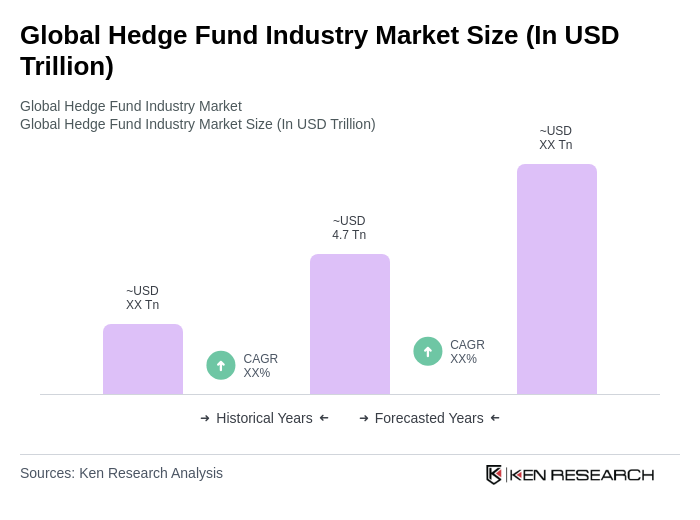
- The Global Hedge Fund Industry Market is valued at approximatelyUSD 4.7 trillion, based on a five-year historical analysis. This growth is primarily driven by increasing institutional investments, diversification strategies, and the demand for alternative investment vehicles. Hedge funds have gained popularity due to their ability to generate returns in various market conditions, attracting both institutional and high-net-worth investors.
- The United States, the United Kingdom, and Hong Kong dominate the hedge fund market due to their established financial infrastructure, regulatory frameworks, and concentration of wealth. These regions host a significant number of hedge fund managers and investment firms, making them attractive for investors seeking sophisticated investment strategies and high returns. North America remains the largest region in the hedge fund market, with Europe and Asia (notably Hong Kong) following.
- In 2023, the U.S. Securities and Exchange Commission (SEC) implemented new regulations requiring hedge funds to enhance their disclosure practices. This regulation mandates that hedge funds provide more detailed information about their investment strategies, risk management practices, and performance metrics, aiming to increase transparency and protect investors.
Global Hedge Fund Industry Market Segmentation
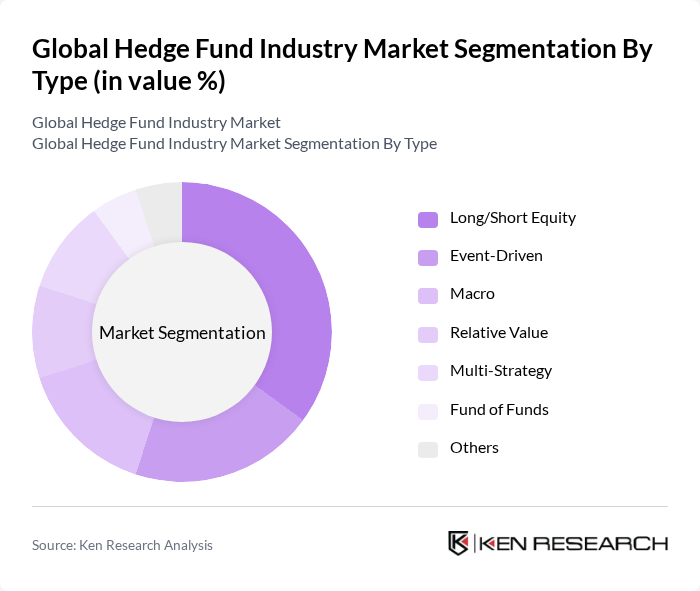
By Type:The hedge fund market is segmented into various types, including Long/Short Equity, Event-Driven, Macro, Relative Value, Multi-Strategy, Fund of Funds, and Others. Among these,Long/Short Equityremains a dominant strategy due to its flexibility in taking both long and short positions, allowing fund managers to capitalize on market inefficiencies. This strategy appeals to investors seeking risk-adjusted returns, especially in volatile market conditions.
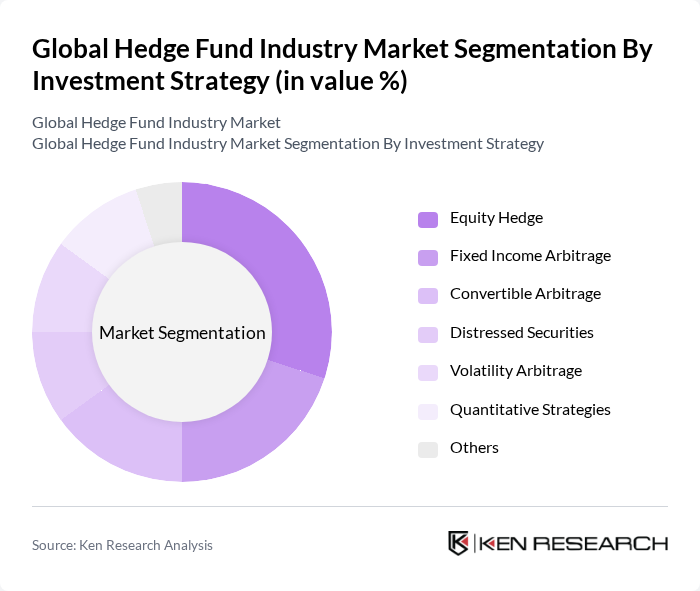
By Investment Strategy:The investment strategies employed by hedge funds include Equity Hedge, Fixed Income Arbitrage, Convertible Arbitrage, Distressed Securities, Volatility Arbitrage, Quantitative Strategies, and Others. TheEquity Hedgestrategy is particularly prominent, as it allows managers to invest in long positions while hedging against market downturns. This strategy has gained traction among investors looking for a balanced approach to risk and return.
Global Hedge Fund Industry Market Competitive Landscape
The Global Hedge Fund Industry Market is characterized by a dynamic mix of regional and international players. Leading participants such as BlackRock, Inc., Bridgewater Associates, LP, Man Group plc, AQR Capital Management, LLC, Renaissance Technologies LLC, Two Sigma Investments, LP, Citadel LLC, Winton Group, Limited, Millennium Management LLC, Point72 Asset Management, L.P., Marshall Wace LLP, Capula Investment Management LLP, Highfields Capital Management, LP, CQS, Element Capital Management, LLC, DE Shaw & Co., L.P., Elliott Management Corporation, Baupost Group, LLC, Pershing Square Capital Management, L.P., Lone Pine Capital LLC contribute to innovation, geographic expansion, and service delivery in this space.
Global Hedge Fund Industry Market Industry Analysis
Growth Drivers
- Increasing Institutional Investment:Institutional investors, including pension funds and endowments, are increasingly allocating capital to hedge funds, with total assets under management reaching approximatelyUSD 4.0 trillionin future. This trend is driven by the need for higher returns in a low-interest-rate environment, as institutional investors seek to diversify their portfolios. According to the World Bank, institutional investment in hedge funds is projected to grow by 8% annually, reflecting a robust appetite for alternative investment strategies.
- Demand for Diversification:The global economic landscape is marked by uncertainty, prompting investors to seek diversification through hedge funds. In future, hedge funds provided an average return ofapproximately 7.5%, outperforming some traditional asset classes. This performance is particularly appealing as investors aim to mitigate risks associated with market volatility. The IMF reports that diversification strategies can reduce portfolio risk by up to20%, making hedge funds an attractive option for risk-averse investors looking to enhance returns.
- Technological Advancements in Trading:The integration of advanced technologies, such as artificial intelligence and machine learning, is revolutionizing hedge fund trading strategies. In future, hedge funds utilizing AI reported a10% increase in trading efficiency. The global fintech market is expected to provide hedge funds with innovative tools to analyze data and execute trades. This technological shift enhances decision-making processes, allowing hedge funds to capitalize on market opportunities more effectively.
Market Challenges
- Market Volatility:The hedge fund industry faces significant challenges due to market volatility, which can adversely affect performance. In future, global equity markets experienced fluctuations, with the S&P 500 index showing adecline of up to 15%at one point. Such volatility can lead to investor withdrawals, as seen in theUSD 40 billion outflowfrom hedge funds during the first half of future. This instability necessitates robust risk management strategies to retain investor confidence and ensure sustainable growth.
- Regulatory Compliance Costs:Compliance with evolving regulations poses a financial burden on hedge funds. The average cost of compliance for hedge funds is estimated atUSD 1.0 million annuallyin future, driven by stringent regulations such as the Dodd-Frank Act and MiFID II. These costs can erode profit margins, particularly for smaller funds. As regulatory scrutiny intensifies, hedge funds must invest in compliance infrastructure, diverting resources from investment strategies and innovation.
Global Hedge Fund Industry Market Future Outlook
The future of the hedge fund industry appears promising, driven by increasing institutional investments and a growing demand for innovative financial products. As hedge funds adapt to market dynamics, the integration of technology will enhance trading strategies and operational efficiencies. Furthermore, the rise of ESG investing is expected to reshape investment approaches, attracting a broader range of investors. Overall, the industry is poised for growth, with a focus on sustainability and technological advancement shaping its trajectory.
Market Opportunities
- Growth in Emerging Markets:Emerging markets present significant opportunities for hedge funds, with assets in these regions projected to grow by10% annuallyin future. As economies in Asia and Africa expand, hedge funds can capitalize on untapped investment potential, diversifying their portfolios and enhancing returns. This growth is supported by increasing foreign direct investment, which reachedUSD 1.3 trillionin future, indicating a robust appetite for investment in these markets.
- Increased Retail Investor Participation:The rise of digital platforms is facilitating greater retail investor participation in hedge funds. Retail investments in hedge funds increased by20%in future, driven by the democratization of access to alternative investments. This trend is expected to continue, as platforms offering lower minimum investments attract a broader investor base, enhancing liquidity and driving growth in the hedge fund sector.
Scope of the Report
| Segment | Sub-Segments |
|---|---|
| By Type | Long/Short Equity Event-Driven Macro Relative Value Multi-Strategy Fund of Funds Others |
| By Investment Strategy | Equity Hedge Fixed Income Arbitrage Convertible Arbitrage Distressed Securities Volatility Arbitrage Quantitative Strategies Others |
| By Fund Size | Small Cap (<$500M AUM) Mid Cap ($500M–$2B AUM) Large Cap ($2B–$10B AUM) Mega Cap (>$10B AUM) |
| By Investor Type | Institutional Investors High Net-Worth Individuals Family Offices Retail Investors Sovereign Wealth Funds |
| By Geographic Focus | Domestic Focus International Focus Global Focus |
| By Performance Fee Structure | Fixed Fee Performance-Based Fee Hybrid Fee |
| By Liquidity Profile | Daily Liquidity Monthly Liquidity Quarterly Liquidity Lock-Up Periods |
Key Target Audience
Investors and Venture Capitalist Firms
Government and Regulatory Bodies (e.g., Securities and Exchange Commission, Commodity Futures Trading Commission)
Institutional Investors
Family Offices
Private Equity Firms
Wealth Management Firms
Hedge Fund Administrators
Financial Advisors and Wealth Managers
Players Mentioned in the Report:
BlackRock, Inc.
Bridgewater Associates, LP
Man Group plc
AQR Capital Management, LLC
Renaissance Technologies LLC
Two Sigma Investments, LP
Citadel LLC
Winton Group, Limited
Millennium Management LLC
Point72 Asset Management, L.P.
Marshall Wace LLP
Capula Investment Management LLP
Highfields Capital Management, LP
CQS
Element Capital Management, LLC
DE Shaw & Co., L.P.
Elliott Management Corporation
Baupost Group, LLC
Pershing Square Capital Management, L.P.
Lone Pine Capital LLC
Table of Contents
Market Assessment Phase
1. Executive Summary and Approach
2. Global Hedge Fund Industry Market Overview
2.1 Key Insights and Strategic Recommendations
2.2 Global Hedge Fund Industry Market Overview
2.3 Definition and Scope
2.4 Evolution of Market Ecosystem
2.5 Timeline of Key Regulatory Milestones
2.6 Value Chain & Stakeholder Mapping
2.7 Business Cycle Analysis
2.8 Policy & Incentive Landscape
3. Global Hedge Fund Industry Market Analysis
3.1 Growth Drivers
3.1.1 Increasing Institutional Investment
3.1.2 Demand for Diversification
3.1.3 Technological Advancements in Trading
3.1.4 Regulatory Changes Favoring Hedge Funds
3.2 Market Challenges
3.2.1 Market Volatility
3.2.2 Regulatory Compliance Costs
3.2.3 Competition from Alternative Investment Vehicles
3.2.4 Limited Transparency
3.3 Market Opportunities
3.3.1 Growth in Emerging Markets
3.3.2 Increased Retail Investor Participation
3.3.3 Innovations in Financial Products
3.3.4 Strategic Partnerships and Collaborations
3.4 Market Trends
3.4.1 Rise of ESG Investing
3.4.2 Use of Artificial Intelligence in Trading
3.4.3 Shift Towards Passive Investment Strategies
3.4.4 Growth of Fund of Funds Structures
3.5 Government Regulation
3.5.1 Dodd-Frank Act Compliance
3.5.2 MiFID II Regulations
3.5.3 FATCA Implementation
3.5.4 AIFMD Compliance
4. SWOT Analysis
5. Stakeholder Analysis
6. Porter's Five Forces Analysis
7. Global Hedge Fund Industry Market Market Size, 2019-2024
7.1 By Value
7.2 By Volume
7.3 By Average Selling Price
8. Global Hedge Fund Industry Market Segmentation
8.1 By Type
8.1.1 Long/Short Equity
8.1.2 Event-Driven
8.1.3 Macro
8.1.4 Relative Value
8.1.5 Multi-Strategy
8.1.6 Fund of Funds
8.1.7 Others
8.2 By Investment Strategy
8.2.1 Equity Hedge
8.2.2 Fixed Income Arbitrage
8.2.3 Convertible Arbitrage
8.2.4 Distressed Securities
8.2.5 Volatility Arbitrage
8.2.6 Quantitative Strategies
8.2.7 Others
8.3 By Fund Size
8.3.1 Small Cap (<$500M AUM)
8.3.2 Mid Cap ($500M–$2B AUM)
8.3.3 Large Cap ($2B–$10B AUM)
8.3.4 Mega Cap (>$10B AUM)
8.4 By Investor Type
8.4.1 Institutional Investors
8.4.2 High Net-Worth Individuals
8.4.3 Family Offices
8.4.4 Retail Investors
8.4.5 Sovereign Wealth Funds
8.5 By Geographic Focus
8.5.1 Domestic Focus
8.5.2 International Focus
8.5.3 Global Focus
8.6 By Performance Fee Structure
8.6.1 Fixed Fee
8.6.2 Performance-Based Fee
8.6.3 Hybrid Fee
8.7 By Liquidity Profile
8.7.1 Daily Liquidity
8.7.2 Monthly Liquidity
8.7.3 Quarterly Liquidity
8.7.4 Lock-Up Periods
9. Global Hedge Fund Industry Market Competitive Analysis
9.1 Market Share of Key Players
9.2 KPIs for Cross Comparison of Key Players
9.2.1 Company Name
9.2.2 Group Size (Large, Medium, or Small as per industry convention)
9.2.3 **Assets Under Management (AUM)**
9.2.4 **Net Return (Annualized, 1Y/3Y/5Y)**
9.2.5 **Sharpe Ratio**
9.2.6 **Volatility (Standard Deviation of Returns)**
9.2.7 **Drawdown (Max/Avg)**
9.2.8 **Client Retention Rate**
9.2.9 **Fee Structure (Management/Performance Fee)**
9.2.10 **Investment Strategy Diversity (Number of Distinct Strategies)**
9.2.11 **Geographic Exposure (% by Region)**
9.2.12 **Regulatory Compliance Score**
9.2.13 **Operational Efficiency Ratio (Cost/AUM)**
9.2.14 **Risk Management Framework (Qualitative/Quantitative)**
9.2.15 **ESG Integration Score**
9.3 SWOT Analysis of Top Players
9.4 Pricing Analysis
9.5 Detailed Profile of Major Companies
9.5.1 BlackRock, Inc.
9.5.2 Bridgewater Associates, LP
9.5.3 Man Group plc
9.5.4 AQR Capital Management, LLC
9.5.5 Renaissance Technologies LLC
9.5.6 Two Sigma Investments, LP
9.5.7 Citadel LLC
9.5.8 Winton Group, Limited
9.5.9 Millennium Management LLC
9.5.10 Point72 Asset Management, L.P.
9.5.11 Marshall Wace LLP
9.5.12 Capula Investment Management LLP
9.5.13 Highfields Capital Management, LP
9.5.14 CQS
9.5.15 Element Capital Management, LLC
9.5.16 DE Shaw & Co., L.P.
9.5.17 Elliott Management Corporation
9.5.18 Baupost Group, LLC
9.5.19 Pershing Square Capital Management, L.P.
9.5.20 Lone Pine Capital LLC
10. Global Hedge Fund Industry Market End-User Analysis
10.1 Procurement Behavior of Key Ministries
10.1.1 Investment Allocation Strategies
10.1.2 Risk Assessment Protocols
10.1.3 Compliance with Regulatory Frameworks
10.2 Corporate Spend on Infrastructure & Energy
10.2.1 Budget Allocation Trends
10.2.2 Investment in Technology Solutions
10.2.3 Focus on Sustainable Investments
10.3 Pain Point Analysis by End-User Category
10.3.1 Performance Pressure
10.3.2 Regulatory Compliance Challenges
10.3.3 Transparency Issues
10.4 User Readiness for Adoption
10.4.1 Technology Adoption Rates
10.4.2 Training and Development Needs
10.4.3 Investment in Research and Development
10.5 Post-Deployment ROI and Use Case Expansion
10.5.1 Measurement of Investment Returns
10.5.2 Expansion into New Markets
10.5.3 Long-term Strategic Partnerships
11. Global Hedge Fund Industry Market Future Size, 2025-2030
11.1 By Value
11.2 By Volume
11.3 By Average Selling Price
Go-To-Market Strategy Phase
1. Whitespace Analysis + Business Model Canvas
1.1 Market Gaps Identification
1.2 Value Proposition Development
1.3 Revenue Model Structuring
1.4 Customer Segmentation
1.5 Competitive Landscape Analysis
1.6 Key Partnerships
1.7 Cost Structure Analysis
2. Marketing and Positioning Recommendations
2.1 Branding Strategies
2.2 Product USPs
2.3 Target Market Identification
2.4 Communication Strategies
2.5 Digital Marketing Approaches
3. Distribution Plan
3.1 Urban Retail vs Rural NGO Tie-ups
3.2 Direct vs Indirect Distribution Channels
3.3 Partnership Opportunities
3.4 Logistics and Supply Chain Management
4. Channel & Pricing Gaps
4.1 Underserved Routes
4.2 Pricing Bands
4.3 Competitive Pricing Analysis
5. Unmet Demand & Latent Needs
5.1 Category Gaps
5.2 Consumer Segments
5.3 Emerging Trends
6. Customer Relationship
6.1 Loyalty Programs
6.2 After-sales Service
6.3 Customer Feedback Mechanisms
7. Value Proposition
7.1 Sustainability
7.2 Integrated Supply Chains
7.3 Innovation in Offerings
8. Key Activities
8.1 Regulatory Compliance
8.2 Branding
8.3 Distribution Setup
9. Entry Strategy Evaluation
9.1 Domestic Market Entry Strategy
9.1.1 Product Mix
9.1.2 Pricing Band
9.1.3 Packaging
9.2 Export Entry Strategy
9.2.1 Target Countries
9.2.2 Compliance Roadmap
10. Entry Mode Assessment
10.1 JV
10.2 Greenfield
10.3 M&A
10.4 Distributor Model
11. Capital and Timeline Estimation
11.1 Capital Requirements
11.2 Timelines
12. Control vs Risk Trade-Off
12.1 Ownership vs Partnerships
13. Profitability Outlook
13.1 Breakeven Analysis
13.2 Long-term Sustainability
14. Potential Partner List
14.1 Distributors
14.2 JVs
14.3 Acquisition Targets
15. Execution Roadmap
15.1 Phased Plan for Market Entry
15.1.1 Market Setup
15.1.2 Market Entry
15.1.3 Growth Acceleration
15.1.4 Scale & Stabilize
15.2 Key Activities and Milestones
15.2.1 Activity Planning
15.2.2 Milestone Tracking
Research Methodology
Phase 1: Approach1
Desk Research
- Analysis of industry reports from financial institutions and hedge fund associations
- Review of regulatory frameworks and compliance guidelines from financial authorities
- Examination of market trends and performance metrics published in financial journals
Primary Research
- Interviews with hedge fund managers and investment analysts
- Surveys targeting institutional investors and family offices
- Field interviews with compliance officers and risk management professionals
Validation & Triangulation
- Cross-validation of findings through multiple data sources including market reports and expert opinions
- Triangulation of quantitative data with qualitative insights from industry experts
- Sanity checks through peer reviews and expert panel discussions
Phase 2: Market Size Estimation1
Top-down Assessment
- Estimation of total assets under management (AUM) in the global hedge fund industry
- Segmentation of market size by hedge fund strategies (e.g., long/short, event-driven)
- Incorporation of macroeconomic indicators influencing hedge fund performance
Bottom-up Modeling
- Analysis of individual hedge fund performance metrics and historical returns
- Operational cost assessments based on management fees and performance fees
- Volume x fee structure calculations for various hedge fund strategies
Forecasting & Scenario Analysis
- Multi-factor regression analysis incorporating interest rates, market volatility, and investor sentiment
- Scenario modeling based on regulatory changes and economic conditions
- Baseline, optimistic, and pessimistic projections through 2030
Phase 3: CATI Sample Composition1
| Scope Item/Segment | Sample Size | Target Respondent Profiles |
|---|---|---|
| Long/Short Equity Hedge Funds | 100 | Portfolio Managers, Equity Analysts |
| Event-Driven Hedge Funds | 80 | Investment Analysts, Risk Managers |
| Global Macro Hedge Funds | 60 | Macro Strategists, Economic Analysts |
| Quantitative Hedge Funds | 50 | Data Scientists, Quantitative Analysts |
| Multi-Strategy Hedge Funds | 70 | Fund Managers, Operations Directors |
Frequently Asked Questions
What is the current value of the Global Hedge Fund Industry Market?
The Global Hedge Fund Industry Market is valued at approximately USD 4.7 trillion, driven by increasing institutional investments and the demand for alternative investment vehicles. This growth reflects a robust interest in hedge funds' ability to generate returns across various market conditions.
Which regions dominate the hedge fund market?
What are the new regulations affecting hedge funds in 2023?
What are the main types of hedge funds?
Other Regional/Country Reports
Indonesia Hedge Fund Industry Market
Malaysia Hedge Fund Industry Market
APAC Hedge Fund Industry Market
SEA Hedge Fund Industry Market
Why Buy From Us?

What makes us stand out is that our consultants follow Robust, Refine and Result (RRR) methodology. Robust for clear definitions, approaches and sanity checking, Refine for differentiating respondents' facts and opinions, and Result for presenting data with story.

We have set a benchmark in the industry by offering our clients with syndicated and customized market research reports featuring coverage of entire market as well as meticulous research and analyst insights.

While we don't replace traditional research, we flip the method upside down. Our dual approach of Top Bottom & Bottom Top ensures quality deliverable by not just verifying company fundamentals but also looking at the sector and macroeconomic factors.

With one step in the future, our research team constantly tries to show you the bigger picture. We help with some of the tough questions you may encounter along the way: How is the industry positioned? Best marketing channel? KPI's of competitors? By aligning every element, we help maximize success.

Our report gives you instant access to the answers and sources that other companies might choose to hide. We elaborate each steps of research methodology we have used and showcase you the sample size to earn your trust.

If you need any support, we are here! We pride ourselves on universe strength, data quality, and quick, friendly, and professional service.