About the Report
Base Year 2024Global Helium Market Overview
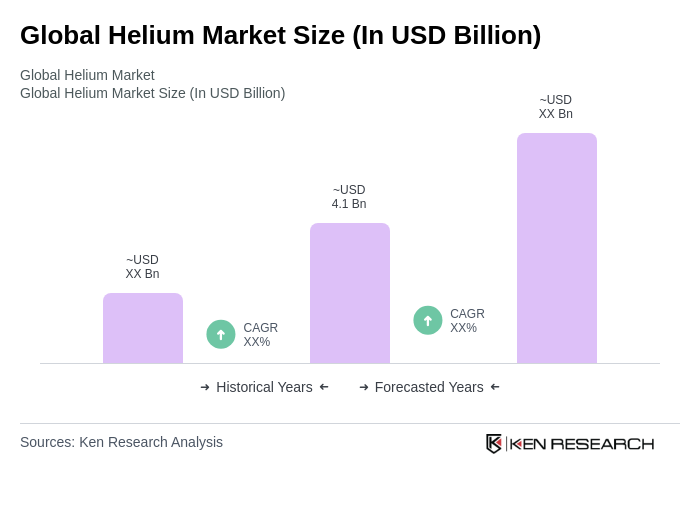
- The Global Helium Market is valued at USD 4.1 billion, based on a five-year historical analysis, with demand driven by healthcare (notably MRI), electronics/semiconductors, aerospace, and research uses. Independent industry trackers place the market size around the low–four billion USD range, consistent with robust consumption in MRI cooling, semiconductor purge and leak detection, and space launch operations .
- The United States, Qatar, and Russia are key producing and supplying countries. The U.S. historically led helium supply through large natural gas-linked output and midstream infrastructure; Qatar is a top global supplier via Ras Laffan helium plants tied to LNG streams with high helium content; Russia is building scale through projects such as Gazprom’s Amur complex to expand export capability .
- U.S. federal helium policy has transitioned from sell-down and privatization toward conservation-oriented management. The Helium Stewardship Act and subsequent privatization process culminated in the transfer of the Federal Helium System, while current policy discussions emphasize recovery and recycling to improve supply security; however, there was no new “Helium Privatization Act” implemented in 2023. Agencies and industry emphasize helium conservation and efficiency measures in critical applications .
Global Helium Market Segmentation
By Type:
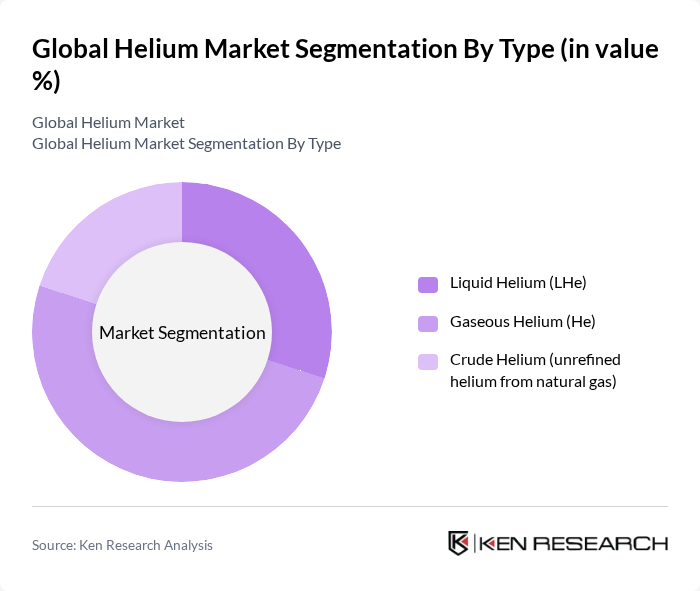
The helium market is segmented into three main types: Liquid Helium (LHe), Gaseous Helium (He), and Crude Helium (unrefined helium from natural gas). Gaseous Helium holds a significant share due to widespread use as an inert purge, carrier, and shielding gas in semiconductors, fiber optics, and leak detection. Liquid Helium is critical for cryogenics—especially MRI magnets—owing to its ultra-low boiling point. Crude Helium from natural gas streams is gaining attention as producers invest in refining/liquefaction to improve recovery yields and cost efficiency .
By End-User:
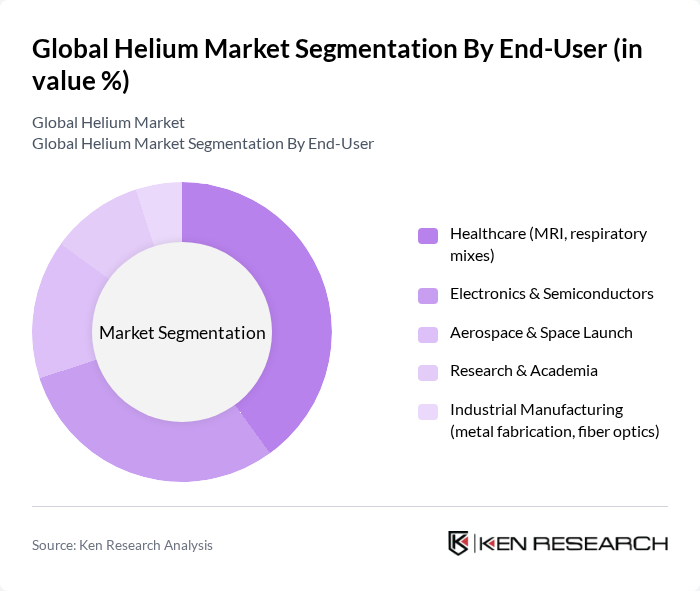
The end-user segmentation includes Healthcare, Electronics & Semiconductors, Aerospace & Space Launch, Research & Academia, and Industrial Manufacturing. Healthcare is a leading end-user because MRI systems require continuous liquid helium for superconducting magnets; conservation technologies reduce but do not eliminate helium use. Electronics & Semiconductors are another major end-user where helium supports wafer fabrication, purge, heat transfer, and leak testing. Aerospace and space launch operations rely on helium for pressurizing and purging rocket systems, while research institutions use helium for cryogenics and experimental physics. Industrial manufacturing applies helium for shielding in specialty welding, fiber optics, and other precision processes .
Global Helium Market Competitive Landscape
The Global Helium Market is characterized by a dynamic mix of regional and international players. Leading participants such as Air Products and Chemicals, Inc., Linde plc, Air Liquide S.A., Messer SE & Co. KGaA, Taiyo Nippon Sanso Corporation (a Nippon Sanso Holdings company), Iwatani Corporation, ExxonMobil Corporation, QatarEnergy (QatarEnergy LNG – Ras Laffan Helium), Gazprom (Amur Helium Project), Sonatrach, Renergen Limited, Helium One Global Ltd., Global Helium Corp., Avanti Helium Corp., Matheson Tri-Gas, Inc. (MATHESON) contribute to innovation, geographic expansion, and service delivery in this space .
Global Helium Market Industry Analysis
Growth Drivers
- Increasing Demand in Electronics Manufacturing:The electronics sector is projected to consume approximately 1.5 billion cubic meters of helium in future, driven by the production of semiconductors and advanced materials. The global semiconductor market is expected to reach $600 billion, with helium playing a crucial role in cooling and purging processes. This surge in electronics manufacturing is a significant growth driver for helium demand, particularly in regions with robust tech industries, such as None.
- Growth in Medical Applications:The medical sector's helium consumption is anticipated to exceed 500 million cubic meters in future, primarily due to its use in MRI machines and other diagnostic equipment. The global healthcare market is projected to grow to $11 trillion, with increased investments in medical technology. This growth is expected to drive helium demand, particularly in None, where healthcare infrastructure is expanding rapidly, necessitating reliable helium supplies for medical applications.
- Expansion of Space Exploration Activities:The space exploration sector is set to utilize around 300 million cubic meters of helium in future, fueled by increased investments in satellite launches and space missions. The global space economy is projected to reach $1 trillion, with significant contributions from private companies. This expansion is particularly relevant for None, where local aerospace initiatives are gaining momentum, further driving helium demand for various applications in space technology.
Market Challenges
- Supply Chain Disruptions:The helium supply chain is vulnerable to disruptions, with global production concentrated in a few regions. In future, supply chain issues could lead to a shortfall of approximately 200 million cubic meters, impacting industries reliant on helium. This challenge is exacerbated by geopolitical tensions and natural disasters, which can halt production and transportation, particularly affecting regions like None that depend on imported helium.
- High Production Costs:The cost of helium production is projected to remain high, with estimates around $100 per thousand cubic meters in future. This is due to the complex extraction processes and the need for advanced technology. High production costs can deter new entrants and limit supply, particularly in None, where local production capabilities are still developing, making it challenging to meet the growing demand effectively.
Global Helium Market Future Outlook
The helium market is poised for significant transformation, driven by technological advancements and a shift towards sustainable practices. As industries increasingly adopt helium recycling and recovery technologies, the market is expected to stabilize supply and reduce environmental impacts. Additionally, the growing focus on supply security will encourage investments in local production capabilities, particularly in None, where emerging technologies can enhance extraction efficiency and sustainability, ensuring a more resilient helium supply chain.
Market Opportunities
- Development of New Extraction Technologies:Innovations in extraction technologies could enhance helium recovery rates by up to 30% in future. This presents a significant opportunity for companies in None to invest in advanced methods, reducing reliance on traditional sources and improving supply stability, ultimately benefiting various industries reliant on helium.
- Expansion into Emerging Markets:Emerging markets are expected to account for a 20% increase in helium demand in future, driven by industrial growth and technological advancements. Companies in None can capitalize on this trend by establishing partnerships and expanding distribution networks, tapping into new customer bases and enhancing market presence in these regions.
Scope of the Report
| Segment | Sub-Segments |
|---|---|
| By Type | Liquid Helium (LHe) Gaseous Helium (He) Crude Helium (unrefined helium from natural gas) |
| By End-User | Healthcare (MRI, respiratory mixes) Electronics & Semiconductors Aerospace & Space Launch Research & Academia Industrial Manufacturing (metal fabrication, fiber optics) |
| By Application | Cryogenics (including MRI) Leak Detection & Trace Gas Pressurizing & Purging (rocket propulsion, pipelines) Welding & Shielding Gas Controlled/Shielded Atmospheres (semiconductor, fiber optics) Lifting/Ballooning |
| By Distribution Channel | Direct Offtake/Long-term Contracts Industrial Gas Distributors Spot/On-demand Sales |
| By Region | North America Europe Asia-Pacific Latin America Middle East & Africa |
| By Pricing Mechanism | Index-linked/Contract Pricing Spot Pricing Tolling/Processing Fees |
| By Others | Helium Recovery & Recycling Onsite Supply (Bulk, Microbulk, cylinders, dewars) |
Key Target Audience
Investors and Venture Capitalist Firms
Government and Regulatory Bodies (e.g., U.S. Geological Survey, Federal Aviation Administration)
Manufacturers and Producers
Distributors and Retailers
Gas Supply Companies
Medical Equipment Manufacturers
Aerospace and Defense Contractors
Industrial Gas Associations
Players Mentioned in the Report:
Air Products and Chemicals, Inc.
Linde plc
Air Liquide S.A.
Messer SE & Co. KGaA
Taiyo Nippon Sanso Corporation (a Nippon Sanso Holdings company)
Iwatani Corporation
ExxonMobil Corporation
QatarEnergy (QatarEnergy LNG Ras Laffan Helium)
Gazprom (Amur Helium Project)
Sonatrach
Renergen Limited
Helium One Global Ltd.
Global Helium Corp.
Avanti Helium Corp.
Matheson Tri-Gas, Inc. (MATHESON)
Table of Contents
Market Assessment Phase
1. Executive Summary and Approach
2. Global Helium Market Overview
2.1 Key Insights and Strategic Recommendations
2.2 Global Helium Market Overview
2.3 Definition and Scope
2.4 Evolution of Market Ecosystem
2.5 Timeline of Key Regulatory Milestones
2.6 Value Chain & Stakeholder Mapping
2.7 Business Cycle Analysis
2.8 Policy & Incentive Landscape
3. Global Helium Market Analysis
3.1 Growth Drivers
3.1.1 Increasing Demand in Electronics Manufacturing
3.1.2 Growth in Medical Applications
3.1.3 Expansion of Space Exploration Activities
3.1.4 Rising Use in Cryogenics
3.2 Market Challenges
3.2.1 Supply Chain Disruptions
3.2.2 Environmental Regulations
3.2.3 High Production Costs
3.2.4 Limited Availability of Natural Gas Sources
3.3 Market Opportunities
3.3.1 Development of New Extraction Technologies
3.3.2 Increasing Investment in Renewable Energy
3.3.3 Expansion into Emerging Markets
3.3.4 Strategic Partnerships and Collaborations
3.4 Market Trends
3.4.1 Shift Towards Sustainable Practices
3.4.2 Technological Advancements in Helium Recovery
3.4.3 Growing Interest in Helium Recycling
3.4.4 Increased Focus on Supply Security
3.5 Government Regulation
3.5.1 Export Controls on Helium
3.5.2 Environmental Compliance Standards
3.5.3 Safety Regulations in Helium Handling
3.5.4 Incentives for Helium Recovery Projects
4. SWOT Analysis
5. Stakeholder Analysis
6. Porter's Five Forces Analysis
7. Global Helium Market Market Size, 2019-2024
7.1 By Value
7.2 By Volume
7.3 By Average Selling Price
8. Global Helium Market Segmentation
8.1 By Type
8.1.1 Liquid Helium (LHe)
8.1.2 Gaseous Helium (He)
8.1.3 Crude Helium (unrefined helium from natural gas)
8.2 By End-User
8.2.1 Healthcare (MRI, respiratory mixes)
8.2.2 Electronics & Semiconductors
8.2.3 Aerospace & Space Launch
8.2.4 Research & Academia
8.2.5 Industrial Manufacturing (metal fabrication, fiber optics)
8.3 By Application
8.3.1 Cryogenics (including MRI)
8.3.2 Leak Detection & Trace Gas
8.3.3 Pressurizing & Purging (rocket propulsion, pipelines)
8.3.4 Welding & Shielding Gas
8.3.5 Controlled/Shielded Atmospheres (semiconductor, fiber optics)
8.3.6 Lifting/Ballooning
8.4 By Distribution Channel
8.4.1 Direct Offtake/Long-term Contracts
8.4.2 Industrial Gas Distributors
8.4.3 Spot/On-demand Sales
8.5 By Region
8.5.1 North America
8.5.2 Europe
8.5.3 Asia-Pacific
8.5.4 Latin America
8.5.5 Middle East & Africa
8.6 By Pricing Mechanism
8.6.1 Index-linked/Contract Pricing
8.6.2 Spot Pricing
8.6.3 Tolling/Processing Fees
8.7 Others
8.7.1 Helium Recovery & Recycling
8.7.2 Onsite Supply (Bulk, Microbulk, cylinders, dewars)
9. Global Helium Market Competitive Analysis
9.1 Market Share of Key Players
9.2 Cross Comparison of Key Players
9.2.1 Company Name (entity level used for reporting)
9.2.2 Helium Revenue/Share of Revenue from Helium
9.2.3 Production Capacity (refined LHe/He, MMCF/y or tonnes/y)
9.2.4 Proven/Probable Reserves or Long-term Supply Access
9.2.5 Geographic Footprint (plants, liquefiers, sourcing regions)
9.2.6 Contract Portfolio Strength (LTAs with healthcare/semiconductor)
9.2.7 Vertical Integration (from upstream gas to distribution)
9.2.8 Capex Pipeline (new wells, LNG-associated helium, plants)
9.2.9 Reliability KPIs (uptime, force majeure incidence)
9.2.10 Pricing Power/Pass-through Mechanisms
9.2.11 Innovation & Recovery Intensity (recycling systems, He recovery rate)
9.2.12 ESG & Safety Metrics (venting reduction, TRIR, emissions)
9.3 SWOT Analysis of Top Players
9.4 Pricing Analysis
9.5 Detailed Profile of Major Companies
9.5.1 Air Products and Chemicals, Inc.
9.5.2 Linde plc
9.5.3 Air Liquide S.A.
9.5.4 Messer SE & Co. KGaA
9.5.5 Taiyo Nippon Sanso Corporation (a Nippon Sanso Holdings company)
9.5.6 Iwatani Corporation
9.5.7 ExxonMobil Corporation
9.5.8 QatarEnergy (QatarEnergy LNG – Ras Laffan Helium)
9.5.9 Gazprom (Amur Helium Project)
9.5.10 Sonatrach
9.5.11 Renergen Limited
9.5.12 Helium One Global Ltd.
9.5.13 Global Helium Corp.
9.5.14 Avanti Helium Corp.
9.5.15 Matheson Tri-Gas, Inc. (MATHESON)
10. Global Helium Market End-User Analysis
10.1 Procurement Behavior of Key Ministries
10.1.1 Government Contracts for Medical Use
10.1.2 Procurement for Research Institutions
10.1.3 Budget Allocations for Aerospace Projects
10.2 Corporate Spend on Infrastructure & Energy
10.2.1 Investment in Helium Supply Chains
10.2.2 Expenditure on Helium Applications in Energy
10.3 Pain Point Analysis by End-User Category
10.3.1 Supply Reliability Issues
10.3.2 Cost Fluctuations
10.3.3 Regulatory Compliance Challenges
10.4 User Readiness for Adoption
10.4.1 Awareness of Helium Applications
10.4.2 Training and Skill Development Needs
10.5 Post-Deployment ROI and Use Case Expansion
10.5.1 Evaluation of Cost Savings
10.5.2 Expansion into New Applications
11. Global Helium Market Future Size, 2025-2030
11.1 By Value
11.2 By Volume
11.3 By Average Selling Price
Go-To-Market Strategy Phase
1. Whitespace Analysis + Business Model Canvas
1.1 Market Gaps Identification
1.2 Business Model Development
2. Marketing and Positioning Recommendations
2.1 Branding Strategies
2.2 Product USPs
3. Distribution Plan
3.1 Urban Retail vs Rural NGO Tie-Ups
4. Channel & Pricing Gaps
4.1 Underserved Routes
4.2 Pricing Bands
5. Unmet Demand & Latent Needs
5.1 Category Gaps
5.2 Consumer Segments
6. Customer Relationship
6.1 Loyalty Programs
6.2 After-Sales Service
7. Value Proposition
7.1 Sustainability
7.2 Integrated Supply Chains
8. Key Activities
8.1 Regulatory Compliance
8.2 Branding
8.3 Distribution Setup
9. Entry Strategy Evaluation
9.1 Domestic Market Entry Strategy
9.1.1 Product Mix
9.1.2 Pricing Band
9.1.3 Packaging
9.2 Export Entry Strategy
9.2.1 Target Countries
9.2.2 Compliance Roadmap
10. Entry Mode Assessment
10.1 JV
10.2 Greenfield
10.3 M&A
10.4 Distributor Model
11. Capital and Timeline Estimation
11.1 Capital Requirements
11.2 Timelines
12. Control vs Risk Trade-Off
12.1 Ownership vs Partnerships
13. Profitability Outlook
13.1 Breakeven Analysis
13.2 Long-Term Sustainability
14. Potential Partner List
14.1 Distributors
14.2 JVs
14.3 Acquisition Targets
15. Execution Roadmap
15.1 Phased Plan for Market Entry
15.1.1 Market Setup
15.1.2 Market Entry
15.1.3 Growth Acceleration
15.1.4 Scale & Stabilize
15.2 Key Activities and Milestones
15.2.1 Activity Planning
15.2.2 Milestone Tracking
Research Methodology
Phase 1: Approach1
Desk Research
- Analysis of global helium production and consumption statistics from the U.S. Geological Survey
- Review of industry reports from the International Helium Association and other relevant organizations
- Examination of market trends and forecasts published in academic journals and trade publications
Primary Research
- Interviews with executives from major helium producers and suppliers
- Surveys targeting end-users in sectors such as healthcare, electronics, and aerospace
- Field interviews with industry experts and analysts to gather qualitative insights
Validation & Triangulation
- Cross-validation of findings through multiple data sources, including trade publications and government reports
- Triangulation of market data with insights from expert interviews to ensure accuracy
- Sanity checks through peer reviews and feedback from industry stakeholders
Phase 2: Market Size Estimation1
Top-down Assessment
- Estimation of global helium market size based on macroeconomic indicators and industry growth rates
- Segmentation of the market by application areas such as medical, industrial, and scientific uses
- Incorporation of regional demand variations and emerging market trends
Bottom-up Modeling
- Collection of production data from leading helium extraction facilities and their output capacities
- Analysis of consumption patterns across different end-user industries
- Estimation of pricing trends based on historical data and current market conditions
Forecasting & Scenario Analysis
- Development of predictive models using historical data and market drivers such as technological advancements
- Scenario analysis based on potential regulatory changes and geopolitical factors affecting supply
- Creation of baseline, optimistic, and pessimistic forecasts through 2030
Phase 3: CATI Sample Composition1
| Scope Item/Segment | Sample Size | Target Respondent Profiles |
|---|---|---|
| Medical Applications of Helium | 100 | Healthcare Administrators, Medical Equipment Suppliers |
| Industrial Helium Usage | 80 | Manufacturing Managers, Process Engineers |
| Aerospace Sector Demand | 70 | Aerospace Engineers, Procurement Specialists |
| Research and Development Applications | 60 | Lab Managers, Research Scientists |
| Emerging Markets for Helium | 90 | Market Analysts, Business Development Managers |
Frequently Asked Questions
What is the current value of the Global Helium Market?
The Global Helium Market is valued at approximately USD 4.1 billion, driven by demand from sectors such as healthcare, electronics, aerospace, and research. This valuation reflects a robust consumption pattern, particularly in MRI cooling and semiconductor applications.
Which countries are the leading producers of helium?
What are the main applications of helium in healthcare?
How is helium used in the electronics industry?
Other Regional/Country Reports
Indonesia Helium Market
Malaysia Helium Market
APAC Helium Market
SEA Helium Market
Why Buy From Us?

What makes us stand out is that our consultants follow Robust, Refine and Result (RRR) methodology. Robust for clear definitions, approaches and sanity checking, Refine for differentiating respondents' facts and opinions, and Result for presenting data with story.

We have set a benchmark in the industry by offering our clients with syndicated and customized market research reports featuring coverage of entire market as well as meticulous research and analyst insights.

While we don't replace traditional research, we flip the method upside down. Our dual approach of Top Bottom & Bottom Top ensures quality deliverable by not just verifying company fundamentals but also looking at the sector and macroeconomic factors.

With one step in the future, our research team constantly tries to show you the bigger picture. We help with some of the tough questions you may encounter along the way: How is the industry positioned? Best marketing channel? KPI's of competitors? By aligning every element, we help maximize success.

Our report gives you instant access to the answers and sources that other companies might choose to hide. We elaborate each steps of research methodology we have used and showcase you the sample size to earn your trust.

If you need any support, we are here! We pride ourselves on universe strength, data quality, and quick, friendly, and professional service.