Global Hip Reconstruction Devices Market

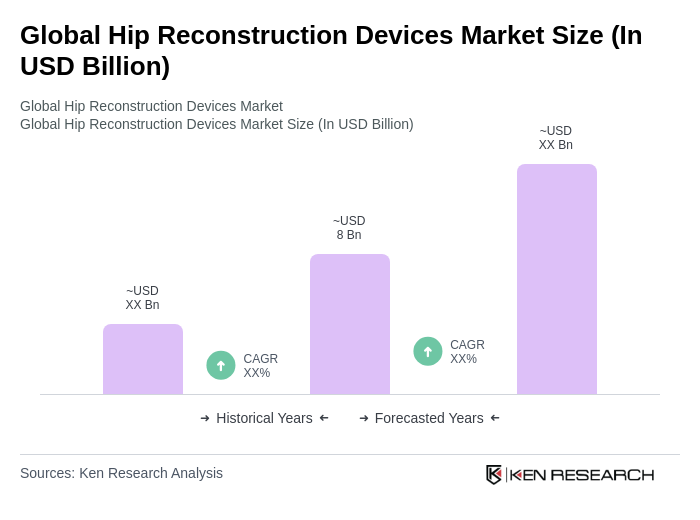
The Global Hip Reconstruction Devices Market, valued at USD 8 billion, is growing due to increasing osteoarthritis cases, innovative minimally invasive techniques, and an aging population worldwide.

Region:Global

Author(s):Dev

Product Code:KRAD0539

Pages:88

Published On:August 2025
About the Report

Base Year 2024

Global Hip Reconstruction Devices Market Overview

  • The Global Hip Reconstruction Devices Market is valued at USD 8 billion, based on a five-year historical analysis. This growth is primarily driven by the increasing prevalence of hip-related disorders (notably osteoarthritis), advancements in surgical techniques and materials (including robotics, minimally invasive approaches, and improved bearings), and the rising geriatric population. The demand for innovative and minimally invasive surgical options has further propelled market expansion, as healthcare providers seek to improve patient outcomes, shorten hospital stays, and reduce recovery times.
  • Key players in this market are predominantly located in North America and Europe, with the United States and Germany leading due to their advanced healthcare infrastructure, high healthcare expenditure, and strong presence of major manufacturers such as Zimmer Biomet, DePuy Synthes (Johnson & Johnson MedTech), Stryker, Smith & Nephew, and B. Braun Melsungen. These regions benefit from a well-established distribution network and a high volume of orthopedic surgeries, contributing to their dominance in the global market.
  • In 2023, the U.S. Food and Drug Administration continued to emphasize robust evidence requirements for orthopedic implants through its premarket pathways. While there was no single broad “new regulation” specific only to hip devices, FDA sustained stricter scrutiny on metal-on-metal hip systems and requires comprehensive clinical and performance data through PMA or 510(k) with appropriate special controls and postmarket surveillance where applicable, aiming to ensure safety and efficacy while supporting innovation.
Global Hip Reconstruction Devices Market Size

Global Hip Reconstruction Devices Market Segmentation

By Type:The market is segmented into various types of hip reconstruction devices, including Primary Hip Reconstruction Devices, Partial Hip Replacement Devices, Hip Resurfacing Systems, Revision Hip Reconstruction Devices, and Fixation & Ancillary Components. Among these, Primary Hip Reconstruction Devices are the most widely used due to their effectiveness in treating severe hip joint damage and their established track record in clinical outcomes.
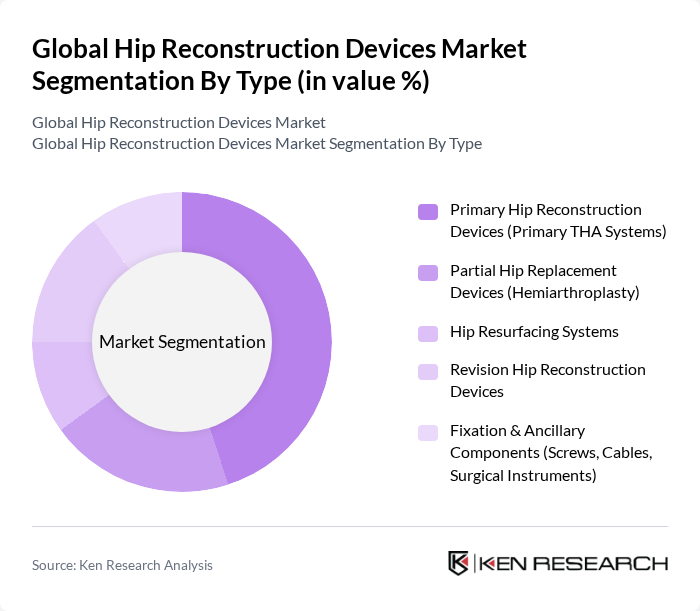
Global Hip Reconstruction Devices Market segmentation by Type.

By End-User:The end-user segmentation includes Hospitals, Ambulatory Surgical Centers, Orthopedic Specialty Clinics, and Rehabilitation Centers. Hospitals dominate this segment due to their comprehensive facilities and the ability to perform complex surgeries, which require advanced hip reconstruction devices. The increasing number of orthopedic procedures performed in hospitals further solidifies their leading position in the market.
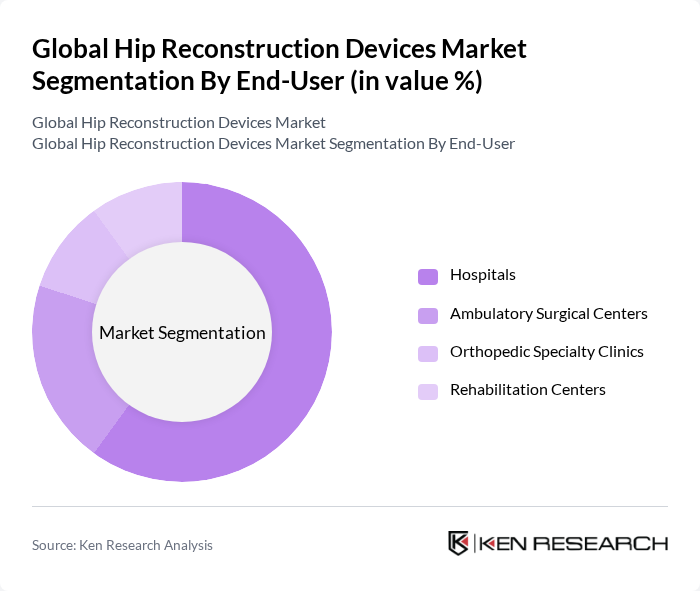
Global Hip Reconstruction Devices Market segmentation by End-User.

Global Hip Reconstruction Devices Market Competitive Landscape

The Global Hip Reconstruction Devices Market is characterized by a dynamic mix of regional and international players. Leading participants such as Johnson & Johnson MedTech (DePuy Synthes), Stryker Corporation, Zimmer Biomet Holdings, Inc., Smith & Nephew plc, B. Braun Melsungen AG (Aesculap), Exactech, Inc., Medacta Group SA, LimaCorporate S.p.A., DJO, LLC (Enovis Corporation), Corin Group, Waldemar Link GmbH & Co. KG (LINK), MicroPort Orthopedics Inc., ConMed Corporation, Orthofix Medical Inc., Heraeus Medical GmbH contribute to innovation, geographic expansion, and service delivery in this space.

Johnson & Johnson MedTech (DePuy Synthes)

1886

New Brunswick, New Jersey, USA

Stryker Corporation

1941

Kalamazoo, Michigan, USA

Zimmer Biomet Holdings, Inc.

1927

Warsaw, Indiana, USA

Smith & Nephew plc

1856

London, England

B. Braun Melsungen AG (Aesculap)

1839

Melsungen, Germany

Company

Establishment Year

Headquarters

Group Size (Large, Medium, or Small as per industry convention)

Hip Segment Revenue (USD) and YoY Growth

Procedure Coverage and Installed Base (Systems/Robotics)

Geographic Footprint (Countries/Regions Served)

Product Portfolio Breadth (Primary, Revision, Resurfacing, Bearings, Fixation)

Regulatory Approvals Pipeline (510(k)/CE approvals in last 24 months)

Global Hip Reconstruction Devices Market Industry Analysis

Growth Drivers

  • Increasing Prevalence of Hip-Related Disorders:The global prevalence of hip-related disorders is projected to reach 14 million cases in the future, driven by factors such as obesity and sedentary lifestyles. According to the World Health Organization, the incidence of osteoarthritis, a major contributor to hip disorders, is expected to rise significantly, affecting approximately 10% of the population over 60 years. This growing patient base necessitates advanced hip reconstruction devices, thereby propelling market growth.
  • Advancements in Surgical Techniques:Innovations in surgical techniques, such as robotic-assisted surgeries, are enhancing the precision and outcomes of hip reconstruction procedures. The American Academy of Orthopaedic Surgeons reported that minimally invasive techniques reduce recovery time by up to 50%, making surgeries more appealing to patients. As these advanced techniques become more widely adopted, the demand for sophisticated hip reconstruction devices is expected to increase, further driving market expansion.
  • Rising Geriatric Population:The global geriatric population is anticipated to exceed 1.5 billion in the future, according to the United Nations. This demographic shift is significant as older adults are more susceptible to hip-related disorders, necessitating surgical interventions. The increasing number of elderly individuals will likely lead to a higher demand for hip reconstruction devices, thereby contributing to market growth as healthcare systems adapt to meet these needs.

Market Challenges

  • High Cost of Hip Reconstruction Devices:The average cost of hip reconstruction devices can range from $15,000 to $30,000, depending on the complexity of the procedure and materials used. This high cost can limit accessibility for patients, particularly in developing regions where healthcare budgets are constrained. As a result, the financial burden may hinder the adoption of advanced hip reconstruction technologies, posing a challenge to market growth.
  • Stringent Regulatory Requirements:Regulatory bodies such as the FDA and European Medicines Agency impose rigorous standards for the approval of medical devices, including hip reconstruction products. The approval process can take several years and requires extensive clinical data, which can delay market entry for new innovations. These stringent regulations can create barriers for manufacturers, impacting their ability to respond swiftly to market demands and technological advancements.

Global Hip Reconstruction Devices Market Future Outlook

The future of the hip reconstruction devices market appears promising, driven by ongoing technological advancements and an increasing focus on patient-centric care. As healthcare systems evolve, the integration of digital technologies and personalized medicine will likely enhance surgical outcomes. Furthermore, the rise in outpatient surgeries is expected to streamline procedures, making them more accessible. These trends indicate a dynamic market landscape, with opportunities for innovation and growth in the future.

Market Opportunities

  • Expansion in Emerging Markets:Emerging markets, particularly in Asia-Pacific and Latin America, are witnessing rapid economic growth and increasing healthcare investments. In the future, healthcare spending in these regions is projected to reach $1 trillion, creating significant opportunities for hip reconstruction device manufacturers to expand their presence and cater to the rising demand for advanced medical technologies.
  • Development of Innovative Materials:The development of innovative materials, such as bioactive ceramics and advanced polymers, is set to revolutionize hip reconstruction devices. These materials can enhance biocompatibility and longevity, addressing issues related to device failures. As research progresses, manufacturers that invest in these innovations will likely gain a competitive edge, tapping into a growing market segment focused on improved patient outcomes.

Scope of the Report

SegmentSub-Segments
By Type

Primary Hip Reconstruction Devices (Primary THA Systems)

Partial Hip Replacement Devices (Hemiarthroplasty)

Hip Resurfacing Systems

Revision Hip Reconstruction Devices

Fixation & Ancillary Components (Screws, Cables, Surgical Instruments)

By End-User

Hospitals

Ambulatory Surgical Centers

Orthopedic Specialty Clinics

Rehabilitation Centers

By Material/Bearing Surface

Metal-on-Polyethylene (MoP)

Ceramic-on-Polyethylene (CoP)

Ceramic-on-Ceramic (CoC)

Advanced Polyethylene Inserts (Highly Cross-Linked/Antioxidant)

By Fixation Technique

Cementless

Cemented

Hybrid

By Distribution Channel

Direct Sales

Distributors

Group Purchasing Organizations (GPOs) and Integrated Delivery Networks (IDNs)

By Region

North America

Europe

Asia-Pacific

Latin America

Middle East & Africa

By Patient Demographics

Age Group (Elderly, Adults)

Gender (Male, Female)

Activity Level (Active, Sedentary)

By Surgical Approach

Anterior Approach

Posterior Approach

Lateral Approach

Robotic-Assisted and Navigation-Enabled

Key Target Audience

Investors and Venture Capitalist Firms

Government and Regulatory Bodies (e.g., U.S. Food and Drug Administration, European Medicines Agency)

Manufacturers and Producers

Distributors and Retailers

Healthcare Providers and Hospitals

Medical Device Wholesalers

Industry Associations (e.g., Orthopaedic Research Society)

Financial Institutions

Players Mentioned in the Report:

Johnson & Johnson MedTech (DePuy Synthes)

Stryker Corporation

Zimmer Biomet Holdings, Inc.

Smith & Nephew plc

B. Braun Melsungen AG (Aesculap)

Exactech, Inc.

Medacta Group SA

LimaCorporate S.p.A.

DJO, LLC (Enovis Corporation)

Corin Group

Waldemar Link GmbH & Co. KG (LINK)

MicroPort Orthopedics Inc.

ConMed Corporation

Orthofix Medical Inc.

Heraeus Medical GmbH

Table of Contents

Market Assessment Phase

1. Executive Summary and Approach


2. Global Hip Reconstruction Devices Market Overview

2.1 Key Insights and Strategic Recommendations

2.2 Global Hip Reconstruction Devices Market Overview

2.3 Definition and Scope

2.4 Evolution of Market Ecosystem

2.5 Timeline of Key Regulatory Milestones

2.6 Value Chain & Stakeholder Mapping

2.7 Business Cycle Analysis

2.8 Policy & Incentive Landscape


3. Global Hip Reconstruction Devices Market Analysis

3.1 Growth Drivers

3.1.1 Increasing prevalence of hip-related disorders
3.1.2 Advancements in surgical techniques
3.1.3 Rising geriatric population
3.1.4 Growing demand for minimally invasive procedures

3.2 Market Challenges

3.2.1 High cost of hip reconstruction devices
3.2.2 Stringent regulatory requirements
3.2.3 Risk of complications and device failures
3.2.4 Limited access to advanced healthcare facilities in developing regions

3.3 Market Opportunities

3.3.1 Expansion in emerging markets
3.3.2 Development of innovative materials
3.3.3 Increasing investment in healthcare infrastructure
3.3.4 Collaborations and partnerships for product development

3.4 Market Trends

3.4.1 Shift towards personalized medicine
3.4.2 Integration of digital technologies in surgical procedures
3.4.3 Growing focus on patient-centric care
3.4.4 Rise in outpatient surgeries

3.5 Government Regulation

3.5.1 FDA regulations on medical devices
3.5.2 CE marking requirements in Europe
3.5.3 Reimbursement policies for hip reconstruction
3.5.4 Guidelines for clinical trials and studies

4. SWOT Analysis


5. Stakeholder Analysis


6. Porter's Five Forces Analysis


7. Global Hip Reconstruction Devices Market Market Size, 2019-2024

7.1 By Value

7.2 By Volume

7.3 By Average Selling Price


8. Global Hip Reconstruction Devices Market Segmentation

8.1 By Type

8.1.1 Primary Hip Reconstruction Devices (Primary THA Systems)
8.1.2 Partial Hip Replacement Devices (Hemiarthroplasty)
8.1.3 Hip Resurfacing Systems
8.1.4 Revision Hip Reconstruction Devices
8.1.5 Fixation & Ancillary Components (Screws, Cables, Surgical Instruments)

8.2 By End-User

8.2.1 Hospitals
8.2.2 Ambulatory Surgical Centers
8.2.3 Orthopedic Specialty Clinics
8.2.4 Rehabilitation Centers

8.3 By Material/Bearing Surface

8.3.1 Metal-on-Polyethylene (MoP)
8.3.2 Ceramic-on-Polyethylene (CoP)
8.3.3 Ceramic-on-Ceramic (CoC)
8.3.4 Advanced Polyethylene Inserts (Highly Cross-Linked/Antioxidant)

8.4 By Fixation Technique

8.4.1 Cementless
8.4.2 Cemented
8.4.3 Hybrid

8.5 By Distribution Channel

8.5.1 Direct Sales
8.5.2 Distributors
8.5.3 Group Purchasing Organizations (GPOs) and Integrated Delivery Networks (IDNs)

8.6 By Region

8.6.1 North America
8.6.2 Europe
8.6.3 Asia-Pacific
8.6.4 Latin America
8.6.5 Middle East & Africa

8.7 By Patient Demographics

8.7.1 Age Group (Elderly, Adults)
8.7.2 Gender (Male, Female)
8.7.3 Activity Level (Active, Sedentary)

8.8 By Surgical Approach

8.8.1 Anterior Approach
8.8.2 Posterior Approach
8.8.3 Lateral Approach
8.8.4 Robotic-Assisted and Navigation-Enabled

9. Global Hip Reconstruction Devices Market Competitive Analysis

9.1 Market Share of Key Players

9.2 Cross Comparison of Key Players

9.2.1 Company Name
9.2.2 Group Size (Large, Medium, or Small as per industry convention)
9.2.3 Hip Segment Revenue (USD) and YoY Growth
9.2.4 Procedure Coverage and Installed Base (Systems/Robotics)
9.2.5 Geographic Footprint (Countries/Regions Served)
9.2.6 Product Portfolio Breadth (Primary, Revision, Resurfacing, Bearings, Fixation)
9.2.7 Regulatory Approvals Pipeline (510(k)/CE approvals in last 24 months)
9.2.8 Pricing and ASP Trend (Premium vs. Value Tiers)
9.2.9 Gross Margin and Operating Margin (Hip/Ortho Segment)
9.2.10 R&D Intensity (% of revenue) and Innovation Velocity (new SKUs/yr)
9.2.11 Supply Chain Resilience (backorders, dual-sourcing, lead times)
9.2.12 Surgeon Engagement (training centers, KOL programs, MAKO/robots deployed)
9.2.13 Service and Distribution Network Strength (direct vs. distributor mix)

9.3 SWOT Analysis of Top Players

9.4 Pricing Analysis

9.5 Detailed Profile of Major Companies

9.5.1 Johnson & Johnson MedTech (DePuy Synthes)
9.5.2 Stryker Corporation
9.5.3 Zimmer Biomet Holdings, Inc.
9.5.4 Smith & Nephew plc
9.5.5 B. Braun Melsungen AG (Aesculap)
9.5.6 Exactech, Inc.
9.5.7 Medacta Group SA
9.5.8 LimaCorporate S.p.A.
9.5.9 DJO, LLC (Enovis Corporation)
9.5.10 Corin Group
9.5.11 Waldemar Link GmbH & Co. KG (LINK)
9.5.12 MicroPort Orthopedics Inc.
9.5.13 ConMed Corporation
9.5.14 Orthofix Medical Inc.
9.5.15 Heraeus Medical GmbH

10. Global Hip Reconstruction Devices Market End-User Analysis

10.1 Procurement Behavior of Key Ministries

10.1.1 Government procurement policies
10.1.2 Budget allocation for healthcare
10.1.3 Preference for local vs. international suppliers

10.2 Corporate Spend on Infrastructure & Energy

10.2.1 Investment in healthcare facilities
10.2.2 Funding for research and development
10.2.3 Expenditure on training and education

10.3 Pain Point Analysis by End-User Category

10.3.1 Challenges faced by hospitals
10.3.2 Issues in outpatient care
10.3.3 Concerns of orthopedic clinics

10.4 User Readiness for Adoption

10.4.1 Awareness of new technologies
10.4.2 Training requirements for staff
10.4.3 Financial readiness for investment

10.5 Post-Deployment ROI and Use Case Expansion

10.5.1 Evaluation of surgical outcomes
10.5.2 Long-term patient follow-up
10.5.3 Opportunities for product upgrades

11. Global Hip Reconstruction Devices Market Future Size, 2025-2030

11.1 By Value

11.2 By Volume

11.3 By Average Selling Price


Go-To-Market Strategy Phase

1. Whitespace Analysis + Business Model Canvas

1.1 Market gaps identification

1.2 Value proposition development

1.3 Revenue model exploration

1.4 Key partnerships and resources

1.5 Customer segments analysis

1.6 Cost structure evaluation

1.7 Competitive landscape overview


2. Marketing and Positioning Recommendations

2.1 Branding strategies

2.2 Product USPs

2.3 Target audience identification

2.4 Communication channels

2.5 Promotional tactics


3. Distribution Plan

3.1 Urban retail strategies

3.2 Rural NGO tie-ups

3.3 Online distribution channels

3.4 Partnerships with healthcare providers


4. Channel & Pricing Gaps

4.1 Underserved routes

4.2 Pricing bands analysis

4.3 Competitor pricing strategies

4.4 Customer willingness to pay


5. Unmet Demand & Latent Needs

5.1 Category gaps identification

5.2 Consumer segments analysis

5.3 Emerging trends and needs

5.4 Feedback from healthcare professionals


6. Customer Relationship

6.1 Loyalty programs

6.2 After-sales service

6.3 Customer feedback mechanisms

6.4 Engagement strategies


7. Value Proposition

7.1 Sustainability initiatives

7.2 Integrated supply chains

7.3 Cost-effectiveness

7.4 Quality assurance


8. Key Activities

8.1 Regulatory compliance

8.2 Branding efforts

8.3 Distribution setup

8.4 Training and development


9. Entry Strategy Evaluation

9.1 Domestic Market Entry Strategy

9.1.1 Product mix considerations
9.1.2 Pricing band analysis
9.1.3 Packaging strategies

9.2 Export Entry Strategy

9.2.1 Target countries selection
9.2.2 Compliance roadmap development

10. Entry Mode Assessment

10.1 Joint Ventures

10.2 Greenfield investments

10.3 Mergers & Acquisitions

10.4 Distributor Model


11. Capital and Timeline Estimation

11.1 Capital requirements

11.2 Timelines for market entry


12. Control vs Risk Trade-Off

12.1 Ownership considerations

12.2 Partnerships evaluation


13. Profitability Outlook

13.1 Breakeven analysis

13.2 Long-term sustainability strategies


14. Potential Partner List

14.1 Distributors

14.2 Joint Ventures

14.3 Acquisition targets


15. Execution Roadmap

15.1 Phased Plan for Market Entry

15.1.1 Market Setup
15.1.2 Market Entry
15.1.3 Growth Acceleration
15.1.4 Scale & Stabilize

15.2 Key Activities and Milestones

15.2.1 Milestone tracking
15.2.2 Activity scheduling

Research Methodology

ApproachModellingSample

Phase 1: Approach1

Desk Research

  • Analysis of industry reports from medical device associations and orthopedic journals
  • Review of market data from health economics studies and hospital procurement reports
  • Examination of regulatory guidelines and updates from health authorities regarding hip reconstruction devices

Primary Research

  • Interviews with orthopedic surgeons specializing in hip reconstruction procedures
  • Surveys with hospital procurement managers to understand purchasing trends
  • Field interviews with medical device sales representatives to gather insights on market dynamics

Validation & Triangulation

  • Cross-validation of findings through multiple data sources including clinical studies and market surveys
  • Triangulation of data from primary interviews and secondary research to ensure consistency
  • Sanity checks through expert panel reviews comprising orthopedic specialists and market analysts

Phase 2: Market Size Estimation1

Top-down Assessment

  • Estimation of market size based on national healthcare expenditure and orthopedic surgery statistics
  • Segmentation of the market by device type, including total hip arthroplasty and partial hip replacement
  • Incorporation of demographic trends such as aging population and prevalence of hip disorders

Bottom-up Modeling

  • Collection of sales data from leading manufacturers of hip reconstruction devices
  • Estimation of unit sales based on surgical volume and average device pricing
  • Analysis of regional market dynamics to capture local variations in device adoption

Forecasting & Scenario Analysis

  • Multi-factor regression analysis incorporating factors such as technological advancements and healthcare policies
  • Scenario modeling based on potential changes in reimbursement policies and surgical techniques
  • Development of baseline, optimistic, and pessimistic forecasts through 2030

Phase 3: CATI Sample Composition1

Scope Item/SegmentSample SizeTarget Respondent Profiles
Orthopedic Surgeons120Surgeons specializing in hip procedures, Clinical Directors
Hospital Procurement Managers90Procurement Officers, Supply Chain Managers
Medical Device Sales Representatives80Sales Managers, Territory Representatives
Healthcare Policy Makers60Health Economists, Policy Analysts
Patients undergoing Hip Reconstruction70Patients, Caregivers, Rehabilitation Specialists

Frequently Asked Questions

What is the current value of the Global Hip Reconstruction Devices Market?

The Global Hip Reconstruction Devices Market is valued at approximately USD 8 billion, driven by factors such as the increasing prevalence of hip-related disorders, advancements in surgical techniques, and a growing geriatric population.

What are the main drivers of growth in the hip reconstruction devices market?

Which regions dominate the Global Hip Reconstruction Devices Market?

What types of hip reconstruction devices are available in the market?

Other Regional/Country Reports

UAE Hip Reconstruction Devices MarketKSA Hip Reconstruction Devices Market

Indonesia Hip Reconstruction Devices Market

Malaysia Hip Reconstruction Devices Market

APAC Hip Reconstruction Devices Market

SEA Hip Reconstruction Devices Market

Why Buy From Us?

Refine Robust Result (RRR) Framework

What makes us stand out is that our consultants follow Robust, Refine and Result (RRR) methodology. Robust for clear definitions, approaches and sanity checking, Refine for differentiating respondents' facts and opinions, and Result for presenting data with story.

Our Reach Is Unmatched

We have set a benchmark in the industry by offering our clients with syndicated and customized market research reports featuring coverage of entire market as well as meticulous research and analyst insights.

Shifting the Research Paradigm

While we don't replace traditional research, we flip the method upside down. Our dual approach of Top Bottom & Bottom Top ensures quality deliverable by not just verifying company fundamentals but also looking at the sector and macroeconomic factors.

More Insights-Better Decisions

With one step in the future, our research team constantly tries to show you the bigger picture. We help with some of the tough questions you may encounter along the way: How is the industry positioned? Best marketing channel? KPI's of competitors? By aligning every element, we help maximize success.

Transparency and Trust

Our report gives you instant access to the answers and sources that other companies might choose to hide. We elaborate each steps of research methodology we have used and showcase you the sample size to earn your trust.

Round the Clock Support

If you need any support, we are here! We pride ourselves on universe strength, data quality, and quick, friendly, and professional service.

Why Clients Choose Us?

400000+
Reports in repository
150+
Consulting projects a year
100+
Analysts
8000+
Client Queries in 2022








