About the Report
Base Year 2024Global Home Fitness Equipment Market Overview
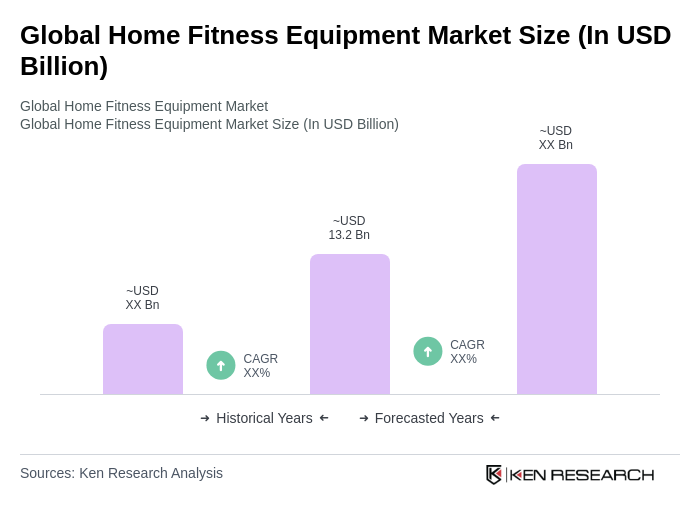
- The Global Home Fitness Equipment Market is valued at approximately USD 13.2 billion, based on a five-year historical analysis. This growth is primarily driven by the increasing health consciousness among consumers, the rise of home workouts, and the convenience of fitness equipment at home. The pandemic has further accelerated this trend, leading to a surge in demand for various fitness solutions that cater to individual preferences and lifestyles.
- Key players in this market include the United States, Germany, and China, which dominate due to their advanced technological capabilities, strong consumer base, and significant investments in fitness innovation. The U.S. leads with a robust fitness culture and high disposable income, while Germany and China benefit from a growing middle class and increasing urbanization, driving demand for home fitness solutions.
- The U.S. government has implemented regulations to promote health and fitness, including initiatives aimed at encouraging innovation in the fitness sector and improving public health outcomes, thereby supporting the growth of the home fitness equipment market.
Global Home Fitness Equipment Market Segmentation
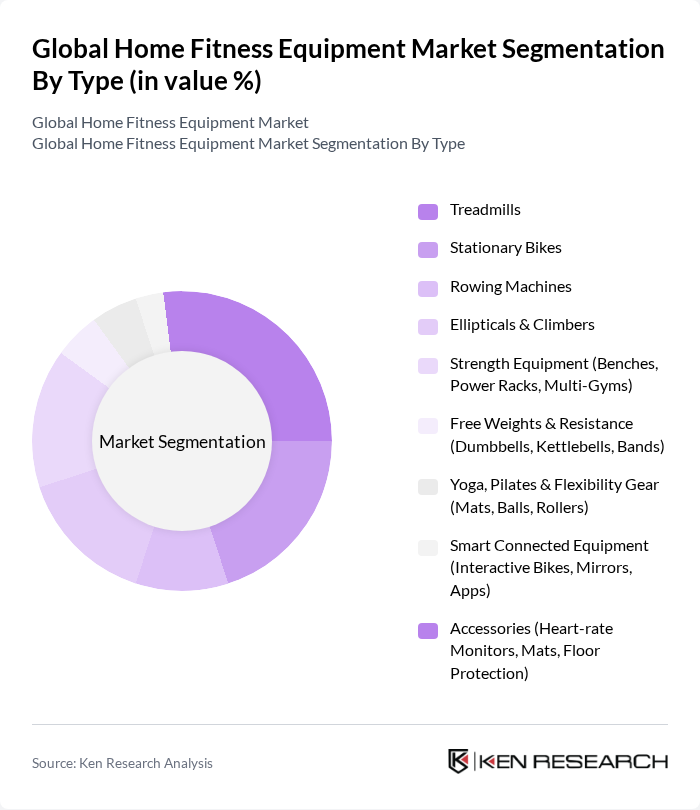
By Type:The market is segmented into various types of fitness equipment, including Treadmills, Stationary Bikes, Rowing Machines, Ellipticals & Climbers, Strength Equipment (Benches, Power Racks, Multi-Gyms), Free Weights & Resistance (Dumbbells, Kettlebells, Bands), Yoga, Pilates & Flexibility Gear (Mats, Balls, Rollers), Smart Connected Equipment (Interactive Bikes, Mirrors, Apps), and Accessories (Heart-rate Monitors, Mats, Floor Protection). Among these, Treadmills and Strength Equipment are particularly popular due to their versatility and effectiveness in home workouts.
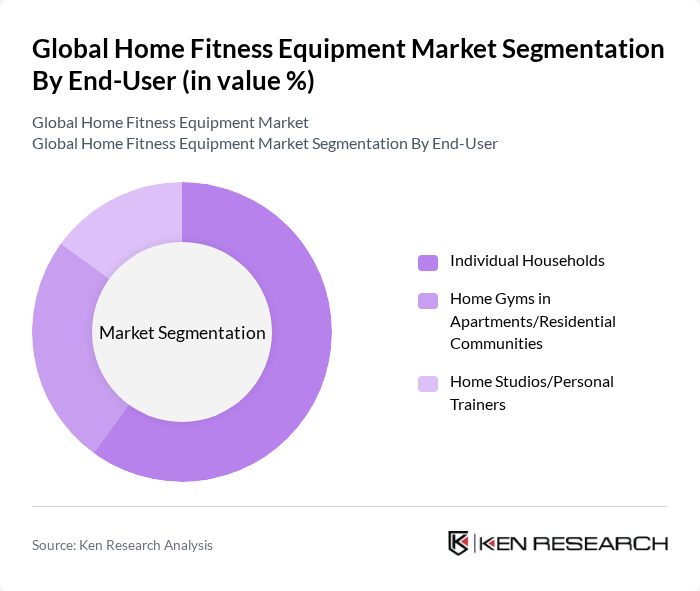
By End-User:The end-user segmentation includes Individual Households, Home Gyms in Apartments/Residential Communities, and Home Studios/Personal Trainers. Individual households represent the largest segment, driven by the increasing trend of home workouts and the convenience of having fitness equipment readily available. The rise of remote work has also contributed to the growth of home gyms, as more people seek to maintain their fitness routines without the need to travel to commercial gyms.
Global Home Fitness Equipment Market Competitive Landscape
The Global Home Fitness Equipment Market is characterized by a dynamic mix of regional and international players. Leading participants such as Peloton Interactive, Inc., Nautilus, Inc. (BowFlex Inc.), Technogym S.p.A., Life Fitness, iFIT Health & Fitness Inc. (ICON Health & Fitness), Johnson Health Tech Co., Ltd. (Horizon Fitness, Matrix), Precor (a Peloton company), NordicTrack (iFIT), ProForm (iFIT), Echelon Fitness, Tonal Systems, Inc., Mirror (Lululemon Studio), Hydrow, Inc., Sunny Health & Fitness, Rogue Fitness contribute to innovation, geographic expansion, and service delivery in this space.
Global Home Fitness Equipment Market Industry Analysis
Growth Drivers
- Increasing Health Awareness:The global health and wellness market is projected to reach $4.5 trillion in future, driven by a growing emphasis on preventive healthcare. This trend is reflected in the rising number of individuals engaging in fitness activities, with 65% of adults in the None region reporting increased health consciousness. As more consumers prioritize physical fitness, the demand for home fitness equipment is expected to surge, leading to increased sales and market growth.
- Rise in Home Workouts:The COVID-19 pandemic has significantly shifted consumer behavior, with 75% of fitness enthusiasts now preferring home workouts over gym visits. This trend is supported by a report indicating that 50% of households in None have invested in home fitness equipment. The convenience and flexibility of exercising at home are driving this shift, resulting in a robust demand for diverse fitness solutions tailored for home use.
- Technological Advancements in Equipment:The integration of technology in fitness equipment is revolutionizing the industry, with smart devices expected to account for 35% of total equipment sales in future. Innovations such as connected fitness machines and mobile apps enhance user experience and engagement. In None, the adoption of smart fitness technology is projected to increase by 30%, as consumers seek personalized and interactive workout experiences, further propelling market growth.
Market Challenges
- High Initial Investment Costs:The average cost of quality home fitness equipment can range from $600 to $2,500, which poses a significant barrier for many consumers. In None, approximately 45% of potential buyers cite high costs as a deterrent to purchasing fitness equipment. This challenge is compounded by economic uncertainties, leading to cautious spending behavior among consumers, which may hinder market expansion in the short term.
- Competition from Commercial Gyms:Despite the rise in home workouts, commercial gyms still attract a substantial portion of fitness enthusiasts. In None, over 55% of individuals prefer gym memberships due to access to diverse equipment and professional trainers. This competition can limit the growth potential of the home fitness equipment market, as many consumers may opt for the social and motivational aspects of gym environments over home-based solutions.
Global Home Fitness Equipment Market Future Outlook
The future of the home fitness equipment market appears promising, driven by ongoing trends in health awareness and technological integration. As consumers increasingly seek personalized fitness solutions, the demand for innovative and smart equipment is expected to rise. Additionally, the growth of online fitness communities will further enhance engagement and motivation, encouraging more individuals to invest in home fitness solutions. This evolving landscape presents significant opportunities for manufacturers and retailers to capitalize on emerging consumer preferences.
Market Opportunities
- Expansion of Smart Fitness Equipment:The demand for smart fitness devices is projected to grow significantly, with an estimated increase of 35% in sales in future. This trend presents an opportunity for manufacturers to innovate and develop advanced equipment that integrates AI and IoT technologies, enhancing user experience and engagement in None.
- Increasing Demand for Personalized Fitness Solutions:As consumers seek tailored fitness experiences, the market for personalized fitness solutions is expected to expand. Companies that offer customizable equipment and training programs can tap into this growing demand, potentially increasing their market share in None by 25% over the next few years.
Scope of the Report
| Segment | Sub-Segments |
|---|---|
| By Type | Treadmills Stationary Bikes Rowing Machines Ellipticals & Climbers Strength Equipment (Benches, Power Racks, Multi-Gyms) Free Weights & Resistance (Dumbbells, Kettlebells, Bands) Yoga, Pilates & Flexibility Gear (Mats, Balls, Rollers) Smart Connected Equipment (Interactive Bikes, Mirrors, Apps) Accessories (Heart-rate Monitors, Mats, Floor Protection) |
| By End-User | Individual Households Home Gyms in Apartments/Residential Communities Home Studios/Personal Trainers |
| By Sales Channel | Online Marketplaces (Amazon, Brand D2C) Specialty Sports & Fitness Retail Mass Merchandisers & Hypermarkets Direct-to-Consumer Subscriptions/Bundles |
| By Price Range | Budget Mid-Range Premium |
| By Brand | Global Established Brands Emerging & Digital-First Brands Private Labels/Retailer Brands |
| By Product Features | Connectivity & App Integration Compact/Foldable Design Multi-functionality/All-in-One Systems Low-Noise & Energy Efficiency |
| By Distribution Mode | Direct-to-Consumer Third-Party Retailers Subscription/Connected Fitness Models |
Key Target Audience
Investors and Venture Capitalist Firms
Government and Regulatory Bodies (e.g., U.S. Consumer Product Safety Commission, European Commission)
Manufacturers and Producers
Distributors and Retailers
Fitness Equipment Wholesalers
Health and Fitness Clubs
Insurance Companies
Market Analysts and Industry Experts
Players Mentioned in the Report:
Peloton Interactive, Inc.
Nautilus, Inc. (BowFlex Inc.)
Technogym S.p.A.
Life Fitness
iFIT Health & Fitness Inc. (ICON Health & Fitness)
Johnson Health Tech Co., Ltd. (Horizon Fitness, Matrix)
Precor (a Peloton company)
NordicTrack (iFIT)
ProForm (iFIT)
Echelon Fitness
Tonal Systems, Inc.
Mirror (Lululemon Studio)
Hydrow, Inc.
Sunny Health & Fitness
Rogue Fitness
Table of Contents
Market Assessment Phase
1. Executive Summary and Approach
2. Global Home Fitness Equipment Market Overview
2.1 Key Insights and Strategic Recommendations
2.2 Global Home Fitness Equipment Market Overview
2.3 Definition and Scope
2.4 Evolution of Market Ecosystem
2.5 Timeline of Key Regulatory Milestones
2.6 Value Chain & Stakeholder Mapping
2.7 Business Cycle Analysis
2.8 Policy & Incentive Landscape
3. Global Home Fitness Equipment Market Analysis
3.1 Growth Drivers
3.1.1 Increasing Health Awareness
3.1.2 Rise in Home Workouts
3.1.3 Technological Advancements in Equipment
3.1.4 Growth of E-commerce Platforms
3.2 Market Challenges
3.2.1 High Initial Investment Costs
3.2.2 Competition from Commercial Gyms
3.2.3 Limited Space in Urban Homes
3.2.4 Product Quality and Durability Concerns
3.3 Market Opportunities
3.3.1 Expansion of Smart Fitness Equipment
3.3.2 Increasing Demand for Personalized Fitness Solutions
3.3.3 Growth in Online Fitness Communities
3.3.4 Partnerships with Fitness Influencers
3.4 Market Trends
3.4.1 Rise of Subscription-Based Fitness Services
3.4.2 Integration of Virtual Reality in Workouts
3.4.3 Focus on Sustainable and Eco-Friendly Products
3.4.4 Customization of Fitness Equipment
3.5 Government Regulation
3.5.1 Safety Standards for Fitness Equipment
3.5.2 Import Tariffs on Fitness Equipment
3.5.3 Regulations on Advertising Health Claims
3.5.4 Incentives for Local Manufacturing
4. SWOT Analysis
5. Stakeholder Analysis
6. Porter's Five Forces Analysis
7. Global Home Fitness Equipment Market Market Size, 2019-2024
7.1 By Value
7.2 By Volume
7.3 By Average Selling Price
8. Global Home Fitness Equipment Market Segmentation
8.1 By Type
8.1.1 Treadmills
8.1.2 Stationary Bikes
8.1.3 Rowing Machines
8.1.4 Ellipticals & Climbers
8.1.5 Strength Equipment (Benches, Power Racks, Multi-Gyms)
8.1.6 Free Weights & Resistance (Dumbbells, Kettlebells, Bands)
8.1.7 Yoga, Pilates & Flexibility Gear (Mats, Balls, Rollers)
8.1.8 Smart Connected Equipment (Interactive Bikes, Mirrors, Apps)
8.1.9 Accessories (Heart-rate Monitors, Mats, Floor Protection)
8.2 By End-User
8.2.1 Individual Households
8.2.2 Home Gyms in Apartments/Residential Communities
8.2.3 Home Studios/Personal Trainers
8.3 By Sales Channel
8.3.1 Online Marketplaces (Amazon, Brand D2C)
8.3.2 Specialty Sports & Fitness Retail
8.3.3 Mass Merchandisers & Hypermarkets
8.3.4 Direct-to-Consumer Subscriptions/Bundles
8.4 By Price Range
8.4.1 Budget
8.4.2 Mid-Range
8.4.3 Premium
8.5 By Brand
8.5.1 Global Established Brands
8.5.2 Emerging & Digital-First Brands
8.5.3 Private Labels/Retailer Brands
8.6 By Product Features
8.6.1 Connectivity & App Integration
8.6.2 Compact/Foldable Design
8.6.3 Multi-functionality/All-in-One Systems
8.6.4 Low-Noise & Energy Efficiency
8.7 By Distribution Mode
8.7.1 Direct-to-Consumer
8.7.2 Third-Party Retailers
8.7.3 Subscription/Connected Fitness Models
9. Global Home Fitness Equipment Market Competitive Analysis
9.1 Market Share of Key Players
9.2 Cross Comparison of Key Players
9.2.1 Company Name
9.2.2 Company Size (Revenue Tier)
9.2.3 Global Home Fitness Revenue (Latest Year)
9.2.4 YoY Revenue Growth (Home Segment)
9.2.5 Active Connected Subscriptions/MAUs (if applicable)
9.2.6 Installed Base/Units Sold (Cumulative)
9.2.7 Average Selling Price (Key Categories)
9.2.8 Gross Margin (Hardware/Subscription, where disclosed)
9.2.9 R&D Intensity (% of Revenue)
9.2.10 Product Release Cadence (Last 24 Months)
9.2.11 Geographic Footprint (Regions Served)
9.2.12 Distribution Mix (D2C vs Retail %)
9.2.13 After-Sales Metrics (Warranty Claims/Return Rate)
9.2.14 NPS/Customer Satisfaction Score
9.2.15 Brand Awareness/Share of Voice
9.3 SWOT Analysis of Top Players
9.4 Pricing Analysis
9.5 Detailed Profile of Major Companies
9.5.1 Peloton Interactive, Inc.
9.5.2 Nautilus, Inc. (BowFlex Inc.)
9.5.3 Technogym S.p.A.
9.5.4 Life Fitness
9.5.5 iFIT Health & Fitness Inc. (ICON Health & Fitness)
9.5.6 Johnson Health Tech Co., Ltd. (Horizon Fitness, Matrix)
9.5.7 Precor (a Peloton company)
9.5.8 NordicTrack (iFIT)
9.5.9 ProForm (iFIT)
9.5.10 Echelon Fitness
9.5.11 Tonal Systems, Inc.
9.5.12 Mirror (Lululemon Studio)
9.5.13 Hydrow, Inc.
9.5.14 Sunny Health & Fitness
9.5.15 Rogue Fitness
10. Global Home Fitness Equipment Market End-User Analysis
10.1 Procurement Behavior of Key Ministries
10.1.1 Government Fitness Initiatives
10.1.2 Budget Allocations for Health Programs
10.1.3 Partnerships with Fitness Equipment Suppliers
10.2 Corporate Spend on Infrastructure & Energy
10.2.1 Investment in Employee Wellness Programs
10.2.2 Budget for Fitness Equipment in Offices
10.3 Pain Point Analysis by End-User Category
10.3.1 Accessibility of Equipment
10.3.2 Maintenance and Support Issues
10.3.3 Space Constraints
10.4 User Readiness for Adoption
10.4.1 Awareness of Home Fitness Solutions
10.4.2 Willingness to Invest in Equipment
10.5 Post-Deployment ROI and Use Case Expansion
10.5.1 Measurement of Fitness Outcomes
10.5.2 Expansion of Equipment Usage
11. Global Home Fitness Equipment Market Future Size, 2025-2030
11.1 By Value
11.2 By Volume
11.3 By Average Selling Price
Go-To-Market Strategy Phase
1. Whitespace Analysis + Business Model Canvas
1.1 Market Gaps Identification
1.2 Business Model Development
2. Marketing and Positioning Recommendations
2.1 Branding Strategies
2.2 Product USPs
3. Distribution Plan
3.1 Urban Retail Strategies
3.2 Rural NGO Tie-ups
4. Channel & Pricing Gaps
4.1 Underserved Routes
4.2 Pricing Bands Analysis
5. Unmet Demand & Latent Needs
5.1 Category Gaps
5.2 Consumer Segments
6. Customer Relationship
6.1 Loyalty Programs
6.2 After-sales Service
7. Value Proposition
7.1 Sustainability Initiatives
7.2 Integrated Supply Chains
8. Key Activities
8.1 Regulatory Compliance
8.2 Branding Efforts
8.3 Distribution Setup
9. Entry Strategy Evaluation
9.1 Domestic Market Entry Strategy
9.1.1 Product Mix Considerations
9.1.2 Pricing Band Strategy
9.1.3 Packaging Options
9.2 Export Entry Strategy
9.2.1 Target Countries
9.2.2 Compliance Roadmap
10. Entry Mode Assessment
10.1 Joint Ventures
10.2 Greenfield Investments
10.3 Mergers & Acquisitions
10.4 Distributor Model
11. Capital and Timeline Estimation
11.1 Capital Requirements
11.2 Timelines for Market Entry
12. Control vs Risk Trade-Off
12.1 Ownership vs Partnerships
13. Profitability Outlook
13.1 Breakeven Analysis
13.2 Long-term Sustainability
14. Potential Partner List
14.1 Distributors
14.2 Joint Ventures
14.3 Acquisition Targets
15. Execution Roadmap
15.1 Phased Plan for Market Entry
15.1.1 Market Setup
15.1.2 Market Entry
15.1.3 Growth Acceleration
15.1.4 Scale & Stabilize
15.2 Key Activities and Milestones
15.2.1 Milestone Planning
Research Methodology
Phase 1: Approach1
Desk Research
- Market reports from industry associations such as the International Health, Racquet & Sportsclub Association (IHRSA)
- Analysis of consumer trends and preferences through online fitness forums and social media platforms
- Review of sales data from major e-commerce platforms and retail outlets specializing in fitness equipment
Primary Research
- Interviews with fitness equipment manufacturers and distributors to gather insights on market dynamics
- Surveys targeting fitness trainers and gym owners to understand equipment usage and preferences
- Focus groups with consumers to assess brand perception and purchasing behavior in home fitness
Validation & Triangulation
- Cross-validation of findings through comparison with historical market data and growth trends
- Triangulation of insights from primary interviews with secondary data sources for accuracy
- Sanity checks conducted through expert panel reviews comprising industry veterans and analysts
Phase 2: Market Size Estimation1
Top-down Assessment
- Estimation of total addressable market (TAM) based on global fitness industry revenue figures
- Segmentation of market size by product categories such as cardio equipment, strength training, and accessories
- Incorporation of demographic data to assess potential market growth in emerging regions
Bottom-up Modeling
- Collection of sales volume data from leading fitness equipment retailers and manufacturers
- Estimation of average selling prices (ASPs) across different product categories
- Calculation of market size based on unit sales multiplied by ASPs for each segment
Forecasting & Scenario Analysis
- Utilization of time-series analysis to project future market growth based on historical data
- Scenario modeling considering factors such as economic conditions, health trends, and technological advancements
- Development of multiple forecasts (baseline, optimistic, and pessimistic) to account for market volatility
Phase 3: CATI Sample Composition1
| Scope Item/Segment | Sample Size | Target Respondent Profiles |
|---|---|---|
| Home Gym Equipment Purchasers | 120 | Homeowners, Fitness Enthusiasts |
| Commercial Gym Equipment Buyers | 100 | Gym Owners, Fitness Center Managers |
| Online Fitness Equipment Shoppers | 100 | eCommerce Managers, Digital Marketing Specialists |
| Fitness Equipment Retailers | 80 | Store Managers, Sales Representatives |
| Fitness Trainers and Coaches | 90 | Personal Trainers, Group Fitness Instructors |
Frequently Asked Questions
What is the current value of the Global Home Fitness Equipment Market?
The Global Home Fitness Equipment Market is valued at approximately USD 13.2 billion, reflecting a significant growth trend driven by increasing health consciousness and the rise of home workouts, particularly accelerated by the COVID-19 pandemic.
What factors are driving the growth of the home fitness equipment market?
Which countries are leading in the home fitness equipment market?
What types of fitness equipment are most popular in the market?
Other Regional/Country Reports
Indonesia Home Fitness Equipment Market
Malaysia Home Fitness Equipment Market
APAC Home Fitness Equipment Market
Why Buy From Us?

What makes us stand out is that our consultants follow Robust, Refine and Result (RRR) methodology. Robust for clear definitions, approaches and sanity checking, Refine for differentiating respondents' facts and opinions, and Result for presenting data with story.

We have set a benchmark in the industry by offering our clients with syndicated and customized market research reports featuring coverage of entire market as well as meticulous research and analyst insights.

While we don't replace traditional research, we flip the method upside down. Our dual approach of Top Bottom & Bottom Top ensures quality deliverable by not just verifying company fundamentals but also looking at the sector and macroeconomic factors.

With one step in the future, our research team constantly tries to show you the bigger picture. We help with some of the tough questions you may encounter along the way: How is the industry positioned? Best marketing channel? KPI's of competitors? By aligning every element, we help maximize success.

Our report gives you instant access to the answers and sources that other companies might choose to hide. We elaborate each steps of research methodology we have used and showcase you the sample size to earn your trust.

If you need any support, we are here! We pride ourselves on universe strength, data quality, and quick, friendly, and professional service.