Global Home Remodeling Market

The global home remodeling market, valued at USD 950 billion, is boosted by increasing homeownership, disposable incomes, and demand for energy-efficient solutions like smart tech and eco-friendly materials.

Region:Global

Author(s):Shubham

Product Code:KRAA1744

Pages:95

Published On:August 2025

About the Report

Base Year 2024

Global Home Remodeling Market Overview

  • The Global Home Remodeling Market is valued at USD 950 billion, based on a five-year historical analysis. The market is underpinned by rising disposable incomes, aging housing stock in developed regions, and sustained interest in home personalization and sustainability, which together support ongoing demand for renovations focused on aesthetics, functionality, and energy efficiency.
  • Key players in this market include the United States, Canada, Germany, and the United Kingdom, where robust economies, higher household spending power, and a strong culture of home improvement and DIY activity are reinforced by mature retail and trade distribution networks. North America holds a leading share of global renovation activity, supported by large home improvement retailers and active professional contractor ecosystems.
  • In 2023, the U.S. government did not implement a federal “Energy Efficiency Improvement Act” targeted at homeowner remodeling tax incentives; however, federal policy has recently expanded energy-efficiency credits and rebates for home upgrades through the Inflation Reduction Act, including tax credits for qualified insulation, windows, doors, heat pumps, and HVAC systems, which encourage energy-efficient renovations. These measures promote sustainable practices in home remodeling and support market growth.
Global Home Remodeling Market Size

Global Home Remodeling Market Segmentation

By Type:The home remodeling market can be segmented into various types, including kitchen remodeling, bathroom remodeling, basement finishing, room additions, exterior/outdoor remodeling, whole-house renovation, and energy-efficient upgrades. Kitchen remodeling is widely cited as one of the most popular and value-accretive projects due to its impact on home value and everyday use, while bathroom remodeling also remains a priority as homeowners seek comfort, accessibility, and upgraded fixtures. Energy-efficient upgrades—such as HVAC replacements, heat pumps, insulation, and high-performance windows/doors—are increasingly emphasized, supported by incentives and consumer focus on lowering energy bills.

Global Home Remodeling Market segmentation by Type.

By End-User:The end-user segmentation includes owner-occupied households, rental property owners and real estate investors, property managers/HOAs, and homebuilders-remodelers and general contractors. Owner-occupied households represent the largest segment as households continue to invest to enhance livability and property value, while rental property owners emphasize upgrades that improve rentability and operating efficiency. Broader market momentum is supported by strong North American participation across both DIY and contractor-led projects.
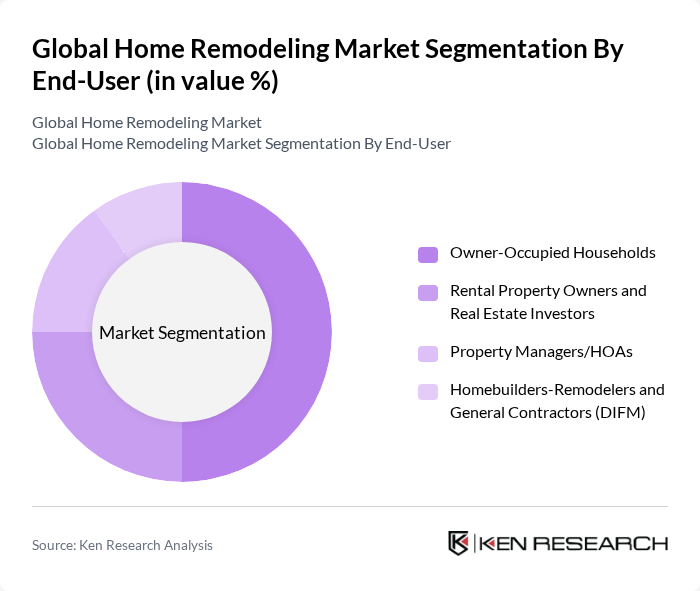
Global Home Remodeling Market segmentation by End-User.

Global Home Remodeling Market Competitive Landscape

The Global Home Remodeling Market is characterized by a dynamic mix of regional and international players. Leading participants such as The Home Depot, Inc., Lowe's Companies, Inc., Masco Corporation, Fortune Brands Innovations, Inc., The Sherwin-Williams Company, Mohawk Industries, Inc., Shaw Industries Group, Inc. (Berkshire Hathaway), Andersen Corporation, Pella Corporation, JELD-WEN Holding, Inc., Cornerstone Building Brands, Inc. (includes Ply Gem), Trex Company, Inc., James Hardie Industries plc, Mohawk’s Daltile (flooring/tiles), Ferguson plc (trade/wholesale distribution) contribute to innovation, geographic expansion, and service delivery in this space.

The Home Depot, Inc.

1978

Atlanta, Georgia, USA

Lowe's Companies, Inc.

1946

Mooresville, North Carolina, USA

Masco Corporation

1929

Livonia, Michigan, USA

Fortune Brands Innovations, Inc.

1988

Deerfield, Illinois, USA

The Sherwin-Williams Company

1866

Cleveland, Ohio, USA

Company

Establishment Year

Headquarters

Revenue (home improvement/remodeling-related)

YoY Revenue Growth

Gross Margin and Operating Margin

Project Mix (DIY vs. DIFM share)

Average Project Ticket/Order Value

Average Lead Time/Backlog

Global Home Remodeling Market Industry Analysis

Growth Drivers

  • Increasing Homeownership Rates:As of future, homeownership rates in the None region are projected to reach 70%, up from 66% in 2020, according to the National Association of Realtors. This increase translates to approximately 1.8 million new homeowners, driving demand for remodeling services. Homeowners are increasingly investing in renovations to enhance property value and personal comfort, with an average expenditure of $16,000 per remodeling project, further stimulating market growth.
  • Rising Disposable Incomes:The average disposable income in the None region is expected to rise to $48,000 in future, reflecting a 6% increase from the previous year, as reported by the Bureau of Economic Analysis. This increase allows homeowners to allocate more funds toward home improvements. With higher disposable incomes, consumers are more likely to invest in quality remodeling projects, particularly in kitchens and bathrooms, which are among the most popular renovation areas, thus propelling market expansion.
  • Demand for Energy-Efficient Solutions:In future, the None region is anticipated to see a 35% increase in demand for energy-efficient home remodeling solutions, driven by rising energy costs and environmental awareness. According to the U.S. Department of Energy, homeowners are increasingly opting for energy-efficient appliances and insulation, with an average investment of $11,000 per project. This trend not only reduces utility bills but also enhances property value, making energy-efficient remodeling a significant growth driver in the market.

Market Challenges

  • High Material Costs:The construction materials market in the None region is facing significant inflation, with prices for lumber and steel projected to rise by 18% in future, according to the National Association of Home Builders. This increase in material costs poses a challenge for remodeling contractors, as it directly impacts project budgets and profit margins. Homeowners may delay or scale back their remodeling plans due to these rising costs, hindering overall market growth.
  • Skilled Labor Shortages:The remodeling industry in the None region is grappling with a skilled labor shortage, with an estimated deficit of 250,000 workers in future, as reported by the Associated General Contractors of America. This shortage is exacerbated by an aging workforce and insufficient training programs. As a result, contractors face delays in project completion and increased labor costs, which can deter homeowners from pursuing remodeling projects, ultimately affecting market dynamics.

Global Home Remodeling Market Future Outlook

The future of the home remodeling market in the None region appears promising, driven by a combination of technological advancements and evolving consumer preferences. The integration of smart home technologies is expected to enhance the appeal of remodeling projects, while sustainability trends will push for eco-friendly materials and practices. Additionally, as urbanization continues, the demand for innovative space-saving solutions will rise, creating new opportunities for contractors and homeowners alike in the coming years.

Market Opportunities

  • Smart Home Technology Integration:The growing interest in smart home technology presents a significant opportunity for remodeling contractors. By incorporating smart systems, such as automated lighting and security, into renovations, homeowners can enhance convenience and energy efficiency. This trend is expected to attract tech-savvy consumers willing to invest an additional 25% on average for smart upgrades, thereby boosting overall project budgets.
  • Sustainable Remodeling Practices:As environmental concerns rise, there is a notable opportunity for contractors to adopt sustainable remodeling practices. Utilizing recycled materials and energy-efficient designs can appeal to eco-conscious consumers. In future, it is estimated that 45% of homeowners will prioritize sustainability in their remodeling projects, potentially increasing demand for green certifications and eco-friendly products, thus creating a competitive edge in the market.

Scope of the Report

SegmentSub-Segments
By Type

Kitchen Remodeling

Bathroom Remodeling

Basement Finishing

Room Additions

Exterior/Outdoor Remodeling (decks, siding, roofing, windows, landscaping)

Whole-House Renovation

Energy-Efficient Upgrades (insulation, HVAC, solar, smart home)

By End-User

Owner-Occupied Households

Rental Property Owners and Real Estate Investors

Property Managers/HOAs

Homebuilders-Remodelers and General Contractors (DIFM)

By Sales Channel

Direct-to-Consumer (Contractor-led/DIFM)

DIY/Online Retail

Home Improvement Stores (Big-box)

Trade/Wholesale Distributors (Pro channels)

By Material Used

Wood and Engineered Wood

Metals (steel, aluminum)

Glass and Glazing

Composites and Synthetics (vinyl, fiber cement, WPC)

By Design Style

Modern/Contemporary

Traditional/Transitional

Rustic/Farmhouse

Minimalist/Scandinavian

By Project Size

Small-Scale (cosmetic, <$10k)

Medium-Scale ($10k–$50k)

Large-Scale (>$50k, structural)

By Region

North America

Europe

Asia-Pacific

Latin America

Middle East & Africa

Others

Key Target Audience

Investors and Venture Capitalist Firms

Government and Regulatory Bodies (e.g., U.S. Department of Housing and Urban Development, European Commission)

Manufacturers and Producers

Distributors and Retailers

Home Improvement Contractors

Real Estate Developers

Insurance Companies

Building Material Suppliers

Players Mentioned in the Report:

The Home Depot, Inc.

Lowe's Companies, Inc.

Masco Corporation

Fortune Brands Innovations, Inc.

The Sherwin-Williams Company

Mohawk Industries, Inc.

Shaw Industries Group, Inc. (Berkshire Hathaway)

Andersen Corporation

Pella Corporation

JELD-WEN Holding, Inc.

Cornerstone Building Brands, Inc. (includes Ply Gem)

Trex Company, Inc.

James Hardie Industries plc

Mohawks Daltile (flooring/tiles)

Ferguson plc (trade/wholesale distribution)

Table of Contents

Market Assessment Phase

1. Executive Summary and Approach


2. Global Home Remodeling Market Overview

2.1 Key Insights and Strategic Recommendations

2.2 Global Home Remodeling Market Overview

2.3 Definition and Scope

2.4 Evolution of Market Ecosystem

2.5 Timeline of Key Regulatory Milestones

2.6 Value Chain & Stakeholder Mapping

2.7 Business Cycle Analysis

2.8 Policy & Incentive Landscape


3. Global Home Remodeling Market Analysis

3.1 Growth Drivers

3.1.1 Increasing Homeownership Rates
3.1.2 Rising Disposable Incomes
3.1.3 Demand for Energy-Efficient Solutions
3.1.4 Urbanization and Population Growth

3.2 Market Challenges

3.2.1 High Material Costs
3.2.2 Skilled Labor Shortages
3.2.3 Regulatory Compliance Issues
3.2.4 Economic Uncertainty

3.3 Market Opportunities

3.3.1 Smart Home Technology Integration
3.3.2 Sustainable Remodeling Practices
3.3.3 Expansion into Emerging Markets
3.3.4 Renovation of Aging Housing Stock

3.4 Market Trends

3.4.1 Increased Focus on Sustainability
3.4.2 Growth of Online Home Improvement Platforms
3.4.3 Customization and Personalization in Design
3.4.4 Rise of DIY Home Improvement Projects

3.5 Government Regulation

3.5.1 Energy Efficiency Standards
3.5.2 Building Codes and Safety Regulations
3.5.3 Tax Incentives for Renovations
3.5.4 Environmental Protection Regulations

4. SWOT Analysis


5. Stakeholder Analysis


6. Porter's Five Forces Analysis


7. Global Home Remodeling Market Market Size, 2019-2024

7.1 By Value

7.2 By Volume

7.3 By Average Selling Price


8. Global Home Remodeling Market Segmentation

8.1 By Type

8.1.1 Kitchen Remodeling
8.1.2 Bathroom Remodeling
8.1.3 Basement Finishing
8.1.4 Room Additions
8.1.5 Exterior/Outdoor Remodeling (decks, siding, roofing, windows, landscaping)
8.1.6 Whole-House Renovation
8.1.7 Energy-Efficient Upgrades (insulation, HVAC, solar, smart home)

8.2 By End-User

8.2.1 Owner-Occupied Households
8.2.2 Rental Property Owners and Real Estate Investors
8.2.3 Property Managers/HOAs
8.2.4 Homebuilders-Remodelers and General Contractors (DIFM)

8.3 By Sales Channel

8.3.1 Direct-to-Consumer (Contractor-led/DIFM)
8.3.2 DIY/Online Retail
8.3.3 Home Improvement Stores (Big-box)
8.3.4 Trade/Wholesale Distributors (Pro channels)

8.4 By Material Used

8.4.1 Wood and Engineered Wood
8.4.2 Metals (steel, aluminum)
8.4.3 Glass and Glazing
8.4.4 Composites and Synthetics (vinyl, fiber cement, WPC)

8.5 By Design Style

8.5.1 Modern/Contemporary
8.5.2 Traditional/Transitional
8.5.3 Rustic/Farmhouse
8.5.4 Minimalist/Scandinavian

8.6 By Project Size

8.6.1 Small-Scale (cosmetic, <$10k)
8.6.2 Medium-Scale ($10k–$50k)
8.6.3 Large-Scale (>$50k, structural)

8.7 By Region

8.7.1 North America
8.7.2 Europe
8.7.3 Asia-Pacific
8.7.4 Latin America
8.7.5 Middle East & Africa
8.7.6 Others

9. Global Home Remodeling Market Competitive Analysis

9.1 Market Share of Key Players

9.2 Cross Comparison of Key Players

9.2.1 Company Name
9.2.2 Revenue (home improvement/remodeling-related)
9.2.3 YoY Revenue Growth
9.2.4 Gross Margin and Operating Margin
9.2.5 Project Mix (DIY vs. DIFM share)
9.2.6 Average Project Ticket/Order Value
9.2.7 Average Lead Time/Backlog
9.2.8 Customer Satisfaction (NPS/CSAT)
9.2.9 Market Penetration (stores/installer network, regions)
9.2.10 Installation Capacity (crew count/utilization)
9.2.11 Pricing Strategy (value, mid-tier, premium)
9.2.12 Digital Reach (online traffic/conversion rate)

9.3 SWOT Analysis of Top Players

9.4 Pricing Analysis

9.5 Detailed Profile of Major Companies

9.5.1 The Home Depot, Inc.
9.5.2 Lowe's Companies, Inc.
9.5.3 Masco Corporation
9.5.4 Fortune Brands Innovations, Inc.
9.5.5 The Sherwin-Williams Company
9.5.6 Mohawk Industries, Inc.
9.5.7 Shaw Industries Group, Inc. (Berkshire Hathaway)
9.5.8 Andersen Corporation
9.5.9 Pella Corporation
9.5.10 JELD-WEN Holding, Inc.
9.5.11 Cornerstone Building Brands, Inc. (includes Ply Gem)
9.5.12 Trex Company, Inc.
9.5.13 James Hardie Industries plc
9.5.14 Mohawk’s Daltile (flooring/tiles)
9.5.15 Ferguson plc (trade/wholesale distribution)

10. Global Home Remodeling Market End-User Analysis

10.1 Procurement Behavior of Key Ministries

10.1.1 Budget Allocation Trends
10.1.2 Decision-Making Processes
10.1.3 Preferred Vendors
10.1.4 Compliance Requirements

10.2 Corporate Spend on Infrastructure & Energy

10.2.1 Investment Priorities
10.2.2 Spending Patterns
10.2.3 Project Approval Processes

10.3 Pain Point Analysis by End-User Category

10.3.1 Budget Constraints
10.3.2 Quality Assurance Issues
10.3.3 Timeliness of Project Completion

10.4 User Readiness for Adoption

10.4.1 Awareness of Remodeling Options
10.4.2 Willingness to Invest
10.4.3 Access to Financing

10.5 Post-Deployment ROI and Use Case Expansion

10.5.1 Measurement of Success
10.5.2 Long-Term Benefits
10.5.3 Opportunities for Further Investment

11. Global Home Remodeling Market Future Size, 2025-2030

11.1 By Value

11.2 By Volume

11.3 By Average Selling Price


Go-To-Market Strategy Phase

1. Whitespace Analysis + Business Model Canvas

1.1 Market Gaps Identification

1.2 Value Proposition Development

1.3 Revenue Streams Analysis

1.4 Cost Structure Evaluation

1.5 Key Partnerships

1.6 Customer Segments

1.7 Channels


2. Marketing and Positioning Recommendations

2.1 Branding Strategies

2.2 Product USPs

2.3 Target Audience Identification

2.4 Marketing Channels

2.5 Campaign Strategies


3. Distribution Plan

3.1 Urban Retail Strategies

3.2 Rural NGO Tie-Ups

3.3 E-commerce Integration

3.4 Logistics and Supply Chain Management


4. Channel & Pricing Gaps

4.1 Underserved Routes

4.2 Pricing Bands Analysis

4.3 Competitor Pricing Strategies


5. Unmet Demand & Latent Needs

5.1 Category Gaps

5.2 Consumer Segments

5.3 Emerging Trends


6. Customer Relationship

6.1 Loyalty Programs

6.2 After-sales Service

6.3 Customer Feedback Mechanisms


7. Value Proposition

7.1 Sustainability Initiatives

7.2 Integrated Supply Chains

7.3 Customer-Centric Approaches


8. Key Activities

8.1 Regulatory Compliance

8.2 Branding Efforts

8.3 Distribution Setup


9. Entry Strategy Evaluation

9.1 Domestic Market Entry Strategy

9.1.1 Product Mix
9.1.2 Pricing Band
9.1.3 Packaging

9.2 Export Entry Strategy

9.2.1 Target Countries
9.2.2 Compliance Roadmap

10. Entry Mode Assessment

10.1 Joint Ventures

10.2 Greenfield Investments

10.3 Mergers & Acquisitions

10.4 Distributor Model


11. Capital and Timeline Estimation

11.1 Capital Requirements

11.2 Timelines


12. Control vs Risk Trade-Off

12.1 Ownership vs Partnerships


13. Profitability Outlook

13.1 Breakeven Analysis

13.2 Long-term Sustainability


14. Potential Partner List

14.1 Distributors

14.2 Joint Ventures

14.3 Acquisition Targets


15. Execution Roadmap

15.1 Phased Plan for Market Entry

15.1.1 Market Setup
15.1.2 Market Entry
15.1.3 Growth Acceleration
15.1.4 Scale & Stabilize

15.2 Key Activities and Milestones

15.2.1 Milestone Planning
15.2.2 Activity Tracking

Research Methodology

ApproachModellingSample

Phase 1: Approach1

Desk Research

  • Analysis of industry reports from home remodeling associations and market research firms
  • Review of government publications on housing trends and construction permits
  • Examination of consumer behavior studies related to home improvement and renovation

Primary Research

  • Interviews with home remodeling contractors and interior designers
  • Surveys targeting homeowners who have recently completed remodeling projects
  • Focus groups with real estate agents to understand market demand and trends

Validation & Triangulation

  • Cross-validation of findings through multiple data sources, including trade publications and consumer surveys
  • Triangulation of insights from primary interviews with secondary data trends
  • Sanity checks conducted through expert panel reviews comprising industry veterans

Phase 2: Market Size Estimation1

Top-down Assessment

  • Estimation of market size based on national housing expenditure and remodeling trends
  • Segmentation by geographic regions and types of remodeling projects (kitchen, bathroom, etc.)
  • Incorporation of macroeconomic indicators such as GDP growth and housing market performance

Bottom-up Modeling

  • Collection of data from leading home improvement retailers on sales volumes
  • Estimation of average project costs based on contractor pricing and consumer spending
  • Volume x cost analysis for various remodeling categories to derive total market value

Forecasting & Scenario Analysis

  • Multi-factor regression analysis incorporating housing market trends, interest rates, and consumer confidence
  • Scenario modeling based on potential economic downturns and shifts in consumer preferences
  • Development of baseline, optimistic, and pessimistic forecasts through 2030

Phase 3: CATI Sample Composition1

Scope Item/SegmentSample SizeTarget Respondent Profiles
Kitchen Remodeling Projects120Homeowners, Kitchen Designers
Bathroom Renovation Trends100Contractors, Interior Designers
Outdoor Living Spaces80Landscape Architects, Homeowners
Energy-Efficient Upgrades70Home Improvement Specialists, Sustainability Consultants
Smart Home Technology Integration90Smart Home Installers, Homeowners

Frequently Asked Questions

What is the current value of the Global Home Remodeling Market?

The Global Home Remodeling Market is valued at approximately USD 950 billion, driven by factors such as rising disposable incomes, aging housing stock, and a growing interest in home personalization and sustainability.

What are the main drivers of growth in the home remodeling market?

Which regions are leading in home remodeling activities?

What types of remodeling projects are most popular?

Other Regional/Country Reports

Indonesia Global Home Remodeling Market

Malaysia Global Home Remodeling Market

KSA Global Home Remodeling Market

APAC Global Home Remodeling Market

SEA Global Home Remodeling Market

Vietnam Global Home Remodeling Market

Why Buy From Us?

Refine Robust Result (RRR) Framework

What makes us stand out is that our consultants follow Robust, Refine and Result (RRR) methodology. Robust for clear definitions, approaches and sanity checking, Refine for differentiating respondents' facts and opinions, and Result for presenting data with story.

Our Reach Is Unmatched

We have set a benchmark in the industry by offering our clients with syndicated and customized market research reports featuring coverage of entire market as well as meticulous research and analyst insights.

Shifting the Research Paradigm

While we don't replace traditional research, we flip the method upside down. Our dual approach of Top Bottom & Bottom Top ensures quality deliverable by not just verifying company fundamentals but also looking at the sector and macroeconomic factors.

More Insights-Better Decisions

With one step in the future, our research team constantly tries to show you the bigger picture. We help with some of the tough questions you may encounter along the way: How is the industry positioned? Best marketing channel? KPI's of competitors? By aligning every element, we help maximize success.

Transparency and Trust

Our report gives you instant access to the answers and sources that other companies might choose to hide. We elaborate each steps of research methodology we have used and showcase you the sample size to earn your trust.

Round the Clock Support

If you need any support, we are here! We pride ourselves on universe strength, data quality, and quick, friendly, and professional service.

Why Clients Choose Us?

400000+
Reports in repository
150+
Consulting projects a year
100+
Analysts
8000+
Client Queries in 2022








