About the Report
Base Year 2024Global Hydrazine Hydrate Market Overview
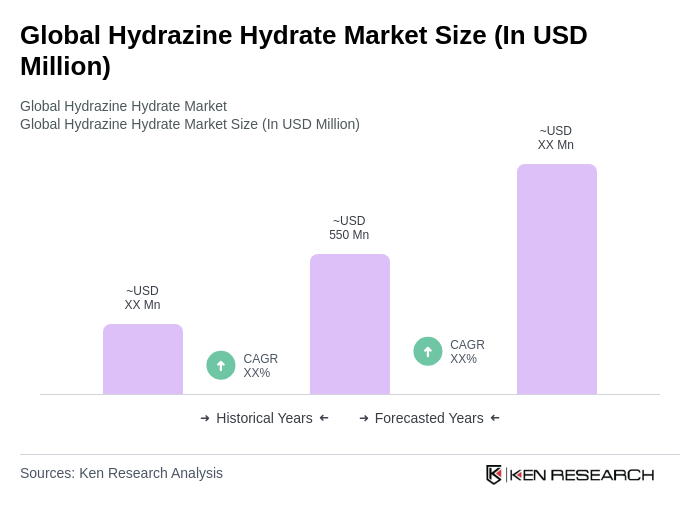
- The Global Hydrazine Hydrate Market is valued at USD 550 million, based on a five-year historical analysis. This value reflects demand across agrochemicals, polymerization and blowing agents, water treatment, and pharmaceuticals, where hydrazine hydrate is used as a reducing agent, oxygen scavenger, and chemical intermediate.
- Key producing and consuming regions include the United States, China, and Germany, supported by developed chemical value chains and installed capacity for downstream uses such as polymer foaming agents, agrochemical intermediates, and boiler treatment chemicals.
- In the European Union, hydrazine is subject to REACH registration and strict control due to its hazardous classification; authorization is required for specific uses and operators must meet stringent exposure controls and risk management measures, which materially influence production practices and industrial usage.
Global Hydrazine Hydrate Market Segmentation
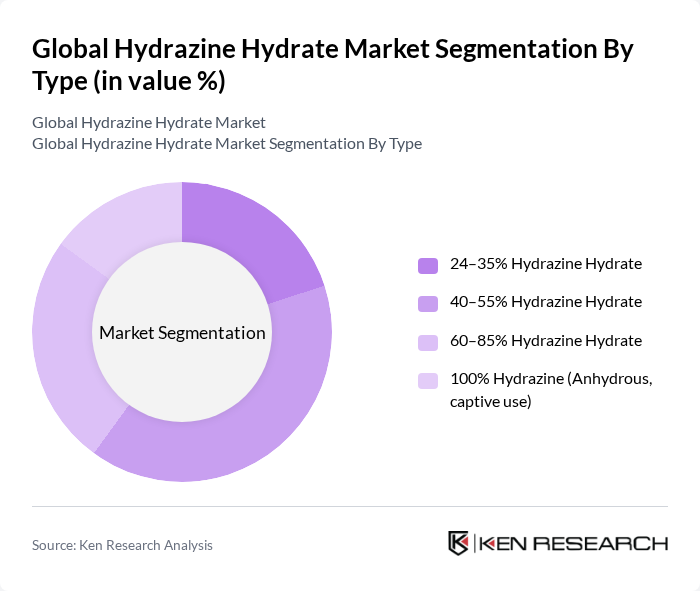
By Type:The market is segmented by concentration into 24–35% Hydrazine Hydrate, 40–55% Hydrazine Hydrate, 60–85% Hydrazine Hydrate, and 100% Hydrazine (Anhydrous, captive use). Commercial supply is commonly concentrated in the 40–55% and 60–85% bands for downstream uses such as polymerization/blowing agents, agrochemical intermediates, and boiler oxygen scavenging. The 40–55% Hydrazine Hydrate range is widely adopted in applications including water treatment and chemical synthesis due to handling practicality and cost-performance in typical industrial dosing regimes.
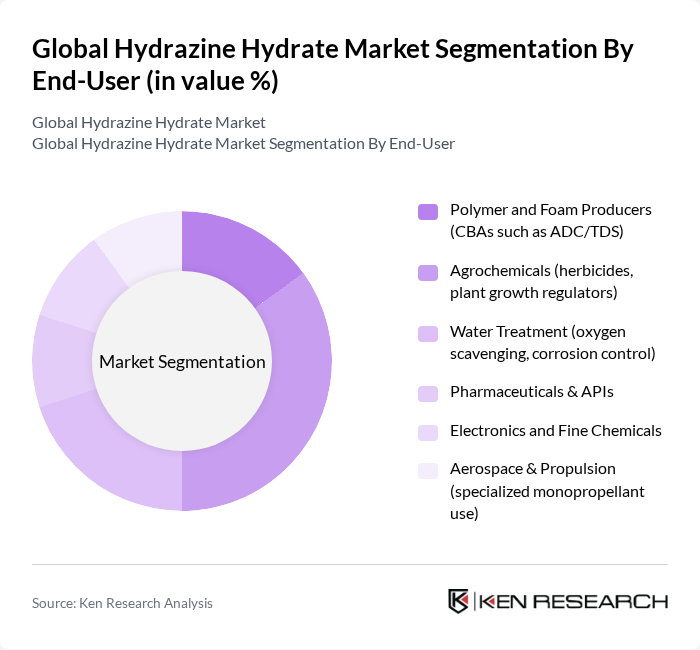
By End-User:End-use industries include Polymer and Foam Producers, Agrochemicals, Water Treatment, Pharmaceuticals & APIs, Electronics and Fine Chemicals, and Aerospace & Propulsion. Polymerization and blowing agents (e.g., azodicarbonamide derivatives), agrochemicals (triazoles and other intermediates), and water treatment as an oxygen scavenger are the principal demand pools cited across industry sources. Agrochemicals continue to be an important application area given ongoing demand for crop protection intermediates, while water treatment adoption is supported by corrosion control needs in industrial boilers.
Global Hydrazine Hydrate Market Competitive Landscape
The Global Hydrazine Hydrate Market is characterized by a dynamic mix of regional and international players. Leading participants such as Arkema S.A., LANXESS AG, Otsuka–MGC Chemical Company, Inc. (OMCC), Japan FineChem Co., Inc., Nippon Carbide Industries Co., Inc., Yibin Tianyuan Group Co., Ltd., Weifang Yaxing Chemical Co., Ltd., Hunan Zhuzhou Chemical Industry Group Co., Ltd., Jiangsu Yabang Chemical Group Co., Ltd., Jiangshan Chemical Co., Ltd. (Jiangshan Holdings), Taminco (Eastman Chemical Company), BASF SE, Huntsman Corporation, Solvay S.A., Lonza Group Ltd. contribute to innovation, geographic expansion, and service delivery in this space.
Global Hydrazine Hydrate Market Industry Analysis
Growth Drivers
- Increasing Demand in Agriculture:The agricultural sector is projected to consume approximately 30,000 tons of hydrazine hydrate in future, driven by its use as a herbicide and fungicide. The global agricultural output is expected to reach $3.4 trillion, with hydrazine hydrate playing a crucial role in enhancing crop yields. This demand is further supported by the rising need for food security, particularly in regions experiencing population growth, such as Asia and Africa, where agricultural productivity is paramount.
- Growth in Pharmaceutical Applications:The pharmaceutical industry is anticipated to utilize around 15,000 tons of hydrazine hydrate in future, primarily for synthesizing active pharmaceutical ingredients (APIs). With the global pharmaceutical market projected to reach $1.5 trillion, the demand for hydrazine hydrate is bolstered by its role in developing treatments for various diseases, including cancer and tuberculosis. This trend is further fueled by increasing investments in research and development, particularly in emerging markets.
- Rising Use in Aerospace and Defense:The aerospace and defense sectors are expected to account for approximately 10,000 tons of hydrazine hydrate in future, primarily for propulsion systems in spacecraft and missiles. The global aerospace market is projected to reach $1 trillion, with hydrazine hydrate being essential for its high-energy density and reliability. This growth is driven by increasing government defense budgets and advancements in space exploration technologies, particularly in North America and Europe.
Market Challenges
- Environmental Concerns and Regulations:The hydrazine hydrate industry faces stringent environmental regulations, with over 50 countries implementing laws to limit hazardous chemical emissions. In future, compliance costs are expected to rise by 20%, impacting production efficiency. The growing awareness of environmental sustainability is pushing companies to invest in cleaner technologies, which may strain financial resources and slow down growth in the short term.
- High Production Costs:The production costs of hydrazine hydrate are projected to increase by 15% in future due to rising raw material prices and energy costs. The global energy market is experiencing volatility, with crude oil prices fluctuating around $80 per barrel. This increase in production costs can lead to higher prices for end-users, potentially reducing demand in price-sensitive markets, particularly in developing regions.
Global Hydrazine Hydrate Market Future Outlook
The future of the hydrazine hydrate market appears promising, driven by technological advancements and a shift towards sustainable practices. Innovations in production techniques are expected to enhance efficiency and reduce environmental impact, while the growing demand for specialty chemicals will further stimulate market growth. Additionally, as emerging markets continue to develop, the need for hydrazine hydrate in various applications will likely increase, presenting significant opportunities for industry players to expand their reach and enhance profitability.
Market Opportunities
- Innovations in Production Techniques:The development of more efficient and eco-friendly production methods could reduce costs by up to 25% in future. This innovation not only addresses environmental concerns but also enhances the competitiveness of hydrazine hydrate in various applications, making it more appealing to manufacturers and end-users alike.
- Expansion into Emerging Markets:Emerging markets, particularly in Asia and Africa, are projected to see a 30% increase in hydrazine hydrate demand in future. This growth is driven by rising industrialization and agricultural needs, presenting significant opportunities for companies to establish a foothold in these regions and capitalize on the growing market potential.
Scope of the Report
| Segment | Sub-Segments |
|---|---|
| By Type | –35% Hydrazine Hydrate –55% Hydrazine Hydrate –85% Hydrazine Hydrate % Hydrazine (Anhydrous, captive use) |
| By End-User | Polymer and Foam Producers (CBAs such as ADC/TDS) Agrochemicals (herbicides, plant growth regulators) Water Treatment (oxygen scavenging, corrosion control) Pharmaceuticals & APIs Electronics and Fine Chemicals Aerospace & Propulsion (specialized monopropellant use) |
| By Application | Polymerization & Blowing Agents Water Treatment Chemicals Agrochemical Intermediates Pharmaceutical Intermediates Chemical Synthesis/Reducing Agent Rocket Propellant/Power Generation |
| By Distribution Channel | Direct/Captive Sales (producer to industrial buyers) Global Chemical Distributors Regional Traders/Blenders Online Procurement Platforms |
| By Region | North America Europe Asia-Pacific Latin America Middle East & Africa |
| By Packaging Type | HDPE Drums IBC Totes ISO Tank/Bulk Specialty Containers (stabilized/returnable) |
| By Price Range | Commodity Grades Mid-spec Industrial Grades High-Purity/Specialty Grades Contract/Spot Blended Solutions |
Key Target Audience
Investors and Venture Capitalist Firms
Government and Regulatory Bodies (e.g., Environmental Protection Agency, Occupational Safety and Health Administration)
Manufacturers and Producers
Distributors and Retailers
Chemical Industry Associations
Pharmaceutical Companies
Aerospace and Defense Contractors
Financial Institutions
Players Mentioned in the Report:
Arkema S.A.
LANXESS AG
OtsukaMGC Chemical Company, Inc. (OMCC)
Japan FineChem Co., Inc.
Nippon Carbide Industries Co., Inc.
Yibin Tianyuan Group Co., Ltd.
Weifang Yaxing Chemical Co., Ltd.
Hunan Zhuzhou Chemical Industry Group Co., Ltd.
Jiangsu Yabang Chemical Group Co., Ltd.
Jiangshan Chemical Co., Ltd. (Jiangshan Holdings)
Taminco (Eastman Chemical Company)
BASF SE
Huntsman Corporation
Solvay S.A.
Lonza Group Ltd.
Table of Contents
Market Assessment Phase
1. Executive Summary and Approach
2. Global Hydrazine Hydrate Market Overview
2.1 Key Insights and Strategic Recommendations
2.2 Global Hydrazine Hydrate Market Overview
2.3 Definition and Scope
2.4 Evolution of Market Ecosystem
2.5 Timeline of Key Regulatory Milestones
2.6 Value Chain & Stakeholder Mapping
2.7 Business Cycle Analysis
2.8 Policy & Incentive Landscape
3. Global Hydrazine Hydrate Market Analysis
3.1 Growth Drivers
3.1.1 Increasing Demand in Agriculture
3.1.2 Growth in Pharmaceutical Applications
3.1.3 Rising Use in Aerospace and Defense
3.1.4 Expanding Chemical Manufacturing Sector
3.2 Market Challenges
3.2.1 Environmental Concerns and Regulations
3.2.2 High Production Costs
3.2.3 Limited Awareness in Emerging Markets
3.2.4 Safety and Handling Issues
3.3 Market Opportunities
3.3.1 Innovations in Production Techniques
3.3.2 Expansion into Emerging Markets
3.3.3 Development of Eco-friendly Alternatives
3.3.4 Strategic Partnerships and Collaborations
3.4 Market Trends
3.4.1 Increasing Focus on Sustainable Practices
3.4.2 Technological Advancements in Production
3.4.3 Growing Demand for Specialty Chemicals
3.4.4 Shift Towards Automation in Manufacturing
3.5 Government Regulation
3.5.1 Stricter Emission Standards
3.5.2 Safety Regulations for Chemical Handling
3.5.3 Incentives for Green Chemistry
3.5.4 Import/Export Regulations on Hazardous Materials
4. SWOT Analysis
5. Stakeholder Analysis
6. Porter's Five Forces Analysis
7. Global Hydrazine Hydrate Market Market Size, 2019-2024
7.1 By Value
7.2 By Volume
7.3 By Average Selling Price
8. Global Hydrazine Hydrate Market Segmentation
8.1 By Type
8.1.1 24–35% Hydrazine Hydrate
8.1.2 40–55% Hydrazine Hydrate
8.1.3 60–85% Hydrazine Hydrate
8.1.4 100% Hydrazine (Anhydrous, captive use)
8.2 By End-User
8.2.1 Polymer and Foam Producers (CBAs such as ADC/TDS)
8.2.2 Agrochemicals (herbicides, plant growth regulators)
8.2.3 Water Treatment (oxygen scavenging, corrosion control)
8.2.4 Pharmaceuticals & APIs
8.2.5 Electronics and Fine Chemicals
8.2.6 Aerospace & Propulsion (specialized monopropellant use)
8.3 By Application
8.3.1 Polymerization & Blowing Agents
8.3.2 Water Treatment Chemicals
8.3.3 Agrochemical Intermediates
8.3.4 Pharmaceutical Intermediates
8.3.5 Chemical Synthesis/Reducing Agent
8.3.6 Rocket Propellant/Power Generation
8.4 By Distribution Channel
8.4.1 Direct/Captive Sales (producer to industrial buyers)
8.4.2 Global Chemical Distributors
8.4.3 Regional Traders/Blenders
8.4.4 Online Procurement Platforms
8.5 By Region
8.5.1 North America
8.5.2 Europe
8.5.3 Asia-Pacific
8.5.4 Latin America
8.5.5 Middle East & Africa
8.6 By Packaging Type
8.6.1 HDPE Drums
8.6.2 IBC Totes
8.6.3 ISO Tank/Bulk
8.6.4 Specialty Containers (stabilized/returnable)
8.7 By Price Range
8.7.1 Commodity Grades
8.7.2 Mid-spec Industrial Grades
8.7.3 High-Purity/Specialty Grades
8.7.4 Contract/Spot Blended Solutions
9. Global Hydrazine Hydrate Market Competitive Analysis
9.1 Market Share of Key Players
9.2 Cross Comparison of Key Players
9.2.1 Company Name
9.2.2 Production Capacity (ktpa)
9.2.3 Utilization Rate (%)
9.2.4 Revenue Growth Rate (Hydrazine-related)
9.2.5 Regional Footprint (APAC/NA/EU/LA/MEA)
9.2.6 Application Mix (% polymerization & CBAs / agrochem / water / pharma)
9.2.7 ASP by Concentration Band (24–35%, 40–55%, 60–85%)
9.2.8 Contract vs. Spot Sales Mix (%)
9.2.9 Integration Level (upstream ammonia/H2O2; downstream CBAs/intermediates)
9.2.10 Compliance & Safety Track (REACH/OSHA/ISO; incidents per MM hours)
9.2.11 R&D/Process IP (ketazine/UHDE/UOP variants; patents count)
9.2.12 Scope 1+2 Emissions Intensity (tCO2e per ton HH)
9.2.13 Supply Reliability (On-time-in-full, lead-time, redundancy)
9.2.14 Pricing Strategy (value-added, long-term offtake, regional differential)
9.3 SWOT Analysis of Top Players
9.4 Pricing Analysis
9.5 Detailed Profile of Major Companies
9.5.1 Arkema S.A.
9.5.2 LANXESS AG
9.5.3 Otsuka–MGC Chemical Company, Inc. (OMCC)
9.5.4 Japan FineChem Co., Inc.
9.5.5 Nippon Carbide Industries Co., Inc.
9.5.6 Yibin Tianyuan Group Co., Ltd.
9.5.7 Weifang Yaxing Chemical Co., Ltd.
9.5.8 Hunan Zhuzhou Chemical Industry Group Co., Ltd.
9.5.9 Jiangsu Yabang Chemical Group Co., Ltd.
9.5.10 Jiangshan Chemical Co., Ltd. (Jiangshan Holdings)
9.5.11 Taminco (Eastman Chemical Company)
9.5.12 BASF SE
9.5.13 Huntsman Corporation
9.5.14 Solvay S.A.
9.5.15 Lonza Group Ltd.
10. Global Hydrazine Hydrate Market End-User Analysis
10.1 Procurement Behavior of Key Ministries
10.1.1 Government Contracts in Agriculture
10.1.2 Pharmaceutical Procurement Policies
10.1.3 Defense Sector Procurement Trends
10.1.4 Chemical Industry Regulations
10.2 Corporate Spend on Infrastructure & Energy
10.2.1 Investment in Chemical Manufacturing
10.2.2 Funding for Agricultural Innovations
10.2.3 Budget Allocations for Aerospace Projects
10.3 Pain Point Analysis by End-User Category
10.3.1 Cost Management in Agriculture
10.3.2 Regulatory Compliance in Pharmaceuticals
10.3.3 Supply Chain Disruptions in Aerospace
10.4 User Readiness for Adoption
10.4.1 Awareness of Hydrazine Hydrate Benefits
10.4.2 Training and Support Needs
10.4.3 Infrastructure Readiness
10.5 Post-Deployment ROI and Use Case Expansion
10.5.1 Measurement of ROI in Agriculture
10.5.2 Case Studies in Pharmaceuticals
10.5.3 Expansion Opportunities in Aerospace
11. Global Hydrazine Hydrate Market Future Size, 2025-2030
11.1 By Value
11.2 By Volume
11.3 By Average Selling Price
Go-To-Market Strategy Phase
1. Whitespace Analysis + Business Model Canvas
1.1 Market Gaps Identification
1.2 Business Model Development
2. Marketing and Positioning Recommendations
2.1 Branding Strategies
2.2 Product USPs
3. Distribution Plan
3.1 Urban Retail Strategies
3.2 Rural NGO Tie-ups
4. Channel & Pricing Gaps
4.1 Underserved Routes
4.2 Pricing Bands Analysis
5. Unmet Demand & Latent Needs
5.1 Category Gaps
5.2 Consumer Segments
6. Customer Relationship
6.1 Loyalty Programs
6.2 After-sales Service
7. Value Proposition
7.1 Sustainability Initiatives
7.2 Integrated Supply Chains
8. Key Activities
8.1 Regulatory Compliance
8.2 Branding Efforts
8.3 Distribution Setup
9. Entry Strategy Evaluation
9.1 Domestic Market Entry Strategy
9.1.1 Product Mix Considerations
9.1.2 Pricing Band Strategy
9.1.3 Packaging Solutions
9.2 Export Entry Strategy
9.2.1 Target Countries
9.2.2 Compliance Roadmap
10. Entry Mode Assessment
10.1 Joint Ventures
10.2 Greenfield Investments
10.3 Mergers & Acquisitions
10.4 Distributor Model
11. Capital and Timeline Estimation
11.1 Capital Requirements
11.2 Timelines for Implementation
12. Control vs Risk Trade-Off
12.1 Ownership Considerations
12.2 Partnerships Evaluation
13. Profitability Outlook
13.1 Breakeven Analysis
13.2 Long-term Sustainability
14. Potential Partner List
14.1 Distributors
14.2 Joint Ventures
14.3 Acquisition Targets
15. Execution Roadmap
15.1 Phased Plan for Market Entry
15.1.1 Market Setup
15.1.2 Market Entry
15.1.3 Growth Acceleration
15.1.4 Scale & Stabilize
15.2 Key Activities and Milestones
15.2.1 Activity Planning
15.2.2 Milestone Tracking
Research Methodology
Phase 1: Approach1
Desk Research
- Analysis of global hydrazine hydrate production statistics from industry reports
- Review of market trends and forecasts from chemical industry publications
- Examination of regulatory frameworks and safety guidelines from international chemical safety organizations
Primary Research
- Interviews with chemical engineers and production managers in hydrazine hydrate manufacturing
- Surveys targeting end-users in aerospace, pharmaceuticals, and agriculture sectors
- Focus groups with industry experts to discuss market dynamics and future trends
Validation & Triangulation
- Cross-validation of data from multiple industry sources to ensure accuracy
- Triangulation of findings from primary interviews and secondary data sources
- Sanity checks through expert panel reviews to confirm market insights
Phase 2: Market Size Estimation1
Top-down Assessment
- Estimation of global hydrazine hydrate market size based on chemical production volumes
- Segmentation by application areas such as fuel additives, pharmaceuticals, and agriculture
- Incorporation of regional market dynamics and growth rates from key markets
Bottom-up Modeling
- Collection of sales data from leading hydrazine hydrate manufacturers
- Estimation of market share based on production capacity and sales volume
- Analysis of pricing trends and cost structures across different regions
Forecasting & Scenario Analysis
- Development of market forecasts using historical data and growth drivers
- Scenario analysis based on potential regulatory changes and technological advancements
- Creation of baseline, optimistic, and pessimistic market projections through 2030
Phase 3: CATI Sample Composition1
| Scope Item/Segment | Sample Size | Target Respondent Profiles |
|---|---|---|
| Aerospace Applications | 100 | R&D Managers, Aerospace Engineers |
| Pharmaceutical Manufacturing | 90 | Production Supervisors, Quality Control Managers |
| Agricultural Chemicals | 80 | Product Development Managers, Agronomists |
| Industrial Applications | 100 | Operations Managers, Supply Chain Analysts |
| Research Institutions | 70 | Research Scientists, Chemical Engineers |
Frequently Asked Questions
What is the current value of the Global Hydrazine Hydrate Market?
The Global Hydrazine Hydrate Market is valued at approximately USD 550 million, reflecting demand across various sectors such as agrochemicals, pharmaceuticals, and water treatment, based on a five-year historical analysis.
Which regions are the key producers and consumers of hydrazine hydrate?
What are the main applications of hydrazine hydrate?
What are the different types of hydrazine hydrate available in the market?
Other Regional/Country Reports
Indonesia Hydrazine Hydrate Market
Malaysia Hydrazine Hydrate Market
APAC Hydrazine Hydrate Market
Why Buy From Us?

What makes us stand out is that our consultants follow Robust, Refine and Result (RRR) methodology. Robust for clear definitions, approaches and sanity checking, Refine for differentiating respondents' facts and opinions, and Result for presenting data with story.

We have set a benchmark in the industry by offering our clients with syndicated and customized market research reports featuring coverage of entire market as well as meticulous research and analyst insights.

While we don't replace traditional research, we flip the method upside down. Our dual approach of Top Bottom & Bottom Top ensures quality deliverable by not just verifying company fundamentals but also looking at the sector and macroeconomic factors.

With one step in the future, our research team constantly tries to show you the bigger picture. We help with some of the tough questions you may encounter along the way: How is the industry positioned? Best marketing channel? KPI's of competitors? By aligning every element, we help maximize success.

Our report gives you instant access to the answers and sources that other companies might choose to hide. We elaborate each steps of research methodology we have used and showcase you the sample size to earn your trust.

If you need any support, we are here! We pride ourselves on universe strength, data quality, and quick, friendly, and professional service.