About the Report
Base Year 2024Listen to the audio summary
Global Hydroponics Market Overview
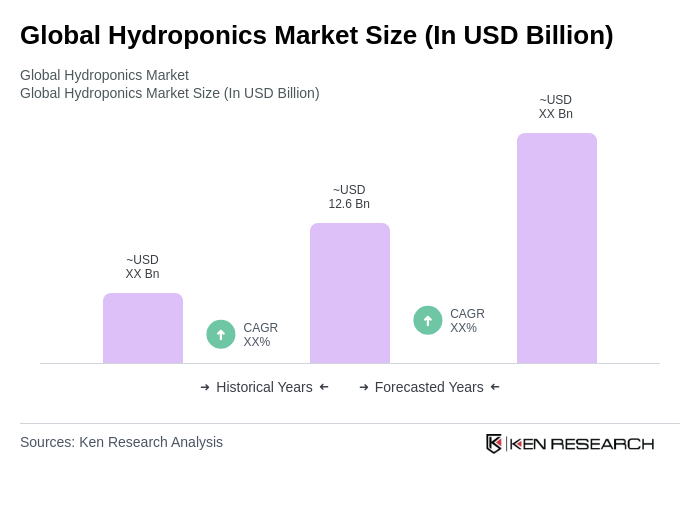
- The Global Hydroponics Market is valued at USD 12.6 billion, based on a five-year historical analysis. This reflects adoption of soilless cultivation to improve yield with precise water and nutrient use, aligning with sustainability and food-security objectives in urban and resource-constrained settings .
- Key players in this market include the United States, Canada, and the Netherlands. The U.S. benefits from advanced controlled-environment agriculture and investment; Canada’s policy support and CEA adoption underpin growth; the Netherlands leads in high-tech greenhouses, water reuse, and horticulture exports .
- The cited “Agricultural Improvement Act” as a 2023 U.S. policy driver is inaccurate. The most recent Farm Bill of that name passed in 2018; subsequent Farm Bill reauthorization has been delayed with extensions, not a new 2023 Act. Hydroponics-related research and USDA grants are supported through broader CEA, specialty crop, and urban agriculture programs rather than a new 2023 Agricultural Improvement Act .
Global Hydroponics Market Segmentation
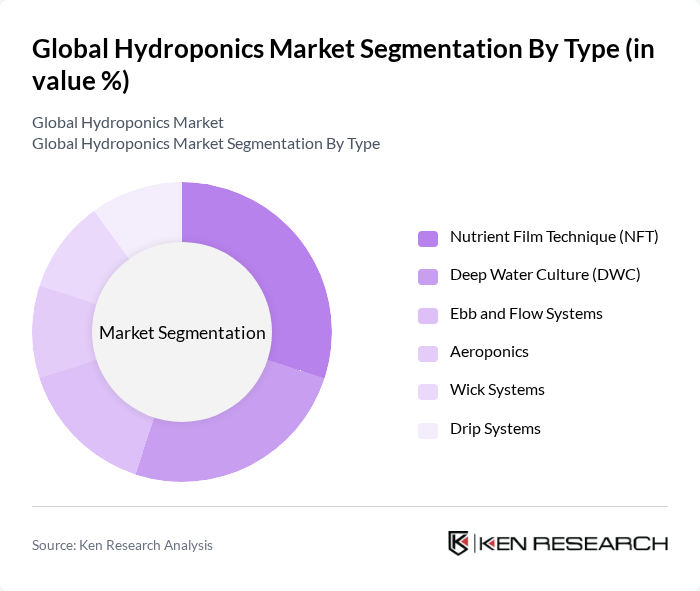
By Type:The hydroponics market can be segmented into various types, including Nutrient Film Technique (NFT), Deep Water Culture (DWC), Ebb and Flow Systems, Aeroponics, Wick Systems, and Drip Systems. Among these, the Nutrient Film Technique (NFT) is gaining traction due to its efficient nutrient delivery and low media requirement, supporting rapid growth and high yields. Deep Water Culture (DWC) remains popular for simplicity and robust leafy green production. Ebb and Flow Systems are valued for versatility across crop types, while Aeroponics is emerging for high-density propagation and faster growth cycles with reduced water use; Drip Systems are widely used in commercial CEA for precise fertigation control .
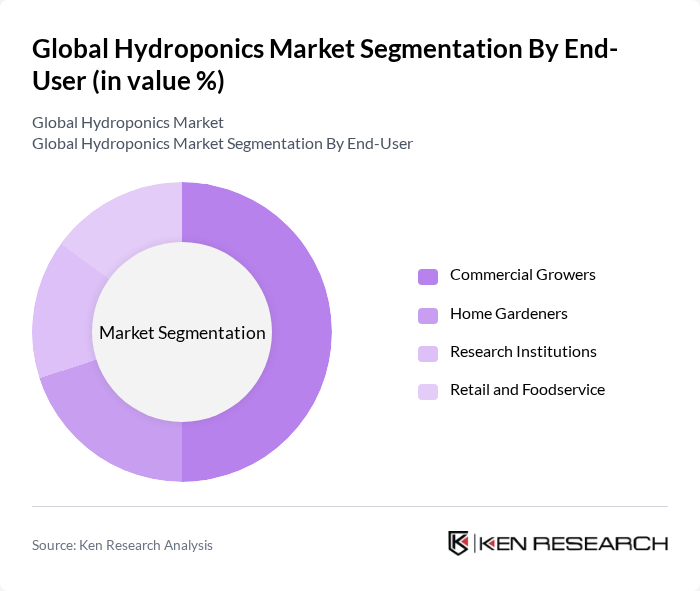
By End-User:The hydroponics market is segmented by end-users, including Commercial Growers, Home Gardeners, Research Institutions, and Retail and Foodservice. Commercial Growers dominate due to scale, year?round production, and cost control in controlled environments. Rising urban and indoor gardening drives Home Gardeners, while Research Institutions advance crop science and system optimization. Retail and Foodservice increasingly engage hydroponic supply to secure consistent, local, and pesticide?free produce .
Global Hydroponics Market Competitive Landscape
The Global Hydroponics Market is characterized by a dynamic mix of regional and international players. Leading participants such as AeroFarms, BrightFarms, Freight Farms, Gotham Greens, Plenty Unlimited, Bowery Farming, Crop One Holdings, Infarm, AmHydro (American Hydroponics), General Hydroponics (Hawthorne Gardening/ScottsMiracle-Gro), Hydrofarm Holdings Group, GrowGeneration, Signify (Philips Horticulture LED), Heliospectra AB, and Priva contribute to innovation, geographic expansion, and service delivery in this space .
Global Hydroponics Market Industry Analysis
Growth Drivers
- Increasing Demand for Organic Produce:The global organic food market reached approximately $142 billion, with projections indicating a growth to $220 billion. This surge is driven by consumer preferences for healthier, chemical-free options. Hydroponics, which allows for pesticide-free cultivation, is well-positioned to meet this demand. The rise in organic produce consumption is particularly notable in urban areas, where access to fresh food is limited, further driving hydroponic adoption.
- Technological Advancements in Hydroponics:The hydroponics sector has seen significant technological innovations, with investments in automation and smart farming technologies exceeding $1.5 billion. These advancements enhance efficiency and yield, making hydroponics more attractive to growers. For instance, the integration of AI and machine learning in monitoring plant health and nutrient levels has improved crop productivity by up to 30%, making hydroponic systems more viable for commercial agriculture.
- Sustainability and Environmental Concerns:With global water scarcity affecting over 2 billion people, hydroponics presents a sustainable solution, using up to 90% less water than traditional farming. In future, the global focus on sustainable agriculture is expected to intensify, with governments and organizations investing over $10 billion in sustainable farming initiatives. Hydroponics not only conserves water but also reduces land use, aligning with global sustainability goals and attracting eco-conscious consumers.
Market Challenges
- High Initial Investment Costs:The setup costs for hydroponic systems can range from $10,000 to $100,000, depending on the scale and technology used. This financial barrier can deter small-scale farmers and new entrants. In future, as the market matures, the need for affordable financing options will become critical, as many potential growers lack the capital to invest in advanced hydroponic systems despite their long-term benefits.
- Technical Expertise Requirement:Hydroponics requires specialized knowledge in plant biology, nutrient management, and system maintenance. A survey indicated that 60% of hydroponic growers reported a lack of skilled labor as a significant barrier to expansion. As the industry grows, the demand for training programs and educational resources will increase, highlighting the need for accessible knowledge transfer to ensure successful hydroponic operations.
Global Hydroponics Market Future Outlook
The hydroponics market is poised for transformative growth, driven by increasing urbanization and the need for sustainable food production. As cities expand, the demand for local, fresh produce will rise, prompting innovations in vertical farming and automated systems. Additionally, the integration of IoT technologies will enhance operational efficiency, allowing growers to monitor and optimize conditions in real-time. This convergence of technology and sustainability will redefine agricultural practices, making hydroponics a cornerstone of future food systems.
Market Opportunities
- Expansion in Emerging Markets:Emerging economies, particularly in Asia and Africa, are witnessing a rapid increase in urban populations. This trend presents a significant opportunity for hydroponics, as these regions face challenges in traditional agriculture. In future, investments in hydroponic systems in these markets could exceed $5 billion, driven by the need for efficient food production methods to meet growing urban demands.
- Integration of IoT in Hydroponics:The adoption of IoT technologies in hydroponics is expected to revolutionize the industry. In future, the market for IoT-enabled hydroponic systems could reach $2 billion, as growers seek to leverage data analytics for improved crop management. This integration will facilitate real-time monitoring and automation, enhancing productivity and reducing operational costs, making hydroponics more accessible to a broader range of growers.
Scope of the Report
| Segment | Sub-Segments |
|---|---|
| By Type | Nutrient Film Technique (NFT) Deep Water Culture (DWC) Ebb and Flow Systems Aeroponics Wick Systems Drip Systems |
| By End-User | Commercial Growers Home Gardeners Research Institutions Retail and Foodservice (Private Label, CEA Supply) |
| By Region | North America Europe Asia-Pacific Latin America Middle East & Africa |
| By Technology | Hydroponic Systems & Substrates (Aggregate and Liquid) LED Grow Lights Climate Control Systems (HVAC, Dehumidifiers) Sensors & Monitoring/Automation (pH/EC, IoT) |
| By Application | Leafy Greens (Lettuce, Spinach, Kale) Herbs (Basil, Mint, Parsley) Fruits (Tomato, Strawberry, Cucumber) Flowers & Ornamentals |
| By Investment Source | Private Investments (VC/PE, Corporate) Government Grants and Subsidies Crowdfunding and Community Financing |
| By Policy Support | Research & Innovation Grants Tax Incentives and Depreciation Benefits Equipment and Energy Subsidies |
Key Target Audience
Investors and Venture Capitalist Firms
Government and Regulatory Bodies (e.g., Food and Drug Administration, Environmental Protection Agency)
Manufacturers and Producers
Distributors and Retailers
Agricultural Technology Companies
Hydroponic System Suppliers
Industry Associations (e.g., Hydroponic Society of America)
Financial Institutions
Players Mentioned in the Report:
AeroFarms
BrightFarms
Freight Farms
Gotham Greens
Plenty Unlimited
Bowery Farming
Crop One Holdings
Infarm
AmHydro (American Hydroponics)
General Hydroponics (Hawthorne Gardening/ScottsMiracle-Gro)
Hydrofarm Holdings Group
GrowGeneration
Signify (Philips Horticulture LED)
Heliospectra AB
Priva
Table of Contents
Market Assessment Phase
1. Executive Summary and Approach
2. Global Hydroponics Market Overview
2.1 Key Insights and Strategic Recommendations
2.2 Global Hydroponics Market Overview
2.3 Definition and Scope
2.4 Evolution of Market Ecosystem
2.5 Timeline of Key Regulatory Milestones
2.6 Value Chain & Stakeholder Mapping
2.7 Business Cycle Analysis
2.8 Policy & Incentive Landscape
3. Global Hydroponics Market Analysis
3.1 Growth Drivers
3.1.1 Increasing Demand for Organic Produce
3.1.2 Technological Advancements in Hydroponics
3.1.3 Urbanization and Space Constraints
3.1.4 Sustainability and Environmental Concerns
3.2 Market Challenges
3.2.1 High Initial Investment Costs
3.2.2 Technical Expertise Requirement
3.2.3 Regulatory Hurdles
3.2.4 Market Competition
3.3 Market Opportunities
3.3.1 Expansion in Emerging Markets
3.3.2 Integration of IoT in Hydroponics
3.3.3 Partnerships with Retailers
3.3.4 Development of New Hydroponic Systems
3.4 Market Trends
3.4.1 Rise of Vertical Farming
3.4.2 Increased Investment in R&D
3.4.3 Shift Towards Automated Solutions
3.4.4 Growing Consumer Awareness
3.5 Government Regulation
3.5.1 Subsidies for Sustainable Agriculture
3.5.2 Safety Standards for Hydroponic Produce
3.5.3 Water Usage Regulations
3.5.4 Tax Incentives for Green Technologies
4. SWOT Analysis
5. Stakeholder Analysis
6. Porter's Five Forces Analysis
7. Global Hydroponics Market Market Size, 2019-2024
7.1 By Value
7.2 By Volume
7.3 By Average Selling Price
8. Global Hydroponics Market Segmentation
8.1 By Type
8.1.1 Nutrient Film Technique (NFT)
8.1.2 Deep Water Culture (DWC)
8.1.3 Ebb and Flow Systems
8.1.4 Aeroponics
8.1.5 Wick Systems
8.1.6 Drip Systems
8.2 By End-User
8.2.1 Commercial Growers
8.2.2 Home Gardeners
8.2.3 Research Institutions
8.2.4 Retail and Foodservice (Private Label, CEA Supply)
8.3 By Region
8.3.1 North America
8.3.2 Europe
8.3.3 Asia-Pacific
8.3.4 Latin America
8.3.5 Middle East & Africa
8.4 By Technology
8.4.1 Hydroponic Systems & Substrates (Aggregate and Liquid)
8.4.2 LED Grow Lights
8.4.3 Climate Control Systems (HVAC, Dehumidifiers)
8.4.4 Sensors & Monitoring/Automation (pH/EC, IoT)
8.5 By Application
8.5.1 Leafy Greens (Lettuce, Spinach, Kale)
8.5.2 Herbs (Basil, Mint, Parsley)
8.5.3 Fruits (Tomato, Strawberry, Cucumber)
8.5.4 Flowers & Ornamentals
8.6 By Investment Source
8.6.1 Private Investments (VC/PE, Corporate)
8.6.2 Government Grants and Subsidies
8.6.3 Crowdfunding and Community Financing
8.7 By Policy Support
8.7.1 Research & Innovation Grants
8.7.2 Tax Incentives and Depreciation Benefits
8.7.3 Equipment and Energy Subsidies
9. Global Hydroponics Market Competitive Analysis
9.1 Market Share of Key Players
9.2 Cross Comparison of Key Players
9.2.1 Company Name
9.2.2 Scale and Footprint (Revenue Band, Regions Served)
9.2.3 Revenue Growth Rate (YoY/CAGR)
9.2.4 Installed Capacity/Production Output (tons/year)
9.2.5 Market Penetration (Sites/Farms Installed or Customers Served)
9.2.6 Customer Retention/Contract Tenure (Average Contract Length)
9.2.7 Average Selling Price (ASP) and Pricing Model (CapEx, Lease, SaaS)
9.2.8 Product/Portfolio Mix (Systems, Nutrients, Lights, Services)
9.2.9 Technology Intensity (Automation Level, IoT/AI usage)
9.2.10 Unit Economics (Yield/m², Water Use/Lb, Energy Use/kg)
9.2.11 Supply Chain & Distribution (Lead Times, In-house vs OEM)
9.2.12 Certifications & Compliance (GAP, Organic-equivalent, Food Safety)
9.3 SWOT Analysis of Top Players
9.4 Pricing Analysis
9.5 Detailed Profile of Major Companies
9.5.1 AeroFarms
9.5.2 BrightFarms
9.5.3 Freight Farms
9.5.4 Gotham Greens
9.5.5 Plenty Unlimited
9.5.6 Bowery Farming
9.5.7 Crop One Holdings
9.5.8 Infarm
9.5.9 AmHydro (American Hydroponics)
9.5.10 General Hydroponics (Hawthorne Gardening/ScottsMiracle-Gro)
9.5.11 Hydrofarm Holdings Group
9.5.12 GrowGeneration
9.5.13 Signify (Philips Horticulture LED)
9.5.14 Heliospectra AB
9.5.15 Priva
10. Global Hydroponics Market End-User Analysis
10.1 Procurement Behavior of Key Ministries
10.1.1 Government Procurement Policies
10.1.2 Budget Allocations for Hydroponics
10.1.3 Collaboration with Private Sector
10.2 Corporate Spend on Infrastructure & Energy
10.2.1 Investment in Hydroponic Facilities
10.2.2 Energy Efficiency Initiatives
10.2.3 Infrastructure Development Trends
10.3 Pain Point Analysis by End-User Category
10.3.1 Cost of Hydroponic Systems
10.3.2 Access to Quality Inputs
10.3.3 Technical Support and Training
10.4 User Readiness for Adoption
10.4.1 Awareness of Hydroponics Benefits
10.4.2 Availability of Resources
10.4.3 Willingness to Invest
10.5 Post-Deployment ROI and Use Case Expansion
10.5.1 Measurement of ROI
10.5.2 Case Studies of Successful Implementations
10.5.3 Future Expansion Plans
11. Global Hydroponics Market Future Size, 2025-2030
11.1 By Value
11.2 By Volume
11.3 By Average Selling Price
Go-To-Market Strategy Phase
1. Whitespace Analysis + Business Model Canvas
1.1 Market Gaps Identification
1.2 Business Model Development
2. Marketing and Positioning Recommendations
2.1 Branding Strategies
2.2 Product USPs
3. Distribution Plan
3.1 Urban Retail Strategies
3.2 Rural NGO Tie-ups
4. Channel & Pricing Gaps
4.1 Underserved Routes
4.2 Pricing Bands Analysis
5. Unmet Demand & Latent Needs
5.1 Category Gaps
5.2 Consumer Segments
6. Customer Relationship
6.1 Loyalty Programs
6.2 After-sales Service
7. Value Proposition
7.1 Sustainability Initiatives
7.2 Integrated Supply Chains
8. Key Activities
8.1 Regulatory Compliance
8.2 Branding Efforts
8.3 Distribution Setup
9. Entry Strategy Evaluation
9.1 Domestic Market Entry Strategy
9.1.1 Product Mix Considerations
9.1.2 Pricing Band Strategy
9.1.3 Packaging Solutions
9.2 Export Entry Strategy
9.2.1 Target Countries
9.2.2 Compliance Roadmap
10. Entry Mode Assessment
10.1 Joint Ventures
10.2 Greenfield Investments
10.3 Mergers & Acquisitions
10.4 Distributor Model
11. Capital and Timeline Estimation
11.1 Capital Requirements
11.2 Timelines for Implementation
12. Control vs Risk Trade-Off
12.1 Ownership Considerations
12.2 Partnerships Evaluation
13. Profitability Outlook
13.1 Breakeven Analysis
13.2 Long-term Sustainability
14. Potential Partner List
14.1 Distributors
14.2 Joint Ventures
14.3 Acquisition Targets
15. Execution Roadmap
15.1 Phased Plan for Market Entry
15.1.1 Market Setup
15.1.2 Market Entry
15.1.3 Growth Acceleration
15.1.4 Scale & Stabilize
15.2 Key Activities and Milestones
15.2.1 Milestone Planning
15.2.2 Activity Tracking
Research Methodology
Phase 1: Approach1
Desk Research
- Analysis of industry reports from agricultural and hydroponics associations
- Review of market trends and forecasts from academic journals and publications
- Examination of government publications on agricultural practices and hydroponics regulations
Primary Research
- Interviews with hydroponics system manufacturers and suppliers
- Surveys with commercial growers utilizing hydroponic systems
- Field visits to hydroponic farms to gather firsthand operational insights
Validation & Triangulation
- Cross-validation of data from multiple sources including trade publications and expert interviews
- Triangulation of market size estimates using both qualitative and quantitative data
- Sanity checks through expert panel discussions and feedback sessions
Phase 2: Market Size Estimation1
Top-down Assessment
- Estimation of total addressable market based on global agricultural output and hydroponics adoption rates
- Segmentation of market by crop type, technology, and geographic region
- Incorporation of growth rates from emerging markets and urban agriculture initiatives
Bottom-up Modeling
- Collection of sales data from leading hydroponics equipment manufacturers
- Estimation of average revenue per hydroponic system installed
- Volume calculations based on the number of operational hydroponic farms globally
Forecasting & Scenario Analysis
- Multi-variable regression analysis incorporating factors such as climate change and food security
- Scenario modeling based on technological advancements and consumer preferences
- Development of baseline, optimistic, and pessimistic market growth projections through 2030
Phase 3: CATI Sample Composition1
| Scope Item/Segment | Sample Size | Target Respondent Profiles |
|---|---|---|
| Commercial Hydroponic Farms | 120 | Farm Owners, Operations Managers |
| Hydroponics Equipment Suppliers | 90 | Sales Managers, Product Development Leads |
| Research Institutions in Agriculture | 60 | Research Scientists, Agricultural Economists |
| Urban Agriculture Initiatives | 50 | Project Managers, Community Organizers |
| Retailers of Hydroponic Produce | 70 | Category Managers, Supply Chain Coordinators |
Frequently Asked Questions
What is the current value of the Global Hydroponics Market?
The Global Hydroponics Market is valued at approximately USD 12.6 billion, reflecting a significant adoption of soilless cultivation methods aimed at improving yield and aligning with sustainability and food security objectives in urban settings.
Which countries are leading in the hydroponics market?
What are the main types of hydroponic systems?
Who are the primary end-users of hydroponics?
Other Regional/Country Reports
Indonesia Hydroponics Market
Malaysia Hydroponics Market
Why Buy From Us?

What makes us stand out is that our consultants follow Robust, Refine and Result (RRR) methodology. Robust for clear definitions, approaches and sanity checking, Refine for differentiating respondents' facts and opinions, and Result for presenting data with story.

We have set a benchmark in the industry by offering our clients with syndicated and customized market research reports featuring coverage of entire market as well as meticulous research and analyst insights.

While we don't replace traditional research, we flip the method upside down. Our dual approach of Top Bottom & Bottom Top ensures quality deliverable by not just verifying company fundamentals but also looking at the sector and macroeconomic factors.

With one step in the future, our research team constantly tries to show you the bigger picture. We help with some of the tough questions you may encounter along the way: How is the industry positioned? Best marketing channel? KPI's of competitors? By aligning every element, we help maximize success.

Our report gives you instant access to the answers and sources that other companies might choose to hide. We elaborate each steps of research methodology we have used and showcase you the sample size to earn your trust.

If you need any support, we are here! We pride ourselves on universe strength, data quality, and quick, friendly, and professional service.