About the Report
Base Year 2024Global Hypermarket Overview
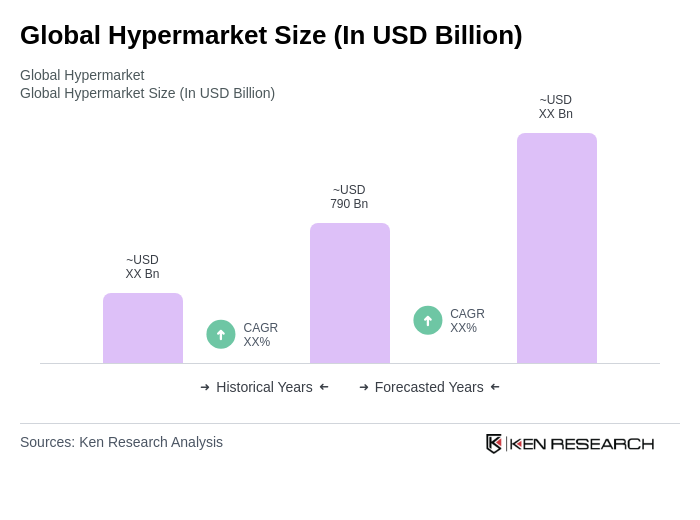
- The Global Hypermarket market is valued at approximately USD 790 billion, based on a five-year historical analysis. This growth is primarily driven by increasing consumer demand for one-stop shopping experiences, convenience, and the expansion of retail chains into emerging markets. The rise of e-commerce and omnichannel retailing has also significantly influenced consumer purchasing behavior, with retailers integrating click-and-collect, micro-fulfillment, and private labels to sustain traffic and margins.
- Key players in this market include the United States, China, and India, which dominate due to their large populations, urbanization trends, and rising disposable incomes. The U.S. is known for its extensive retail infrastructure, while China and India are experiencing growth in modern retail formats amid urbanization and investment in organized retail, contributing to Asia–Pacific holding the largest regional position in hypermarkets.
- In 2023, the European Union implemented regulations aimed at promoting sustainable retail practices, mandating that hypermarkets reduce food waste by 30% by 2025. This regulation encourages hypermarkets to adopt better inventory management practices and collaborate with local food banks, thereby enhancing their corporate social responsibility initiatives.
Global Hypermarket Market Segmentation
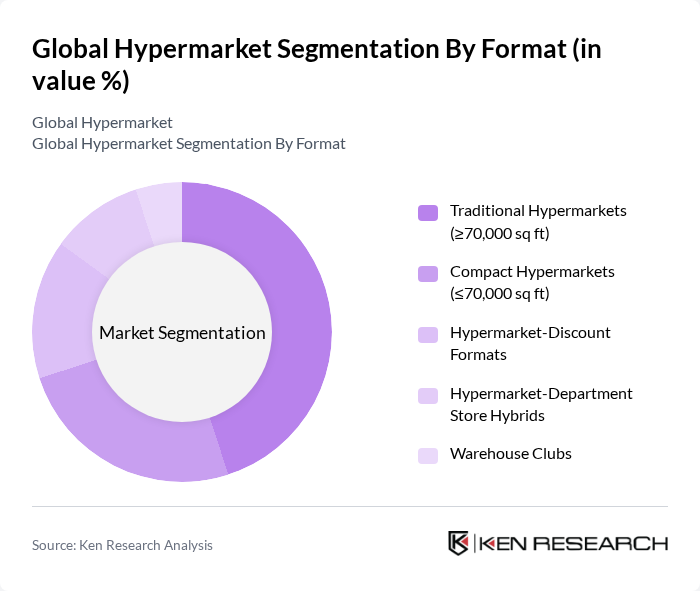
By Format:The hypermarket market is segmented into various formats, including Traditional Hypermarkets, Compact Hypermarkets, Hypermarket-Discount Formats, Hypermarket-Department Store Hybrids, and Warehouse Clubs. Traditional Hypermarkets, which are typically larger than 70,000 sq ft, dominate the market due to their extensive product offerings and ability to attract a diverse customer base. Compact Hypermarkets are gaining traction in urban areas where space is limited, while Hypermarket-Discount Formats appeal to cost-conscious consumers. The market is also seeing growth in Warehouse Clubs, which offer bulk purchasing options.
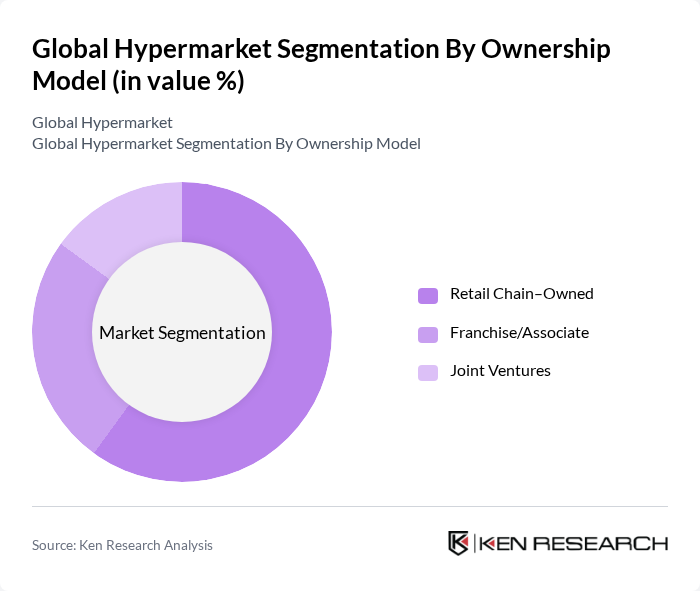
By Ownership Model:The ownership model segmentation includes Retail Chain–Owned, Franchise/Associate, and Joint Ventures. Retail Chain–Owned hypermarkets dominate the market due to their established brand presence and economies of scale, allowing for competitive pricing and extensive marketing strategies. Franchise models are also popular, enabling rapid expansion with lower capital investment. Joint Ventures are increasingly common in emerging markets, where local knowledge and resources are essential for success.
Global Hypermarket Competitive Landscape
The Global Hypermarket market is characterized by a dynamic mix of regional and international players. Leading participants such as Walmart Inc., Carrefour S.A., Tesco PLC, Aldi Einkauf SE & Co. oHG, Costco Wholesale Corporation, Metro AG, Target Corporation, Seven & I Holdings Co., Ltd. (Ito-Yokado), Lidl Stiftung & Co. KG, Koninklijke Ahold Delhaize N.V., E.Leclerc (É.Leclerc), J Sainsbury plc, Groupe Auchan (Auchan Retail), El Corte Inglés, S.A. (Hipercor), Big Bazaar (Future Retail Ltd.) contribute to innovation, geographic expansion, and service delivery in this space.
Global Hypermarket Industry Analysis
Growth Drivers
- Increasing Urbanization:Urbanization is a significant driver for hypermarkets, with the United Nations projecting that by future, 56.2% of the global population will reside in urban areas. This shift leads to higher foot traffic and demand for convenient shopping options. In cities, the average household size is decreasing, resulting in increased per capita spending on groceries and household goods, which is expected to reach $3,800 annually in urban centers, further boosting hypermarket sales.
- Rising Disposable Incomes:As global economies recover, disposable incomes are projected to rise significantly. According to the World Bank, global GDP per capita is expected to increase by $1,500 in future, leading to enhanced purchasing power. This increase allows consumers to spend more on premium products and services offered by hypermarkets. In regions like Asia-Pacific, disposable income growth is anticipated to reach $6 trillion, directly benefiting hypermarket sales and expansion.
- Expansion of E-commerce:The e-commerce sector is rapidly growing, with global online retail sales projected to reach $7 trillion by future, according to eMarketer. Hypermarkets are increasingly integrating online platforms to enhance customer experience and convenience. This shift is driven by the fact that 75% of consumers prefer shopping online for groceries, leading to a hybrid shopping model that combines physical and digital experiences, ultimately increasing overall sales and customer loyalty.
Market Challenges
- Intense Competition:The hypermarket sector faces fierce competition from both traditional retailers and emerging e-commerce platforms. In future, it is estimated that over 35% of grocery sales will occur online, intensifying the pressure on brick-and-mortar hypermarkets. Major players like Walmart and Carrefour are investing heavily in technology and customer experience to maintain market share, which can strain smaller hypermarkets that lack similar resources, leading to potential market exit.
- Supply Chain Disruptions:The global supply chain remains vulnerable to disruptions, as evidenced by the COVID-19 pandemic's impact. In future, logistics costs are expected to rise by 20%, affecting hypermarket operations. Increased shipping costs and delays can lead to stock shortages, impacting customer satisfaction and sales. Additionally, fluctuating commodity prices can further complicate inventory management, forcing hypermarkets to adapt quickly to maintain profitability.
Global Hypermarket Future Outlook
The future of the hypermarket industry appears promising, driven by technological advancements and evolving consumer preferences. As retailers increasingly adopt omnichannel strategies, integrating online and offline shopping experiences, customer engagement is expected to improve significantly. Furthermore, the focus on health and wellness will shape product offerings, with hypermarkets likely to expand their organic and health-focused product lines. Sustainability initiatives will also play a crucial role, as consumers demand environmentally friendly practices from retailers, influencing purchasing decisions.
Market Opportunities
- Expansion into Emerging Markets:Emerging markets present significant growth opportunities for hypermarkets. With a combined population of over 2.8 billion, regions like Southeast Asia and Africa are experiencing rapid urbanization and rising incomes. By future, these markets are expected to contribute an additional $1.2 trillion in retail sales, making them attractive for hypermarket expansion and investment.
- Adoption of Technology in Retail:The integration of technology in retail operations offers hypermarkets a chance to enhance efficiency and customer experience. By future, investments in AI and big data analytics are projected to exceed $250 billion globally. This technology can optimize inventory management, personalize marketing efforts, and streamline supply chains, ultimately driving sales and improving customer satisfaction in hypermarkets.
Scope of the Report
| Segment | Sub-Segments |
|---|---|
| By Format | Traditional Hypermarkets (?70,000 sq ft) Compact Hypermarkets (?70,000 sq ft) Hypermarket-Discount Formats Hypermarket-Department Store Hybrids Warehouse Clubs |
| By Ownership Model | Retail Chain–Owned Franchise/Associate Joint Ventures |
| By Channel | In-Store (Brick-and-Mortar) Click-and-Collect (BOPIS) Home Delivery (Own Fleet/Third-Party) |
| By Product Category | Food & Grocery Consumer Electronics & Appliances Apparel, Footwear & Accessories Home & Furniture Health, Beauty & Personal Care Toys, Stationery & Seasonal |
| By Pricing & Assortment Strategy | Everyday Low Price (EDLP) High–Low Promotions Private Label–Led Premium Assortment |
| By Store Location | Urban Suburban Peri-Urban/Rural |
| By Region | Asia-Pacific Europe North America Latin America Middle East & Africa |
Key Target Audience
Investors and Venture Capitalist Firms
Government and Regulatory Bodies (e.g., Food and Drug Administration, Federal Trade Commission)
Manufacturers and Producers
Distributors and Retailers
Logistics and Supply Chain Companies
Real Estate Developers and Property Management Firms
Technology Providers
Financial Institutions
Players Mentioned in the Report:
Walmart Inc.
Carrefour S.A.
Tesco PLC
Aldi Einkauf SE & Co. oHG
Costco Wholesale Corporation
Metro AG
Target Corporation
Seven & I Holdings Co., Ltd. (Ito-Yokado)
Lidl Stiftung & Co. KG
Koninklijke Ahold Delhaize N.V.
E.Leclerc (E.Leclerc)
J Sainsbury plc
Groupe Auchan (Auchan Retail)
El Corte Ingles, S.A. (Hipercor)
Big Bazaar (Future Retail Ltd.)
Table of Contents
Market Assessment Phase
1. Executive Summary and Approach
2. Global Hypermarket Overview
2.1 Key Insights and Strategic Recommendations
2.2 Global Hypermarket Overview
2.3 Definition and Scope
2.4 Evolution of Market Ecosystem
2.5 Timeline of Key Regulatory Milestones
2.6 Value Chain & Stakeholder Mapping
2.7 Business Cycle Analysis
2.8 Policy & Incentive Landscape
3. Global Hypermarket Analysis
3.1 Growth Drivers
3.1.1 Increasing Urbanization
3.1.2 Rising Disposable Incomes
3.1.3 Expansion of E-commerce
3.1.4 Demand for One-Stop Shopping
3.2 Market Challenges
3.2.1 Intense Competition
3.2.2 Supply Chain Disruptions
3.2.3 Changing Consumer Preferences
3.2.4 Regulatory Compliance Issues
3.3 Market Opportunities
3.3.1 Expansion into Emerging Markets
3.3.2 Adoption of Technology in Retail
3.3.3 Sustainability Initiatives
3.3.4 Private Label Growth
3.4 Market Trends
3.4.1 Omnichannel Retailing
3.4.2 Health and Wellness Focus
3.4.3 Personalization in Shopping Experience
3.4.4 Integration of AI and Big Data
3.5 Government Regulation
3.5.1 Food Safety Standards
3.5.2 Labor Laws
3.5.3 Environmental Regulations
3.5.4 Trade Policies
4. SWOT Analysis
5. Stakeholder Analysis
6. Porter's Five Forces Analysis
7. Global Hypermarket Market Size, 2019-2024
7.1 By Value
7.2 By Volume
7.3 By Average Selling Price
8. Global Hypermarket Segmentation
8.1 By Format
8.1.1 Traditional Hypermarkets (?70,000 sq ft)
8.1.2 Compact Hypermarkets (?70,000 sq ft)
8.1.3 Hypermarket-Discount Formats
8.1.4 Hypermarket-Department Store Hybrids
8.1.5 Warehouse Clubs
8.2 By Ownership Model
8.2.1 Retail Chain–Owned
8.2.2 Franchise/Associate
8.2.3 Joint Ventures
8.3 By Channel
8.3.1 In-Store (Brick-and-Mortar)
8.3.2 Click-and-Collect (BOPIS)
8.3.3 Home Delivery (Own Fleet/Third-Party)
8.4 By Product Category
8.4.1 Food & Grocery
8.4.2 Consumer Electronics & Appliances
8.4.3 Apparel, Footwear & Accessories
8.4.4 Home & Furniture
8.4.5 Health, Beauty & Personal Care
8.4.6 Toys, Stationery & Seasonal
8.5 By Pricing & Assortment Strategy
8.5.1 Everyday Low Price (EDLP)
8.5.2 High–Low Promotions
8.5.3 Private Label–Led
8.5.4 Premium Assortment
8.6 By Store Location
8.6.1 Urban
8.6.2 Suburban
8.6.3 Peri-Urban/Rural
8.7 By Region
8.7.1 Asia-Pacific
8.7.2 Europe
8.7.3 North America
8.7.4 Latin America
8.7.5 Middle East & Africa
9. Global Hypermarket Competitive Analysis
9.1 Market Share of Key Players
9.2 Cross Comparison of Key Players
9.2.1 Company Name
9.2.2 Group Size (Global, Regional, or National chain)
9.2.3 Revenue Growth Rate (YoY, %)
9.2.4 Same-Store Sales (Comparable Sales, %)
9.2.5 Sales per Square Foot/Square Meter
9.2.6 Average Basket Size (Units/Value)
9.2.7 Online Penetration (% of Sales via Digital)
9.2.8 Click-and-Collect Orders as % of Online
9.2.9 Inventory Turnover (x)
9.2.10 Private Label Mix (% of Sales)
9.2.11 Store Count and Net Openings/Closures
9.2.12 Geographic Footprint (Countries/Regions)
9.3 SWOT Analysis of Top Players
9.4 Pricing Analysis
9.5 Detailed Profile of Major Companies
9.5.1 Walmart Inc.
9.5.2 Carrefour S.A.
9.5.3 Tesco PLC
9.5.4 Aldi Einkauf SE & Co. oHG
9.5.5 Costco Wholesale Corporation
9.5.6 Metro AG
9.5.7 Target Corporation
9.5.8 Seven & I Holdings Co., Ltd. (Ito-Yokado)
9.5.9 Lidl Stiftung & Co. KG
9.5.10 Koninklijke Ahold Delhaize N.V.
9.5.11 E.Leclerc (É.Leclerc)
9.5.12 J Sainsbury plc
9.5.13 Groupe Auchan (Auchan Retail)
9.5.14 El Corte Inglés, S.A. (Hipercor)
9.5.15 Big Bazaar (Future Retail Ltd.)
10. Global Hypermarket End-User Analysis
10.1 Procurement Behavior of Key Ministries
10.1.1 Budget Allocation Trends
10.1.2 Procurement Processes
10.1.3 Supplier Selection Criteria
10.2 Corporate Spend on Infrastructure & Energy
10.2.1 Investment Priorities
10.2.2 Spending Patterns
10.2.3 Cost Management Strategies
10.3 Pain Point Analysis by End-User Category
10.3.1 Supply Chain Inefficiencies
10.3.2 Product Availability Issues
10.3.3 Pricing Concerns
10.4 User Readiness for Adoption
10.4.1 Technology Adoption Rates
10.4.2 Training and Support Needs
10.4.3 Feedback Mechanisms
10.5 Post-Deployment ROI and Use Case Expansion
10.5.1 Performance Metrics
10.5.2 Use Case Diversification
10.5.3 Long-term Value Realization
11. Global Hypermarket Future Size, 2025-2030
11.1 By Value
11.2 By Volume
11.3 By Average Selling Price
Go-To-Market Strategy Phase
1. Whitespace Analysis + Business Model Canvas
1.1 Market Gaps Identification
1.2 Value Proposition Development
1.3 Revenue Streams Analysis
1.4 Cost Structure Evaluation
1.5 Key Partnerships Exploration
1.6 Customer Segmentation
1.7 Channels of Distribution
2. Marketing and Positioning Recommendations
2.1 Branding Strategies
2.2 Product USPs
2.3 Target Audience Identification
2.4 Communication Strategies
2.5 Digital Marketing Approaches
3. Distribution Plan
3.1 Urban Retail Strategies
3.2 Rural NGO Tie-ups
3.3 Logistics Optimization
3.4 Distribution Channel Selection
4. Channel & Pricing Gaps
4.1 Underserved Routes
4.2 Pricing Bands Analysis
4.3 Competitor Pricing Comparison
5. Unmet Demand & Latent Needs
5.1 Category Gaps
5.2 Consumer Segments Analysis
5.3 Emerging Trends Identification
6. Customer Relationship
6.1 Loyalty Programs
6.2 After-sales Service
6.3 Customer Feedback Mechanisms
7. Value Proposition
7.1 Sustainability Initiatives
7.2 Integrated Supply Chains
7.3 Customer-Centric Approaches
8. Key Activities
8.1 Regulatory Compliance
8.2 Branding Efforts
8.3 Distribution Setup
9. Entry Strategy Evaluation
9.1 Domestic Market Entry Strategy
9.1.1 Product Mix Considerations
9.1.2 Pricing Band Strategy
9.1.3 Packaging Innovations
9.2 Export Entry Strategy
9.2.1 Target Countries Analysis
9.2.2 Compliance Roadmap
10. Entry Mode Assessment
10.1 Joint Ventures
10.2 Greenfield Investments
10.3 Mergers & Acquisitions
10.4 Distributor Model Evaluation
11. Capital and Timeline Estimation
11.1 Capital Requirements
11.2 Timelines for Implementation
12. Control vs Risk Trade-Off
12.1 Ownership Considerations
12.2 Partnerships Evaluation
13. Profitability Outlook
13.1 Breakeven Analysis
13.2 Long-term Sustainability Strategies
14. Potential Partner List
14.1 Distributors
14.2 Joint Ventures
14.3 Acquisition Targets
15. Execution Roadmap
15.1 Phased Plan for Market Entry
15.1.1 Market Setup
15.1.2 Market Entry
15.1.3 Growth Acceleration
15.1.4 Scale & Stabilize
15.2 Key Activities and Milestones
15.2.1 Milestone Planning
15.2.2 Activity Tracking
Research Methodology
Phase 1: Approach1
Desk Research
- Analysis of global hypermarket industry reports and market trends from reputable market research firms
- Review of government publications and trade association reports related to retail and consumer behavior
- Examination of financial statements and annual reports of leading hypermarket chains
Primary Research
- In-depth interviews with senior executives from major hypermarket chains
- Surveys targeting consumers to understand shopping preferences and behaviors
- Focus groups with retail analysts and industry experts to gather qualitative insights
Validation & Triangulation
- Cross-validation of findings through multiple data sources including sales data and consumer surveys
- Triangulation of insights from primary interviews with secondary research findings
- Sanity checks conducted through expert panel reviews to ensure data accuracy
Phase 2: Market Size Estimation1
Top-down Assessment
- Estimation of total market size based on national retail sales data and hypermarket penetration rates
- Segmentation of market size by geographic regions and product categories
- Incorporation of macroeconomic indicators such as GDP growth and consumer spending trends
Bottom-up Modeling
- Collection of sales data from a sample of hypermarkets to establish average revenue per store
- Estimation of store count growth based on planned openings and market expansion strategies
- Analysis of product mix and average transaction values to refine revenue projections
Forecasting & Scenario Analysis
- Development of forecasting models using historical sales data and market growth rates
- Scenario analysis based on potential economic shifts and consumer behavior changes
- Creation of best-case, worst-case, and most-likely scenarios through 2030
Phase 3: CATI Sample Composition1
| Scope Item/Segment | Sample Size | Target Respondent Profiles |
|---|---|---|
| Consumer Shopping Behavior | 150 | Frequent Hypermarket Shoppers, Occasional Buyers |
| Supply Chain Management Insights | 100 | Supply Chain Managers, Logistics Coordinators |
| Product Category Preferences | 80 | Category Managers, Merchandising Directors |
| Marketing Strategies Evaluation | 70 | Marketing Executives, Brand Managers |
| Store Operations Feedback | 90 | Store Managers, Operations Supervisors |
Frequently Asked Questions
What is the current market value of the Global Hypermarket industry?
The Global Hypermarket market is valued at approximately USD 790 billion, driven by increasing consumer demand for one-stop shopping experiences and the expansion of retail chains into emerging markets.
Which regions dominate the Global Hypermarket market?
What are the key growth drivers for the Global Hypermarket market?
What challenges does the Global Hypermarket industry face?
Other Regional/Country Reports
Indonesia Hypermarkets Market
Malaysia Hypermarkets Market
APAC Hypermarkets Market
SEA Hypermarkets Market
Why Buy From Us?

What makes us stand out is that our consultants follow Robust, Refine and Result (RRR) methodology. Robust for clear definitions, approaches and sanity checking, Refine for differentiating respondents' facts and opinions, and Result for presenting data with story.

We have set a benchmark in the industry by offering our clients with syndicated and customized market research reports featuring coverage of entire market as well as meticulous research and analyst insights.

While we don't replace traditional research, we flip the method upside down. Our dual approach of Top Bottom & Bottom Top ensures quality deliverable by not just verifying company fundamentals but also looking at the sector and macroeconomic factors.

With one step in the future, our research team constantly tries to show you the bigger picture. We help with some of the tough questions you may encounter along the way: How is the industry positioned? Best marketing channel? KPI's of competitors? By aligning every element, we help maximize success.

Our report gives you instant access to the answers and sources that other companies might choose to hide. We elaborate each steps of research methodology we have used and showcase you the sample size to earn your trust.

If you need any support, we are here! We pride ourselves on universe strength, data quality, and quick, friendly, and professional service.