About the Report
Base Year 2024Global Immersive Simulation Market Overview
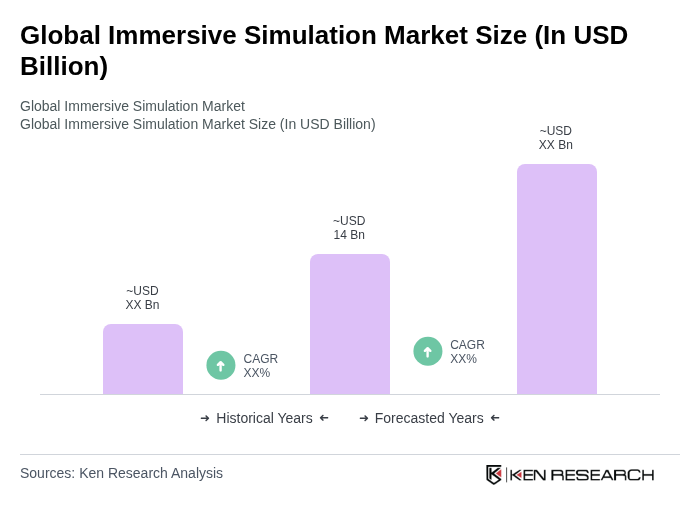
- The Global Immersive Simulation Market is valued at USD 14 billion, based on a five-year historical analysis. This growth is primarily driven by advancements in technology, increasing demand for training and education solutions, rising adoption of virtual and augmented reality applications across various industries, and heightened safety-training mandates in hazardous industries.
- Key regions in this market include the United States, Germany, and China, which dominate due to their strong technological infrastructure, significant investments in research and development, and a high concentration of leading companies in the immersive simulation space. The United States immersive simulator market is expected to reach USD 17 billion by 2032, while China's market is projected to reach USD 33 billion during the same period, reflecting the region's rapid adoption and investment in immersive technologies.
- In 2023, the U.S. government implemented regulations to promote the use of immersive simulation technologies in military training. This initiative includes funding aimed at enhancing training effectiveness and operational readiness through advanced simulation systems, thereby fostering innovation and competitiveness in the defense sector.
Global Immersive Simulation Market Segmentation
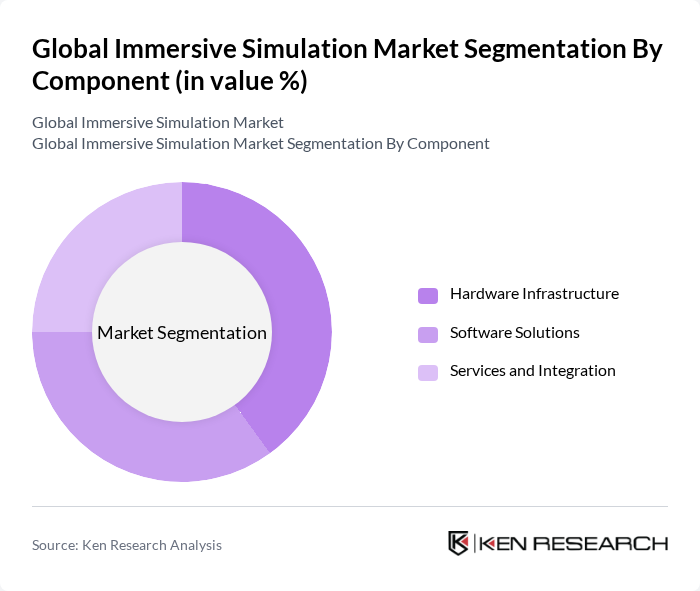
By Component:The components of the immersive simulation market include hardware infrastructure, software solutions, and services and integration. Each of these subsegments plays a crucial role in the overall market dynamics. Hardware infrastructure encompasses the physical devices required for immersive experiences, while software solutions provide the necessary applications and platforms. Services and integration ensure that these technologies are effectively implemented and maintained.
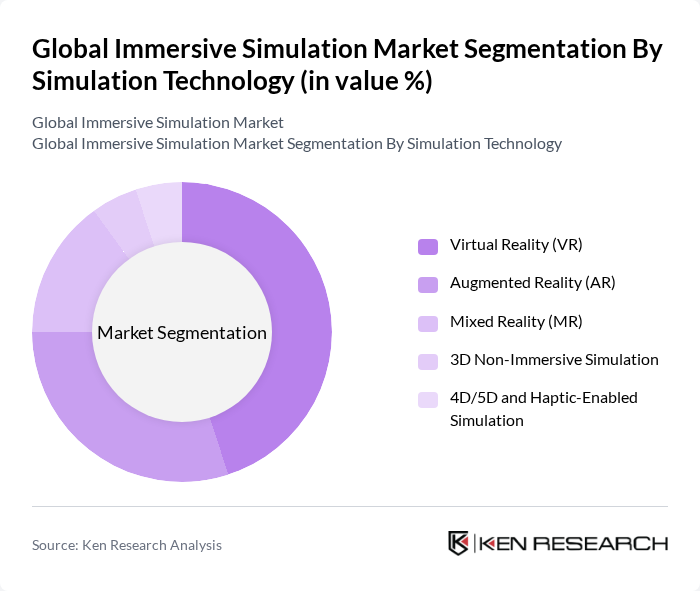
By Simulation Technology:The simulation technology segment includes virtual reality (VR), augmented reality (AR), mixed reality (MR), 3D non-immersive simulation, and 4D/5D and haptic-enabled simulation. VR and AR are leading technologies due to their widespread application in training and entertainment, while MR and haptic technologies are gaining traction for their immersive capabilities.
Global Immersive Simulation Market Competitive Landscape
The Global Immersive Simulation Market is characterized by a dynamic mix of regional and international players. Leading participants such as Unity Technologies, Epic Games, Siemens AG, PTC Inc., CAE Inc., Dassault Systèmes, Lockheed Martin Corporation, Boeing Defense, Space & Security, EON Reality, Meta Platforms, Inc. (Oculus), Microsoft Corporation, NVIDIA Corporation, HTC VIVE, Autodesk Inc., AVEVA Group contribute to innovation, geographic expansion, and service delivery in this space.
Global Immersive Simulation Market Industry Analysis
Growth Drivers
- Increasing Demand for Training and Education Solutions:Theglobal education sectoris projected to reach $10 trillion by 2025, driving the need for innovative training solutions. Immersive simulations enhance learning experiences, with institutions increasingly adopting these technologies. For instance, the U.S. Department of Education reported a 30% increase in the use of simulation-based learning tools in vocational training programs from 2020 to 2023, highlighting a significant shift towards immersive educational methodologies.
- Advancements in Virtual Reality and Augmented Reality Technologies:The VR and AR market is expected to grow to $209.2 billion in the near future, fueled by technological advancements. Companies like Oculus and Microsoft are investing heavily in R&D, leading to improved hardware and software capabilities. In the near future, the introduction of 5G technology has further enhanced the performance of immersive simulations, allowing for more realistic and interactive experiences, which is crucial for sectors like healthcare and military training.
- Rising Adoption in Healthcare for Surgical Simulations:The healthcare simulation market is projected to reach $2.5 billion in the near future, driven by the need for effective training solutions. Surgical simulations allow for risk-free practice, with studies showing a 40% improvement in surgical skills among trainees using immersive technologies. Additionally, the World Health Organization emphasizes the importance of simulation in medical training, further propelling its adoption across hospitals and medical schools globally.
Market Challenges
- High Initial Investment Costs:The upfront costs associated with immersive simulation technologies can be prohibitive, often exceeding $100,000 for comprehensive setups. Many organizations, particularly in developing regions, struggle to allocate budgets for such investments. A report from the International Monetary Fund indicates that only 15% of educational institutions in low-income countries can afford advanced simulation technologies, limiting their adoption and hindering potential growth in these markets.
- Lack of Skilled Workforce:The rapid evolution of immersive simulation technologies has outpaced the availability of skilled professionals. According to the World Economic Forum, 54% of companies report difficulties in finding qualified candidates for simulation-related roles. This skills gap is particularly pronounced in sectors like healthcare and defense, where specialized training is essential. Without a trained workforce, the effective implementation of these technologies remains a significant challenge.
Global Immersive Simulation Market Future Outlook
The future of the immersive simulation market appears promising, driven by technological advancements and increasing applications across various sectors. As organizations continue to recognize the value of immersive training solutions, investments in VR and AR technologies are expected to rise. Furthermore, the integration of artificial intelligence will enhance the realism and effectiveness of simulations, making them more appealing to users. Collaborative virtual environments will also gain traction, fostering teamwork and communication in training scenarios.
Market Opportunities
- Growth in E-Learning Platforms:The e-learning market is projected to reach $375 billion in the near future, creating significant opportunities for immersive simulation technologies. As educational institutions increasingly adopt online learning, integrating simulations can enhance engagement and retention, making them a valuable asset in the e-learning landscape.
- Development of Affordable VR/AR Devices:The introduction of cost-effective VR and AR devices is expected to expand market access. With prices dropping below $300 for quality headsets, more organizations can invest in immersive training solutions. This trend will likely drive adoption across various sectors, including education, healthcare, and corporate training.
Scope of the Report
| Segment | Sub-Segments |
|---|---|
| By Component | Hardware Infrastructure Software Solutions Services and Integration |
| By Simulation Technology | Virtual Reality (VR) Augmented Reality (AR) Mixed Reality (MR) D Non-Immersive Simulation D/5D and Haptic-Enabled Simulation |
| By End-User Industry | Aviation and Aerospace Healthcare and Medical Training Military and Defense Manufacturing and Industrial Education and Corporate Training Oil & Gas and Energy Automotive Others |
| By Application | Operator Training Maintenance and Troubleshooting Product Design and Prototyping Emergency Response and Scenario Planning Entertainment and Gaming Others |
| By Deployment Mode | On-Premises Cloud-Based Hybrid |
| By Region | North America Europe Asia-Pacific Latin America Middle East & Africa |
Key Target Audience
Investors and Venture Capitalist Firms
Government and Regulatory Bodies (e.g., Federal Aviation Administration, Department of Defense)
Manufacturers and Producers of Simulation Equipment
Distributors and Retailers of Simulation Software
Healthcare Organizations and Medical Institutions
Defense and Military Organizations
Corporate Training and Development Departments
Insurance Companies and Risk Management Firms
Players Mentioned in the Report:
Unity Technologies
Epic Games
Siemens AG
PTC Inc.
CAE Inc.
Dassault Systemes
Lockheed Martin Corporation
Boeing Defense, Space & Security
EON Reality
Meta Platforms, Inc. (Oculus)
Microsoft Corporation
NVIDIA Corporation
HTC VIVE
Autodesk Inc.
AVEVA Group
Table of Contents
Market Assessment Phase
1. Executive Summary and Approach
2. Global Immersive Simulation Market Overview
2.1 Key Insights and Strategic Recommendations
2.2 Global Immersive Simulation Market Overview
2.3 Definition and Scope
2.4 Evolution of Market Ecosystem
2.5 Timeline of Key Regulatory Milestones
2.6 Value Chain & Stakeholder Mapping
2.7 Business Cycle Analysis
2.8 Policy & Incentive Landscape
3. Global Immersive Simulation Market Analysis
3.1 Growth Drivers
3.1.1 Increasing Demand for Training and Education Solutions
3.1.2 Advancements in Virtual Reality and Augmented Reality Technologies
3.1.3 Rising Adoption in Healthcare for Surgical Simulations
3.1.4 Expanding Use in Military and Defense Training
3.2 Market Challenges
3.2.1 High Initial Investment Costs
3.2.2 Technical Limitations and Integration Issues
3.2.3 Lack of Skilled Workforce
3.2.4 Data Privacy and Security Concerns
3.3 Market Opportunities
3.3.1 Growth in E-Learning Platforms
3.3.2 Expansion in the Gaming Industry
3.3.3 Increasing Government Investments in Defense Training
3.3.4 Development of Affordable VR/AR Devices
3.4 Market Trends
3.4.1 Integration of AI in Simulation Technologies
3.4.2 Rise of Cloud-Based Simulation Solutions
3.4.3 Focus on User-Centric Design and Experience
3.4.4 Growth of Collaborative Virtual Environments
3.5 Government Regulation
3.5.1 Standards for Safety and Efficacy in Training Simulations
3.5.2 Data Protection Regulations for User Information
3.5.3 Compliance Requirements for Military Training Simulations
3.5.4 Incentives for Technology Development in Education
4. SWOT Analysis
5. Stakeholder Analysis
6. Porter's Five Forces Analysis
7. Global Immersive Simulation Market Market Size, 2019-2024
7.1 By Value
7.2 By Volume
7.3 By Average Selling Price
8. Global Immersive Simulation Market Segmentation
8.1 By Component
8.1.1 Hardware Infrastructure
8.1.2 Software Solutions
8.1.3 Services and Integration
8.2 By Simulation Technology
8.2.1 Virtual Reality (VR)
8.2.2 Augmented Reality (AR)
8.2.3 Mixed Reality (MR)
8.2.4 3D Non-Immersive Simulation
8.2.5 4D/5D and Haptic-Enabled Simulation
8.3 By End-User Industry
8.3.1 Aviation and Aerospace
8.3.2 Healthcare and Medical Training
8.3.3 Military and Defense
8.3.4 Manufacturing and Industrial
8.3.5 Education and Corporate Training
8.3.6 Oil & Gas and Energy
8.3.7 Automotive
8.3.8 Others
8.4 By Application
8.4.1 Operator Training
8.4.2 Maintenance and Troubleshooting
8.4.3 Product Design and Prototyping
8.4.4 Emergency Response and Scenario Planning
8.4.5 Entertainment and Gaming
8.4.6 Others
8.5 By Deployment Mode
8.5.1 On-Premises
8.5.2 Cloud-Based
8.5.3 Hybrid
8.6 By Region
8.6.1 North America
8.6.2 Europe
8.6.3 Asia-Pacific
8.6.4 Latin America
8.6.5 Middle East & Africa
9. Global Immersive Simulation Market Competitive Analysis
9.1 Market Share of Key Players
9.2 Cross Comparison of Key Players
9.2.1 Company Name
9.2.2 Company Size Classification (Large, Medium, or Small)
9.2.3 Annual Revenue and Growth Rate (%)
9.2.4 Market Share (%)
9.2.5 R&D Investment as % of Revenue
9.2.6 Customer Base Size and Retention Rate (%)
9.2.7 Product Portfolio Breadth (Hardware, Software, Services)
9.2.8 Geographic Presence (Number of Countries)
9.2.9 Average Contract Value (ACV)
9.2.10 Customer Satisfaction Score (NPS or CSAT)
9.3 SWOT Analysis of Top Players
9.4 Pricing Analysis
9.5 Detailed Profile of Major Companies
9.5.1 Unity Technologies
9.5.2 Epic Games
9.5.3 Siemens AG
9.5.4 PTC Inc.
9.5.5 CAE Inc.
9.5.6 Dassault Systèmes
9.5.7 Lockheed Martin Corporation
9.5.8 Boeing Defense, Space & Security
9.5.9 EON Reality
9.5.10 Meta Platforms, Inc. (Oculus)
9.5.11 Microsoft Corporation
9.5.12 NVIDIA Corporation
9.5.13 HTC VIVE
9.5.14 Autodesk Inc.
9.5.15 AVEVA Group
10. Global Immersive Simulation Market End-User Analysis
10.1 Procurement Behavior of Key Ministries
10.1.1 Budget Allocation Trends
10.1.2 Decision-Making Processes
10.1.3 Preferred Vendors and Suppliers
10.1.4 Evaluation Criteria for Procurement
10.2 Corporate Spend on Infrastructure & Energy
10.2.1 Investment Trends in Simulation Technologies
10.2.2 Budgeting for Training and Development
10.2.3 Spending on R&D for Simulation Solutions
10.2.4 Cost-Benefit Analysis of Simulation Investments
10.3 Pain Point Analysis by End-User Category
10.3.1 Challenges in Implementation
10.3.2 User Experience Issues
10.3.3 Integration with Existing Systems
10.3.4 Support and Maintenance Concerns
10.4 User Readiness for Adoption
10.4.1 Training Needs Assessment
10.4.2 Technology Familiarity Levels
10.4.3 Infrastructure Readiness
10.4.4 Change Management Strategies
10.5 Post-Deployment ROI and Use Case Expansion
10.5.1 Metrics for Measuring Success
10.5.2 Case Studies of Successful Implementations
10.5.3 Feedback Mechanisms for Continuous Improvement
10.5.4 Future Use Case Development
11. Global Immersive Simulation Market Future Size, 2025-2030
11.1 By Value
11.2 By Volume
11.3 By Average Selling Price
Go-To-Market Strategy Phase
1. Whitespace Analysis + Business Model Canvas
1.1 Market Gaps Identification
1.2 Value Proposition Development
1.3 Revenue Streams Analysis
1.4 Key Partnerships Exploration
1.5 Cost Structure Evaluation
1.6 Customer Segmentation
1.7 Channels and Customer Relationships
2. Marketing and Positioning Recommendations
2.1 Branding Strategies
2.2 Product USPs
2.3 Target Audience Identification
2.4 Communication Strategies
2.5 Digital Marketing Approaches
3. Distribution Plan
3.1 Urban Retail Strategies
3.2 Rural NGO Tie-Ups
3.3 Online Distribution Channels
3.4 Partnerships with Educational Institutions
4. Channel & Pricing Gaps
4.1 Underserved Routes
4.2 Pricing Bands Analysis
4.3 Competitor Pricing Strategies
4.4 Customer Willingness to Pay
5. Unmet Demand & Latent Needs
5.1 Category Gaps Identification
5.2 Consumer Segments Analysis
5.3 Emerging Trends and Needs
5.4 Future Demand Projections
6. Customer Relationship
6.1 Loyalty Programs
6.2 After-Sales Service Strategies
6.3 Customer Feedback Mechanisms
6.4 Community Engagement Initiatives
7. Value Proposition
7.1 Sustainability Initiatives
7.2 Integrated Supply Chains
7.3 Unique Selling Points
7.4 Customer-Centric Innovations
8. Key Activities
8.1 Regulatory Compliance
8.2 Branding Initiatives
8.3 Distribution Setup
8.4 Training and Development Programs
9. Entry Strategy Evaluation
9.1 Domestic Market Entry Strategy
9.1.1 Product Mix Considerations
9.1.2 Pricing Band Strategies
9.1.3 Packaging Innovations
9.2 Export Entry Strategy
9.2.1 Target Countries Analysis
9.2.2 Compliance Roadmap Development
10. Entry Mode Assessment
10.1 Joint Ventures
10.2 Greenfield Investments
10.3 Mergers & Acquisitions
10.4 Distributor Model Evaluation
11. Capital and Timeline Estimation
11.1 Capital Requirements Analysis
11.2 Timelines for Market Entry
12. Control vs Risk Trade-Off
12.1 Ownership vs Partnerships
12.2 Risk Mitigation Strategies
Research Methodology
Phase 1: Approach1
Desk Research
- Industry reports from market research firms focusing on immersive simulation technologies
- Academic publications and white papers on advancements in virtual and augmented reality
- Market analysis from trade associations and industry bodies related to simulation and training
Primary Research
- Interviews with technology leaders in immersive simulation companies
- Surveys targeting end-users in sectors such as healthcare, education, and defense
- Focus groups with training and development managers to understand user needs
Validation & Triangulation
- Cross-validation of findings through multiple expert interviews and industry surveys
- Triangulation of data from primary and secondary sources to ensure consistency
- Sanity checks through feedback from a panel of industry experts and stakeholders
Phase 2: Market Size Estimation1
Top-down Assessment
- Analysis of global spending on training and simulation technologies across various sectors
- Segmentation of the market by application areas such as healthcare, military, and education
- Incorporation of trends in digital transformation and remote training solutions
Bottom-up Modeling
- Estimation of market size based on revenue data from leading immersive simulation providers
- Volume estimates derived from user adoption rates in key industries
- Cost analysis of immersive simulation solutions to determine pricing models
Forecasting & Scenario Analysis
- Multi-variable forecasting using growth rates in technology adoption and training budgets
- Scenario analysis based on potential regulatory changes and technological advancements
- Development of baseline, optimistic, and pessimistic market projections through 2030
Phase 3: CATI Sample Composition1
| Scope Item/Segment | Sample Size | Target Respondent Profiles |
|---|---|---|
| Healthcare Training Simulations | 100 | Medical Educators, Simulation Center Directors |
| Military Training Programs | 80 | Defense Training Officers, Program Managers |
| Corporate Training Solutions | 110 | HR Managers, Learning and Development Specialists |
| Educational Institutions' Adoption | 90 | School Administrators, Curriculum Developers |
| Virtual Reality in Gaming | 60 | Game Developers, User Experience Designers |
Frequently Asked Questions
What is the current value of the Global Immersive Simulation Market?
The Global Immersive Simulation Market is valued at approximately USD 14 billion, driven by technological advancements and increasing demand for training and education solutions across various industries.
Which regions dominate the Global Immersive Simulation Market?
What are the main components of the immersive simulation market?
What technologies are included in the immersive simulation market?
Other Regional/Country Reports
Indonesia Immersive Simulation Market
Malaysia Immersive Simulation Market
KSA Immersive Simulation Market
APAC Immersive Simulation Market
SEA Immersive Simulation Market
Other Adjacent Reports
Bahrain Healthcare Simulation Market
Indonesia Military Simulation Market
South Korea Aviation Training Market
Kuwait Automotive Simulation Market
Kuwait Gaming Technology Market
Why Buy From Us?

What makes us stand out is that our consultants follow Robust, Refine and Result (RRR) methodology. Robust for clear definitions, approaches and sanity checking, Refine for differentiating respondents' facts and opinions, and Result for presenting data with story.

We have set a benchmark in the industry by offering our clients with syndicated and customized market research reports featuring coverage of entire market as well as meticulous research and analyst insights.

While we don't replace traditional research, we flip the method upside down. Our dual approach of Top Bottom & Bottom Top ensures quality deliverable by not just verifying company fundamentals but also looking at the sector and macroeconomic factors.

With one step in the future, our research team constantly tries to show you the bigger picture. We help with some of the tough questions you may encounter along the way: How is the industry positioned? Best marketing channel? KPI's of competitors? By aligning every element, we help maximize success.

Our report gives you instant access to the answers and sources that other companies might choose to hide. We elaborate each steps of research methodology we have used and showcase you the sample size to earn your trust.

If you need any support, we are here! We pride ourselves on universe strength, data quality, and quick, friendly, and professional service.