About the Report
Base Year 2024Global Industrial Pump Market Overview
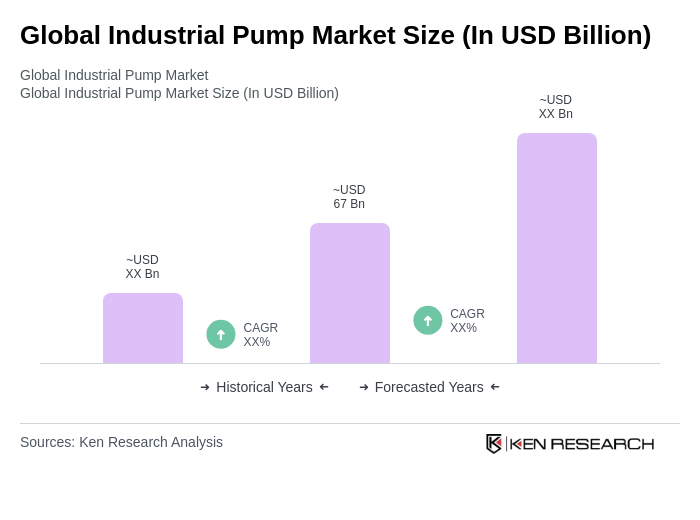
- The Global Industrial Pump Market is valued at USD 67 billion, based on a five-year historical analysis. This growth is primarily driven by increasing demand across various sectors, including oil and gas, water and wastewater management, and chemicals. The rising need for efficient fluid handling solutions and advancements in pump technology have further propelled market expansion.
- Key players in this market include the United States, Germany, and China, which dominate due to their robust industrial bases and significant investments in infrastructure development. The presence of leading manufacturers and a strong focus on innovation in these countries contribute to their market leadership.
- In 2023, the European Union implemented regulations aimed at enhancing energy efficiency in industrial pumps. This regulation mandates that all new pumps meet specific energy performance standards, promoting the adoption of energy-efficient technologies and reducing operational costs for industries.
Global Industrial Pump Market Segmentation
By Type:The market is segmented into various types of pumps, including centrifugal pumps, positive displacement pumps, submersible pumps, slurry pumps, vacuum pumps, metering/dosing pumps, and others. Each type serves distinct applications across industries, with centrifugal pumps being the most widely used due to their efficiency and versatility.

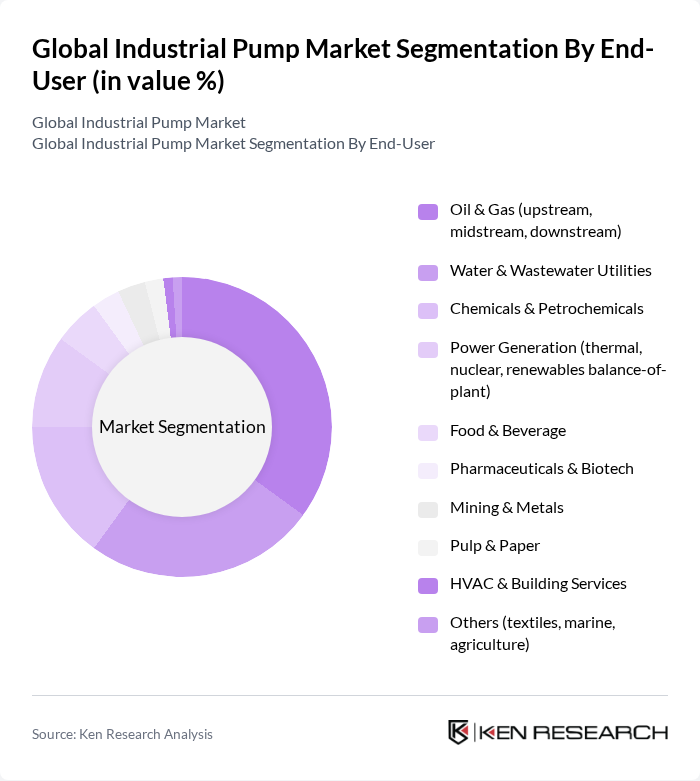
By End-User:The industrial pump market is further segmented by end-user industries, including oil and gas, water and wastewater utilities, chemicals and petrochemicals, power generation, food and beverage, pharmaceuticals and biotech, mining and metals, pulp and paper, HVAC and building services, and others. The oil and gas sector is a significant contributor due to its extensive use of pumps in various processes.
Global Industrial Pump Market Competitive Landscape
The Global Industrial Pump Market is characterized by a dynamic mix of regional and international players. Leading participants such as Flowserve Corporation, Grundfos Holding A/S, KSB SE & Co. KGaA, Sulzer Ltd, Xylem Inc., ITT Inc., Pentair plc, Ebara Corporation, The Weir Group PLC, Alfa Laval AB, Ingersoll Rand (ARO Fluid Management), Tsurumi Manufacturing Co., Ltd., Wilo SE, NOV Inc. (formerly National Oilwell Varco), SPX FLOW, Inc. contribute to innovation, geographic expansion, and service delivery in this space.
Global Industrial Pump Market Industry Analysis
Growth Drivers
- Increasing Demand for Energy-Efficient Pumps:The global push for energy efficiency is driving the industrial pump market, with energy-efficient pumps projected to save approximately 20-30% on energy costs. In future, the energy-efficient pump segment is expected to account for over $12 billion in sales, supported by initiatives from the International Energy Agency (IEA) that aim to reduce energy consumption across industries. This trend is particularly strong in manufacturing and water treatment sectors, where operational costs are critical.
- Expansion of Industrial Sectors:The industrial sector is projected to grow significantly, with the manufacturing output expected to reach $5.5 trillion in future, according to the World Bank. This expansion is driving demand for industrial pumps, particularly in emerging markets where infrastructure development is accelerating. The construction of new facilities and the modernization of existing ones are expected to increase pump installations, particularly in sectors such as oil and gas, chemicals, and food processing.
- Technological Advancements in Pump Design:Innovations in pump technology, such as the development of smart pumps, are enhancing efficiency and reliability. In future, the market for smart pumps is anticipated to exceed $4 billion, driven by advancements in IoT and automation. These technologies enable real-time monitoring and predictive maintenance, reducing downtime and operational costs. Companies investing in these technologies are likely to gain a competitive edge in the rapidly evolving industrial landscape.
Market Challenges
- High Initial Investment Costs:The high upfront costs associated with purchasing and installing industrial pumps can be a significant barrier to entry for many businesses. In future, the average cost of a high-quality industrial pump system is estimated to be around $18,000 to $55,000, depending on the application. This financial burden can deter smaller companies from upgrading their systems, limiting market growth and innovation in the sector.
- Fluctuating Raw Material Prices:The industrial pump market is heavily influenced by the prices of raw materials such as steel and plastics, which have seen volatility in recent years. In future, steel prices are projected to fluctuate between $750 and $950 per ton, impacting manufacturing costs. This unpredictability can lead to increased production costs and reduced profit margins for pump manufacturers, complicating pricing strategies and market competitiveness.
Global Industrial Pump Market Future Outlook
The future of the industrial pump market appears promising, driven by technological advancements and increasing demand for sustainable solutions. As industries continue to adopt automation and IoT technologies, the integration of smart pumps will likely enhance operational efficiency. Additionally, the focus on renewable energy projects and water management solutions will create new avenues for growth, particularly in emerging markets where infrastructure investments are on the rise. Companies that adapt to these trends will be well-positioned for success.
Market Opportunities
- Growth in Renewable Energy Projects:The global shift towards renewable energy is creating significant opportunities for industrial pump manufacturers. With investments in solar and wind energy projected to reach $600 billion in future, the demand for specialized pumps in these sectors is expected to rise. This trend presents a lucrative opportunity for companies to develop tailored solutions that meet the unique requirements of renewable energy applications.
- Increased Focus on Water Management Solutions:As water scarcity becomes a pressing global issue, the demand for efficient water management solutions is surging. The global water management market is expected to reach $1.2 trillion in future, driving the need for advanced pumping solutions. Companies that innovate in water conservation technologies and efficient distribution systems will find substantial growth opportunities in this expanding market.
Scope of the Report
| Segment | Sub-Segments |
|---|---|
| By Type | Centrifugal Pumps (single-stage, multi-stage, axial flow, radial flow, mixed flow) Positive Displacement Pumps (rotary: gear, screw, lobe; reciprocating: piston, plunger, diaphragm) Submersible Pumps Slurry Pumps Vacuum Pumps Metering/Dosing Pumps Others (peristaltic, magnetic drive, sump, jet) |
| By End-User | Oil & Gas (upstream, midstream, downstream) Water & Wastewater Utilities Chemicals & Petrochemicals Power Generation (thermal, nuclear, renewables balance-of-plant) Food & Beverage Pharmaceuticals & Biotech Mining & Metals Pulp & Paper HVAC & Building Services Others (textiles, marine, agriculture) |
| By Application | Transfer & Circulation Process Dosing & Metering Dewatering & Sludge Handling Boiler Feed & Condensate Fire Protection Systems Irrigation Others |
| By Distribution Channel | Direct Sales (OEM and key accounts) Distributors/Channel Partners EPC/Project Contractors Online & E-commerce Others (aftermarket service providers) |
| By Region | North America Europe Asia-Pacific Latin America Middle East & Africa Others |
| By Price Range | Low-End Pumps Mid-Range Pumps High-End Pumps |
| By Technology | Smart/Connected Pumps (with VFDs, sensors, remote monitoring) Energy-Efficient Pumps (IE4/IE5 motor-driven, optimized hydraulics) Conventional Pumps Severe-Duty Pumps (corrosion/abrasion resistant, API/ANSI compliant) |
Key Target Audience
Investors and Venture Capitalist Firms
Government and Regulatory Bodies (e.g., Environmental Protection Agency, Department of Energy)
Manufacturers and Producers
Distributors and Retailers
Industrial Equipment Suppliers
Energy and Utility Companies
Construction and Infrastructure Firms
Oil and Gas Companies
Players Mentioned in the Report:
Flowserve Corporation
Grundfos Holding A/S
KSB SE & Co. KGaA
Sulzer Ltd
Xylem Inc.
ITT Inc.
Pentair plc
Ebara Corporation
The Weir Group PLC
Alfa Laval AB
Ingersoll Rand (ARO Fluid Management)
Tsurumi Manufacturing Co., Ltd.
Wilo SE
NOV Inc. (formerly National Oilwell Varco)
SPX FLOW, Inc.
Table of Contents
Market Assessment Phase
1. Executive Summary and Approach
2. Global Industrial Pump Market Overview
2.1 Key Insights and Strategic Recommendations
2.2 Global Industrial Pump Market Overview
2.3 Definition and Scope
2.4 Evolution of Market Ecosystem
2.5 Timeline of Key Regulatory Milestones
2.6 Value Chain & Stakeholder Mapping
2.7 Business Cycle Analysis
2.8 Policy & Incentive Landscape
3. Global Industrial Pump Market Analysis
3.1 Growth Drivers
3.1.1 Increasing demand for energy-efficient pumps
3.1.2 Expansion of industrial sectors
3.1.3 Technological advancements in pump design
3.1.4 Rising environmental regulations
3.2 Market Challenges
3.2.1 High initial investment costs
3.2.2 Fluctuating raw material prices
3.2.3 Competition from alternative technologies
3.2.4 Maintenance and operational complexities
3.3 Market Opportunities
3.3.1 Growth in renewable energy projects
3.3.2 Emerging markets demand
3.3.3 Innovations in smart pump technologies
3.3.4 Increased focus on water management solutions
3.4 Market Trends
3.4.1 Shift towards automation and IoT integration
3.4.2 Adoption of sustainable practices
3.4.3 Customization of pump solutions
3.4.4 Growth of e-commerce in pump sales
3.5 Government Regulation
3.5.1 Energy efficiency standards
3.5.2 Environmental protection regulations
3.5.3 Safety compliance requirements
3.5.4 Water usage regulations
4. SWOT Analysis
5. Stakeholder Analysis
6. Porter's Five Forces Analysis
7. Global Industrial Pump Market Market Size, 2019-2024
7.1 By Value
7.2 By Volume
7.3 By Average Selling Price
8. Global Industrial Pump Market Segmentation
8.1 By Type
8.1.1 Centrifugal Pumps (single-stage, multi-stage, axial flow, radial flow, mixed flow)
8.1.2 Positive Displacement Pumps (rotary: gear, screw, lobe; reciprocating: piston, plunger, diaphragm)
8.1.3 Submersible Pumps
8.1.4 Slurry Pumps
8.1.5 Vacuum Pumps
8.1.6 Metering/Dosing Pumps
8.1.7 Others (peristaltic, magnetic drive, sump, jet)
8.2 By End-User
8.2.1 Oil & Gas (upstream, midstream, downstream)
8.2.2 Water & Wastewater Utilities
8.2.3 Chemicals & Petrochemicals
8.2.4 Power Generation (thermal, nuclear, renewables balance-of-plant)
8.2.5 Food & Beverage
8.2.6 Pharmaceuticals & Biotech
8.2.7 Mining & Metals
8.2.8 Pulp & Paper
8.2.9 HVAC & Building Services
8.2.10 Others (textiles, marine, agriculture)
8.3 By Application
8.3.1 Transfer & Circulation
8.3.2 Process Dosing & Metering
8.3.3 Dewatering & Sludge Handling
8.3.4 Boiler Feed & Condensate
8.3.5 Fire Protection Systems
8.3.6 Irrigation
8.3.7 Others
8.4 By Distribution Channel
8.4.1 Direct Sales (OEM and key accounts)
8.4.2 Distributors/Channel Partners
8.4.3 EPC/Project Contractors
8.4.4 Online & E-commerce
8.4.5 Others (aftermarket service providers)
8.5 By Region
8.5.1 North America
8.5.2 Europe
8.5.3 Asia-Pacific
8.5.4 Latin America
8.5.5 Middle East & Africa
8.5.6 Others
8.6 By Price Range
8.6.1 Low-End Pumps
8.6.2 Mid-Range Pumps
8.6.3 High-End Pumps
8.7 By Technology
8.7.1 Smart/Connected Pumps (with VFDs, sensors, remote monitoring)
8.7.2 Energy-Efficient Pumps (IE4/IE5 motor-driven, optimized hydraulics)
8.7.3 Conventional Pumps
8.7.4 Severe-Duty Pumps (corrosion/abrasion resistant, API/ANSI compliant)
9. Global Industrial Pump Market Competitive Analysis
9.1 Market Share of Key Players
9.2 Cross Comparison of Key Players
9.2.1 Company Name (legal entity)
9.2.2 Group Size (Large, Medium, Small by global pump revenues)
9.2.3 Industrial Pump Revenue (USD, latest fiscal year)
9.2.4 Revenue Growth Rate (YoY and 3-year CAGR)
9.2.5 Geographic Footprint (regions served, manufacturing sites)
9.2.6 Product Portfolio Breadth (centrifugal, PD, submersible, slurry, dosing)
9.2.7 End-Market Exposure Mix (O&G, water, chemicals, power, mining, F&B, pharma)
9.2.8 Aftermarket Share (service/parts as % of pump revenue)
9.2.9 Order Backlog/Book-to-Bill
9.2.10 Installed Base (estimated units or capacity)
9.2.11 Innovation Intensity (R&D as % of sales, patents, new launches)
9.2.12 Pricing Power (gross margin, premium vs. peers)
9.2.13 Operational Efficiency (inventory turns, lead times, on-time delivery)
9.2.14 Supply Chain Resilience (multi-sourcing, localization, critical components)
9.2.15 ESG & Energy Efficiency (energy savings claims, IE ratings, scope targets)
9.2.16 Standards Compliance (API/ANSI/ISO certifications)
9.2.17 Strategic Moves (M&A, JV, capacity expansions, digital offerings)
9.3 SWOT Analysis of Top Players
9.4 Pricing Analysis
9.5 Detailed Profile of Major Companies
9.5.1 Flowserve Corporation
9.5.2 Grundfos Holding A/S
9.5.3 KSB SE & Co. KGaA
9.5.4 Sulzer Ltd
9.5.5 Xylem Inc.
9.5.6 ITT Inc.
9.5.7 Pentair plc
9.5.8 Ebara Corporation
9.5.9 The Weir Group PLC
9.5.10 Alfa Laval AB
9.5.11 Ingersoll Rand (ARO Fluid Management)
9.5.12 Tsurumi Manufacturing Co., Ltd.
9.5.13 Wilo SE
9.5.14 NOV Inc. (formerly National Oilwell Varco)
9.5.15 SPX FLOW, Inc.
10. Global Industrial Pump Market End-User Analysis
10.1 Procurement Behavior of Key Ministries
10.1.1 Government contracts and tenders
10.1.2 Budget allocation for infrastructure projects
10.1.3 Compliance with environmental standards
10.2 Corporate Spend on Infrastructure & Energy
10.2.1 Investment in water management systems
10.2.2 Funding for energy-efficient solutions
10.2.3 Expenditure on maintenance and upgrades
10.3 Pain Point Analysis by End-User Category
10.3.1 Reliability and downtime issues
10.3.2 Cost of maintenance
10.3.3 Need for energy efficiency
10.4 User Readiness for Adoption
10.4.1 Awareness of new technologies
10.4.2 Training and support requirements
10.4.3 Financial readiness for investment
10.5 Post-Deployment ROI and Use Case Expansion10.5.1 Measurement of operational efficiency gains10.5.2 Expansion into new applications10.5.3 Long-term cost savings analysis11. Global Industrial Pump Market Future Size, 2025-203011.1 By Value11.2 By Volume11.3 By Average Selling PriceGo-To-Market Strategy Phase1. Whitespace Analysis + Business Model Canvas1.1 Market gaps identification1.2 Value proposition development1.3 Revenue model exploration1.4 Customer segmentation analysis1.5 Competitive landscape overview1.6 Key partnerships identification1.7 Resource allocation strategy2. Marketing and Positioning Recommendations2.1 Branding strategies2.2 Product USPs2.3 Target market identification2.4 Communication strategy2.5 Digital marketing approach2.6 Customer engagement tactics3. Distribution Plan3.1 Urban retail strategies3.2 Rural NGO tie-ups3.3 Online distribution channels3.4 Direct sales force deployment3.5 Logistics and supply chain management4. Channel & Pricing Gaps4.1 Underserved routes4.2 Pricing bands analysis4.3 Competitor pricing strategies4.4 Customer willingness to pay4.5 Value-based pricing opportunities5. Unmet Demand & Latent Needs5.1 Category gaps identification5.2 Consumer segments analysis5.3 Emerging trends and needs5.4 Product development opportunities5.5 Market entry barriers6. Customer Relationship6.1 Loyalty programs6.2 After-sales service enhancements6.3 Customer feedback mechanisms6.4 Relationship management strategies6.5 Community engagement initiatives7. Value Proposition7.1 Sustainability initiatives7.2 Integrated supply chains7.3 Cost-saving solutions7.4 Customization options7.5 Long-term partnership benefits8. Key Activities8.1 Regulatory compliance8.2 Branding efforts8.3 Distribution setup8.4 Market research activities8.5 Training and development programs9. Entry Strategy Evaluation9.1 Domestic Market Entry Strategy9.1.1 Product mix considerations9.1.2 Pricing band analysis9.1.3 Packaging strategies9.2 Export Entry Strategy9.2.1 Target countries selection9.2.2 Compliance roadmap development10. Entry Mode Assessment10.1 Joint Ventures10.2 Greenfield investments10.3 Mergers & Acquisitions10.4 Distributor Model11. Capital and Timeline Estimation11.1 Capital requirements analysis11.2 Timelines for market entry12. Control vs Risk Trade-Off12.1 Ownership considerations12.2 Partnerships evaluation13. Profitability Outlook13.1 Breakeven analysis13.2 Long-term sustainability strategies14. Potential Partner List14.1 Distributors identification14.2 Joint Ventures opportunities14.3 Acquisition targets15. Execution Roadmap15.1 Phased Plan for Market Entry15.1.1 Market Setup15.1.2 Market Entry15.1.3 Growth Acceleration15.1.4 Scale & Stabilize15.2 Key Activities and Milestones15.2.1 Milestone tracking15.2.2 Activity schedulingDisclaimerContact Us
Research Methodology
Phase 1: Approach1
Desk Research
- Industry reports from organizations such as the Hydraulic Institute and the American Pump Manufacturers Association
- Market analysis from trade publications and journals focusing on industrial equipment and fluid dynamics
- Government publications and statistics related to manufacturing output and industrial growth
Primary Research
- Interviews with key decision-makers in manufacturing firms utilizing industrial pumps
- Surveys targeting engineers and procurement specialists in various sectors such as oil & gas, water treatment, and chemicals
- Field visits to industrial sites to observe pump applications and gather firsthand insights
Validation & Triangulation
- Cross-validation of data from multiple sources including industry reports, expert interviews, and market surveys
- Triangulation of findings through comparison of quantitative data with qualitative insights from industry experts
- Sanity checks conducted through expert panel reviews to ensure data accuracy and relevance
Phase 2: Market Size Estimation1
Top-down Assessment
- Analysis of global industrial pump market size based on macroeconomic indicators and sectoral growth rates
- Segmentation of the market by pump type, application, and region to identify key growth areas
- Incorporation of trends in automation and digitalization impacting pump demand
Bottom-up Modeling
- Estimation of market size based on sales data from leading pump manufacturers and distributors
- Volume estimates derived from production capacities and operational efficiencies of major industrial sectors
- Cost analysis based on average selling prices and market penetration rates of various pump types
Forecasting & Scenario Analysis
- Utilization of time-series analysis to project future market trends based on historical data
- Scenario modeling to assess the impact of economic fluctuations, regulatory changes, and technological advancements
- Development of multiple forecasts (baseline, optimistic, and pessimistic) to account for uncertainties in market dynamics
Phase 3: CATI Sample Composition1
| Scope Item/Segment | Sample Size | Target Respondent Profiles |
|---|---|---|
| Oil & Gas Sector Pump Usage | 100 | Operations Managers, Field Engineers |
| Water Treatment Facilities | 80 | Plant Managers, Environmental Engineers |
| Chemical Processing Plants | 90 | Procurement Managers, Process Engineers |
| Food & Beverage Industry | 70 | Quality Control Managers, Production Supervisors |
| Mining and Mineral Processing | 60 | Site Managers, Equipment Maintenance Supervisors |
Frequently Asked Questions
What is the current value of the Global Industrial Pump Market?
The Global Industrial Pump Market is valued at approximately USD 67 billion, reflecting a robust growth trajectory driven by increasing demand in sectors such as oil and gas, water management, and chemicals, alongside advancements in pump technology.
What are the main drivers of growth in the industrial pump market?
Which countries are leading in the industrial pump market?
What types of pumps are included in the Global Industrial Pump Market?
Other Regional/Country Reports
Indonesia Industrial Pump Market
Malaysia Industrial Pump Market
APAC Industrial Pump Market
Why Buy From Us?

What makes us stand out is that our consultants follow Robust, Refine and Result (RRR) methodology. Robust for clear definitions, approaches and sanity checking, Refine for differentiating respondents' facts and opinions, and Result for presenting data with story.

We have set a benchmark in the industry by offering our clients with syndicated and customized market research reports featuring coverage of entire market as well as meticulous research and analyst insights.

While we don't replace traditional research, we flip the method upside down. Our dual approach of Top Bottom & Bottom Top ensures quality deliverable by not just verifying company fundamentals but also looking at the sector and macroeconomic factors.

With one step in the future, our research team constantly tries to show you the bigger picture. We help with some of the tough questions you may encounter along the way: How is the industry positioned? Best marketing channel? KPI's of competitors? By aligning every element, we help maximize success.

Our report gives you instant access to the answers and sources that other companies might choose to hide. We elaborate each steps of research methodology we have used and showcase you the sample size to earn your trust.

If you need any support, we are here! We pride ourselves on universe strength, data quality, and quick, friendly, and professional service.