About the Report
Base Year 2024Global Inflight Catering Market Overview
- The Global Inflight Catering Market is valued at approximately USD 20–22 billion, based on a five-year historical analysis. This growth is primarily driven by the increasing number of air travelers, rising disposable incomes, and the growing demand for premium inflight services, with airlines expanding diverse menu options and enhancing onboard experience to differentiate service.
- Key players in this market include the United States, Germany, and China, which dominate due to their extensive airline networks and high passenger traffic. The presence of major airlines and strong aviation infrastructure in these regions underpins leadership, while Asia Pacific overall currently leads regionally in market share.
- No European Union regulation was implemented in the stated period mandating that all inflight meals must meet specific nutritional standards across airlines. Aviation food safety and labeling are governed by general EU food law and national aviation authority guidance; airlines have voluntarily expanded healthier and special-diet options rather than complying with a binding EU-wide nutritional mandate for inflight meals.
Global Inflight Catering Market Segmentation
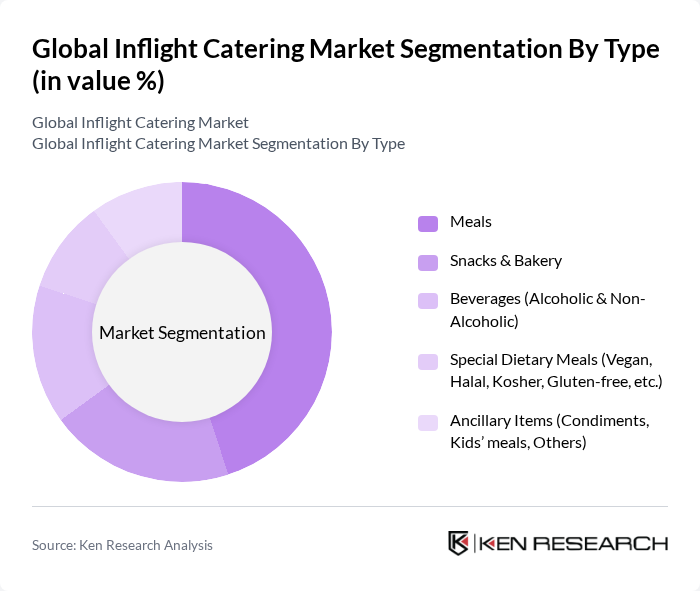
By Type:This segmentation includes various categories of inflight catering services, focusing on the types of food and beverages offered to passengers. The subsegments are Meals, Snacks & Bakery, Beverages (Alcoholic & Non-Alcoholic), Special Dietary Meals (Vegan, Halal, Kosher, Gluten-free, etc.), and Ancillary Items (Condiments, Kids’ meals, Others). Among these, Meals dominate the market due to the essential nature of providing substantial food options during flights, especially on medium- and long-haul routes, and the continued expansion of pre-order and customized meal programs by airlines.
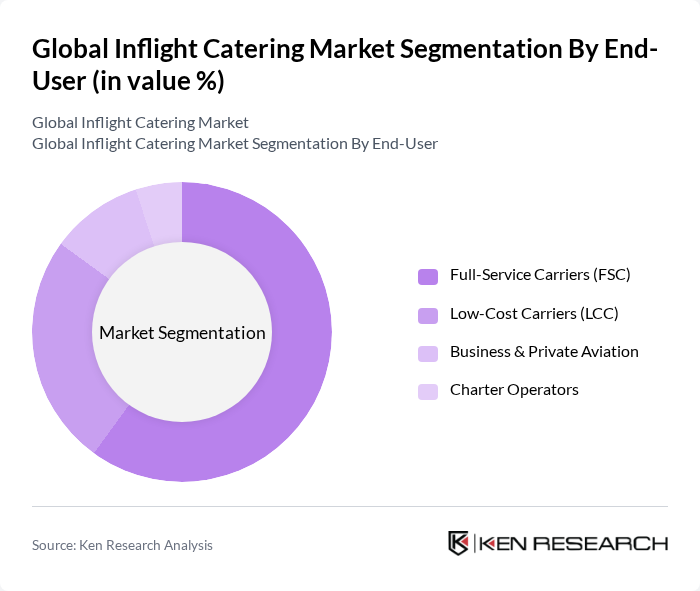
By End-User:This segmentation focuses on the different types of airlines and aviation services that utilize inflight catering. The subsegments include Full-Service Carriers (FSC), Low-Cost Carriers (LCC), Business & Private Aviation, and Charter Operators. Full-Service Carriers dominate this segment as they typically offer comprehensive inflight services, including meals, which are integral to their customer experience strategy; LCCs increasingly drive volume through buy-on-board and pre-order programs.
Global Inflight Catering Market Competitive Landscape
The Global Inflight Catering Market is characterized by a dynamic mix of regional and international players. Leading participants such as Gategroup (Gate Gourmet), LSG Group (LSG Sky Chefs), DO & CO Aktiengesellschaft, Flying Food Group, Newrest, Servair (Groupe ADP), Emirates Flight Catering, dnata Catering, SATS Ltd., Cathay Pacific Catering Services (H.K.) Ltd., Saudi Airlines Catering Company, Sky Café/Alpha Flight Services (dnata/Alpha legacy), ANA Catering Service Co., Ltd., KLM Catering Services Schiphol, IGS Catering Services contribute to innovation, geographic expansion, and service delivery in this space.
Global Inflight Catering Market Industry Analysis
Growth Drivers
- Increasing Passenger Traffic:The global airline industry is projected to handle approximately 4.5 billion passengers in future, reflecting a significant recovery from the pandemic. This surge in passenger numbers directly correlates with the demand for inflight catering services. According to the International Air Transport Association (IATA), the growth in air travel is expected to drive inflight catering revenues, as airlines seek to enhance customer experience through improved meal offerings.
- Rising Demand for Premium Services:As disposable incomes rise, particularly in emerging markets, there is a notable shift towards premium inflight services. In future, the premium travel segment is expected to grow by 15%, driven by affluent travelers seeking enhanced dining experiences. Airlines are responding by investing in gourmet meal options and personalized catering services, which are essential for attracting and retaining high-value customers in a competitive market.
- Innovations in Food Technology:The inflight catering sector is witnessing rapid advancements in food technology, including the use of sous-vide cooking and advanced preservation techniques. These innovations not only enhance food quality but also extend shelf life, reducing waste. In future, the adoption of these technologies is expected to increase by 20%, allowing airlines to offer fresher, more diverse meal options that cater to evolving consumer preferences for quality and sustainability.
Market Challenges
- Stringent Food Safety Regulations:Compliance with international food safety standards poses a significant challenge for inflight catering providers. In future, the global food safety market is projected to reach $20 billion, emphasizing the importance of adhering to regulations. Airlines must invest in rigorous quality control measures and training to ensure compliance, which can increase operational costs and complicate supply chain logistics.
- Fluctuating Fuel Prices:The volatility of fuel prices directly impacts operational costs for airlines, which in turn affects inflight catering budgets. In future, the average price of jet fuel is expected to remain around $80 per barrel, creating pressure on airlines to manage costs effectively. This uncertainty can lead to reduced investment in catering services, as airlines prioritize essential operational expenditures over premium meal offerings.
Global Inflight Catering Market Future Outlook
The inflight catering market is poised for significant transformation as airlines adapt to changing consumer preferences and economic conditions. With a focus on sustainability and health-conscious options, airlines are likely to enhance their catering services by incorporating local ingredients and innovative meal personalization. Additionally, advancements in logistics technology will streamline operations, improving efficiency and reducing waste. As the market evolves, partnerships with local suppliers will become increasingly vital, fostering a more sustainable and diverse inflight dining experience.
Market Opportunities
- Growth in Emerging Markets:Emerging markets, particularly in Asia and Africa, present substantial growth opportunities for inflight catering. With a projected increase in air travel by 25% in these regions in future, airlines can capitalize on this trend by offering tailored catering solutions that cater to local tastes and preferences, enhancing customer satisfaction and loyalty.
- Demand for Sustainable Catering Options:The rising consumer awareness regarding sustainability is driving demand for eco-friendly catering solutions. In future, it is estimated that 60% of travelers will prefer airlines that offer sustainable meal options. This trend presents an opportunity for inflight caterers to innovate by sourcing local, organic ingredients and reducing single-use plastics, aligning with consumer values and enhancing brand reputation.
Scope of the Report
| Segment | Sub-Segments |
|---|---|
| By Type | Meals Snacks & Bakery Beverages (Alcoholic & Non-Alcoholic) Special Dietary Meals (Vegan, Halal, Kosher, Gluten?free, etc.) Ancillary Items (Condiments, Kids’ meals, Others) |
| By End-User | Full-Service Carriers (FSC) Low-Cost Carriers (LCC) Business & Private Aviation Charter Operators |
| By Service Type | Onboard Catering (Hot/Cold Meals) Buy-on-Board & Pre?Order Trolley & Commissary Services Lounge & Airport Catering Support |
| By Flight Duration | Short?Haul Medium?Haul Long?Haul |
| By Distribution/Contract Model | Direct Contracts with Airlines Third?Party/Outsourced Caterers Hybrid/JV Models |
| By Class of Service | Economy Premium Economy Business First |
| By Packaging & Sustainability | Single?Use/Disposable Reusable/Returnable Eco?Friendly/Compostable Waste Reduction & Logistics Solutions |
| By Region | North America Europe Asia?Pacific Latin America Middle East & Africa |
Key Target Audience
Investors and Venture Capitalist Firms
Government and Regulatory Bodies (e.g., Federal Aviation Administration, European Union Aviation Safety Agency)
Airline Operators
Catering Service Providers
Food and Beverage Suppliers
Logistics and Supply Chain Companies
Airport Authorities
Health and Safety Regulatory Agencies
Players Mentioned in the Report:
Gategroup (Gate Gourmet)
LSG Group (LSG Sky Chefs)
DO & CO Aktiengesellschaft
Flying Food Group
Newrest
Servair (Groupe ADP)
Emirates Flight Catering
dnata Catering
SATS Ltd.
Cathay Pacific Catering Services (H.K.) Ltd.
Saudi Airlines Catering Company
Sky Cafe/Alpha Flight Services (dnata/Alpha legacy)
ANA Catering Service Co., Ltd.
KLM Catering Services Schiphol
IGS Catering Services
Table of Contents
Market Assessment Phase
1. Executive Summary and Approach
2. Global Inflight Catering Market Overview
2.1 Key Insights and Strategic Recommendations
2.2 Global Inflight Catering Market Overview
2.3 Definition and Scope
2.4 Evolution of Market Ecosystem
2.5 Timeline of Key Regulatory Milestones
2.6 Value Chain & Stakeholder Mapping
2.7 Business Cycle Analysis
2.8 Policy & Incentive Landscape
3. Global Inflight Catering Market Analysis
3.1 Growth Drivers
3.1.1 Increasing passenger traffic
3.1.2 Rising demand for premium services
3.1.3 Innovations in food technology
3.1.4 Expansion of low-cost carriers
3.2 Market Challenges
3.2.1 Stringent food safety regulations
3.2.2 Fluctuating fuel prices
3.2.3 Supply chain disruptions
3.2.4 Competition from local food services
3.3 Market Opportunities
3.3.1 Growth in emerging markets
3.3.2 Demand for sustainable catering options
3.3.3 Technological advancements in logistics
3.3.4 Partnerships with local food suppliers
3.4 Market Trends
3.4.1 Personalization of inflight meals
3.4.2 Increased focus on health-conscious options
3.4.3 Use of local ingredients
3.4.4 Digital transformation in ordering systems
3.5 Government Regulation
3.5.1 Compliance with international food safety standards
3.5.2 Regulations on waste management
3.5.3 Labeling requirements for allergens
3.5.4 Restrictions on single-use plastics
4. SWOT Analysis
5. Stakeholder Analysis
6. Porter's Five Forces Analysis
7. Global Inflight Catering Market Market Size, 2019-2024
7.1 By Value
7.2 By Volume
7.3 By Average Selling Price
8. Global Inflight Catering Market Segmentation
8.1 By Type
8.1.1 Meals
8.1.2 Snacks & Bakery
8.1.3 Beverages (Alcoholic & Non-Alcoholic)
8.1.4 Special Dietary Meals (Vegan, Halal, Kosher, Gluten?free, etc.)
8.1.5 Ancillary Items (Condiments, Kids’ meals, Others)
8.2 By End-User
8.2.1 Full-Service Carriers (FSC)
8.2.2 Low-Cost Carriers (LCC)
8.2.3 Business & Private Aviation
8.2.4 Charter Operators
8.3 By Service Type
8.3.1 Onboard Catering (Hot/Cold Meals)
8.3.2 Buy-on-Board & Pre?Order
8.3.3 Trolley & Commissary Services
8.3.4 Lounge & Airport Catering Support
8.4 By Flight Duration
8.4.1 Short?Haul
8.4.2 Medium?Haul
8.4.3 Long?Haul
8.5 By Distribution/Contract Model
8.5.1 Direct Contracts with Airlines
8.5.2 Third?Party/Outsourced Caterers
8.5.3 Hybrid/JV Models
8.6 By Class of Service
8.6.1 Economy
8.6.2 Premium Economy
8.6.3 Business
8.6.4 First
8.7 By Packaging & Sustainability
8.7.1 Single?Use/Disposable
8.7.2 Reusable/Returnable
8.7.3 Eco?Friendly/Compostable
8.7.4 Waste Reduction & Logistics Solutions
8.8 By Region
8.8.1 North America
8.8.2 Europe
8.8.3 Asia?Pacific
8.8.4 Latin America
8.8.5 Middle East & Africa
9. Global Inflight Catering Market Competitive Analysis
9.1 Market Share of Key Players
9.2 Cross Comparison of Key Players
9.2.1 Company Name
9.2.2 Scale & Network Footprint (Kitchens/Locations, Countries Served)
9.2.3 Contract Portfolio (Airlines Served, Long?term vs Short?term Mix)
9.2.4 Revenue Growth Rate (YoY)
9.2.5 Flight Segments Mix (Short/Medium/Long?Haul Exposure)
9.2.6 Class Mix (Economy vs Premium Cabin Coverage)
9.2.7 On?Time Delivery & Uplift Performance (%)
9.2.8 Food Safety & Compliance Score (e.g., HACCP/ISO Certifications)
9.2.9 Innovation Index (Pre?order, Digital, Sustainable Packaging)
9.2.10 Unit Cost per Meal & Menu Price Bands
9.2.11 Kitchen Throughput Capacity (meals/day)
9.2.12 Sustainability KPIs (Food Waste per Passenger, Reusable Ratio)
9.2.13 Customer Satisfaction/NPS (Airline Clients)
9.3 SWOT Analysis of Top Players
9.4 Pricing Analysis
9.5 Detailed Profile of Major Companies
9.5.1 Gategroup (Gate Gourmet)
9.5.2 LSG Group (LSG Sky Chefs)
9.5.3 DO & CO Aktiengesellschaft
9.5.4 Flying Food Group
9.5.5 Newrest
9.5.6 Servair (Groupe ADP)
9.5.7 Emirates Flight Catering
9.5.8 dnata Catering
9.5.9 SATS Ltd.
9.5.10 Cathay Pacific Catering Services (H.K.) Ltd.
9.5.11 Saudi Airlines Catering Company
9.5.12 Sky Café/Alpha Flight Services (dnata/Alpha legacy)
9.5.13 ANA Catering Service Co., Ltd.
9.5.14 KLM Catering Services Schiphol
9.5.15 IGS Catering Services
10. Global Inflight Catering Market End-User Analysis
10.1 Procurement Behavior of Key Ministries
10.1.1 Budget Allocation Trends
10.1.2 Decision-Making Processes
10.1.3 Supplier Selection Criteria
10.2 Corporate Spend on Infrastructure & Energy
10.2.1 Investment in Catering Facilities
10.2.2 Expenditure on Technology Upgrades
10.2.3 Budget for Sustainability Initiatives
10.3 Pain Point Analysis by End-User Category
10.3.1 Quality of Food
10.3.2 Timeliness of Service
10.3.3 Variety of Options
10.4 User Readiness for Adoption
10.4.1 Awareness of Catering Options
10.4.2 Willingness to Pay for Premium Services
10.5 Post-Deployment ROI and Use Case Expansion
10.5.1 Measurement of Customer Satisfaction
10.5.2 Analysis of Repeat Business
10.5.3 Expansion into New Routes
11. Global Inflight Catering Market Future Size, 2025-2030
11.1 By Value
11.2 By Volume
11.3 By Average Selling Price
Go-To-Market Strategy Phase
1. Whitespace Analysis + Business Model Canvas
1.1 Market Gaps Identification
1.2 Value Proposition Development
1.3 Revenue Streams Analysis
1.4 Key Partnerships Exploration
1.5 Cost Structure Assessment
2. Marketing and Positioning Recommendations
2.1 Branding Strategies
2.2 Product USPs
2.3 Target Audience Segmentation
2.4 Communication Channels
3. Distribution Plan
3.1 Urban Retail Strategies
3.2 Rural NGO Tie-Ups
3.3 Direct vs Indirect Distribution
4. Channel & Pricing Gaps
4.1 Underserved Routes
4.2 Pricing Bands Analysis
4.3 Competitor Pricing Comparison
5. Unmet Demand & Latent Needs
5.1 Category Gaps
5.2 Consumer Segments Analysis
5.3 Emerging Trends Identification
6. Customer Relationship
6.1 Loyalty Programs
6.2 After-Sales Service
6.3 Customer Feedback Mechanisms
7. Value Proposition
7.1 Sustainability Initiatives
7.2 Integrated Supply Chains
7.3 Unique Selling Points
8. Key Activities
8.1 Regulatory Compliance
8.2 Branding Efforts
8.3 Distribution Setup
9. Entry Strategy Evaluation
9.1 Domestic Market Entry Strategy
9.1.1 Product Mix Considerations
9.1.2 Pricing Band Strategy
9.1.3 Packaging Innovations
9.2 Export Entry Strategy
9.2.1 Target Countries Identification
9.2.2 Compliance Roadmap Development
10. Entry Mode Assessment
10.1 Joint Ventures
10.2 Greenfield Investments
10.3 Mergers & Acquisitions
10.4 Distributor Model Evaluation
11. Capital and Timeline Estimation
11.1 Capital Requirements
11.2 Timelines for Implementation
12. Control vs Risk Trade-Off
12.1 Ownership vs Partnerships
12.2 Risk Management Strategies
13. Profitability Outlook
13.1 Breakeven Analysis
13.2 Long-Term Sustainability Plans
14. Potential Partner List
14.1 Distributors
14.2 Joint Ventures
14.3 Acquisition Targets
15. Execution Roadmap
15.1 Phased Plan for Market Entry
15.1.1 Market Setup
15.1.2 Market Entry
15.1.3 Growth Acceleration
15.1.4 Scale & Stabilize
15.2 Key Activities and Milestones
15.2.1 Milestone Planning
15.2.2 Activity Tracking
Research Methodology
Phase 1: Approach1
Desk Research
- Industry reports from aviation and catering associations
- Market analysis from global food service publications
- Government regulations and guidelines on inflight catering
Primary Research
- Interviews with inflight catering managers at major airlines
- Surveys with suppliers of inflight meal components
- Field interviews with airport ground service providers
Validation & Triangulation
- Cross-validation of data from multiple industry sources
- Triangulation of insights from airline executives and catering firms
- Sanity checks through expert panel discussions and feedback
Phase 2: Market Size Estimation1
Top-down Assessment
- Analysis of global airline passenger traffic growth trends
- Estimation of average spend per passenger on inflight meals
- Incorporation of regional variations in catering preferences
Bottom-up Modeling
- Volume estimates based on the number of flights and passenger load factors
- Cost analysis of meal production and logistics for catering firms
- Assessment of contract values with airlines for catering services
Forecasting & Scenario Analysis
- Multi-factor regression analysis considering travel trends and economic factors
- Scenario planning based on potential changes in airline operations
- Baseline, optimistic, and pessimistic forecasts through 2030
Phase 3: CATI Sample Composition1
| Scope Item/Segment | Sample Size | Target Respondent Profiles |
|---|---|---|
| Major Airlines Inflight Catering | 120 | Catering Managers, Airline Executives |
| Regional Airlines Catering Services | 85 | Operations Managers, Procurement Officers |
| Inflight Meal Suppliers | 70 | Product Development Managers, Sales Directors |
| Airport Ground Services | 55 | Logistics Coordinators, Service Managers |
| Inflight Catering Technology Providers | 45 | Technology Officers, Business Development Managers |
Frequently Asked Questions
What is the current value of the Global Inflight Catering Market?
The Global Inflight Catering Market is valued at approximately USD 2022 billion, driven by increasing air travel, rising disposable incomes, and a growing demand for premium inflight services. Airlines are expanding menu options to enhance the onboard experience.
Which regions dominate the Global Inflight Catering Market?
What types of inflight catering services are available?
How do Full-Service Carriers differ from Low-Cost Carriers in inflight catering?
Other Regional/Country Reports
Indonesia Inflight Catering Market
Malaysia Inflight Catering Market
APAC Inflight Catering Market
SEA Inflight Catering Market
Why Buy From Us?

What makes us stand out is that our consultants follow Robust, Refine and Result (RRR) methodology. Robust for clear definitions, approaches and sanity checking, Refine for differentiating respondents' facts and opinions, and Result for presenting data with story.

We have set a benchmark in the industry by offering our clients with syndicated and customized market research reports featuring coverage of entire market as well as meticulous research and analyst insights.

While we don't replace traditional research, we flip the method upside down. Our dual approach of Top Bottom & Bottom Top ensures quality deliverable by not just verifying company fundamentals but also looking at the sector and macroeconomic factors.

With one step in the future, our research team constantly tries to show you the bigger picture. We help with some of the tough questions you may encounter along the way: How is the industry positioned? Best marketing channel? KPI's of competitors? By aligning every element, we help maximize success.

Our report gives you instant access to the answers and sources that other companies might choose to hide. We elaborate each steps of research methodology we have used and showcase you the sample size to earn your trust.

If you need any support, we are here! We pride ourselves on universe strength, data quality, and quick, friendly, and professional service.