About the Report
Base Year 2024Listen to the audio summary
Global Influenza Vaccine Market Overview
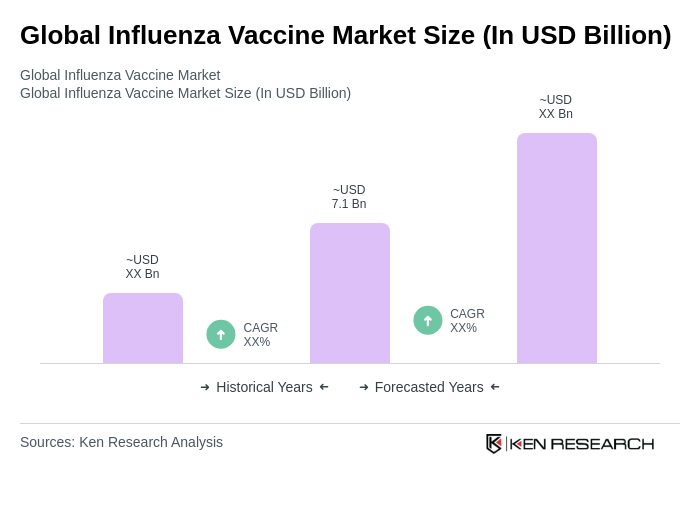
- The Global Influenza Vaccine Market is valued at USD 7.1 billion, based on a five-year historical analysis. This growth is primarily driven by the increasing prevalence of influenza outbreaks, heightened awareness regarding vaccination, and government initiatives promoting immunization programs. WHO-supported national programs and seasonal campaigns continue to expand coverage, while aging populations and post?pandemic emphasis on respiratory vaccination sustain demand.
- Key players in this market include the United States, Germany, and Japan, which dominate due to their advanced healthcare infrastructure, significant investments in research and development, and robust public health policies. High vaccination coverage and established procurement in these countries underpin consistent demand for influenza vaccines.
- In 2023, the U.S. government implemented the "Influenza Vaccination Program," which mandates annual flu vaccinations for healthcare workers and vulnerable populations. This specific federal mandate is not in effect; rather, the U.S. Centers for Disease Control and Prevention recommends annual vaccination for everyone 6 months and older, and many healthcare systems and states set their own requirements for healthcare personnel, but there is no nationwide federal mandate.
Global Influenza Vaccine Market Segmentation
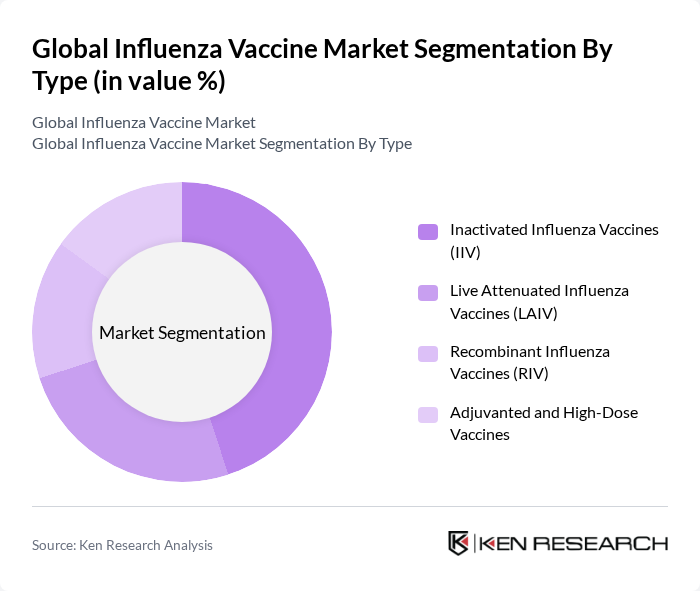
By Type:The market is segmented into various types of influenza vaccines, including Inactivated Influenza Vaccines (IIV), Live Attenuated Influenza Vaccines (LAIV), Recombinant Influenza Vaccines (RIV), and Adjuvanted and High-Dose Vaccines. Among these, Inactivated Influenza Vaccines (IIV) dominate the market due to their widespread acceptance and proven efficacy in preventing influenza. The preference for IIV is driven by their safety profile and the ability to be administered to a broader population, including pregnant women and individuals with compromised immune systems.
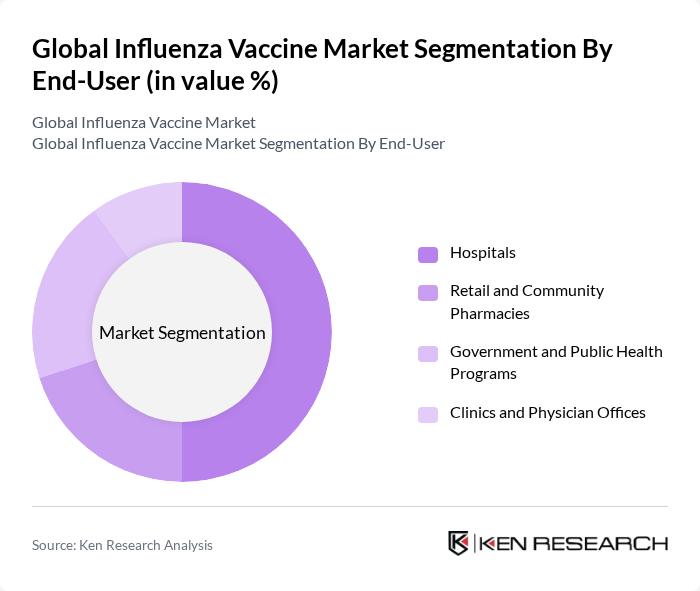
By End-User:The end-user segmentation includes Hospitals, Retail and Community Pharmacies, Government and Public Health Programs, and Clinics and Physician Offices. Hospitals are the leading end-users, primarily due to their capacity to administer vaccines to large populations and their role in managing influenza outbreaks. The growing role of retail pharmacies and public health clinics in mass immunization campaigns also drives significant volumes, with many countries leveraging pharmacies for accessible seasonal flu vaccination.
Global Influenza Vaccine Market Competitive Landscape
The Global Influenza Vaccine Market is characterized by a dynamic mix of regional and international players. Leading participants such as Sanofi, GSK plc, CSL Seqirus, AstraZeneca, Moderna, Inc., Pfizer Inc., Novavax, Inc., Sinovac Biotech Ltd., Daiichi Sankyo Company, Limited, Serum Institute of India Pvt. Ltd., Bharat Biotech International Ltd., Hualan Biological Engineering Inc., KM Biologics Co., Ltd., GC Biopharma (Green Cross Corporation), Abbott Laboratories contribute to innovation, geographic expansion, and service delivery in this space.
Global Influenza Vaccine Market Industry Analysis
Growth Drivers
- Increasing Prevalence of Influenza Outbreaks:The World Health Organization reported that seasonal influenza epidemics result in approximately 3 to 5 million severe cases annually, leading to 290,000 to 650,000 respiratory deaths. This alarming prevalence drives demand for vaccines, as governments and health organizations prioritize immunization to mitigate outbreaks. The economic burden of influenza, estimated at $87 billion in the U.S. alone, further emphasizes the necessity for effective vaccination strategies to protect public health and reduce healthcare costs.
- Rising Awareness About Vaccination:Public health campaigns have significantly increased awareness regarding the importance of influenza vaccination. In future, the CDC reported that vaccination rates among high-risk groups rose to 60%, up from 50% in previous years. This heightened awareness is supported by educational initiatives and community outreach programs, which have proven effective in encouraging vaccination. As more individuals recognize the benefits of vaccination, the demand for influenza vaccines is expected to continue its upward trajectory, positively impacting market growth.
- Government Initiatives Promoting Vaccination:Governments worldwide are implementing various initiatives to promote influenza vaccination. For instance, the U.S. government allocated $1.5 billion for vaccine distribution and public health campaigns. Such funding supports free or subsidized vaccines for vulnerable populations, enhancing accessibility. Additionally, mandatory vaccination policies in certain regions have further increased uptake rates. These initiatives not only bolster public health but also stimulate market growth by ensuring a steady demand for influenza vaccines.
Market Challenges
- Vaccine Hesitancy Among Populations:Vaccine hesitancy remains a significant challenge, with studies indicating that approximately 30% of adults express reluctance to receive the influenza vaccine. This hesitancy is often fueled by misinformation and distrust in healthcare systems. The World Health Organization has identified vaccine hesitancy as one of the top ten global health threats, which can hinder vaccination efforts and ultimately impact market growth. Addressing these concerns through education and outreach is crucial for overcoming this challenge.
- High Costs of Vaccine Production:The production of influenza vaccines is associated with high costs, primarily due to the complex manufacturing processes and stringent regulatory requirements. For instance, the cost to produce a single dose of the vaccine can range from $10 to $30, depending on the technology used. These costs can limit the ability of manufacturers to supply vaccines at affordable prices, particularly in low-income regions. Consequently, this financial barrier poses a challenge to achieving widespread vaccination coverage and market expansion.
Global Influenza Vaccine Market Future Outlook
The future of the influenza vaccine market appears promising, driven by ongoing advancements in vaccine technology and increasing global health initiatives. As personalized vaccines gain traction, tailored immunization strategies are expected to enhance efficacy and acceptance. Furthermore, the integration of digital health solutions will facilitate better tracking and management of vaccination programs. With a focus on preventive healthcare, the market is poised for growth, supported by collaborative efforts between public and private sectors to improve vaccine accessibility and distribution.
Market Opportunities
- Expansion into Emerging Markets:Emerging markets present significant opportunities for growth, as vaccination rates remain low. For example, in Africa, only 10% of the population receives the influenza vaccine. Targeting these regions with tailored strategies can enhance market penetration and improve public health outcomes, creating a win-win scenario for both manufacturers and communities.
- Development of Next-Generation Vaccines:The demand for next-generation vaccines, such as mRNA-based formulations, is on the rise. These innovative vaccines offer improved efficacy and faster production times. With an estimated $2 billion investment in mRNA technology anticipated, companies that focus on developing these advanced solutions can capitalize on the growing market interest and enhance their competitive edge.
Scope of the Report
| Segment | Sub-Segments |
|---|---|
| By Type | Inactivated Influenza Vaccines (IIV) Live Attenuated Influenza Vaccines (LAIV) Recombinant Influenza Vaccines (RIV) Adjuvanted and High-Dose Vaccines |
| By End-User | Hospitals Retail and Community Pharmacies Government and Public Health Programs Clinics and Physician Offices |
| By Distribution Channel | Public Procurement (e.g., national immunization programs) Private Channel (pharmacies, providers, employers) Wholesalers and Distributors Online/Telehealth-Enabled Scheduling and Fulfillment |
| By Age Group | Pediatric (6 months–17 years) Adults (18–64 years) Older Adults (65+ years) |
| By Geography | North America Europe Asia-Pacific Latin America Middle East & Africa |
| By Vaccine Formulation | Trivalent Quadrivalent Cell-based Egg-based Recombinant |
| By Pricing Tier | Standard-Dose (Private and Public Pricing) High-Dose and Adjuvanted (Premium) Pediatric and Public Tender (Budget) |
Key Target Audience
Investors and Venture Capitalist Firms
Government and Regulatory Bodies (e.g., World Health Organization, Centers for Disease Control and Prevention)
Pharmaceutical Manufacturers
Biotechnology Companies
Public Health Organizations
Healthcare Providers and Hospitals
Supply Chain and Logistics Companies
Insurance Companies and Payers
Players Mentioned in the Report:
Sanofi
GSK plc
CSL Seqirus
AstraZeneca
Moderna, Inc.
Pfizer Inc.
Novavax, Inc.
Sinovac Biotech Ltd.
Daiichi Sankyo Company, Limited
Serum Institute of India Pvt. Ltd.
Bharat Biotech International Ltd.
Hualan Biological Engineering Inc.
KM Biologics Co., Ltd.
GC Biopharma (Green Cross Corporation)
Abbott Laboratories
Table of Contents
Market Assessment Phase
1. Executive Summary and Approach
2. Global Influenza Vaccine Market Overview
2.1 Key Insights and Strategic Recommendations
2.2 Global Influenza Vaccine Market Overview
2.3 Definition and Scope
2.4 Evolution of Market Ecosystem
2.5 Timeline of Key Regulatory Milestones
2.6 Value Chain & Stakeholder Mapping
2.7 Business Cycle Analysis
2.8 Policy & Incentive Landscape
3. Global Influenza Vaccine Market Analysis
3.1 Growth Drivers
3.1.1 Increasing prevalence of influenza outbreaks
3.1.2 Rising awareness about vaccination
3.1.3 Government initiatives promoting vaccination
3.1.4 Technological advancements in vaccine development
3.2 Market Challenges
3.2.1 Vaccine hesitancy among populations
3.2.2 High costs of vaccine production
3.2.3 Regulatory hurdles in vaccine approval
3.2.4 Limited access in low-income regions
3.3 Market Opportunities
3.3.1 Expansion into emerging markets
3.3.2 Development of next-generation vaccines
3.3.3 Partnerships with healthcare organizations
3.3.4 Increased funding for vaccine research
3.4 Market Trends
3.4.1 Shift towards personalized vaccines
3.4.2 Growth of digital health solutions for vaccination
3.4.3 Increased focus on preventive healthcare
3.4.4 Rise in public-private partnerships
3.5 Government Regulation
3.5.1 Mandatory vaccination policies
3.5.2 Funding for vaccine research and development
3.5.3 Guidelines for vaccine distribution
3.5.4 Safety monitoring regulations post-vaccination
4. SWOT Analysis
5. Stakeholder Analysis
6. Porter's Five Forces Analysis
7. Global Influenza Vaccine Market Market Size, 2019-2024
7.1 By Value
7.2 By Volume
7.3 By Average Selling Price
8. Global Influenza Vaccine Market Segmentation
8.1 By Type
8.1.1 Inactivated Influenza Vaccines (IIV)
8.1.2 Live Attenuated Influenza Vaccines (LAIV)
8.1.3 Recombinant Influenza Vaccines (RIV)
8.1.4 Adjuvanted and High-Dose Vaccines
8.2 By End-User
8.2.1 Hospitals
8.2.2 Retail and Community Pharmacies
8.2.3 Government and Public Health Programs
8.2.4 Clinics and Physician Offices
8.3 By Distribution Channel
8.3.1 Public Procurement (e.g., national immunization programs)
8.3.2 Private Channel (pharmacies, providers, employers)
8.3.3 Wholesalers and Distributors
8.3.4 Online/Telehealth-Enabled Scheduling and Fulfillment
8.4 By Age Group
8.4.1 Pediatric (6 months–17 years)
8.4.2 Adults (18–64 years)
8.4.3 Older Adults (65+ years)
8.5 By Geography
8.5.1 North America
8.5.2 Europe
8.5.3 Asia-Pacific
8.5.4 Latin America
8.5.5 Middle East & Africa
8.6 By Vaccine Formulation
8.6.1 Trivalent
8.6.2 Quadrivalent
8.6.3 Cell-based
8.6.4 Egg-based
8.6.5 Recombinant
8.7 By Pricing Tier
8.7.1 Standard-Dose (Private and Public Pricing)
8.7.2 High-Dose and Adjuvanted (Premium)
8.7.3 Pediatric and Public Tender (Budget)
9. Global Influenza Vaccine Market Competitive Analysis
9.1 Market Share of Key Players
9.2 Cross Comparison of Key Players
9.2.1 Company Name
9.2.2 Portfolio Breadth (trivalent/quadrivalent, egg/cell/recombinant, high-dose, adjuvanted)
9.2.3 Annual Influenza Vaccine Doses Supplied (million doses)
9.2.4 Geographic Footprint (countries with marketing authorizations)
9.2.5 Tender Wins and Public Procurement Share
9.2.6 Manufacturing Modality Mix (egg-based vs cell-based vs recombinant)
9.2.7 Fill-Finish Capacity and Utilization
9.2.8 R&D Pipeline (next-gen flu, mRNA, universal/combination candidates)
9.2.9 Time-to-Strain-Update (weeks from WHO strain selection to first release)
9.2.10 Cold Chain and Distribution Reach (sites/pharmacy coverage)
9.2.11 Pricing Bands (public tenders vs private channel)
9.2.12 Regulatory Approvals (FDA/EMA/PMDA, age indications, high-risk groups)
9.2.13 Pharmacovigilance and Safety Signals (rate per 100k doses)
9.2.14 Real-World Effectiveness (VE estimates by season/age)
9.2.15 Market Share Percentage
9.3 SWOT Analysis of Top Players
9.4 Pricing Analysis
9.5 Detailed Profile of Major Companies
9.5.1 Sanofi
9.5.2 GSK plc
9.5.3 CSL Seqirus
9.5.4 AstraZeneca
9.5.5 Moderna, Inc.
9.5.6 Pfizer Inc.
9.5.7 Novavax, Inc.
9.5.8 Sinovac Biotech Ltd.
9.5.9 Daiichi Sankyo Company, Limited
9.5.10 Serum Institute of India Pvt. Ltd.
9.5.11 Bharat Biotech International Ltd.
9.5.12 Hualan Biological Engineering Inc.
9.5.13 KM Biologics Co., Ltd.
9.5.14 GC Biopharma (Green Cross Corporation)
9.5.15 Abbott Laboratories
10. Global Influenza Vaccine Market End-User Analysis
10.1 Procurement Behavior of Key Ministries
10.1.1 Budget Allocation for Vaccination Programs
10.1.2 Decision-Making Processes
10.1.3 Evaluation Criteria for Vaccine Selection
10.2 Corporate Spend on Infrastructure & Energy
10.2.1 Investment in Vaccine Storage Facilities
10.2.2 Funding for Distribution Networks
10.2.3 Expenditure on Training Healthcare Personnel
10.3 Pain Point Analysis by End-User Category
10.3.1 Accessibility Issues
10.3.2 Affordability Concerns
10.3.3 Awareness Gaps
10.4 User Readiness for Adoption
10.4.1 Attitudes Towards Vaccination
10.4.2 Preparedness for New Vaccine Technologies
10.4.3 Training Needs for Healthcare Providers
10.5 Post-Deployment ROI and Use Case Expansion10.5.1 Metrics for Evaluating Vaccine Effectiveness10.5.2 Long-term Health Outcomes10.5.3 Opportunities for Future Vaccine Development11. Global Influenza Vaccine Market Future Size, 2025-203011.1 By Value11.2 By Volume11.3 By Average Selling PriceGo-To-Market Strategy Phase1. Whitespace Analysis + Business Model Canvas1.1 Market Gaps Identification1.2 Value Proposition Development1.3 Revenue Streams Analysis1.4 Cost Structure Evaluation1.5 Key Partnerships1.6 Customer Segments1.7 Channels2. Marketing and Positioning Recommendations2.1 Branding Strategies2.2 Product USPs3. Distribution Plan3.1 Urban Retail vs Rural NGO Tie-ups4. Channel & Pricing Gaps4.1 Underserved Routes4.2 Pricing Bands5. Unmet Demand & Latent Needs5.1 Category Gaps5.2 Consumer Segments6. Customer Relationship6.1 Loyalty Programs6.2 After-sales Service7. Value Proposition7.1 Sustainability7.2 Integrated Supply Chains8. Key Activities8.1 Regulatory Compliance8.2 Branding8.3 Distribution Setup9. Entry Strategy Evaluation9.1 Domestic Market Entry Strategy9.1.1 Product Mix9.1.2 Pricing Band9.1.3 Packaging9.2 Export Entry Strategy9.2.1 Target Countries9.2.2 Compliance Roadmap10. Entry Mode Assessment10.1 JV10.2 Greenfield10.3 M&A10.4 Distributor Model11. Capital and Timeline Estimation11.1 Capital Requirements11.2 Timelines12. Control vs Risk Trade-Off12.1 Ownership vs Partnerships13. Profitability Outlook13.1 Breakeven Analysis13.2 Long-term Sustainability14. Potential Partner List14.1 Distributors14.2 JVs14.3 Acquisition Targets15. Execution Roadmap15.1 Phased Plan for Market Entry15.1.1 Market Setup15.1.2 Market Entry15.1.3 Growth Acceleration15.1.4 Scale & Stabilize15.2 Key Activities and Milestones15.2.1 Activity Timeline15.2.2 Milestone TrackingDisclaimerContact Us
Research Methodology
Phase 1: Approach1
Desk Research
- Analysis of global influenza vaccine market reports from health organizations and industry publications
- Review of scientific literature on vaccine efficacy, production methods, and market trends
- Examination of regulatory frameworks and guidelines from WHO and national health authorities
Primary Research
- Interviews with vaccine manufacturers and biotechnology firms involved in influenza vaccine production
- Surveys with healthcare professionals, including immunologists and public health officials
- Focus groups with patients and healthcare providers to understand vaccination attitudes and uptake
Validation & Triangulation
- Cross-validation of data from multiple sources, including market reports and expert interviews
- Triangulation of quantitative data with qualitative insights from industry experts
- Sanity checks through peer reviews and expert panel discussions to ensure data reliability
Phase 2: Market Size Estimation1
Top-down Assessment
- Estimation of total market size based on global healthcare expenditure and vaccination rates
- Segmentation of market by geography, vaccine type, and distribution channel
- Incorporation of government vaccination programs and public health initiatives
Bottom-up Modeling
- Collection of sales data from leading vaccine manufacturers and distributors
- Estimation of production capacities and operational costs associated with vaccine development
- Volume x price analysis to derive revenue projections for different market segments
Forecasting & Scenario Analysis
- Utilization of time-series analysis to project future market growth based on historical data
- Scenario modeling based on potential pandemic outbreaks and vaccine demand fluctuations
- Development of baseline, optimistic, and pessimistic forecasts through 2030
Phase 3: CATI Sample Composition1
| Scope Item/Segment | Sample Size | Target Respondent Profiles |
|---|---|---|
| Vaccine Manufacturers | 90 | Production Managers, R&D Directors |
| Healthcare Providers | 140 | Physicians, Nurses, Public Health Officials |
| Regulatory Bodies | 50 | Regulatory Affairs Specialists, Policy Makers |
| Pharmacy Chains | 80 | Pharmacy Managers, Supply Chain Coordinators |
| Patient Advocacy Groups | 60 | Advocacy Leaders, Community Health Workers |
Frequently Asked Questions
What is the current value of the Global Influenza Vaccine Market?
The Global Influenza Vaccine Market is valued at approximately USD 7.1 billion, driven by increasing influenza outbreaks, heightened vaccination awareness, and government initiatives promoting immunization programs. This market is expected to grow further due to ongoing public health efforts.
What factors are driving the growth of the influenza vaccine market?
Which countries are the leading players in the influenza vaccine market?
What types of influenza vaccines are available in the market?
Other Regional/Country Reports
Indonesia Influenza Vaccine Market
Malaysia Influenza Vaccine Market
APAC Influenza Vaccine Market
Why Buy From Us?

What makes us stand out is that our consultants follow Robust, Refine and Result (RRR) methodology. Robust for clear definitions, approaches and sanity checking, Refine for differentiating respondents' facts and opinions, and Result for presenting data with story.

We have set a benchmark in the industry by offering our clients with syndicated and customized market research reports featuring coverage of entire market as well as meticulous research and analyst insights.

While we don't replace traditional research, we flip the method upside down. Our dual approach of Top Bottom & Bottom Top ensures quality deliverable by not just verifying company fundamentals but also looking at the sector and macroeconomic factors.

With one step in the future, our research team constantly tries to show you the bigger picture. We help with some of the tough questions you may encounter along the way: How is the industry positioned? Best marketing channel? KPI's of competitors? By aligning every element, we help maximize success.

Our report gives you instant access to the answers and sources that other companies might choose to hide. We elaborate each steps of research methodology we have used and showcase you the sample size to earn your trust.

If you need any support, we are here! We pride ourselves on universe strength, data quality, and quick, friendly, and professional service.