About the Report
Base Year 2024Global Infrared Thermometer Market Overview
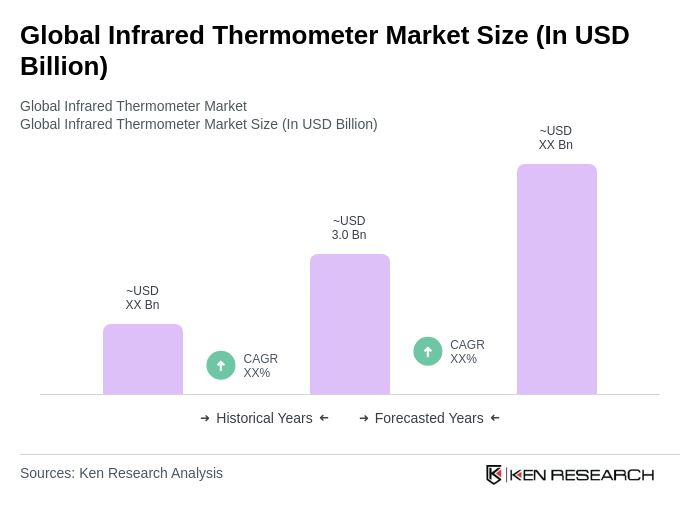
- The Global Infrared Thermometer Market is valued at USD 3.0 billion, based on a five-year historical analysis. This growth is primarily driven by the increasing demand for non-contact temperature measurement solutions in healthcare, industrial, and food safety applications. The rising awareness of hygiene and safety standards, especially post-pandemic, has further accelerated the adoption of infrared thermometers across various sectors.
- Key players in this market include the United States, Germany, and China, which dominate due to their advanced healthcare infrastructure, robust manufacturing capabilities, and significant investments in research and development. The presence of leading companies and a growing consumer base in these regions also contribute to their market leadership.
- There is no federal U.S. regulation that universally mandated non-contact thermometers in healthcare settings in the cited timeframe; rather, U.S. agencies and professional bodies emphasize infection control and appropriate thermometer use without mandating infrared devices specifically. Guidance during and after the pandemic promoted non-contact screening as a risk-reduction practice, which supported demand in hospitals, clinics, workplaces, and public venues.
Global Infrared Thermometer Market Segmentation
By Type:The market is segmented into various types of infrared thermometers, including handheld/portable, fixed/stationary, medical non-contact, smart/connected, and infrared thermometer modules & sensors. Each type serves different applications and user needs, contributing to the overall market dynamics.
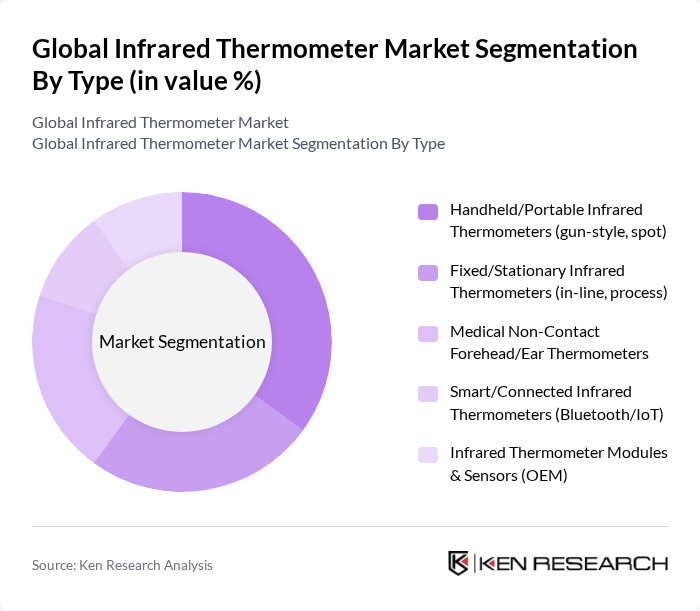
The handheld/portable infrared thermometers dominate the market due to their versatility and ease of use in various settings, including healthcare, industrial, and home applications. Their compact design and quick response time make them ideal for on-the-go temperature measurements. The increasing consumer preference for non-contact solutions, especially in the wake of health crises, has further solidified their market leadership. Additionally, advancements in technology have led to the development of more accurate and user-friendly handheld models, enhancing their appeal.
By End-User:The market is segmented based on end-users, including healthcare & homecare, food & beverage processing, industrial manufacturing, HVAC, automotive, veterinary, and others. Each segment has unique requirements and applications for infrared thermometers.
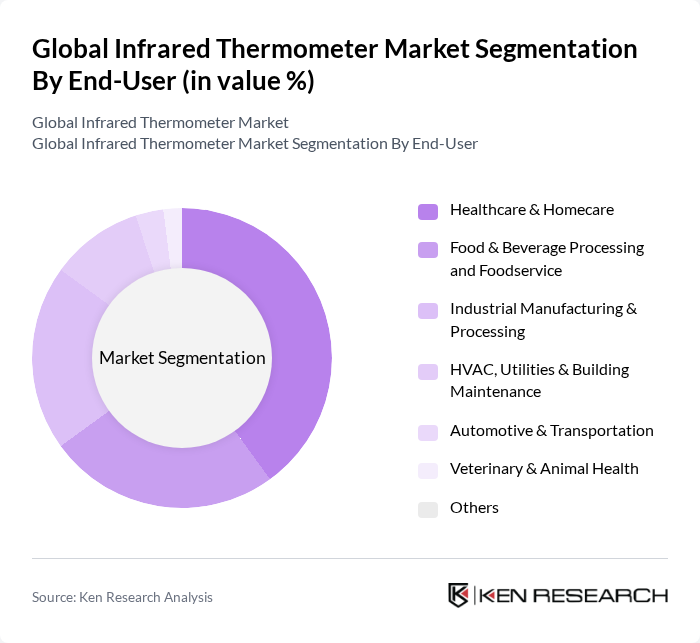
The healthcare and homecare segment leads the market due to the heightened focus on health and safety, particularly in clinical settings. The demand for non-contact thermometers has surged in hospitals and clinics, driven by the need for quick and accurate temperature assessments. Additionally, the growing trend of home healthcare has further propelled the adoption of infrared thermometers among consumers, making this segment a significant contributor to market growth.
Global Infrared Thermometer Market Competitive Landscape
The Global Infrared Thermometer Market is characterized by a dynamic mix of regional and international players. Leading participants such as Fluke Corporation, OMRON Healthcare Co., Ltd., Braun GmbH (Braun Health Care, a P&G brand), Exergen Corporation, ThermoWorks, Inc., Omega Engineering, Inc., PCE Instruments (PCE Holding GmbH), Testo SE & Co. KGaA, Klein Tools, Inc., Milwaukee Tool (Techtronic Industries), Acurite (Chaney Instrument Co.), BTMETER, Hti-Xintai (Xintai Instrument), Seek Thermal, Inc., CEM Instruments (Shenzhen Everbest Machinery Industry Co., Ltd.) contribute to innovation, geographic expansion, and service delivery in this space.
Global Infrared Thermometer Market Industry Analysis
Growth Drivers
- Increasing Demand for Non-Contact Temperature Measurement:The global demand for non-contact temperature measurement devices is surging, driven by the need for quick and safe temperature assessments in various sectors. In future, the healthcare sector accounted for approximately $12 billion in infrared thermometer sales, reflecting a 15% increase from the previous year. This trend is expected to continue as industries prioritize safety and efficiency, particularly in environments where traditional thermometers pose contamination risks.
- Rising Health and Safety Regulations:Governments worldwide are implementing stricter health and safety regulations, particularly in response to the COVID-19 pandemic. For instance, the U.S. Occupational Safety and Health Administration (OSHA) reported a 20% increase in compliance inspections related to health safety in future. This regulatory environment is driving the adoption of infrared thermometers in workplaces, schools, and public spaces, as organizations seek to comply with these evolving standards and ensure employee and customer safety.
- Technological Advancements in Infrared Sensing:The infrared thermometer market is benefiting from rapid technological advancements, including improved sensor accuracy and faster response times. In future, the introduction of new sensor technologies is projected to enhance measurement precision by up to 30%. This innovation is crucial for industries such as food safety and healthcare, where accurate temperature readings are essential for compliance and operational efficiency, further driving market growth.
Market Challenges
- High Competition and Price Sensitivity:The infrared thermometer market is characterized by intense competition, with numerous players vying for market share. In future, over 150 companies were identified as active participants in this sector, leading to aggressive pricing strategies. This price sensitivity can erode profit margins, making it challenging for manufacturers to invest in research and development, which is essential for innovation and maintaining competitive advantage in a saturated market.
- Calibration and Accuracy Issues:Ensuring the accuracy of infrared thermometers is a significant challenge, as improper calibration can lead to erroneous readings. In future, approximately 25% of reported inaccuracies were attributed to calibration errors, impacting user trust and product reliability. This issue is particularly critical in healthcare settings, where precise temperature measurements are vital for patient safety, necessitating ongoing efforts to improve calibration standards and user training.
Global Infrared Thermometer Market Future Outlook
The future of the infrared thermometer market appears promising, driven by ongoing technological advancements and increasing health awareness among consumers. As industries continue to prioritize safety and efficiency, the integration of smart technologies and IoT capabilities is expected to enhance product functionality. Furthermore, the expansion into emerging markets will provide new growth avenues, as these regions increasingly adopt advanced healthcare solutions and safety measures, fostering a robust demand for infrared thermometers.
Market Opportunities
- Expansion in Emerging Markets:Emerging markets present significant growth opportunities for infrared thermometers, with a projected increase in demand driven by rising healthcare investments. In future, countries like India and Brazil are expected to invest over $5 billion in healthcare infrastructure, creating a favorable environment for the adoption of advanced temperature measurement solutions.
- Development of Smart Thermometers:The development of smart thermometers, which integrate with mobile applications and health monitoring systems, is gaining traction. In future, it is anticipated that smart thermometers will capture 40% of the market share, driven by consumer demand for connected health devices that provide real-time data and enhance user experience in health monitoring.
Scope of the Report
| Segment | Sub-Segments |
|---|---|
| By Type | Handheld/Portable Infrared Thermometers (gun-style, spot) Fixed/Stationary Infrared Thermometers (in-line, process) Medical Non-Contact Forehead/Ear Thermometers Smart/Connected Infrared Thermometers (Bluetooth/IoT) Infrared Thermometer Modules & Sensors (OEM) |
| By End-User | Healthcare & Homecare Food & Beverage Processing and Foodservice Industrial Manufacturing & Processing HVAC, Utilities & Building Maintenance Automotive & Transportation Veterinary & Animal Health Others |
| By Application | Clinical Screening & Medical Diagnostics Predictive Maintenance & Industrial Monitoring Food Safety & HACCP Compliance HVAC/R Inspection and Energy Audits Electronics and Thermal Process Control Others |
| By Distribution Channel | Online Retail & Marketplaces Offline Retail (Pharmacies, Electronics, Industrial) Direct/B2B Sales (enterprise, OEM, tenders) Distributor/Wholesaler Networks |
| By Region | North America Europe Asia-Pacific Latin America Middle East & Africa |
| By Price Range | Budget (sub-USD 30, consumer) Mid-Range (USD 30–150, prosumer/pro) Premium (USD 150+, professional/medical/industrial) |
| By Brand | Established Brands Emerging Brands Private Labels Others |
Key Target Audience
Investors and Venture Capitalist Firms
Government and Regulatory Bodies (e.g., Food and Drug Administration, Environmental Protection Agency)
Manufacturers and Producers
Distributors and Retailers
Healthcare Institutions and Hospitals
Pharmaceutical Companies
Industrial and Manufacturing Companies
Quality Control and Assurance Agencies
Players Mentioned in the Report:
Fluke Corporation
OMRON Healthcare Co., Ltd.
Braun GmbH (Braun Health Care, a P&G brand)
Exergen Corporation
ThermoWorks, Inc.
Omega Engineering, Inc.
PCE Instruments (PCE Holding GmbH)
Testo SE & Co. KGaA
Klein Tools, Inc.
Milwaukee Tool (Techtronic Industries)
Acurite (Chaney Instrument Co.)
BTMETER
Hti-Xintai (Xintai Instrument)
Seek Thermal, Inc.
CEM Instruments (Shenzhen Everbest Machinery Industry Co., Ltd.)
Table of Contents
Market Assessment Phase
1. Executive Summary and Approach
2. Global Infrared Thermometer Market Overview
2.1 Key Insights and Strategic Recommendations
2.2 Global Infrared Thermometer Market Overview
2.3 Definition and Scope
2.4 Evolution of Market Ecosystem
2.5 Timeline of Key Regulatory Milestones
2.6 Value Chain & Stakeholder Mapping
2.7 Business Cycle Analysis
2.8 Policy & Incentive Landscape
3. Global Infrared Thermometer Market Analysis
3.1 Growth Drivers
3.1.1 Increasing demand for non-contact temperature measurement
3.1.2 Rising health and safety regulations
3.1.3 Technological advancements in infrared sensing
3.1.4 Growing applications in various industries
3.2 Market Challenges
3.2.1 High competition and price sensitivity
3.2.2 Calibration and accuracy issues
3.2.3 Regulatory compliance complexities
3.2.4 Market saturation in developed regions
3.3 Market Opportunities
3.3.1 Expansion in emerging markets
3.3.2 Increasing adoption in healthcare settings
3.3.3 Development of smart thermometers
3.3.4 Integration with IoT and smart devices
3.4 Market Trends
3.4.1 Shift towards digital and smart thermometers
3.4.2 Growing focus on hygiene and safety
3.4.3 Increased use in food safety applications
3.4.4 Rising consumer awareness about health monitoring
3.5 Government Regulation
3.5.1 Standards for medical device safety
3.5.2 Compliance with FDA and CE regulations
3.5.3 Guidelines for workplace safety
3.5.4 Regulations on electronic waste disposal
4. SWOT Analysis
5. Stakeholder Analysis
6. Porter's Five Forces Analysis
7. Global Infrared Thermometer Market Market Size, 2019-2024
7.1 By Value
7.2 By Volume
7.3 By Average Selling Price
8. Global Infrared Thermometer Market Segmentation
8.1 By Type
8.1.1 Handheld/Portable Infrared Thermometers (gun-style, spot)
8.1.2 Fixed/Stationary Infrared Thermometers (in-line, process)
8.1.3 Medical Non-Contact Forehead/Ear Thermometers
8.1.4 Smart/Connected Infrared Thermometers (Bluetooth/IoT)
8.1.5 Infrared Thermometer Modules & Sensors (OEM)
8.2 By End-User
8.2.1 Healthcare & Homecare
8.2.2 Food & Beverage Processing and Foodservice
8.2.3 Industrial Manufacturing & Processing
8.2.4 HVAC, Utilities & Building Maintenance
8.2.5 Automotive & Transportation
8.2.6 Veterinary & Animal Health
8.2.7 Others
8.3 By Application
8.3.1 Clinical Screening & Medical Diagnostics
8.3.2 Predictive Maintenance & Industrial Monitoring
8.3.3 Food Safety & HACCP Compliance
8.3.4 HVAC/R Inspection and Energy Audits
8.3.5 Electronics and Thermal Process Control
8.3.6 Others
8.4 By Distribution Channel
8.4.1 Online Retail & Marketplaces
8.4.2 Offline Retail (Pharmacies, Electronics, Industrial)
8.4.3 Direct/B2B Sales (enterprise, OEM, tenders)
8.4.4 Distributor/Wholesaler Networks
8.5 By Region
8.5.1 North America
8.5.2 Europe
8.5.3 Asia-Pacific
8.5.4 Latin America
8.5.5 Middle East & Africa
8.6 By Price Range
8.6.1 Budget (sub-USD 30, consumer)
8.6.2 Mid-Range (USD 30–150, prosumer/pro)
8.6.3 Premium (USD 150+, professional/medical/industrial)
8.7 By Brand
8.7.1 Established Brands
8.7.2 Emerging Brands
8.7.3 Private Labels
8.7.4 Others
9. Global Infrared Thermometer Market Competitive Analysis
9.1 Market Share of Key Players
9.2 Cross Comparison of Key Players
9.2.1 Company Name
9.2.2 Product Portfolio Breadth (medical, industrial, food, HVAC)
9.2.3 Global Revenue from Infrared Thermometers
9.2.4 Infrared Thermometer Revenue Growth Rate (YoY)
9.2.5 Geographic Footprint (regions served, distribution reach)
9.2.6 Regulatory Approvals & Certifications (FDA 510(k), CE, ISO 13485)
9.2.7 Accuracy & Measurement Specs (± error, response time, emissivity)
9.2.8 R&D Intensity/New Product Launches (last 3 years)
9.2.9 Pricing Positioning (budget/mid-range/premium)
9.2.10 Channel Strength (direct, distributors, e-commerce)
9.2.11 Installed Base/Units Shipped
9.2.12 After-Sales & Calibration Services Coverage
9.3 SWOT Analysis of Top Players
9.4 Pricing Analysis
9.5 Detailed Profile of Major Companies
9.5.1 Fluke Corporation
9.5.2 OMRON Healthcare Co., Ltd.
9.5.3 Braun GmbH (Braun Health Care, a P&G brand)
9.5.4 Exergen Corporation
9.5.5 ThermoWorks, Inc.
9.5.6 Omega Engineering, Inc.
9.5.7 PCE Instruments (PCE Holding GmbH)
9.5.8 Testo SE & Co. KGaA
9.5.9 Klein Tools, Inc.
9.5.10 Milwaukee Tool (Techtronic Industries)
9.5.11 Acurite (Chaney Instrument Co.)
9.5.12 BTMETER
9.5.13 Hti-Xintai (Xintai Instrument)
9.5.14 Seek Thermal, Inc.
9.5.15 CEM Instruments (Shenzhen Everbest Machinery Industry Co., Ltd.)
10. Global Infrared Thermometer Market End-User Analysis
10.1 Procurement Behavior of Key Ministries
10.1.1 Government health departments
10.1.2 Food safety authorities
10.1.3 Industrial safety regulators
10.2 Corporate Spend on Infrastructure & Energy
10.2.1 Healthcare facilities
10.2.2 Food processing companies
10.2.3 Manufacturing plants
10.3 Pain Point Analysis by End-User Category
10.3.1 Healthcare sector
10.3.2 Food industry
10.3.3 Industrial applications
10.4 User Readiness for Adoption
10.4.1 Healthcare professionals
10.4.2 Food safety inspectors
10.4.3 Industrial workers
10.5 Post-Deployment ROI and Use Case Expansion
10.5.1 Healthcare efficiency improvements
10.5.2 Food safety compliance
10.5.3 Industrial process optimization
11. Global Infrared Thermometer Market Future Size, 2025-2030
11.1 By Value
11.2 By Volume
11.3 By Average Selling Price
Go-To-Market Strategy Phase
1. Whitespace Analysis + Business Model Canvas
1.1 Market gaps identification
1.2 Value proposition development
1.3 Revenue model exploration
1.4 Customer segmentation analysis
1.5 Competitive landscape assessment
1.6 Key partnerships identification
1.7 Resource allocation strategy
2. Marketing and Positioning Recommendations
2.1 Branding strategies
2.2 Product USPs
2.3 Target audience identification
2.4 Marketing channels selection
2.5 Messaging and communication strategy
3. Distribution Plan
3.1 Urban retail strategy
3.2 Rural NGO tie-ups
3.3 E-commerce integration
3.4 Direct sales approach
4. Channel & Pricing Gaps
4.1 Underserved routes
4.2 Pricing bands analysis
4.3 Competitor pricing comparison
4.4 Value-based pricing strategy
5. Unmet Demand & Latent Needs
5.1 Category gaps identification
5.2 Consumer segments analysis
5.3 Product development opportunities
6. Customer Relationship
6.1 Loyalty programs
6.2 After-sales service
6.3 Customer feedback mechanisms
7. Value Proposition
7.1 Sustainability initiatives
7.2 Integrated supply chains
7.3 Customer-centric approach
8. Key Activities
8.1 Regulatory compliance
8.2 Branding efforts
8.3 Distribution setup
9. Entry Strategy Evaluation
9.1 Domestic Market Entry Strategy
9.1.1 Product mix considerations
9.1.2 Pricing band strategy
9.1.3 Packaging options
9.2 Export Entry Strategy
9.2.1 Target countries selection
9.2.2 Compliance roadmap development
10. Entry Mode Assessment
10.1 Joint Ventures
10.2 Greenfield investments
10.3 Mergers & Acquisitions
10.4 Distributor Model
11. Capital and Timeline Estimation
11.1 Capital requirements
11.2 Timelines for market entry
12. Control vs Risk Trade-Off
12.1 Ownership considerations
12.2 Partnerships evaluation
13. Profitability Outlook
13.1 Breakeven analysis
13.2 Long-term sustainability strategies
14. Potential Partner List
14.1 Distributors
14.2 Joint Ventures
14.3 Acquisition targets
15. Execution Roadmap
15.1 Phased Plan for Market Entry
15.1.1 Market Setup
15.1.2 Market Entry
15.1.3 Growth Acceleration
15.1.4 Scale & Stabilize
15.2 Key Activities and Milestones
15.2.1 Activity timelines
15.2.2 Milestone tracking
Research Methodology
Phase 1: Approach1
Desk Research
- Industry reports from market research firms focusing on infrared thermometer trends
- Published articles and white papers from scientific journals on infrared technology
- Government publications and standards related to temperature measurement devices
Primary Research
- Interviews with product managers at leading infrared thermometer manufacturers
- Surveys conducted with healthcare professionals using infrared thermometers
- Field interviews with retailers and distributors in the medical and industrial sectors
Validation & Triangulation
- Cross-validation of data from multiple sources including sales figures and market reports
- Triangulation of insights from primary interviews and secondary data sources
- Sanity checks through expert panels comprising industry veterans and analysts
Phase 2: Market Size Estimation1
Top-down Assessment
- Analysis of global healthcare expenditure trends impacting infrared thermometer demand
- Segmentation of market size by application areas such as healthcare, industrial, and consumer use
- Incorporation of regional market dynamics and growth rates in key geographical areas
Bottom-up Modeling
- Volume estimates based on sales data from major distributors and retailers
- Cost analysis derived from manufacturing and operational expenses of infrared thermometers
- Estimation of market size through unit sales multiplied by average selling price
Forecasting & Scenario Analysis
- Multi-variable regression analysis considering factors like technological advancements and health crises
- Scenario planning based on potential regulatory changes and market entry of new players
- Development of baseline, optimistic, and pessimistic forecasts through 2030
Phase 3: CATI Sample Composition1
| Scope Item/Segment | Sample Size | Target Respondent Profiles |
|---|---|---|
| Healthcare Sector Usage | 120 | Healthcare Practitioners, Hospital Administrators |
| Industrial Applications | 100 | Quality Control Managers, Safety Officers |
| Consumer Market Insights | 80 | Retail Buyers, Product Managers |
| Research & Development Feedback | 60 | R&D Engineers, Product Development Specialists |
| Distribution Channel Analysis | 90 | Supply Chain Managers, Logistics Coordinators |
Frequently Asked Questions
What is the current value of the Global Infrared Thermometer Market?
The Global Infrared Thermometer Market is valued at approximately USD 3.0 billion, reflecting significant growth driven by the increasing demand for non-contact temperature measurement solutions across healthcare, industrial, and food safety applications.
What factors are driving the growth of the infrared thermometer market?
Which regions dominate the Global Infrared Thermometer Market?
What types of infrared thermometers are available in the market?
Other Regional/Country Reports
Indonesia Infrared Thermometer Market
Malaysia Infrared Thermometer Market
APAC Infrared Thermometer Market
SEA Infrared Thermometer Market
Why Buy From Us?

What makes us stand out is that our consultants follow Robust, Refine and Result (RRR) methodology. Robust for clear definitions, approaches and sanity checking, Refine for differentiating respondents' facts and opinions, and Result for presenting data with story.

We have set a benchmark in the industry by offering our clients with syndicated and customized market research reports featuring coverage of entire market as well as meticulous research and analyst insights.

While we don't replace traditional research, we flip the method upside down. Our dual approach of Top Bottom & Bottom Top ensures quality deliverable by not just verifying company fundamentals but also looking at the sector and macroeconomic factors.

With one step in the future, our research team constantly tries to show you the bigger picture. We help with some of the tough questions you may encounter along the way: How is the industry positioned? Best marketing channel? KPI's of competitors? By aligning every element, we help maximize success.

Our report gives you instant access to the answers and sources that other companies might choose to hide. We elaborate each steps of research methodology we have used and showcase you the sample size to earn your trust.

If you need any support, we are here! We pride ourselves on universe strength, data quality, and quick, friendly, and professional service.